Video about Rubicon Trail aimed at users

El Dorado County has ventured into the world of video production in an ongoing effort to protect the world famous off-road Rubicon Trail. The El Dorado County Board of Supervisors unanimously approved the new video titled, “It’s In Your Hands”.

“It’s In Your Hands” educates the public on proper use and expected behavior while visiting the Rubicon Trail in order to preserve it as the crown jewel of OHV trails for future generations. The video encourages off-road enthusiasts to consider the “Four S’s” of Trail use: Safety, Spills, Sedimentation and Sanitation.

Emmy award winning “Deadliest Catch” producer Todd Stanley produced the film under contract with El Dorado County. The video was shot at several locations on and nearby near the famed Rubicon Trail.

“It’s In Your Hands” was funded through a grant from the California State Parks, Off-Highway Motor Vehicle Division.

It is airing on the County website and on local cable Channel 2.


Andean music trio coming to LTCC

Tahoe Arts Project is bringing Andean music trio Chasinakuy to Lake Tahoe Community College on April 30 at 7pm at Duke Theatre.

Chaskinakuy will be performing for local students April 25-29 as part of Tahoe Arts Project’s performing arts in the schools program.

Tickets are $10 for adults and $5 for children and seniors and can be purchased in advance at the California or Nevada visitors centers. To charge tickets by phone, call (530) 542.3632. Tickets will also be available at the door.

For information, call (530) 542.3632.


Disabled Access seminar

As part of its Chamber EDucation program, the North Lake Tahoe Chamber of Commerce is hosting a “Disabled Access” Seminar May 3, 1-4pm at the Tahoe City Public Utility District’s Board Room, 221 Fairway Drive, Tahoe City.

The seminar is geared for commercial business owners and tenants and will cover the history of disabled access regulations and the Americans with Disability Act as it pertains to buildings, the difference between California Title 24 Disabled Access Code Provisions and the ADA, Placer County building permit deadlines and time lines, and SB1608 and California access.

Attendees will also take away steps to evaluate their business compliance with all ADA requirements, how to reduce the risk of litigation, and strategies for dealing with lawsuits if an individual gets sued for ADA access violations.

Speakers include Chief Building Official Tim Wegner of Placer County, Certified Access Specialist Mike Gardner of CASp Inspections and Tony DeCristoforo of Stoel Rives Law Offices.

This seminar is free to North Lake Tahoe Chamber of Commerce members and is $20/person for non-members.

For details, contact North Lake Tahoe Chamber of Commerce Manager Kym Fabel at (530) 581.8764 or kym@PureTahoeNorth.com.


LTCC chooses 4 finalists for president

In a quest to find Lake Tahoe Community College’s next president, the selection committee has narrowed the field to four people with experience with California community colleges.

ltccThey are:

• Cheryl Babler, vice president of instruction at Coastline Community College.

• William W. Cochran, vice president of academic affairs at Shasta College.

• Kindred I. Murillo, vice chancellor of administrative services at Contra Costa Community College District.

• Dale Paul Parnell Jr., vice president of academic affairs at Rio Hondo College.

Open forums for the finalists are scheduled for May 11-12. The forums are open to LTCC faculty, staff and the community at large. There will be opportunities for feedback and evaluations of the candidates at the forums.

The two-year institution in South Lake Tahoe has been led by a controversial interim president his academic year. Paul Killpatrick left after not fulfilling his three-year contract. Guy Lease and Jim Duke were presidents for the bulk of the college’s 30-plus year existence.

The presidential search is on tonight’s closed session. The college board meeting starts at 5:45pm April 26.

— Lake Tahoe News staff report


Potent rat poisons killing off wildlife

By Tom Knudson, Sacramento Bee

Outside Palm Desert, a young bobcat dies mysteriously at a nature preserve. South of Nevada City, a farmer finds an owl dead near his decoy shed. In San Rafael, a red-shouldered hawk bleeds heavily from its mouth and nose before succumbing at an animal care center.

Each of those incidents shares a link to a widely used toxin that is turning up at dangerous levels in wildlife across California: rat poison.

Over the years, rat poison has spared state residents untold filth and disease. But a new generation of highly toxic, long-lasting poisons is killing not only rats, mice and ground squirrels, but whatever feeds on them, too.

As a result, toxins are rippling outward from warehouses to woodlands, from golf courses and housing complexes to marshes and nature sanctuaries. In California, the victims include bobcats, barn owls, red-tailed hawks, coyotes, kit foxes, kestrels and scores of other predators and scavengers.

“Rodenticides are the new DDT,” said Maggie Sergio, director of advocacy at WildCare, a Bay Area wildlife rehabilitation center that has responded to dozens of poisoning cases. “It is an emergency, an environmental disaster. We are killing nature’s own rodent control.”

Researchers say the federal government has been slow to respond to the problem, which has been building for more than a decade. This June, after years of study, regulations take effect nationwide banning the most toxic, long-lasting rat poisons from hardware stores, big box home improvement centers and other consumer outlets.

Read the whole story


Heavenly Foundation’s Grapes & Gates fundraiser

The 10th Annual Grapes & Gates, an evening of wine tasting and gourmet food to benefit the Heavenly Ski & Snowboard Foundation’s Scholarship Fund, is at Edgewood Tahoe beginning at 6pm May 11.

The event will feature local restaurants including Cafe Fiore, Cork & More, Embassy Suites, Latin Soul, Riva Grill and Thai One On. A variety of wineries will be represented.

A silent auction and raffle will be avaialbe.

Tickets for this event are limited. Prices are $75, $65 for foundation alumni. Reservations may be made by calling (530) 314.9285.


Recognition for school bus drivers

To the community,

The state of California recognizes the fourth Tuesday of April as “School Bus Driver Day.” The California Highway Patrol joins with the Legislature and Gov. Jerry Brown in publicly expressing great appreciation to the state’s school bus drivers for safely transporting our most cherished cargo to and from school and school activities; escorting them safely across busy streets and highways, helping them board school buses via wheelchair lifts and ramps; buckling seat belts, and finally delivering them safely to parents and guardians at the end of the school day.

“These are some of the most professional drivers in the state, and they’re passionate about what they do,” said CHP Commissioner Joe Farrow. “I applaud them for their extraordinary safety record, and the pride they take every day in the safe transportation of California’s children.”

School bus drivers will tell you their primary goal is pupil safety. They are extensively trained and rigorously tested to ensure this goal remains first and foremost in their thinking and actions when transporting children. While crashes may occur, school bus drivers have traveled millions of collision-free miles over the years.

Despite the number of school buses being operated throughout the state, school buses remain one of the safest modes of school transportation. In fact, California has not experienced a pupil-passenger fatality in 15 years. This is can be attributed to the school bus drivers’ commitment to safety, their excellent driving skills and attention to detail.

Though school bus drivers do their part to safely transport school children to and from their destinations, the motoring public has an obligation to do their part as well. Most school bus-related injuries and fatalities occur around or near the school bus during the loading and unloading process. Therefore, it is essential the motoring public be reminded to exercise due caution when driving near schools and school buses. Slow to 25 mph in school zones unless a lower speed is posted and stop behind a school bus when the flashing red lights and stop arm are activated.

Please join the CHP on School Bus Drivers’ Day as we extend our gratitude to school bus drivers throughout the state for their valued service and safe transportation of the children of California.

Officer Jeff Gartner, South Lake Tahoe office


Movie about bullied gay student to be shown at LTCC

Generation HOPE and Friends of Ally clubs at Lake Tahoe Community College are bringing “Bullied, A Student, a School, and a Case that Made History” to the South Lake Tahoe campus.

The documentary narrates the story of a student who, because of his sexual orientation, was the subject of unrelenting bullying by his classmates. This film will be presented with Spanish subtitles.

It will be shown April 29 at 6:30pm in the Duke Theatre. Tickets are $5 and will be sold at the door.

All proceeds from this movie will go toward scholarships for college students.

For more information,contact Arturo Rangel or Lisa Shafer at (530) 541-4660, ext. 231.


Lecture focuses on shoulder injuries

Join Kyle Swanson, orthopedic surgeon, and Kris Terrain, certified athletic trainer, from Tahoe Orthopedics & Sports Medicine on April 27 from 6:30 to 7:30pm at Lake Tahoe Community College in the Aspen Room.

The talk is about shoulder anatomy and common injuries; including rotator cuff tears, shoulder instability, dislocations and arthritis of the shoulder.

This shoulder injury presentation is one of many educational opportunities geared toward educating the community about living healthful lifestyles. Attend any four of Barton’s 2011 wellness lectures and receive an attendance “punch card” and automatically be entered to win a 2011-12 season pass to a Lake Tahoe ski resort and other prizes.

Go online for complete details and the 2011 lecture series line up. For more information, call (530) 543.5656.


Hwy. 50 project not total answer for what ails S. Tahoe

By Kathryn Reed

Even though Caltrans will break ground today on a $40 million project to improve water quality, the pipes that carry runoff into Lake Tahoe will continue to muck up the scenic corridor to keep it looking more like a Third World beach community than a world-class destination.

Billions of dollars have been spent and are slated to be spent on lake clarity. But that measurement has everything to do with what a dinner plate of sorts looks like and nothing to do with the near shore, which is where people swim and what they look at from a pier.
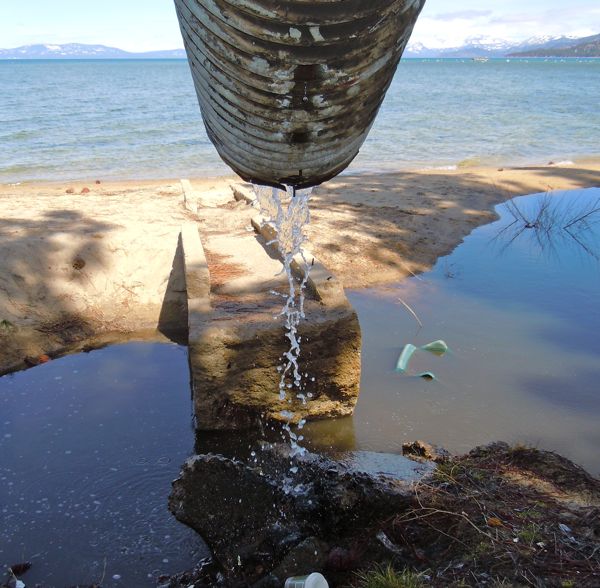
Untreated water flows directly into Lake Tahoe in South Lake Tahoe. All photos are from April 17, 2011. Photos/Kathryn Reed

Untreated water flows directly into Lake Tahoe. All photos are from April 17, 2011, in South Tahoe. Photos/Kathryn Reed

About a half dozen pipes from El Dorado Beach to Ski Run Marina bring untreated water into Lake Tahoe. All carry the oils and gunk from Highway 50, along with sediment from the mountain side of the road that runs through South Lake Tahoe. Some of that water carries fertilizer from Bijou Golf Course to the lake.

This is always the best time of year to see what flows into Tahoe because of the snowmelt. The high-mark for runoff is not likely to be reached until late May or early June, so the flow of water will continue at a good clip for at least another month.

Garbage is strewn about at some of these outflows. The outflow near Lakeshore Lodge and Spa is clogged because it is a grate. The water is a rusty orange-brown color. It flows east, discoloring the water all the way to Ski Run Marina. It goes out into the lake well past the end point of the pier at Lakeland Village.

Although the much-heralded Trout Creek to Ski Run Boulevard highway improvement project will help prevent some of the less desirable nutrients from reaching the lake, it won’t solve the entire problem.

Part of the issue is Caltrans does not own the pipes so the state agency is not replacing them. So, even if cleaner water flows from some of them, those unsightly discharge pipes will remain.

No official could tell Lake Tahoe News who owns all of the pipes, but the city of South Lake Tahoe is responsible for most.

Another issue is not all of the pipes carrying untreated water are part of the Highway 50 project.

“The outfall at Lakeview Commons is not getting any treatment at lake level. That is in the second phase of the project, of which there is no funding for,” said Jim Marino, capital improvement project manager for South Lake Tahoe. “Caltrans is providing all the pre-treatment facilities on the highway to clean up the water.”

(The contractor started mobilizing at Lakeview Commons near El Dorado Beach last week and expects to start work May 2 on phase one.)

“The Alta Mira (outflow) is a little unclear. There is some talk by the California Tahoe Conservancy to purchase those properties to expand Lakeview Commons and in that case that outfall,” Marino explained. “But right now it’s only getting pre-treatment on the highway so it should be cleaner, but the ugly look will probably stay.”

This area is at the east end of the pedestrian area where from the highway the lake is no longer visible.

Bijou project

There isn’t anything Lakeshore Lodge or Lakeland Village can do about the nasty water coming out of the pipe by the Bijou Center. General managers of both properties told Lake Tahoe News the Bijou erosion control project can’t start soon enough.

They will have to wait until 2013 – or later.

“That is a landmark project the city is undertaking. That will be a pump and treatment system,” Marino explained. “It will take the mucky stormwater out of the Bijou neighborhood and pump it back into the meadow and allow the meadow to discharge and cleanse it out. It’s a complex project.”

With 95 percent of the funding in place, the city hopes to start on it in two years.

Pat Ronan, who runs Lakeshore Lodge and Spa, said his guests will comment on the unsightly pipe, but his employees explain what it is and that it’s runoff starting at Heavenly Mountain Resort that winds up on the edge of his beach.

Although Jerry Bindel at Lakeland Village collects, treats and monitors the runoff from his property’s parking lots, he can’t stop the trail of orange water from flowing in front of his complex this time of year from the Bijou pipe.

Two pipes from his property carry water to the lake, though they are buried under the sand. Both are visible from the shore.

“The ones coming from our beach don’t (bother guests). We have some pretty strict guidelines on property to make sure nothing gets into the lake from our property,” Bindel said.

Permitting agencies

Lahontan Regional Water Quality Control Board and Tahoe Regional Planning Agency issued permits for the multi-year highway project that will bring improvements to both sides of Highway 50.

“The water, hopefully, coming out of them will be a lot cleaner, but it will still be an eyesore. I understand they look ugly,” Bud Amorfini, engineering geologist with Lahontan, said of the culverts.

Although detention basins are the optimal choice for treating stormwater runoff, that is not possible with the highway so close to the lake. That is why sand vaults and Delaware sand filters will be used.

But the goal, Amorfini said, is all the water in that section of the highway will be treated in some manner before it reaches Lake Tahoe. That will be a marked difference from what goes on today and has been allowed to happen for years.

With the Total Maximum Daily Load requirements passed last week by the state water board – which the Environmental Protection Agency must still sign-off on – this highway project will allow Caltrans to receive credit for reducing the amount of sediment reaching the lake.

This road project also qualifies as an Environmental Improvement Project under the oversight of TRPA.

“Highway 50 Trout Creek to Ski Run is an example of an area that needed full treatment, but which also needed roadwork, landscaping, pedestrian and bicycle improvements, so it naturally took a long time to plan and fund,” Jeff Cowen, TRPA spokesman, said. “The NEAT (Natural Environment As Treatment) plan lays out Caltrans projects to infiltrate all stormwater from its roads in the basin. They are accountable to that plan.”

Caltrans spokeswoman Deanna Shoopman said crews are bringing in equipment, putting up fencing and doing other staging work this week. Work that would interfere with traffic will not begin until after May 15 – when the first stage of the Amgen Tour de California bike race on the South Shore is over.

Improvements coming

The project begins on the west side of the city near the Trout Creek bridge by Meeks Lumber and goes to Ski Run Boulevard.

With it being a water quality project, much of the work is happening under the road surface where the drainage – and treatment – of runoff will occur.

Sidewalks, 6-foot shoulders (aka bike lanes), and new signals are part of the plans. Lighting will occur on the mountain (south) side of the highway. Landscaping on both sides will be provided. Walkways will adhere to American with Disabilities Act regulations.

This project has been in the works for more than a decade.

The plan is to time as much of the Lakeview Commons work into Caltrans’ schedule so the same areas of town are not torn up more than once.

Although the end product will be visually and environmentally better, it won’t be without inconveniences.

This is the preliminary schedule, though Caltrans may change things or have updates at today’s 1pm groundbreaking ceremony at Campground by the Lake:

• April 25: Contractor began mobilization.

• April 25 to May 13: Contractor will set up BMPs for TRPA permit and pre-grade inspection.

• May 1 to Oct. 15: Utilities will relocate infrastructure.

• May 17: Contractor begins phase 1.

• Phase 1: 2011 construction season — Trout Creek to Ski Run westbound (lake side) curb, gutter, and streetscape.

• Phase 2: 2012 construction season — Ski Run to Trout Creek eastbound (mountain side) curb, gutter, and streetscape.

• Phase 3 – 2013 construction season — full limits both directions – grind, pave and stripe.

Expect lane closures for the three years of work. The contractor will be working day and night until July 1. From July 1 to Labor Day, contractor will work nights, with limited daytime work.

ngg_shortcode_0_placeholder (Click on photos to enlarge.)