Ben Kunibe — 1917-2011

Ben Kunibe, longtime South Lake Tahoe resident, died April 30, 2011.

Mr. Kunibe was 93.

Ben Kunibe

Ben Kunibe

Mr. Kunibe was an active member of the Optimist Club. Last weekend he participated in the club’s annual Easter egg hunt.

He died of heart failure at Renown Medical Center in Reno.

In November he was profiled on Lake Tahoe News.

Services are pending.


NTPUD picks GM-CEO from within

Paul Schultz was appointed by the board of directors as the general manager/CEO of the North Tahoe Public Utility District.

Schultz has been will the district approximately one year, serving as the planning and engineering manager. Prior to his time with the district, Schultz worked independently as a civil engineer in the Tahoe area for four years and brings more than 25 years of experience in the fields of civil and environmental engineering to the Ddstrict.

Paul Shultz

Paul Schultz

Board President Lane Lewis noted Schultz’s experience in the water, wastewater, stormwater and drainage specialties as well as his experience in project management, planning and design.

Schultz enjoys skiing and kayaking and is a docent at the Tahoe Maritime Museum in Homewood. He lives on the West Shore with his wife, Kathleen, and their dog, Kiva.


Calif. water districts could be taxed under proposed bill

By Bradley J. Fikes, North County Times

Retail water districts would pay a new tax under proposed state legislation to fund water-related supply, environmental and recreation projects. The size of the tax has yet to be calculated, but it would be significant.

A hearing is scheduled May 4 for the bill, Senate Bill 34, in the California Senate’s Governance and Finance committee. Since the bill would impose a tax, it requires two-thirds approval by the Legislature.

SB34 was introduced in the Natural Resources and Water committee by state Sen. Joe Simitian, D-Palo Alto. The influential legislator is perhaps best known as the author of California’s hands-free cellphone law. The water tax bill was approved April 12 by the committee on a 5-3 vote.

Simitian is offering SB 34 as an alternative to an $11.4 billion water bond measure the Legislature recently placed on the ballot for November 2012. The bill doesn’t specify the level of taxes but is expected to be revised later to do so.

Backers say the bill pays for necessary upgrades to California’s water infrastructure, especially in the Sacramento River delta, which showed its inadequacy during the state’s recently ended drought.

Opponents say SB34 doesn’t give specifics about where the money will be spent. They include water districts around the state and the Association of California Water Agencies, a statewide organization of water agencies.

Read the whole story


Snippets about Lake Tahoe

jeep• There will be a hands-on 4-wheel drive clinic June 4 from 9am-1pm on the Twin Peaks Trail on the South Shore. Register online.

•The El Dorado County Board of Supervisors and Sheriff John D’Agostini’s lack of love for one another is evident on this video.

• Douglas County Community Development Department is having a workshop May 12 from 5:30-7pm to review the goals and policies of the master plan regional and community plans. The meeting is at Kahle Community Center, Stateline.

• A scenic 880-acre meadow near Bridgeport is now in the hands of the U.S. Forest Service. The feds bought the property near the Hoover Wilderness area for $2.2 million from the Arlington, Va.-based nonprofit organization Conservation Fund.

• Book launch for Andrew Homan’s “Life in the Slipstream: The Legend of Bobby Walthour Sr.” is May 6 from 6:30-8:30pm at Bona Fide Books, 1069 Magua St., No. 4, Meyers. Reading, presentation and sale of book at the event.

• Here is Caltrans‘ roadwork schedule for the next week in and around the Lake Tahoe Basin.

• Monitor Pass is now open.

• Sept. 13 is when Nevada voters will pick a replacement for Rep. Dean Heller, R-Carson City. Heller will replace John Ensign in the Senate.


Opinion: Nevada’s domestic partner register not enough

By John Cereso

It’s been almost a year and a half since the Nevada Domestic Partnership Registry launched. In and of itself, this law provided gay and lesbian residents of Nevada with a tremendous step forward in terms of recognition of their relationships, but it isn’t enough.

The federal government in 1996 passed the Defense of Marriage Act, and many states have either passed laws or amended their constitutions — as was the case in Nevada — that closely follow the federal law, which essentially says that only marriages between a man and a woman are recognized, even if validly performed in another state. (For the sake of simplicity, I’ll often use the term DOMA — Defense of Marriage Act — when generally describing these types of restrictive laws.)

By and large, the domestic partnership ordinance in Nevada takes care of the state recognizing gay and lesbian relationships for state law purposes and limits DOMA’s effect. However, domestic partnerships fall far short of full marriage equality.

Under the Nevada Domestic Partnership law, registered partners can be denied access to health care benefits offered by employers, probably the most tangible spousal benefit. Employers and insurers are able to simply say “you’re not legally married, so we don’t have to cover you.”

Under federal law, more than 1,100 rights and benefits to marriage exist, none of which is available to gay and lesbian couples. Yes, you can do some complicated estate planning, but virtually all of the rights marriage conveys on a federal level are simply unavailable without full marriage rights.

John Cereso is a lawyer whose practice includes family law. He is a member of the National Lesbian and Gay Lawyers Association.

Read the whole story


Federal protection sought for Sierra red fox

By Matt Weiser, Sacramento Bee

A conservation group on Wednesday asked the federal government to protect the Sierra Nevada red fox under the Endangered Species Act, a move that may have broad effects on land management.

The petition came from the Center for Biological Diversity. The U.S. Fish and Wildlife Service now has 90 days to review the petition, and then 12 months to make a ruling.

The Sierra Nevada red fox is one of the rarest mammals in North America. Until recently, only a few dozen were known to exist at Lassen Volcanic National Park.

But in August, U.S. Forest Service biologists found a handful more than 200 miles away, near Sonora Pass, a discovery later confirmed through genetic tests.

The fox once existed throughout the Sierra Nevada, but its numbers were decimated by trapping, logging and development.

Read the whole story


Kennedy initiated recognition of seniors in U.S.

A meeting with the National Council of Senior Citizens resulted in President John F. Kennedy designating May 1963 as Senior Citizens Month, encouraging the nation to pay tribute in some way to older people across the country.

In 1980, President Jimmy Carter’s proclamation changed the name to Older Americans Month, a time to celebrate those 65 and older through ceremonies, events and public recognition.

As of July 1, 2009, there were 39.6 million people 65 and older in the United States.

This age group accounted for 13 percent of the total population. Between 2008 and 2009, this age group increased by 770,699 people, according to the U.S. Census.

Projections are for the population of people 65 and older in 2050 to be at 88.5 million. . People in this age group would comprise 20 percent of the total population at that time.

In 2009, 6.5 million people 65 and older who were in the labor force. Projections indicate that by 2018, the number will reach 11.1 million.


How Asian/Pacific American Heritage Week came to be

In 1978, a joint congressional resolution established Asian/Pacific American Heritage Week. The first 10 days of May were chosen to coincide with two important milestones in Asian/Pacific American history: the arrival in the United States of the first Japanese immigrants (May 7, 1843) and contributions of Chinese workers to the building of the transcontinental railroad, completed May 10, 1869.

In 1992, Congress expanded the observance to a monthlong celebration. Per a 1997 Office of Management and Budget directive, the Asian or Pacific Islander racial category was separated into two categories: one being Asian and the other Native Hawaiian and Other Pacific Islander.


Kirkwood making strides to tie into PG&E electric lines

By Kathryn Reed

KIRKWOOD – While utility rates are not likely to go down for decades at Kirkwood, the reliability of the lights staying on will increase by tapping into PG&E’s lines.

About a dozen people showed up Saturday to voice their concerns and opinions about the four proposals being studied by the U.S. Forest Service. (One option is to do nothing.)
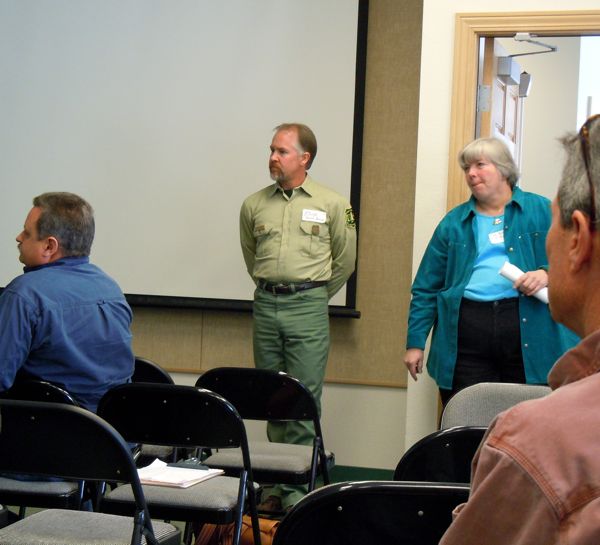
Rick Hopson and Sue Rodman of the Forest Service listen to questions April 30 about the Kirkwood-PG&E project. Photos/Kathryn Reed

Rick Hopson and Sue Rodman of the Forest Service listen to questions April 30 about the Kirkwood-PG&E project. Photos/Kathryn Reed

Kirkwood Meadows Public Utility District wants to build and operate a 34.5-kilovolt power line. Twenty-eight miles away is where the power would come from – PG&E’s hydroelectric plant at Salt Springs Reservoir in Amador County. That is alternative 2 – the Forest Service’s preferred route.

However, it will be up to Forest Supervisor Ramiro Villalvazo to make the final decision.

Most of the transmission lines would be underground. But lines would be above ground from the reservoir to Lower Bear River Reservoir. Near the subdivision is where a substation is proposed.

Clint Selby, who is on the board of directors for the Bear River Summer Homeowners Association, said his group voted unanimously for alternative 4 because the substation would be farther from cabins than other proposals.

Bear River residents were initially concerned it would interfere with the forest experience because it comes with a 12-foot fence.

The group is not in favor of no action “because we want Kirkwood to have power.”

The power supplier is going to change this summer when the purchase agreement between KMPUD and Mountain Utilities, an investor-owned utility regulated by the California Public Utilities Commission, go through. The deal was signed in April 2010 for Mountain Utilities to be the electric service provider for the residents of Kirkwood and the ski resort.

An environmental impact study was required because 85 percent of the area is on the Eldorado National Forest.

“We would need to give them a special use permit,” Rick Hopson, USFS district ranger, told Lake Tahoe News during a break.

The other concern of the Forest Service is that with about two-thirds of Kirkwood Mountain Resort being on federal land, the agency wants to ensure riders have lifts that keep running.
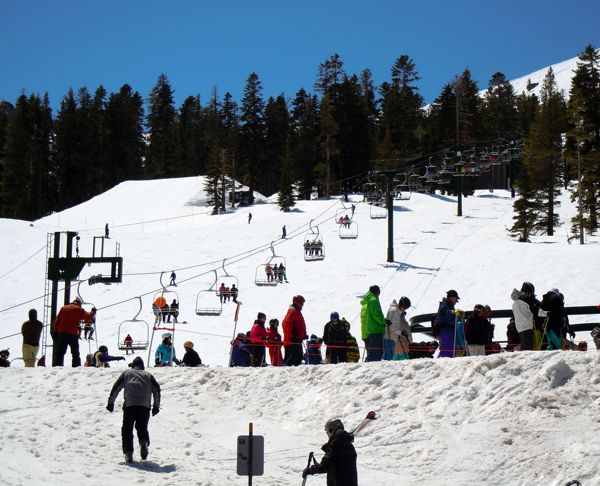
Plenty of power for the chairlifts at Kirkwood on April 30.

Plenty of power for chairlifts at Kirkwood on April 30.

That hasn’t always been the case at this resort that straddles El Dorado, Amador and Alpine counties off Highway 88. One of the worst situations was in January 2010 when the powerhouse burned to the ground and skiers were stuck on inoperable lifts.

(The powerhouse should be rebuilt by the start of next ski season and would act as a backup once PG&E is on board. Since January 2010 diesel generators on flatbeds have been keeping the lights on and lifts turning.)

Michael Sharp, Kirkwood Meadows PUD assistant manager, said during the April 30 meeting that not having to rely on the diesel generators would help the entire area in terms of reliability and costs.

“We want a more stable rate in the future,” Sharp said.

With a bond needed to pay for the multi-million dollar project, that won’t be paid off for 20 to 30 years. While that is outstanding, ratepayers won’t see a drop in rates.

Right now Kirkwood’s rates range from 35 cents to 60 cents per kilowatt-hour. The peak was 97 cents in July 2009.

“These rates are four to 10 times greater on average per kilowatt-hour than charged by Pacific Gas & Electric,” according to the draft EIS.

The plan is for Kirkwood to secure enough electricity to power the valley at full build-out. When that will happen depends on whose real estate-economic crystal ball one looks at.

But resort officials know what it will look like. Currently there are about 700 electric customers – it will max out at 1,400. Maximum peak overnight guests is 3,000 and could double in the future. The mountain can handle 6,932 skiers a day, which is projected to grow to 10,300. Current use is 7,000-megawatt hours; which is projected to more than triple.

It’s possible the line could be put in starting summer 2012.

To review the draft environment impact statement, go online. Comments may be sent to comments-pacificsouthwest-elderado@fs.fed.us.

Another meeting will be May 3 from 7-9pm at the Amado County Board of Supervisors office, 810 Court St., Jackson.

Susan Wood contributed to this story.



Seasonal burn permits required in El Dorado, Amador counties

The Amador-El Dorado-Sacramento-Alpine Unit of CalFire is reminding everyone dooryard burn permits are required starting May 1.

These permits are issued to the public for free, are valid for three years from the date of issuance, and allows for the burning of dry vegetation (not household trash) that originates on the landowner’s property.

Unit Chief Kelly Keenan in a press release said, “We still have a lot of extra vegetation (fuel) all over the county from the very destructive December storms and if we don’t continue to aggressively dispose of this fuel, come summer our wildfires will have the potential of becoming catastrophic. It is estimated that in some areas there is 33 percent more fuel on the ground than in past years from this single storm.”

Last year 23 percent of wildland fires in Amador and El Dorado counties was from burning debris piles that escaped the control of the person in charge, Keenan said.

For Amador County call (209) 223.6246 and for El Dorado County call (530) 621.5897.

Burn permits are available at most locally staffed fire stations.

The use of burn barrels is no longer legal in El Dorado or Amador counties.