Wildfire summit in Tahoe City

The second annual Lake Tahoe Basin Wildfire Wildfire Summit is June 24 from 9am to 4pm at Granlibakken Resort in Tahoe City.

The goal of the summit is to provide information and tools to assist residents to reduce wildfire risks to their homes and communities in the Tahoe basin and to develop recommendations for each Tahoe basin fire district on reducing wildfire risk in those communities.

The event will include several overview presentations on wildfire history in Tahoe and informational sessions on reducing the vulnerability of the built environment, wildfire behavior and effectiveness of fuels treatments at reducing wildfire severity in the Tahoe Basin. Participants will choose between available field trips including a walking tour of nearby community to view home construction, a walking tour of thinning project at Granlibakken resort, or a driving tour to the Washoe Fire.

The event will conclude with an interactive session for participants to identify reasons that members of their communities do not implement defensible space and brainstorming with their fire district staff on how to overcome these barriers. An optional “ask an expert” session and no-host bar will be at the end of the day.

Anyone interested in learning about wildfire issues in the Tahoe basin including residents and homeowners, staff and decision makers with state, local, federal and tribal agencies concerned with defensible space, emergency preparedness and forest management is invited to attend.

Registration is free, but required and limited to the first 150 people.

For more information, contact Susie Kocher at (530) 542. 2571 or sdkocher@ucdavis.edu..


Opinion: Cooperation needed to get Tahoe moving

By Tom Wendell

Why does it take a calamity like a natural or human caused disaster to bring out the best in human nature?

The question somewhat answers itself — because that’s human nature. We as a species appear to be hard wired to put aside concerns for our own safety and well being during disasters. Witness the brave Japanese workers at a radiation leaking power plant, selfless Good Samaritan rescuers working to free earthquake victims from under a collapsed freeway or our own response to the Angora Fire.

Tom Wendell

Tom Wendell

Scenes like these have been unfolding all over the world with increasing frequency, yet collectively we seem unwilling to apply these altruistic sensibilities to avoid a slow motion disaster in the making. Acknowledging that biochemical responses like adrenalin affect our behavior in emergency situations, it still baffles me why we don’t marshal our considerable cerebral capabilities to act decisively on commonly recognized issues that are slowly but inexorably deteriorating into emergencies. Much like the fable of the frog who will jump to safety if placed in boiling water but will slowly succumb in water that is gradually heated to a boil, we as a community are metaphorically sitting in water that has been gradually heating for decades and is about to reach the boiling point.

Instead of responding to deteriorating economic and environmental conditions (which eventually affect everyone) with a major outpouring of community spirit and cooperation, we often act like purely instinct driven squirrels — fighting over a dwindling supply of acorns whilst the oak trees that produce them are slowly dying out because no acorns are left to propagate the species. While some squirrels would undoubtedly survive longer, in the end they will all have to find a new home or perish unless they work cooperatively to reinvest acorns for their common good. In the squirrel metaphor, it’s easy to identify the common good — the continued growth of oak trees.

For complex human issues the trick of course is to come to consensus as to what constitutes common good.

There are scores of examples of this conundrum throughout the Tahoe region, never mind over the entire globe. The question is: What are we going to do about it? We could start by exhibiting the model community concept by working together cooperatively as a community instead of like gangs of squirrels squabbling over a diminishing supply of acorns. While each situation has its own unique challenges, one factor that they all have in common is a need for us to roll up our sleeves, work together cooperatively, be ready to identify and compromise on non-essential preferences/desires to achieve a common goal: The restoration and sustentation of our natural and built environment and our economy.

As I see it, the overarching goal is to ensure that we protect and maintain a physical and social environment that will provide a good quality of life for all and attract the kind of low-impact tourism that will sustain and enhance all aspects of our physical and social environment. This is a simple closed-loop model: Nurture your physical and social environment and it will sustain you. If we can agree that this is the goal, then back casting from there, we can collectively draw a road map to a brighter future.

It’s my hope that this missive will attract some ideas and inspire us as a community and a group of communities to tackle critical issues and work together to achieve this goal. What do you see as major issues that pose a threat to social, economic and environmental sustainability? Let’s hear them and start the process of finding our own solutions as a community.

On April 29 there was a well-attended meeting about proposed changes and up-grades to Lake Tahoe Boulevard from Viking Way to Clear Creek Road. The majority of those in attendance appeared to be residents of neighborhoods who use this stretch of mostly four-lane highway to commute between their homes and South Lake Tahoe. Most (but not all speakers) were opposed to reducing the up to 55 mph stretch to two lanes and reducing speed limits in order to more safely accommodate bicycle traffic and better manage runoff. Reasons given ranged from legal challenges, snow removal and emergency response concerns to a perceived drop in home values.

The snow removal and emergency concerns were quickly quashed by county personnel and active emergency responders; some who live in the affected neighborhoods. The home value argument is a total red herring as home values historically increase whenever quality-of-life improvements like increased walkability and bikeability are incorporated into community plans. The issue of the legality of changing the road due to stipulations in the deed that gave the road to the county will have to be addressed but if all four lanes remain and the only substantial change is which type of vehicles are allowed to use which lane, that might render the legal issue moot.

Tom Wendell is a member of South Lake Tahoe’s Sustainability Commission.


Tahoe National Forest to benefit from sales of tree-shrub product

Wildfires, destructive insects and disease destroy millions of acres of U.S. national forests each year, but there’s a way consumers can help.

Bayer Advanced, one of the leading consumer lawn and garden brands in the United States, is working with the Arbor Day Foundation for the sixth consecutive year to help restore our national forests and demonstrate Bayer’s commitment to sustainability.

Bayer Advanced will donate one tree for each 32-ounce bottle or 1–gallon bottle peope buy of Bayer Advanced Tree & Shrub Protect & Feed Concentrate. (Limit: 50,000 trees through May 31.)

The U.S. Forest Service has identified more than a million acres of devastated forests that are in need of replanting due to wildfires, destructive insects and disease.

This spring, more trees are being planted as a result of this program, bringing the total to 580,000 trees planted in seven national forests in four states:

Tahoe National Forest (Nevada City)

Inyo National Forest (Bishop)

Lassen National Forest (Susanville)

Sequoia National Forest (Porterville)

Bankhead National Forest (Double Springs, Ala.)

Huron–Manistee National Forest (Cadillac, Mich.)

Flathead National Forest (Kalispell, Mont.).


Recreation measure language massaged to appeal to voters

By Kathryn Reed

R is for recreation. At least that’s the thinking of the three-member panel that is moving closer to putting a measure on the November ballot that would redefine how Measure S money might be spent.

Measure S, approved in 2000, taxes property owners in El Dorado County who live in the Lake Tahoe Basin $18 a year.

Two years ago people not satisfied with how far the money was going for ball fields failed in their attempt with Measure B.
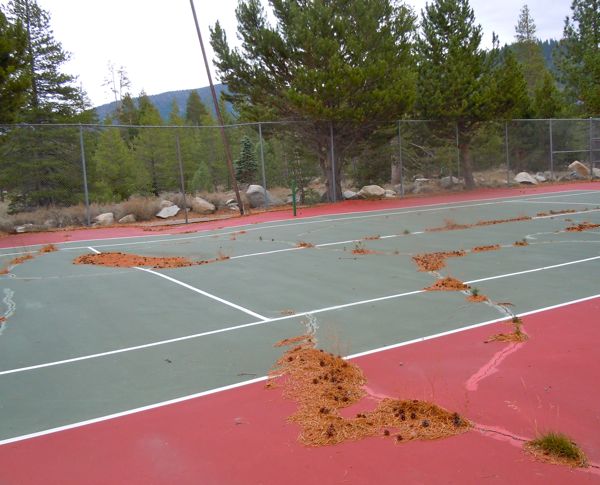
No one talks about the sorry shape Tahoe Paradise Park is in -- and Measure S is supposed to help it. Photo/Kathryn Reed

No one talks about the sorry shape Tahoe Paradise Park is in -- and Measure S is supposed to help it. Photo/Kathryn Reed

What has people thinking voters will be more amenable to altering the measure now is that the cycling community is being considered. With Measure B, the money allocated for bike trails would have been spent on ball fields.

Measure R, as the 2011 rewrite is being called, would allow bike trails installed pre-Measure S to be fixed with these funds that will continue to be collected until 2030.

The tax won’t change; just how it can be spent will be.

It’s at the June 30 meeting of South Lake Tahoe Recreation Facilities Joint Powers Authority that the final vote is expected as to whether to definitively go forward. All the language for the ballot must be approved by July 29. Those wanting to write a rebuttal to be included in the Nov. 8 election material would have until Aug. 2 to do so.

The three-member JPA made up of El Dorado County Supervisor Norma Santiago, South Lake Tahoe City Councilman Hal Cole and Tahoe Paradise Park board member Deborah Henderson met May 5 to talk about Measure R, which they dubbed it at the meeting.

They agreed to lose the Little League specific language and change it to youth baseball and softball fields. And instead of targeting improvements for the fields at Rufus Allen Boulevard and Lyons Avenue, money could go to fields within the boundaries of the special district.

Henderson relayed the message that her board would not support Measure R if there were any known opposition to it because of not seeing the money to do so as being a worthy expenditure.

It cost $18,000 (money that is collected through Measure S) to bring Measure B to the ballot. It’s not the people advocating for these changes that must incur the expense to do so, it’s the taxpayers via Measure S. This in turn means less money going toward recreation. It could cost that much or double that amount to bring Measure R to voters in November. It’s dependant on sharing the costs with other entities that have elections in November.

Santiago said the legalities of this are spelled out in the election code.

Gender equality

Part of the reason for making the language encompass girls and boys is Senate Bill 2404 enforces the civil rights of girls in community athletics as an institution in local jurisdictions and special districts.

The whole Title IX issue of equity in athletics at the K-12 level may play a roll as well as the lines of ownership of the fields becomes more convoluted, along with maintenance and accessibility.

Marilyn Breisacher voiced her concerns Thursday about the disparity among fields used for softball and baseball. The latter are in much better shape, including basics like covered dugouts.

To counter Little League coach Carl Buchholz’s statement that every organization should be doing its part to keep fields playable, Breisacher said that would be easier if the softball teams didn’t also have to pay to use the field at STHS.

Breisacher is also concerned girls will be losing a field in a proposal circulating amongst the city and Lake Tahoe Unified School District staff that would alter the use at South Tahoe High School. That whole issue – which would include a $250,000 commitment from the city – is scheduled to be before the City Council May 17.

“Boys’ baseball teams currently have a decent field and concession building at South Tahoe Middle School. In order to bring about equity, LTUSD will construct a comparable concession building at the girls’ softball field, which will be available to ASA and other teams. Restrooms for their facility will be constructed as part of the new Joint Use Student Union Building. The city of South Lake Tahoe through CACC (Community Athletic Coordinating Council) funds will improve the fields and assist in the material costs for the girls’ dugout,” LTUSD Superintendent Jim Tarwater wrote in an April 28 letter to the South Lake Tahoe City Council.

Another item in Title IX is that improvements to a playing area must be equal for the genders. While the football field at STHS gets lights this summer for its games to be played Friday nights, the theory is this opens the field up for girls soccer on weekends when normally football had access to the field.

Not everyone is in agreement that this meets the spirit of gender equality in K-12 sports because the improvements are in fact being made for football – a sport played by boys. The improvements to the STHS fields are the result of a lawsuit. Time will tell if the football field lights will prompt another Title IX lawsuit.

Some history

Originally Measure S was to pay for an ice rink ($4.3 million facility opened in 2002), four ball fields ($1.3 million spent near Lake Tahoe Community College on one field that opened in 2005), improve Tahoe Paradise Park (no evidence exists that has been done), and maintain 25 miles of new bike trails (about 10 miles have been built).

Most of the $625,000 that is collected annually is spent on bond principal and debt — $400,000. Tahoe Paradise Resort Improvement District receives $50,000 a year, as does ball field maintenance. Bike maintenance is $5,000 per new mile of new trail, with up to $125,000 set aside/spent per year.

Another $4,000 a year (or $40/hour) goes to John Upton, the loan paid staff member. He was not at Thursday’s meeting.

Metered water users flood STPUD rate increase hearing

By Kathryn Reed

A four-hour meeting Thursday night about potential South Tahoe Public Utility District rate increases ended with metered water customers’ voices being heard and no one opposing the likely 3 percent sewer rate increase.

The latter will definitely be on the May 19 agenda (meeting time 2pm) for a board vote. It would increase the average customer’s rate by less than $1 a month starting July 1.

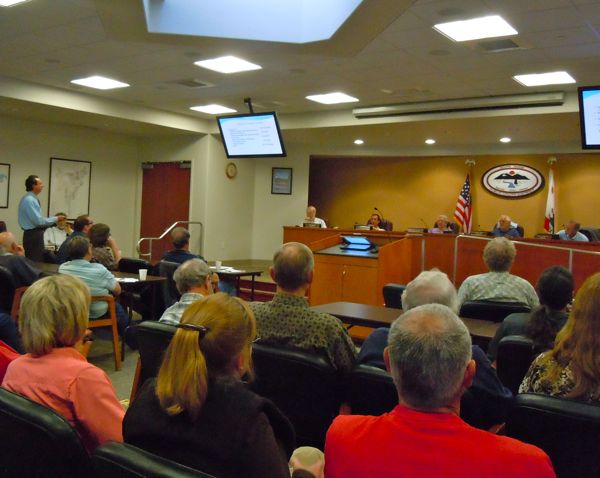
Nearly 40 people turned out May 5 for the public hearing about STPUD's proposed rate increases. Photo/Kathryn Reed

Nearly 40 people turned out May 5 for the public hearing about STPUD's proposed rate increases. Photo/Kathryn Reed

The water meter rate, though, is a bit more convoluted process. Although staff will be meeting with the board’s finance committee comprised of Chris Cefalu and Eric Schafer next week, it’s likely a new proposal will not be crafted before the next meeting. (Agendas are posted on the district’s website which can be accessed by clicking on the ad to the right of this story.)

Part of the issue is the state is mandating water districts install meters by 2025. And the customers with meters as of 2011 must be charged based on consumption, per state mandates.

Until now South Tahoe Public Utility District residential customers have all been billed a flat rate. The 3,000-plus customers with meters are about to have a fluctuating bill based in part on the amount of water they use.

Most of the approximately 40 people at the meeting May 5 were there to talk about their metered rates. What many of them are concerned about is the summer irrigation season could cause their quarterly bill to hit four figures.

For people in the Angora burn area, where growing anything is exasperatingly difficult, they fear for what their next bill will be.

Tony Colombo, who lost his house in the 2007 fire, said he and his wife have spent nearly $50,000 on landscaping because of the 50 percent attrition rate on plants. The soil, even though he has rototilled twice and added amendments, is not fostering plant growth.

He watches the high water table that wasn’t there pre-fire, because conifers absorbed the moisture, send water oozing off his land and into the street, while at the same time he knows he’ll soon need to turn the sprinklers on for the young vegetation.

Exasperation fills his voice as he addresses the five-member board.

The post-Angora Fire area is not the only place within STPUD’s jurisdiction with a high water table.

Lake Tahoe News has approached STPUD, South Lake Tahoe and Tahoe Regional Planning Agency officials with the idea that locations with high water tables ought to be looked at as areas to capture water that could be reused for irrigation. A city employee told LTN because water is not scarce here that is not likely to happen. And with rules in place that aren’t friendly to using gray water, they say, what’s the point?

Why metered water?

The impetus for the state legislation was based on the desire to decrease consumption. For most of the state, the country and the world water is a scarce resource. As much as it is renewable, it cannot be manufactured.

The theory is if people pay for what they use, they will use less – at least initially.

But for districts like STPUD that is easing into meters instead of installing them all at once, it means varied rates for customers. California mandates the district not charge more than it needs to operate.

Although that figure is not a moving target, changing the rate structure to get to the needed operating dollar amount makes rates a moving target for metered customers. It’s balancing fixed costs against consumption.

About 87 percent of what South Tahoe PUD charges water customers is based on fixed costs, while the remaining 13 percent is consumption.

Looking at options

Consultant Shawn Koorn of HDR Engineering Inc. is tasked with revisiting his numbers that led him to come up with the metered rate plan.

What people in the audience spoke to was a desire to have a higher fixed rate and lower consumption rate. This would allow them have a more predictable bill and to ease into this whole metered rate plan.

“We have to let our landscaping go or it will cost us $1,000 (in water),” Linda Thompson told the board.

She was articulate and forceful in her frustration with the proposed rates.

Harold Singer, speaking as a citizen and one who lost his home in the 2007 fire, said with the district close to meeting its 2015 consumption goals as of today, why not restructure the rate for metered customers to make it a more gradual transition.

Plus, he said, “You may have more stable revenue if you have a higher fixed rate.”

Singer also suggested the district educate people to read their meters so they don’t face sticker shock when the bill arrives.


Opinion: Wealthy Americans not paying their fare share of taxes

By Robert Reich

Nobody likes taxes, but shouldn’t the wealthy pay their fair share?

That’s a key question underlying the budget fight now moving into high gear in Washington. The plan pushed by House budget Chair Paul Ryan and his Republican colleagues calls for massive spending cuts along with additional tax breaks for the wealthy. The president says he’s just as serious about deficit reduction, but instead of cutting as much spending, he wants to raise taxes on the wealthy.

The president is right. In fact, his proposals for raising taxes on the superrich don’t go nearly far enough.

Over the past three decades, the distribution of income in America has become wildly out of whack. Despite an economy that’s twice as large as it was 30 years ago, the bottom 90 percent of Americans remain stuck in the mud. If they’re employed, they’re earning on average only about $280 more a year than 30 years ago, adjusted for inflation. That’s less than a 1 percent gain over more than a third of a century.

Yet even as their share of the nation’s total income has withered, the tax burden on average workers has grown. They’re shelling out a far bigger chunk of incomes in payroll taxes, sales taxes and property taxes than 30 years ago.

It’s just the opposite for the superrich.

Over the last three decades, the richest 1 percent’s share of national income has doubled (from 10 percent in 1981 to well over 20 percent now). The share going to the richest one-tenth of 1 percent has tripled.

Robert Reich, former U.S. secretary of labor, is professor of public policy at UC Berkeley and the author of the new book “Aftershock: The Next Economy and America’s Future.” He blogs at www.robertreich.org.

Read the whole story


Pioneer Trail to be torn up for months starting May 10

Another main road through the South Shore is about to be torn up.

Starting May 10 Southwest Gas will be installing a 12 inch gas main on Pioneer Trail from the intersection of Al Tahoe Boulevard to the intersection Highway 50 at Stateline.

There will also be work on Park Avenue as well as the intersection of Highway 50 and Heavenly Village Way.

The work will involve open cut trenching as well as horizontal boring. The contractor plans to work east from Al Tahoe toward Stateline.

The work is expected to take all summer.

This project is necessary to relocate utilities for the Caltrans Highway 50 project from Trout Creek to Ski Run Boulevard.

The project will at times cause delays in traffic because of lane closures.


Bears looking for food in Tahoe neighborhoods

It’s that time of year when bears are roaming Lake Tahoe neighborhoods.

Although it’s never a good idea to put trash out before the day it picked up, it’s even more critical now not to so these bruins don’t get hooked on human food.

The anonymous South Lake Tahoe photographer says this bear named Brutus was hit by a car two weeks ago and is now scavenging for food.

An anonymous South Lake Tahoe photographer says this bear named Brutus was hit by a car two weeks ago and is now scavenging for food.

The Bear League has information about living with bears.

Lake Tahoe Wildlife Care is also a good resource for information.

— Lake Tahoe News staff report


North Shore bike trails open

In preparation for the 2011 Amgen Tour of California that will be in the Tahoe area May 15-16, North Lake Tahoe trail crews have been working long days to clear snow from the region’s many paved bike trails.

Spectators can now gather on the miles of paved trails to cheer on the Tour’s professional cyclists as they race for the coveted yellow jersey during Stage 1, which includes a lap-and-a-half around the lake starting on the South Shore and finishing at Northstar-at-Tahoe May 15. Stage 2 takes off at the Village at Squaw Valley and onto Highway 89 before heading to Truckee May 16.

North Lake Tahoe is also hosting the Tahoe 10-Day Countdown, kicking off May 5, prior to Stage 1 and Stage 2 with a number of community-oriented events planned in the region’s commercial core districts that are now reachable via the paved bike paths.

All of North Lake Tahoe’s paved bike trails are recreational-rider friendly and some favorites include the route along the Truckee River from Tahoe City to Squaw Valley, the West Shore from Tahoe City to Sugar Pine Point State Park and Lakeshore Drive in Incline Village with its awe-inspiring Tahoe mansions.

Although the paved bike trails are accessible, the trails officially open May 27. Riders and walkers are advised to be aware of any missing signage and asphalt repairs, as well as freezing conditions at night that can make trails slick in the early morning.


LTCC Foundation fundraiser

Lake Tahoe Community College Foundation’s biggest fundraiser — Rhythms & Wine & Microbrew Too is July 9 from 6-9pm.

It is outdoors, at the entrance courtyard of the college.

For more information, contact Melonie Guttry at (530) 541.4660, ext. 245 or email guttry@ltcc.edu.