46 states forced to reduce services to deal with budget gaps

By Marsha Mercer, AARP Bulletin

Despite signs the economy is brightening, state governments face a fourth straight year of financial crisis. To balance their budgets over the past three years, officials have cut programs that help their most vulnerable residents, including older people and the disabled. They’ve hiked university tuitions and sliced K-12 school spending. They’ve laid off hundreds of thousands of public employees and pared workers’ benefits and pensions.

It took all this and more to close $430 billion in state budget gaps during the worst economic period since the Great Depression.

But more tough decisions and deep cuts lie ahead. On the chopping block are programs that Americans rely upon from cradle to grave: Many states are slashing child care assistance, and at least one state, Virginia, will eliminate the fund that paid for indigent burials.

“Everything is on the table — and it has to be,” says Chris Whatley, deputy executive director of the Council of State Governments, a nonpartisan policy research group based in Lexington, Ky.

Forty-four states and the District of Columbia are projecting $122 billion in budget shortfalls for fiscal 2012, according to the Center on Budget and Policy Priorities, which reports that nearly every state plans to spend less in 2012 than in 2008, after inflation.

Fiscal 2012, which starts July 1 in most states, “is shaping up as one of the most difficult budget years on record,” according to the center, which advocates fiscal policies that help low- and moderate-income people. And some states are predicting deficits totaling $75 billion in fiscal 2013, which starts in July 2012.

“These are painful cuts,” California Gov. Jerry Brown said in March as he signed $11.2 billion in spending reductions to programs benefiting the poor, the sick and older people, to close a $26.6 billion deficit in the 2011-2012 budget. “It hits vulnerable people. It’s not the kind of thing I like doing … But when you have a deficit, you have to.”

But, the governor warned, “the next round of cuts will be much more painful and much more disruptive.”

Read the whole story


Embracing China’s historical and modern marvels

By Kathryn Reed

BEIJING – “Don’t yell protest.”

That was my niece’s sage advice as we walked along Tiananmen Square.

As the largest public square in the world, this mass of concrete in itself is not so impressive. Its history, of course, is what makes it seem like something more than it is.

Police officers mill about. But they have no weapons visible. Military units march in. Also weaponless. But cameras adorn many of the light standards. In a corner across the street inside the Forbidden City are riot helmets and shields lined against a wall.

Each Terracotta Warrior is unique. Photos/Kathryn Reed

Each Terracotta Warrior is unique. Photos/Kathryn Reed

China, as the oldest continuous world civilization with records dating back 3,500 years, is a complex country.

On the one hand Beijing can boast of having one of the seven seven-star hotels in the world – the Morgan Plaza that opened just before the 2008 Summer Olympics. On the other hand, people are using construction tools that look like they came from the 1800s.

On one corner are high-end shops like Versace and Gucci. Across the street is a traditional market where with the right person in your group silk scarves can be negotiated down to $4.

In hotels the card key is inserted inside the room to turn on the lights. Taking the card when leaving means no wasted electricity while out of the room. Then there are many public bathrooms that require hovering and bringing your own toilet paper.

China is the world’s largest energy consumer and the world’s third-largest net importer of crude oil, after the United States and Japan. I would never want to drive there. Veronica says getting around on a bike is easy. Congestion is so rampant that fast-food places deliver via bicycle instead of automobile.

While hotels have wireless access, Facebook and Twitter are off-limits.

I had the opportunity to spend two weeks in China this spring. My sister, Pam, and I went to visit our niece who lives in Beijing. It was her college graduation present – which was her idea. In the process of planning our adventure we invited our mom along. Having someone speak near-fluent Mandarin and plan all of our travel inside the country made for one of the most relaxing trips I’ve been on.

Veronica made sure we didn’t get ripped off and Pam provided the frequent flier miles for all of us. Like most vacations, you can spend lots or little. For the most part, though, China is not expensive – except for Apple products.

Land of pandas

After an initial night in Beijing we flew to Chengdu. Chengdu is in the Sichuan Province – home of incredibly, fabulous spicy food.

Veronica said watch out for that tiny numbing pepper. It was in my mouth already. Naively I asked how it got its name. She said because it will make my tongue numb. It was soon making my throat numb.

This area is one of China’s agricultural regions. As the world’s most populous country (1.3 billion people), not having to import all of ones food is important. However, only 13.5 percent of the land is suitable for agricultural, though 40 percent of the labor force works in agriculture.

Peppers of all shapes, sizes and heat are available. They seem to be mixed in with everything. One of my favorites was the spicy peanuts. And the mushrooms. I never got tired of the variety of mushrooms I ate throughout the country; cooked differently each time.

Hot pot is a specialty of Sichuan. It’s similar to fondue in that veggies, meat and fish are cooked in a broth and everyone is sharing from the same pot.

We came to this area so I could see the pandas. Holding the little guy was definitely one of the highlights for me.

Having never been to China, everything was new and magical. And so much of what is built is to such a large scale.

The Leshan Buddha is the largest stone Buddha in the world at 233-feet tall and 92-feet across. Construction on it started in 713 AD.

Walking down the narrow stairs is worth it as you stare up at this piece of history that sits at the confluence of the Minjiang, Dadu and Qingyi rivers.

Taking a side trip, we stop off at a tea plantation. Rows of terraced plants that look like hedges grow in a bowl shaped area. Leaves are picked one by one.

Terracotta Warriors

Xi’an is the only city in China that still has a wall surrounding it. Like most cities in China, the history extends thousands of years. But what it is most famous for now is the 1974 discovery of the Terracotta Warriors.

Nearly 2,000 warriors have been unearthed. Each is life size and no two are alike. Experts believe more are buried, but new pits are not being searched for until scientists are able to find a technique to preserve the original color of the warriors.

Not having the technology of the 21st century, these soldiers have such precision and detail it’s hard to believe they were created in less than two years.

Emperor Qin had them built to protect him in the afterlife. They were in the ground for 2,000 years until a farmer discovered the artifacts.

In 1979, a museum opened at the site. The structure is built around the main excavation site.

PBS had a special about the warriors that aired earlier this month.

China’s capital

Beijing is huge, with more to see and do than a week allows. But, still, we felt like Veronica’s itinerary allowed us to hit the highlights, with some non-traditional stops as well.

The Great Wall is aptly named. At 5,500 miles, we barely touched it. To think this was built more than 2,000 years ago is mind-boggling. Though it’s not one of the original Seven Wonders of the World, modern lists would include it.

The Forbidden City is fascinating with its lore. There are 9,999 rooms in more than 200 buildings.

The Summer Palace is definitely worth seeing.

Walking around the Olympic Park was such a contrast to having visited so many historical sites. The modern architecture of the Cube and Birds Nest are so much more impressive in person than on television.

Spending an afternoon and evening in a cooking class just for the four of us was fabulous. It’s definitely not something that could be done in the U.S. because it was in the home (non-commercial) kitchen of three siblings. My stomach feels full thinking about it and I’m still wary of ever picking up a clever again.

Veronica found us a tea seminar through the Chinese version of Groupon. There’s a lot more to tea than boiling water and putting in a bag. And fact, I don’t know if tea bags exist in China. It’s all loose leaves.

Street food is excellent, though I’m glad I had someone ordering for me instead of just pointing to things.

All of the food in China was wonderful — nothing like what you get in the States.

ngg_shortcode_0_placeholder (Click on photos to enlarge.)



Skip the detour — Echo Summit is open

Echo Summit is open.

This section of Highway 50 that connects the South Shore to points west will be open on weekends and subject to controlled traffic during the week.

Motorists can expect 20-minute delays while work continues for up to six week.

Work on Echo Summit finished ahead of schedule. Randy Pench/Sacramento Bee

Work on Echo Summit finished ahead of schedule. Randy Pench/Sacramento Bee

There will be no traffic restrictions on weekends including over the Memorial Day Weekend.

The rock wall barrier replacement project at Echo Summit was funded in part ($1.9 million) by the American Recovery and Reinvestment Act of 2009.

The following are quick facts about the barrier replacement project at Echo Summit:

• 1,302 lineal feet rock barriers along Highway 50 at Echo Summit were removed and replaced.

• The entire width of the roadway for one mile was resurfaced.

• The rebuilding effort included seven walls along the eastbound lane; the longest is 298 feet and the shortest is 68 feet.

• Approximately 20-25 people worked at the job site during each of two shifts (except when work was temporarily suspended due to weather).

• The historic rock walls were removed two feet below the roadway. In addition, most of the eastbound lane along the length of the walls was removed to a similar depth.

• The form liners for new barrier have a rock texture; workers hand carved the top surface and ends for design authenticity.

• The rock and rubble removed from the project becomes the property of South Lake Tahoe and will be delivered to a designated site.


Input sought on what KMS should be

Douglas County School District is having two meetings to find out what the community would like to see Kingsbury Middle School turned into.

The Stateline school closed a few years ago because of declining enrollment. It has sat empty since then.

The first meeting is May 26 at 6:30pm at Whittell High School, Room 3.

The next meeting is June 1 at 6pm at Douglas High School in the library.

For more information, call (775) 782.5135 or email ideas to suptoffice@dcsd.k12.nv.us.


The good and the bad of an epic snow season

By Agatha Wasilewska, Transworld Business

Resorts and their marketers dream of big dumps and lots of them to befall their mountains; the press is fabulous and it brings the crowds out in droves and makes for fantastic photo opps. This year the ski areas around Lake Tahoe must have been praying extra hard because they got more than anyone could have imagined or bargained for.

As the season winds down and the mountains start closing, Transworld Business thought it would be interesting to pay Tahoe a visit and find out how this record breaking snow season has affected the resorts and local retailers from both the good and bad sides of the fence.

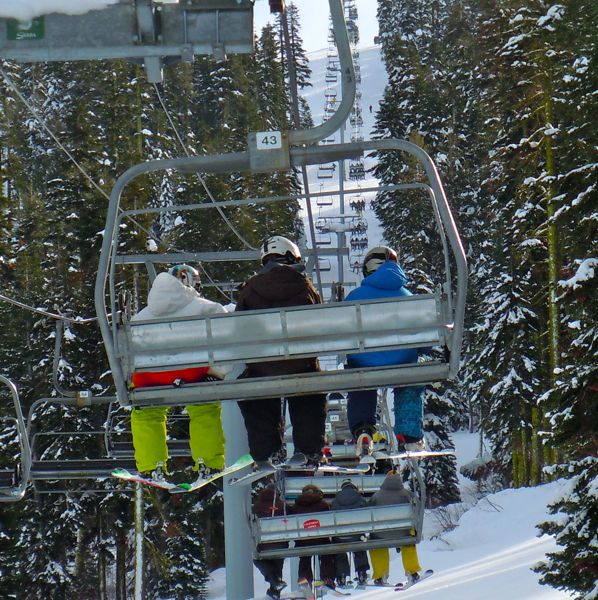
2010-11 was an epic ski season in Lake Tahoe. Photo/LTN

2010-11 was an epic ski season in Lake Tahoe. Photo/LTN

Lake Tahoe is perfectly situated to attract the San Francisco Bay Area crowd and keep a steady stream of visitors from far and away coming to this unique ski destination. With so many resorts, all of which set record breaking snowfall amounts this year despite a drought-ridden January, at such close proximity to each other, the competition for customer loyalty is steep, and each resort has uniquely branded itself with that in mind.

Here is an overview of a selection of resorts we visited and their reflections on how the season went down.

Read the whole story


Snippets about Lake Tahoe

stpud• South Tahoe Public Utility District has a rebate plan for commercial customers. Call (530) 543.6268 for a free commercial water-use review. Rates for sewer customers are going up 3 percent July 1.

• Leadership Lake Tahoe is looking for participants. Applications are due June 17. For more information, call (775) 588.1728.

• Barton Hospice is looking for volunteers at the lake and in the valley. Call (530) 543.5605 for information.

• Apricot Lane has moved from the Y in South Lake Tahoe to Heavenly Village.

• On May 24 at 7pm in Camp Richardson’s lodge, the Lake Tahoe Historical Society will present a “first person” account of the Pony Express at Tahoe. Specialist Kim Copel and historian Frank Tortorich will relate stories of this short lived, but exciting endeavor. The event is free.

• Here is Caltrans’ schedule for Sierra roadwork for the next week.


Amateur bodybuilding competition at MontBleu

The Tahoe Show, a National Physique Committee-sanctioned amateur bodybuilding, figure, bikini and fitness championship, is Aug. 27 at MontBleu in Stateline.

Promoters of the Tahoe Show are offering a number features that are outside the norm. From the website, competitor may register to compete, as well as purchase show photos, tanning, event DVD, hair and makeup, a posing clinic with Greg Atoyan and a lakeside photo shoot after the show. Plus, recognizing the stringent dieting of a competitor, registrants will, have free access to microwaves to heat their pre-prepared food, free buffet after the show along with free access to an after party at MontBleu’s Opal Ultra Lounge.

Categories include bodybuilding, bikini, figure and fitness with open, novice, masters and teen divisions. The show will be fast passed and energetic. Included will be special celebrity appearances, a live DJ, video broadcast and a pound-for-pound lifting contest. The pound-for-pound lifting contest gives those who might not want to show off their physique an opportunity to participate. These competitors will compete to see who can bench press their body weight for the most number of repetitions.

Expected at the show are about 200 competitors and 1,500 or more spectators.

The title sponsor is Zephyr Cove’s Anytime Fitness.

For tickets, information, registration and a full event schedule, go online, email Chris@TahoeShow.com or call (775) 267.7564.


S. Tahoe writer to release ‘Poems on Travel’

Suzanne Roberts’ book launch party for “Three Hours to Burn a Body: Poems on Travel” is June 17 at 6:30pm. Also, being celebrated is the opening of the photography show “Faces,” featuring some of her travel photographs from around the world.

The event at Bona Fide Books includes a short poetry reading, book signing, drinks, appetizers, tribal belly dancers, and more.

Bona Fide Books is located in Meyers at 1069 Magua St., No. 4, behind the Getaway Café.


Opinion: Time running out on dealing with invasive species

Publisher’s note: This editorial is from the May 14, 2011, Reno Gazette-Journal.

The possible discovery of quagga mussels in two of Northern Nevada’s must important reservoirs is reason for considerable concern.

The invasive mollusk has become Public Enemy No. 1 in waterways throughout the United States, including Lake Mead, where they were first found in 2007. From there, they migrated to Lake Havasu.

The natives of eastern Europe, and their cousins, zebra mussels, already have caused millions of dollars of damage in the Great Lakes and the Mississippi River.

According to the U.S. Department of Agriculture, they clog water intake pipes, foul hydroelectric operations and, particularly worrisome, voraciously eat the food that native species depend on for survival.

Officials at Lake Tahoe have battled fiercely to prevent an invasion of the alpine lake, where they could undo decades of hard work that has been done to protect its famous clarity. The mussels’ favored method of transportation is on the private boats that often are moved from lake to lake. That’s why boats entering Lake Tahoe have been subject to inspection and decontamination since 2008.

Inspections also are occurring at other area lakes.

Read the whole story


Transit district working numbers to create balanced budget

By Kathryn Reed

STATELINE — The Tahoe Transportation District needs to find about $50,000 in the next month or it won’t be able to approve a balanced budget.

The board was given the sobering news at its meeting this month.

Another component that could affect the district is the May revise to the California budget which calls for reductions in transportation dollars.

The budget has been broken into capital improvement projects, transit and general fund. Because TTD has not been the parent of the BlueGo bus system for an entire fiscal year, the operating numbers are difficult to compare year-over-year.

But revenues are definitely on the decline. South Tahoe Public Utility District puts a portion of connection/hook-up fees toward TTD. With construction near a standstill, those dollars are waning.

Since the bankruptcy of South Tahoe Area Transit Authority, not all the partners associated with that group have signed on to be part of the BlueGo run by TTD.

An item that struck board members odd is the $30,000 allocation for the telephone system. Accountant Joanie Schmitt said she has been working with AT&T, but the issue is tied up in bankruptcy. Board members said they’d work their connections to resolve that issue.

If that comes to fruition, the current deficit of $48,782 would be substantially decreased.

With fuel costs on the rise, the budget calls for $785,000 on that line.

The board is expected to vote on the budget at the June meeting.

In other action:

• It was disclosed that the Stateline-to-Stateline bike demo project may still start this summer, but because the U.S. Forest Service has not signed off on all the paperwork the delay will mean it won’t be completed in one building season.

• The board accepted the donation of two prefabricated bus shelters from Bently Nevada.

• Andrew Strain was nominated to be chair of the board for another year and Will Garner vice chair. A vote will be taken at the June meeting.

• Angela Swanson has replaced Bruce Grego as South Lake Tahoe’s rep to the district. She was nominated to oversee a committee devoted solely to BlueGo.

• The deadline to submit a request for proposal to operate BlueGo was extended to May 25.