Stateline casinos buck state trend — April numbers up

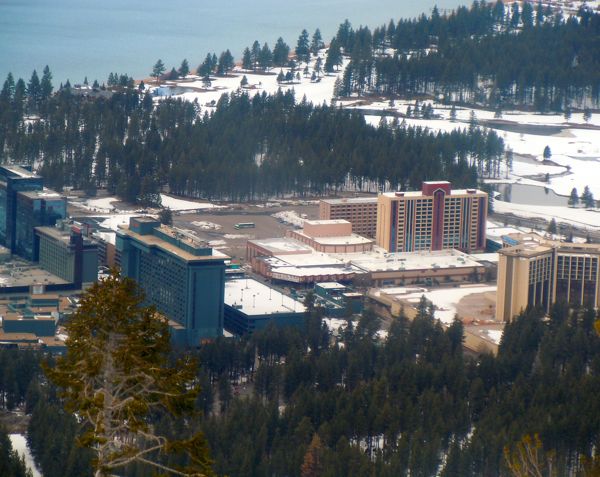
Gaming revenues surged at Stateline in April by 14.99 percent or $14.3 million compared to the same time in 2010.

Statewide, casinos collected $806 million from gamblers, which is a 0.58 percent decline compared with $810.7 million collected in April 2010, according to the state Gaming Control Board which released the April data this morning.

Stateline casino earnings were up in April. Photo/LTN

Stateline casino earnings were up in April. Photo/LTN

Carson Valley reported a drop of 3.34 percent.

In March, Stateline casinos reported a 29.8 percent drop in revenue. Often times March is a good month for casinos because of betting on college basketball.

April 2011 did have more skier days than usual with resorts staying open until late in the month to accommodate Easter. Most of the bed base for South Shore ski areas is within walking distance to the Stateline casinos.

— Kathryn Reed


South Tahoe exchanges 50 TAUs for neighborhood park

By Kathryn Reed

South Lake Tahoe city councilmembers were more concerned about dogs than tourist accommodation units when they approved the transfer Tuesday of 50 units to Stateline.

The five had a lively discussion about whether a dog park should be part of a larger park on Bonanza Avenue where the former C&M Lodge sits. Little was said about Edgewood Companies using the 50 TAUs it has development rights to from that property for the planned Edgewood Lodge on its golf course about 6 miles away in Nevada.

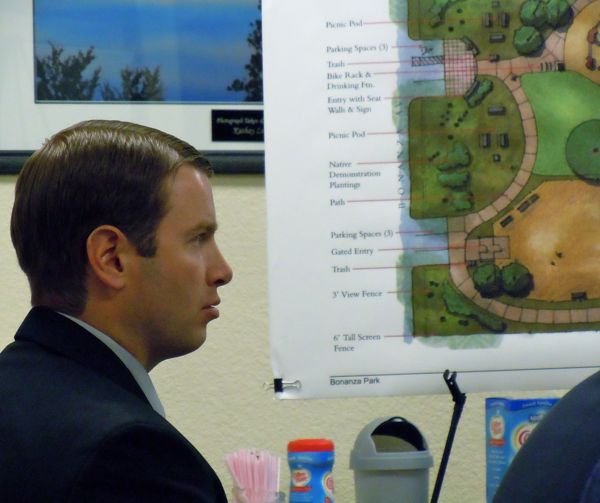
Brandon Hill, project manager of the Edgewood Lodge, listens June 7 to council deliberations. Photo/Kathryn Reed

Brandon Hill, project manager of Edgewood Lodge, listens June 7 to council deliberations. Photo/Kathryn Reed

Hotel rooms are a commodity because the Tahoe Regional Planning Agency has said so. This is the bi-state regulatory agency’s way of limiting the number of hotel rooms in the Lake Tahoe Basin.

The council approved the transfer 5-0.

The dog park was ultimately eliminated from the plans. But having it dog friendly is a must, according to the council.

Before Edgewood has access to the TAUs it must build the park (it has said it can do it before winter) or put up a bond that would ensure it is built. The city has a history of not securing such performance bonds – just look at the hole in the ground near Stateline that was supposed be a convention center, two hotels, retail and open space. Now it’s bankrupt. (And hearings just keep getting moved forward with no resolution, with a July date now on the calendar for the parties to come to a resolution.)

A consultant was brought in to help decipher the city’s best use of the TAUs. (Documents are available on the city’s website under the June 7 agenda.) Transferring the TAUs and having Edgewood get rid of the structures on the property and build a park was the best option, according to the report that cost nearly $16,000. (The city and Edgewood split that expense.)

The city will own the park, with an anticipated annual maintenance expense of $7,000.


Vail Resorts posts increase in quarterly earnings

Vail Resorts Inc.’s fiscal third-quarter earnings rose 5.6 percent, with resort officials today underlining skier visits were up in Colorado and California, and declaring for the first time a quarterly dividend for stock investors.

For the quarter ended April 30, the only publicly traded ski resort reported a profit of $76.9 million. This is up from $72.8 million a year ago. The latest period included $2.6 million in write-downs and $6.6 million in debt-extinguishment charges. Revenue jumped 18 percent to $414.5 million.

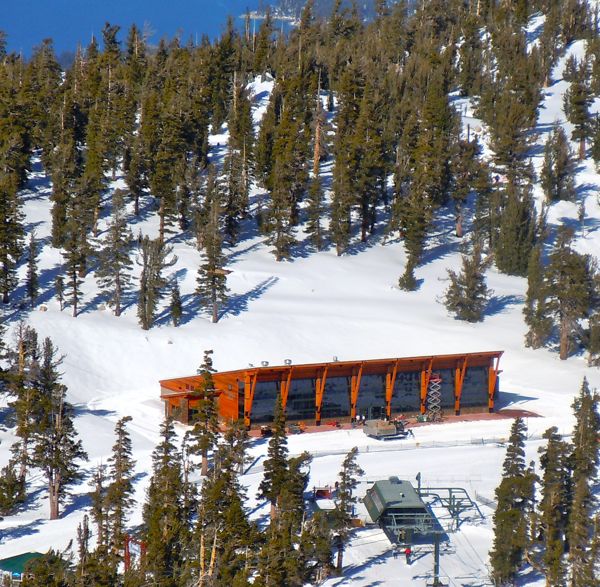
The Tamarack Lodge, which opened this past season at Heavenly, helped boost F+B sales for Vail Resorts. Photo/LTN file

The Tamarack Lodge, which opened this past season at Heavenly, helped boost F+B sales for Vail Resorts. Photo/LTN file

Shares closed Wednesday at $43.41 and are down 17 percent this year.

This is often the most telling of the quarterly reports because it includes February, March and April – all ski months.

Vail is an indicator the travel and tourism sector is on the rebound.

The company bucked a trend in California where overall skier visits were down 12 percent for the 2010-11 season.

“For the 2010-2011 ski season, visits to our Colorado resorts were up 4 percent compared with a gain of 1 percent for the rest of the Rocky Mountain region. Visits to our Tahoe resorts, including Northstar-at-Tahoe in both periods, increased 3.9 percent in contrast to a 7.1 percent decline for the rest of the Pacific Southwest Region (which includes California). Visits to all six of our resorts were up 4 percent, adjusted as if we owned Northstar-at-Tahoe in both periods, compared with 0.1 percent growth for the rest of the U.S. ski industry,” CEO Rob Katz said in a statement. “Northstar-at-Tahoe has been a great addition to our company, achieving record visitation and profitability, and helping to drive a 36 percent increase in our Tahoe season pass program for the 2010-2011 season.”

Vail owns Heavenly Mountain Resort on the South Shore. In October it acquired Northstar-at-Tahoe in Truckee.

Companywide spring season pass sales for the 2011-12 season were up 19 percent in units and 27 percent in sales dollars through June 5, compared with the prior year period ended June 6, 2010, (adjusted as if Northstar-at Tahoe were owned in both periods).

One-third of Vail’s season pass sales come in the spring when the price is at its lowest. Those sales are not part of this quarterly earnings report.

Lodging reported net revenue was $49.8 million for the quarter compared to $44.9 million for the same period last year, for an increase of 11 percent.

Closing of four condominium units at the Ritz-Carlton Residences at Lion’s Head helped drive a surge in Vail Resorts’ real estate porfolio. Net revenue was $13.2 million for the quarter compared to $3.2 million a year ago.

It was also announced Vail Resorts’ will be issuing its first cash dividend of 15 cents per share of common stock.

— Kathryn Reed


History: Taking a ride on the Lake Valley Railroad

Publisher’s note: This is reprinted from the August 1975 Lake Tahoe Historical Society newsletter.

A look backward at earlier days in Lake Valley, an easy hour’s ramble through the pine trees, picking wild strawberries in a forest-surrounded meadow, a valuable find for the Museum, and a picnic was enjoyed by more than 30 Society members and guests on Sunday, July 27th, when Tom Armstrong led the group on a tour over the roadbed site of one of the spurs of the old logging railroad operated in to the Meyers area until 1897-98.

museum logoAlthough another railroad operated about 1875-85 from Camp Richardson to Meyers for logging purposes, the tour involved the Lake Valley Railroad which extended from Bijou. About 1885, George Washington Chubbuck, who was operating Sierra House under a lease from Mr. Siebeck, built a tramway operation in Bijou involving wooden rails with flat cars pulled by oxen. The wooden rails wore out so fast they were soon replaced by 35 lb. steel rails, three foot gauge. Chubbuck had a locomotive of sorts but it was heavy and bulky to operate. His oxen method of moving the timber he was cutting under a subcontract to the Bliss interest in Glenbrook was too expensive. When he went bankrupt in 1886, the Bliss company took over the railroad and, as the area was logged out, extended the rail further south and west, possibly as far as present day Christmas Valley.

The locomotive Santa Cruz was brought from Glenbrook on a barge for use; when it broke down, as often happened, others were brought from Glenbrook for temporary service, including Engine No. 2, the Glenbrook, now on the grounds of the State Museum in Carson City.

The logs were loaded on flat cars and taken to the 1800 foot Bijou pier to be rafted or barged across to Glenbrook, worked through the mill there, then taken to Spooner Summit by railroad, sent down the flume to the Carson Valley to be taken on to Virginia City. If San Francisco is the city built by Virginia City, then San Francisco owes it all to Lake Tahoe from where the timbers came that hold up the town of the Comstock.

When the heydey of Virginia City was imminent, Duane Bliss felt the time had come to connect Lake Tahoe with the outside world. He took the rail and used it to build the Lake Tahoe Railway and Transportation Company, operating between Tahoe City and Truckee until the Southern Pacific bought it from the Bliss family in 1925 and converted the track to standard gauge of 4 feet 8½ inches. Rail service there lasted until World War II.

Mr. Armstrong, who at the age of two accompanied his father when he was conducting historical tours for the Pontiac, Michigan Recreation Department, carried on the family heritage well as he led the group over the route which is amazingly visible after more than 75 years since the rails were taken up. Located was the very apparent site of a trestle over the creek with a log protruding from the bank which was no doubt a part of the trestle. A rock outcropping showed evidence of the drill holes for placing the powder to blast away the rock to build the roadbed. One portion of the creekbank was stacked with rocks to make a higher embankment to support the road. After crossing the creek and proceeding some little way across a meadow, the group spied wild strawberries and stopped for a short recess. Continuing on, a site was located where the logs were dragged parallel to the tracks for loading on the flat cars. A considerable amount of bark still is lying on the ground at this location.

At the end of the spur track was quite likely the site of a small settlement. It would not have been unusual for a few cabins to have been set up so the loggers would not have to go back into “town”. Each time the track was extended further, they would take all the boards and put up some more cabins. At this particular location, about 100 feet to the west, evidence of such a cabin had been located.

The main group commenced their return to the starting point of the tour. Others led by Ed Laine and Tom Armstrong looked further around at the area at the end of the spur and made a valuable find for the Museum in the remains of a railroad tie from the trackbed. While the major portion of the tie had long since disintegrated, there was sufficient remaining to readily identify it because of the spike holes at each end is reasonable approximation to the 3 foot gauge.

The group then had lunch in the shade of the trees along the creek the Norman Celio, Vera Broder Silberstein and Elsa Barber Strait sharing memories of their childhood in this particular area.


Snippets about Lake Tahoe

tyfs• Tahoe Youth & Family Services is closing its thrift shop Hope’s Closet on June 15. Sales are going on until then at the shop near the corner of Highway 50 and Tahoe Keys Boulevard in South Lake Tahoe.

• Sierra Quilting Camps are July 11-15, Aug. 8-12 and Sept. 12-16 in Truckee. For more info, go online and click on Sierra Quilting Camps, or call (530) 587.7892 or email Sewlinda@aol.com.

• Kirkwood Mountain Resort has cat skiing throughout June because there is so much snow.

• South Tahoe High School’s Sober Grad Night is June 10 from 9pm to 4am June 11 at the Heavenly California Lodge.

• Red Hut on Ski Run Boulevard in South Tahoe is having a burger night June 15 from 5-8pm for Tahoe Douglas Rotary. Pay $10 for dinner and you will be supporting community projects in the area. You get a burger, homemade chips and a fountain soda.

• El and I’s last show on KTHO radio is tonight starting at 5:15. They are asking listeners to stop by the Ski Run Marina studio in South Lake Tahoe to say goodbye, and drop off canned food for the Back Door Ministries.


Money in the bank to keep Measure G projects going

By Kathryn Reed

Voters approved Measure G in 2008, but few have seen what their money has been spent on.

This is because most people don’t have a student at South Tahoe High School and that is where the bulk to the work has been since construction began. The high school has been transformed and continues to be. The third new structure will open to students at the start of the 2011-12 school year in August.

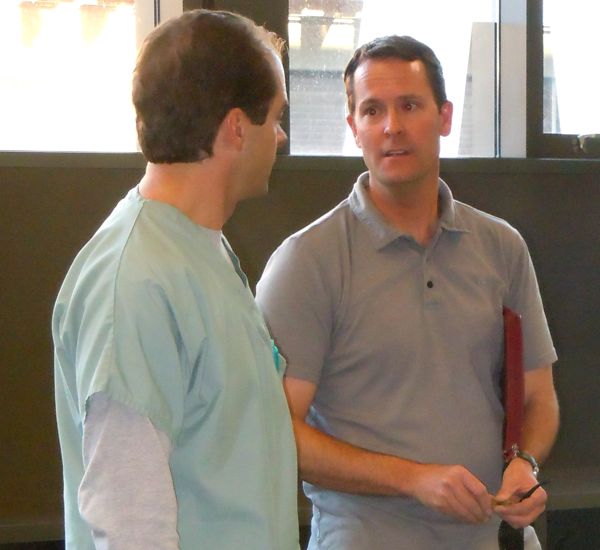
Pat Martin, left, talks with contractor Joe Stewart during the June 8 tour of the TADA building. Photo/Kathryn Reed

Pat Martin, left, talks with contractor Joe Stewart during the June 8 tour of the TADA building. Photo/Kathryn Reed

To get the public oriented with what is going on at Gardner Mountain an open house is slated for Aug. 26 from 5-7pm.

This is something the bond oversight committee embraced at its June 8 meeting at the high school.

The irony is people much farther away know about the improvements Lake Tahoe Unified School District is making structurally and with programs. A president of a Korean university has toured the campus. Calls have come from Alaska and other areas of the country asking what STHS is doing and how it has been able to do so.

At the Wednesday meeting the committee also went over the annual financial statement. More than $16.7 million in bonds still need to be issued. CFO Deb Yates said the third series couldn’t go out now because the assessed value of properties in the district is so low.

What is allowing construction to keep going is the state has pledged more than $30 million to the district in matching grant dollars, with more than $27 million of that in the bank.

When the committee last met in January the cash flow was getting a bit iffy, but since then the state has come through with its money.

The district has a meeting set for June 22 with its bond counsel to discuss where to go from here.

With the state awarding LTUSD so much cash, it means more projects will get completed than originally planned for. But at the same time the 2010 building code changes are costing some projects more than anticipated.

The second annual report to the community will be available on Lake Tahoe News soon. The district needs to make minor corrections that were identified at the meeting.

In other action:

• The committee re-elected Pat Martin as chairman, and voted in Casey Blann as second in command.


Opinion: SB271 an opportunity to open dialogue between states

By Joanne Marchetta

In the final hours of the 2011 Nevada state legislative session, the bill known as SB271 passed, bringing with it opportunities for the two states that bound Lake Tahoe to reinvigorate the spirit of compromise that created the Tahoe Regional Planning Compact more than 40 years ago. The bi-state consensus that brought about that original agreement was no doubt hard-fought, and when Lake Tahoe’s future is in the balance, the spirit of compromise has succeeded in bringing the two states together in a significant way.

SB271 is the latest signal sounding that Lake Tahoe’s future is currently in the balance. Discussing bi-state consensus is again in order, but the pressing issues are different. Forty years ago, the problems were rampant growth and a lack of environmental controls on new development. Change was needed. Today, Lake Tahoe faces an outmoded economic base, aging infrastructure, and the need for a stormwater control program to restore lake clarity that could cost up to $1.5 billion over the next 20 years.

Joanne Marchetta

Joanne Marchetta

Throughout the proceedings on SB271, the Nevada legislators and stakeholders who worked on this bill showed clearly that they want to protect Lake Tahoe. But they also want TRPA to again be the solution, not the roadblock, to needed changes at Lake Tahoe. And rather than look at this legislation as a negative for the lake, the better view is for the community to see the encouraging possibilities for reasonable reforms it opens up for us.

The hearings gave us an opportunity to show many that TRPA had already set a new course within the agency with its strategic plan. Since last year, we have been changing and improving our operations to meet more regional challenges and to reposition the agency as an environmental innovator and partnership builder. We were able to educate them on how we are honing the focus of the Regional Plan Update on water quality gains and the need for environmental redevelopment of Lake Tahoe’s commercial centers. The feedback we received on the agency’s new direction was positive and our commitment to changing the way we do business received broad support from legislators, state agency representatives and members of the public. Regardless, concerns lingered about provisions in our bi-state Compact.

SB271 brought these frustrations to the fore in Nevada and they can be seen clearly in the final text of the bill. The law calls for amendments to the Compact regarding our board’s voting rules, consideration of changing economic conditions in our regional planning, and placing the legal burden of proof that an action violates the Compact on the challenger.

When one considers the hurdles it takes to amend the Lake Tahoe Regional Planning Compact, the significance of Lake Tahoe as a natural resource is evident. Amending the Compact to reflect the provisions in Nevada’s SB271 would require a vote of both houses of the California Legislature, as well as ratification by the U.S. Congress and signatures from the governor of California and the president of the United States.

But keep in mind that the Compact was successfully amended once before. The Compact under which TRPA operates today was amended in this way in 1980 to require the adoption of Environmental Threshold Carrying Capacities and to add broader state representation to the TRPA Governing Board. What ushered those amendments through the process was the possibility for more radical outcomes. Ultimately, statesmanship and a spirit of compromise that focused on what the two states had in common rather than their differences prevailed. What they had in common was the continued health of a natural resource that is invaluable to both states and the nation. The same holds true today.

It’s important to note the final Nevada bill does not pull the state out of the Tahoe Compact and sets 2015 as a date for changes to be implemented with a possible extension to 2017 if the state proclaims that progress is being made. While nothing immediately changes on the ground as a result of this bill, TRPA remains committed to its mission to protect the spectacular environment of the Tahoe region and to implement the policy direction of the two states.

We’ve made considerable strides in our 40-plus-year history — we didn’t allow Lake Tahoe to become a city the size of San Francisco. We worked with agency partners to conserve thousands of sensitive parcels in the Lake Tahoe Basin. And, we’ve arrested the slide in the lake’s extraordinary clarity. These accomplishments would have been impossible working in a vacuum and continued partnerships are crucial to attacking the Basin’s challenges. If Gov. (Brian) Sandoval signs SB271, we’re hopeful the Nevada legislation will kick start a revitalized dialogue between California and Nevada about the direction of Lake Tahoe so TRPA can continue making the positive difference needed for the lake and our communities in the 21st century.

Joanne Marchetta is executive director of the Tahoe Regional Planning Agency.


STHS high-tech theater arts building to open in August

By Kathryn Reed

It’s the best theater on the South Shore.

That was the overriding sentiment heard Wednesday night as members of the Measure G Bond Oversight Committee toured the Theatre Arts and Design Academy that will welcome students in August at the start of the next school year.

Also overheard were comments from committee members being happy either their children or grandchildren would be going to South Tahoe High School one day – to experience the facilities and programs.
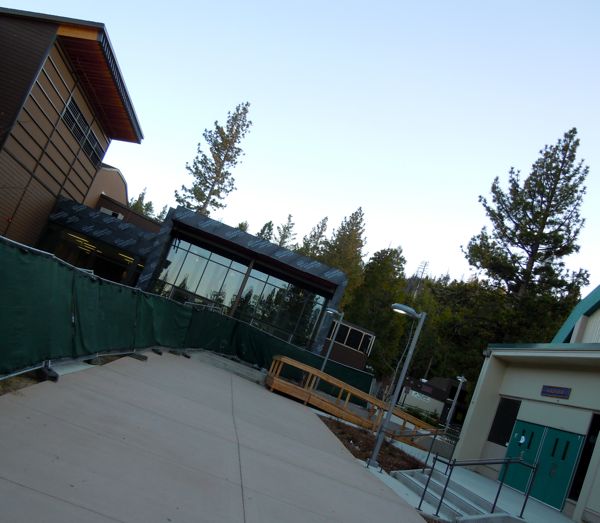
The Theater Arts and Design Academy is changing the look of South Tahoe High School. Photos/Kathryn Reed

The Theater Arts and Design Academy is changing the look of South Tahoe High School. Photos/Kathryn Reed

While the seating at the theater is slightly less than the old theater (350 vs. 265), everything else about it makes it look like a metropolitan performing arts center – albeit scaled down.

Eliminating seating had to happen to accommodate use by disabled people, improving visibility and making the necessary acoustical enhancements.

A spiral staircase is to the audience’s left – which could be incorporated into a production or just be used to access the rafters for lighting needs. What looks like bed springs have give to them to eliminate noise from the production crew walking overhead during a performance.

The 28,000-square-foot building is one of several being built at South Tahoe High School as a result of the voter-approved $64.5 million facilities bond (known as Measure G) and subsequent state matching grant dollars totaling $32 million.

While the whole sum is not being spent on the high school, the bulk is — $44 million.

The Stadium View building opened this school year, while the Construction, Arts and Transportation Academy opened in April 2010. More are still to come.

Steve Morales, facilities director for Lake Tahoe Unified School District, said the final touches on the TADA building would be made this month, with staff being trained in July and students occupying it starting Aug. 29. Seats in the theater will arrive about June 20.

“This is the hardest one-story building I’ve ever built,” Joe Stewart of SMC Contracting told Lake Tahoe News. “I doubt I’ll ever build something like this again.”

It’s all the small details and abundance of technology that made it more intricate than the average classroom. Subtleties like installing oversized doors facing the CAT building so theater sets can be brought in were not left out.

About 17,000-square-feet of the original performing arts building was used, with 11,000-square-feet being new.

“If we don’t do this, we lose this generation,” Angela Swanson said walking from one high-tech room to the next. She was on the school board when Measure G was passed and is now a consultant helping continue to secure grants for LTUSD.

What she was speaking about is all the high-tech components incorporated into this building.

Morales said they like to call it a mini Pixar Studios.

Some of the doors are so heavy one needs to be in good shape to open them. This is all about the acoustics.

There are multiple walls to deal with acoustics, too. One might be a structural fire-rating wall, with a wall on either side to keep noise from the outside out.

“There is acoustic treatment in every room. Some are higher than others,” Morales said in the TV studio. No echo could be heard. It was like a flat, true sound of his voice resonated, or rather didn’t resonate.

Principal Ivone Larson said much of the design concept is the result of years of trips to Hollywood by students and staff to learn about jobs in Hollywood.

“Everything you see today is a replica of actual studios,” Larson said.

The whole idea is students will be ready for a job when they graduate high school. With the No. 1 industry in California being entertainment, STHS is equipped the mold the next crop of creative geniuses.

“We have rooms that reflect the programs. You don’t often have that,” Superintendent Jim Tarwater said as he tagged along on the tour that revealed sound rooms, editing areas, a TV studio, music room, media lab, sound mixing area and more.

LTUSD is reaching to the lower grades to get them on a career path that ties into the high school and might lead them to Lake Tahoe Community College. There are 11 areas where the district wants to link South Tahoe Middle School to South Tahoe High.

Digital arts will be one of the first electives for eighth-graders. Culinary arts is another area.

While the TADA building is nearing completion, work on the Blue and Gold gym next to it has started with the removal of asbestos. SMC should be able to start its work on it Saturday.

ngg_shortcode_0_placeholder (Click on photos to enlarge.)


Controversial grave markers removed in El Dorado County

By Carlos Alcalá, Sacramento Bee

Controversial grave markers at the Mormon Island Relocation Cemetery in El Dorado Hills have been removed in preparation for installation of new markers.

The original markers on graves relocated from the Negro Hill Cemetery in 1954 had to be changed because they substituted the racist N-word for Negro where they indicated the original location.

Read the whole story


Calif. budget talks hit impasse over tax extension

By Anthony York and Shane Goldmacher, Los Angeles Times

SACRAMENTO — Republican lawmakers are prepared to let voters decide whether to close California’s stubborn budget deficit with higher taxes in exchange for major changes in state spending, public pensions and regulatory policies.

But a week before the legal deadline for a spending plan, and with lawmakers’ pay hanging in the balance, a final budget accord between Gov. Jerry Brown and Republicans remains elusive amid disagreement over which should come first — tax hikes or an election.

Both sides said Tuesday that the crucial stumbling block is a demand by Brown that Republicans extend current vehicle and sales tax rates to help balance the budget until voters have their say. Those rates will otherwise expire July 1.

Brown said such a “bridge tax” is necessary after talks on a June ballot measure collapsed earlier this year. Republicans said they were not willing to raise taxes themselves but would be willing to ask voters to do so.

“Right now, this tax question is the sticking point,” Brown said in an interview Tuesday.

He and Republicans have largely settled, however, on a core package of policy overhauls to be enacted if a tax deal can be forged soon. Those include a new restraint on state spending to force California to use any future windfalls to pay down tens of billions of dollars in debt incurred by past budgets.

In addition, public employees would have the option of a retirement package that would include a 401(k), according to legislative staffers who spoke on condition of anonymity because budget negotiations are still in progress.

Read the whole story