DeCelle Memorial Lake Tahoe Relay
DeCelle Memorial Lake Tahoe Relay is June 11 starting at 7am.
The seven-person, 72-mile relay race around Lake Tahoe begins in South Lake Tahoe at the Y.
For more information, go online.
DeCelle Memorial Lake Tahoe Relay is June 11 starting at 7am.
The seven-person, 72-mile relay race around Lake Tahoe begins in South Lake Tahoe at the Y.
For more information, go online.
The inaugural yard sale benefiting the Sierra Nevada Alliance is June 25 from 9am-1pm.
It’s at the Sierra Nevada Alliance office, 2489 Lake Tahoe Blvd., South Lake Tahoe.
Since 1993, the Sierra Nevada Alliance has been protecting and restoring Sierra lands, water, wildlife and rural communities.
All proceeds benefit the Sierra Nevada Alliance.
Tahoe-Baikal Institute’s annual Friendraiser Gala is July 1 at Heavenly Mountain Resort’s Lakeview Lodge.
Tickets are $60.
Parking will be at Heavenly’s California Base Lodge
The tram will begin operation at 5pm. The formal program begins at 6pm.
The Tahoe-Baikal Institute is a nonprofit organization based in South Lake Tahoe that promotes international cultural understanding and global cooperation in meeting environmental challenges, specifically through an exchange program that focuses on Lake Tahoe in California and Lake Baikal in southern Siberia. This event is used to showcase the exchange participants and the successful international partnership between Lake Tahoe and Lake Baikal. All proceeds benefit TBI’s programs.
For more information or to purchase tickets, call (530) 542.5599 or email gala@tahoebaikal.org.
Lake Tahoe Music Festival’s three summer acts are at Northstar-at-Tahoe – Blues Traveler is July 21, Colbie Caillat on Aug. 4, and Michael Bolton Aug. 25.
Doors open at 5pm, with music beginning at 7pm.
More information is online.
 • Looking for a hike? Check out the Tahoe Rim Trail Association’s calendar.
• Squaw Valley and Alpine Meadows will be open for skiing Independence Day weekend. Sugar Bowl will be open just to season pass holders.
• Douglas County Parks Division received a $6,000 grant from the Community Athletic Coordinating Council of South Lake Tahoe to restore turf at the Kahle Community Park soccer fields in Stateline.
• Latcham Vineyards and sister winery Granite Springs in Fair Play have merged their tasting rooms into one at Latcham.
• SiriusXM’s Spice Radio this month launched “Live! At The Mustang Ranch,” a weekly two-hour show broadcast from the brothel.
An agreement was reached by the South Lake Tahoe City Council, but enthusiasm was missing for any of El Dorado County’s five redistricting proposals.
Per federal law, the county must assess its five supervisorial districts and redraw the lines to make each one contain approximately the same number of people.
Some of the proposals would mean the South Shore would have two representatives, but both could live off the hill based on proposed boundaries.
Ultimately the council on June 7 lent its support for Alternative 3 (which has one supe representing the South Shore), and if that doesn’t happen, then Alternative 5 (with two supes).
Supervisors are expected to discuss redistricting later this month.
— Kathryn Reed
By Kathryn Reed
STATELINE – Will Lake Tahoe be part of the 2012 Tour de California and what do the financials from this year look like for the region?
“Don’t know” is the answer to both questions.
South Shore officials have an appointment to speak with AEG officials – owners of the race – at the end of the month about what the future holds for the area. Until all the invoices come in, the money issue is a moving target.
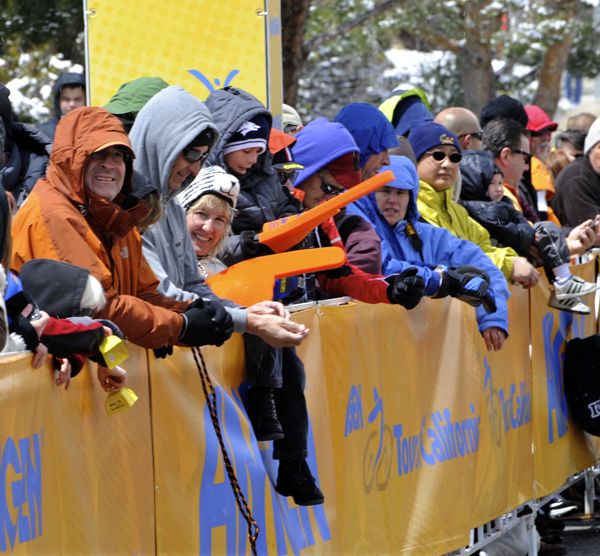
Next time the Tour de California is in Tahoe, everyone hopes lighter weight clothing is required. Photo/Lisa J. Tolda
With Andrew Messick, president of AEG Sports, leaving this month to be CEO of World Triathlon Corporation, it could make the future of the tour interesting. He has been the heart and sole behind the road bike event.
On top of that, Amgen’s three-year contract to be title sponsor expired when the race finished last month. It’s not known if the biotech firm will bid to retain that designation.
Carol Chaplin, Lake Tahoe Visitors Authority executive director, told Lake Tahoe News on June 9 the South Shore wants to be part of the multi-day bike race again, but it doesn’t have to be the initial start location. Instead, being the start or end site for a stage would be more to its liking.
Jerry Bindel, a member of the LTVA board, on Thursday said hosting the end of a stage is his preference.
The board discussed the race that never was at its June 9 meeting. The South Shore was supposed to be the start location May 15, with Northstar-at-Tahoe the site where riders would end stage 1. Stage 2 was to start the next day from Squaw Valley. Instead, Mother Nature (aka snow) forced tour organizers to bypass Tahoe completely and start the race that Monday in Nevada City.
AEG officials are contemplating having the race in 2013 start in Southern California, which weather-wise could make a stop in Tahoe more appealing. Santa Rosa is the 2012 start city. Officials are also talking about having one year be all Southern California and another all Northern California.
Chaplin on Thursday told her board, “We did get a huge amount of pre-event press. We got everything we wanted out of that.”
But it was the international television exposure that would ideally entice people to Lake Tahoe that was to be the big long-term financial benefit of hosting this event. That isn’t likely to happen even though Tahoe received some TV coverage at the get-go.
Chaplin and Andy Chapman, tourism guru for North Lake Tahoe Resort Association, were at the finish in Thousand Oaks – where they were on TV. But it wasn’t the same as having Lake Tahoe as the backdrop for cameras.
Chaplin admitted the immediate economic boost from hosting the event fell flatter than anticipated.
Board member Jon Koster (Harrah’s-Harveys), Bindel (Lakeland Village) and Pat Ronan (Lakeshore Lodge) all said they had plenty of rooms available that weekend.
“We kept hearing 30,000 people, and if they were here, I don’t know where they were staying,” Koster said.
Bindel said while his property didn’t see a boost in room nights from the bike race, overall he sees the event as a benefit for the community.
Chaplin pointed out without hard analysis of knowing why people were in town, it’s possible the room nights could have been even worse had the race not been scheduled on the South Shore.
But the board members were also in agreement the region came together in a way that is seldom seen – that a sense of pride permeated the frigid temperatures that day and for the days leading up to that Sunday.
Sue Barton, LTVA deputy executive director, said with the riders and their entourages being in town several days before the race was to start, it meant they were seeing a better side of Tahoe than on race day.
“I know some rode to Fallen Leaf Lake and some ate at Sprouts. They interacted with the locals,” Barton said.
The board had praise for staff, volunteers and the community.
The weather affected the race in ways that went beyond not having the event in Tahoe. It started with airline delays from points east of Tahoe that meant volunteers being patient while picking up dignitaries.
Volunteers willingly agreed to take a larger size T-shirt knowing they would have to wear it over their clothes to be identifiable. This meant being wet – not having a Gore-Tex outer layer on.
Riders, who had already submitted detailed menus of what they’d eat, had breakfast at 7am. After the initial delay word came in they would need to be fed again at 10am. But MontBleu and Harveys, the host hotels, weren’t prepared to do that – financially or food-wise.
The tour paid for the meals. MontBleu had them go through the buffet and Harvey’s put on another banquet breakfast.
This last-minute ability to juggle is part of the reason the tour has told local organizing officials they want Tahoe to be part of the tour again. Plus, the elevation gains and scenery are perfect for riders and spectators.
By Tony O’Rourke
As the city sets it sights on improving the roads of South Lake Tahoe, it’s a good time to reflect on the overall condition of the streets and how the Road to Tahoe ever got paved in the first place.
• The city’s current roadway network is comprised of over 256 lane miles of roadway.
• Prior to 1960–1965, “rural road standards” existed throughout the community. In 1965 when the city incorporated it inherited the roadway network from the county.
Tony O'Rourke
• The “typical” roadway structure on these rural roadways has been a minimal two inches of asphalt over existing compacted dirt. In most cases, no drainage infrastructure nor curb or gutter was installed. By comparison, today’s standard residential roadways are 4 inches of asphalt over 8 inches of compacted Class II aggregate base material.
• Making the old roadway conditions even worse, the asphalt mixture used to create these roads included an oil-based binding material resulting in strong, but inflexible roads causing large thermal cracking throughout the network.
• In 1995, the city began investing approximately $546,903 per year for roadway rehabilitation and overlay – for a total of $7,109,749 expended, excluding years 2000, 2004 and 2005.
• In 2007, the city created a pavement management system to more accurately evaluate and prioritize road maintenance. Prior to the new system, windshield surveys were used to visually observe the road conditions and repairs were scheduled based on appearance. Using the new system, the city inspected every roadway and assigned a score based on the amount of pavement distress per segment. The higher the score, the better the road condition. The average score on a scale of 1 to 100 is an overall 50 or an F grade.
• The city recently evaluated the cost to covert and improve all roadways from rural conditions to “complete streets,” which includes curb, gutter, sidewalk, landscaping and lighting at cost of approximately $300 million.
• For the first time in the city’s history, the City Council adopted a Strategic Plan and five-year financial plan which places roadway rehabilitation as a high priority and for the first time the city is allocating a substantial amount of funds to roads. The city will be expending approximately $4 million annually or $20 million over the next five years for roadway improvements. This figure is eight times the amount spent on any previous year in the city’s history.
The roads to Tahoe will finally begin to look and wear better than ever.
Tony O’Rourke is city manager of South Lake Tahoe.
Tahoe Symphony Orchestra and Chorus (Toccata) launches its 6th Big Blue Summer Music Fest with a concert series entitled Baroque to Broadway.
Flutist Josue Casillas will be the featured guest along with the Tahoe Symphony Orchestra and Chorus and vocal soloists. Works by C.P.E. Bach, Vivaldi, and Barber will be performed along with Broadway favorites, spirituals and patriotic songs.
Concerts are July 2 at 7pm at St. Patrick’s Episcopal Church in Incline Village; July 3 at 3pm at St. Theresa Catholic Church in South Lake Tahoe; and July 5 at 7pm at St. Thomas Aquinas Cathedral in Reno. The Reno concert is part of the Artown festival.
Tickets are $25 adults, $20 seniors, and $5 students. Preferred seating is $35. Tickets may be purchased in advance by credit card online or at the door by cash or check.
For more information, call (775) 313.9697.
By Kathryn Reed
It’s Day 3 – or at least it’s forecasted to be. Day 3 of sunshine that is. Day 3 of feeling like summer might have arrived in Lake Tahoe before the calendar says it’s supposed to. The National Weather Service expects it will hit 71 in South Lake Tahoe on Monday.
That’s good news for a region that disagrees with economists who say the recession is over. Just look at the near 17 percent unemployment rate in South Lake Tahoe, the vacancy signs on hotels, the empty parking lots and abandoned storefronts.

The Tahoe Queen will race the M.S. Dixie II on Labor Day weekend. Photo/LTN file
Summer is Lake Tahoe’s bread and butter season. It was beginning to seem more like burnt toast after the dusting of snow covered the ground throughout the basin on Monday and May being more gray sky than blue, which turned the Amgen Tour de California into a bust for Lake Tahoe and Memorial Day one not to remember.
But when things start heating up in Sacramento – it’s supposed to be in the 80s today and higher going forward – those Central Valley dwellers start thinking of cooler climates. Tahoe is often that perfect spot to get-away to.
Lake Tahoe Basin tourism officials are hoping word from the Leisure Travel Summit in New York last week will come to fruition. U.S. residents are expected to travel more this summer compared to a year ago, according to experts from Best Western, AAA and the U.S. Travel Association.
At the annual summit, Best Western reported advance reservations for peak summer travel up more than 4 percent at its U.S. hotels.
On the South Shore, hoteliers are also saying summer bookings are better than a year ago. And for an industry that has seen advance booking become a rarity and the last-minute reservation more the norm, this is a welcome change.
Despite gas prices hovering at about $4 a gallon in Tahoe and just less than that elsewhere, AAA predicts 85 to 90 percent of Americans will travel by vehicle this summer.
All of this could bode well for Tahoe, which despite trying to be a destination market for people with fat wallets, is still reliant on the drive-up market.
This is evident with Lake Tahoe Visitors Authority spending the bulk of its advertising dollars on the Sacramento and Bay Area markets.
Carol Chaplin, LTVA executive director, told Lake Tahoe News it is seeing success with the two television ads that are aired during San Francisco Giants games. They are on cable and network channels, but the Giants games are where they are doing the best.
One TV ad is based on a Japanese game show that shows two guys with pantyhose on their heads, which then leads to the same old visuals of the South Shore. The other lead-in is two boxing chins. The tagline on both is “Get your vacation on.”
That’s the same campaign Duncan/Channon of San Francisco came up with for summer 2010.
“The idea of both is to catch your attention. They are weird and stop you,” Chaplin said.
Radio stations in the Sacramento and Bay Area markets have been airing ads since mid-May that the LTVA is paying for. Soon those ads will be replaced with promos touting the American Century Celebrity Golf Tournament, which is July 12-17 in Stateline. Then the regular ads will be broadcast until just past Labor Day.
What is new this Labor Day is a return to having the three-day weekend be more than just a fireworks show that Sunday.
Tourism officials on Thursday made the rounds to the South Lake Tahoe Lodging Association and Lake Tahoe Visitors Authority meetings to tout what is hoped to be a culinary extravaganza on land and water.
A winemaker dinner aboard the Tahoe Queen and M.S. Dixie II paddle-wheelers will start the fun Sept. 2, with a race between the two boats the next day.
For the past several years the boat race has been in June – in what was dubbed Opening Days Lake Tahoe. That event has been scrubbed from events lists. In the early 1990s Labor Day Lake Tahoe featured the race between the two boats and had events throughout that weekend as a way to keep locals entertained and put heads in beds.
Tourism officials are going back to that line of thinking – making that weekend be full of fun.
Also on Sept. 3 will be Viva Valhalla, a celebration of Tahoe’s Latino culture on Ski Run Boulevard from 10am-5pm.
On the Sunday of Labor Day will be the second annual Sample the Sierra. That night is the annual fireworks show.
But the fireworks are expected to be better and cost LTVA less money. The same goes for the Fourth of July event.
While Pyro Spectaculars is still putting on the show, the music choreographer has been fired and Jerry Bindel, LTVA board member, will be helping coordinate that aspect of the pyrotechnic display.
Mike Frye, who handles special events for the tourism agency, negotiated the rate from $10,000 a minute to $6,000 for the fireworks. The July 4 display will have about 23 minute of fireworks or 1 minute longer than last year, while the Labor Day show is a few minutes less – which is always the case.
Lodging association board members said much discussion was had in January with the LTVA about whether the July 4 fireworks should be moved to July 3 so they would be on a Sunday. Mixed and heated emotions rose to the surface about whether that would be unpatriotic, would tourists be confused if the date were changed, and what is the best option for increasing room nights.
Ultimately, it was decided July 4 fireworks should happen on July 4.