Park family — 115 years of history at Lake Tahoe

By Linda Fine Conaboy

Lake Tahoe News resurrected an interview conducted with Brooks Park in 1992 when he was 79. He quietly filled the role of family patriarch and owned Park Cattle Company, now known as Edgewood Companies. Brooks died in 2000. At the request of family members, this interview was not published until now. Members of the family were recently called, with most declining an interview.

Some may be familiar with Edgewood Tahoe Golf Course and others may be aware Edgewood Companies has plans to begin construction a five-star hotel, Edgewood Lodge, near the clubhouse at the golf course.

Now, with what will be a major move by the family and Edgewood Companies, we believe the time is right to present a three-part series on the Park family and the role they play and have played at Lake Tahoe. Our series takes a look at the past, the present and what the future holds in store for not only the family, but also Edgewood Companies.

A little history — as told to Linda Fine Conaboy in 1992 by Brooks Park

In 1992, when Brooks Park was 79, he lived life pretty much as he always had —up at 6am, on the range by 8 and home close to dark. His home in 1992 was across the road (Highway 395, south of Gardnerville) from the house in which he was raised. But he was technically a native Californian.

“All the ladies went to San Francisco and had their babies and then brought them home,” he said, eschewing the thought he was not a native of Nevada.

Brooks Park, right, with his golfing buddies at Edgewood Tahoe. Photo/Edgewood Companies

Brooks Park, right, with his golfing buddies at Edgewood Tahoe. Photo/Edgewood Companies

An offspring of a pioneering Nevada family (David Brooks Park and Unity McCue Park were his grandparents), Brooks attended Douglas County High School, St. Ignatius High School in San Francisco and graduated in 1935 from UNR where he was a member of ATO fraternity. His son was an ATO at UNR, as was his grandson. The tradition continues today.

He married Jeanne Cardinal, a Gardnerville native and a descendant of the Dangberg family, in 1936; together they had three children — Bruce, Kay and Jeanne.

Although he said his grandfather, David, died before he was born, David evidently had the entrepreneurial spirit reflected in his descendents. With the purchase of 571 acres of pastureland at Lake Tahoe in 1896, the Parks became Tahoe property owners.

“My grandfather wanted to graze cattle,” Brooks said simply. Except for a small parcel sold to Harrah’s and a few acres described by Brooks as “a little piece of beach frontage sticking out there” given to the 4-H Club, the land remains intact today.

After David’s death, Brooks’ father, Wallace Brooks Park, continued the ranching and cattle business.

“As for me, I haven’t ventured too far from home,” he said, launching into stories of Tahoe, Friday’s Station and Edgewood.

He said the property in the old days was always called Friday’s Station, but he was unable to recall when and why it was changed to Edgewood. He clearly remembered the early days and his time at Friday’s Station when he was a boy.

Friday's Station -- family members use it on occasion. Photo/Kathryn Reed

Friday's Station -- family members use it on occasion. Photo/Kathryn Reed

“My grandfather and grandmother operated Friday’s as a kind of a way station and they kept a butcher shop for wagon travelers (1918-20). They operated it in the summer and closed it in the winter,” Brooks said.

He said the house, sitting today where it’s always been, in the shade of huge pines on a grassy knoll on the corner of Highway 50 and Lake Parkway at Stateline, across the street from Edgewood Tahoe Golf Course was constructed sometime prior to 1864.

“Just prior to the Pony Express era,” he said.

His first recollection of Friday’s was when he was 6-years-old.

“I remember a large house with a big kitchen, milk rooms and a great big iron stove. There was a wood shed and on the side of the house were water troughs. There were lots of vines and big cottonwoods; everything was big,” he said.

An ice house was located where Harvey’s Casino garage is now and most of the land now home to the Stateline casinos was pastureland.

“My grandfather didn’t see what it could become. He ran a butcher shop and peddled the meat out of a wagon, but primarily, the land he bought in 1896 was for pasture,” Brooks said.

Even though his mother loved Tahoe, his dad hated it. “I can recall dad complaining that he had to work on the ranch all year long to pay the taxes at Friday’s.”

Although it looks like a grand plantation home, according to Brooks, it’s a log house with log rafters. He said the family refurbished the home in the early 1980s and he predicted it would last for years.

The original blacksmith shop is still on the Stateline property. Photo/Kathryn Reed

The original blacksmith shop is still on the Stateline property. Photo/Kathryn Reed

As history tells us, Friday’s Station, which is comprised of the main house as well as outbuildings including the old blacksmith shop, on nearly 23 acres, played an important part in the short-lived Pony Express, a mail service crossing the Great Plains, the Rocky Mountains and the High Sierra from St. Joseph, Mo., to Sacramento from April 1860 to October 1861.

Maybe Friday’s role in Nevada history was significant and duly noted, but history was lost on young Brooks.

“When I was 12- to 14-years-old, I stayed up there and irrigated for my dad — we had cattle up there. I didn’t like it. There were no paved roads and no kids to play with. Life was hell. Lake Tahoe was so cold,” he recalled.

“The cattle grazed where the golf course is; about 200 head. We raised our own feed in Carson Valley. We herded the cows over Kingsbury Grade.”

In 1925, there was a box, Brooks remembered, where people and animals had to wade through to disinfect their feet for fear of hoof and mouth disease.

Nevada officials try to ban beavers from Truckee River

By Susan Voyles, Reno Gazette-Journal

Every week day since December, a Washoe County sheriff’s community service crew has worked the banks of the Truckee River, wrapping trees with chicken wire to protect them from beavers, cleaning up homeless camps and picking up other debris.

Since December, they’ve wrapped 423 trees and removed 95 homeless camps, 1,058 large bags of garbage and 63 hazards such as rebar and pipe that present a danger to people, said Don Lawson, work supervisor.

But once a Truckee River Fund grant for $90,000 runs out in late July, the crew of six to eight members will be disbanded for a lack of a supervisor.

“We have been on beavers since December,” Lawson said. “We got started when the river was coming up. There’s still a lot of work to do. There’s a lot of trees to be wrapped. We are hitting the worst spots.”

The Truckee River Fund is supported by customers of the Truckee Meadows Water Authority, the area’s biggest water company.

Mike Carrigan, TMWA board chairman, said he would encourage the sheriff’s office to apply for another grant through the board’s grant advisory committee. “I think it’s money well spent,” he said, after hearing the statistics.

Read the whole story


Biodegradable products may not be so green

By Wynne Parry, LiveScience

Once thrown out, biodegradable products — everything from trash bags and diaper liners to pens — are designed to break down relatively quickly and disappear into the natural environment. But these products may not live up to their green image, new research indicates.

“The implication is, it’s biodegradable, therefore, it’s better for the environment — and our point is: Well, not necessarily and not so fast,” said study researcher Morton Barlaz, who heads North Carolina State University’s Department of Civil, Construction, and Environmental Engineering.

These biodegradable products release a potent greenhouse gas, methane, as they break down in landfills, a problem aggravated by the relatively rapid rate at which they decompose.

Barlaz and colleagues looked at what happened when food waste, office paper, newsprint, municipal solid waste overall, and a biodegradable polymer called PHBO were buried in the average American landfill. Their modeling experiment showed that materials with higher rates of decomposition, like food waste and PHBO, ultimately emitted more methane into the atmosphere.

Read the whole story


Train conductor killed in crash from South Lake Tahoe

By Doug Jastrow, Contra Costa Times

CONCORD — One of Mindy Mohammed’s favorite memories was when her grandmother allowed her to be a real conductor on a train.

She was only 10 years old at the time, but her grandmother Laurette Lee let her pull the train whistle, see the engine room and learn about the engineer’s complex set of controls.

And once the train began to leave the station, Lee and her granddaughter got to work collecting tickets.

Read more


Snippets about Lake Tahoe

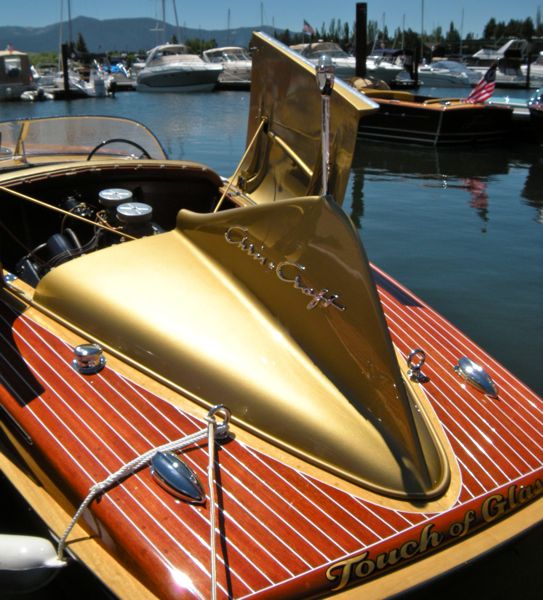
boat• South Tahoe Wooden Boat Classic (July 29-30) at Tahoe Keys Marina in South Lake Tahoe has discount tickets at any Raley’s, Nob Hill, or Bel Air market in California and Nevada. Tickets at the stores are $15 – a $5 savings. Kids 12 and under are free.

• El Dorado County’s 2010-11 Grand Jury report does not have anything scathing to say about South Lake Tahoe this year.

• Straw Hat pizza has opened in Harveys casino at Stateline.

• John Poell has been promoted to battalion chief and fire marshal at Lake Valley Fire Protection District.

• Census: The ratio of married-to-unmarried couples is 9-to-1 in El Dorado and Placer counties.


Forgotten Feast at Cedar House in Truckee

Cedar House’s summer calendar kicks off with a celebration of wild plants and mushrooms, game and seafood. Indulge in The Forgotten Feast with Hank Shaw author of “Hunt, Gather, Cook: Finding the Forgotten Feast” on July 16. Shaw spends his days thinking and writing about ways to cook and enjoy anything that walks, flies, swims or crawls.

The Forgotten Feast begins with cocktails and a book signing by Shaw at 5:30pm and is followed by a five-course tasting menu inspired by Shaw’s book.

Cost is $75 plus tax and service includes cocktails and wine.

For more information about this event in Truckee, call (530) 582.5655.


Help for students needing to obtain GED

Do you need your GED or do you know someone who does?

Susie Meier, a former GED instructor and examiner, will assess your skill level through a series of pretests – for free.

Then she will assign a course of study to ensure success in all five academic areas: science, social studies, reading, writing and math.

For information and to schedule a session, call (530) 721.1506 or email jumpstartmylife@sbcglobal.net.


Next generation learns importance of trail building

To the community,

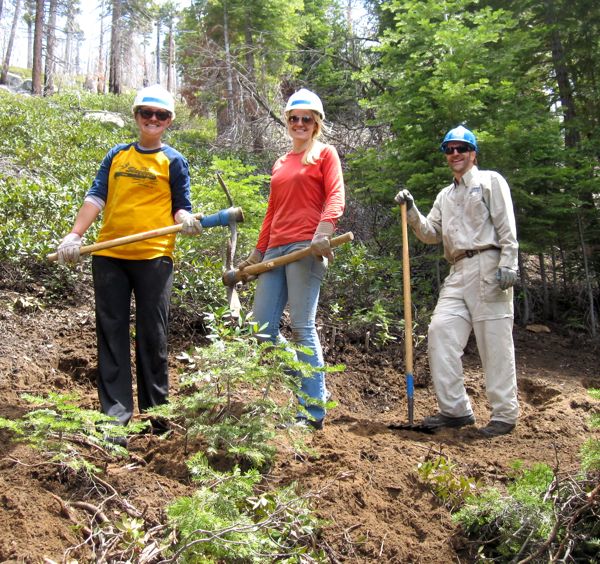
The Tahoe Rim Trail received a little “tender care” from the newly formed Tahoe Regional Young Professionals on June 11 and June 14. TRYP members, along with many other outdoor enthusiasts, hiked Daggett Summit to move dirt, boulders, crush granite and clear roots, all while taking in the majestic scenery.

TRYP would like to give a special thank you to the Tahoe Rim Trail Association crew leaders who dedicate their time to teach volunteers and to this tireless project which aims to move miles of trail from pavement to forest, improving the trail experience and eliminating conflicts with vehicles. When complete, the project will add 13 miles of new trail to the TRT system.

TRYP members Ashley Hogue and Lyndsay Bryant clearing the trail at Daggett Summit. Photo/Provided

TRYP members Ashley Hogue and Lyndsay Bryant clearing the trail at Daggett Summit. Photo/Provided

After the trail build, members and crew leaders joined TRYP at Mott Canyon for a relaxing evening of food and drinks.

TRYP is a newly formed organization in South Lake Tahoe and aims to connect Tahoe’s next generation to help the Lake Tahoe region. TRYP encourages members to partake in fundraisers, socials, networking opportunities and most of all … build a better community. The young professional’s next community event is slated for August.

For upcoming events, visit Facebook and search “Tahoe Regional Young Professionals” or email tahoetryp@gmail.com.

Becca Wass, TRYP advocate


Manual typewriters survive with collectors

By Sam McManis, Sacramento Bee

My, what is that clacking cacophony piercing the pleasant murmur and hum and halogen glow of the workplace?

Staccato bursts, startling as gunfire, ring out through the cubicle partitions. Now here comes a single bell chime, followed by a dissonant rrrpppttt noise, like an angry boss clearing his throat. Someone, anyone, please, make it stop.

In an office dotted with Hewlett-Packard flat screens, a lone typewriter holdover at the state’s Employment Development Department hunts and pecks with impunity on a hulking, cast-iron Underwood No. 5 model, built in 1903.

“I know, I know,” said Linda Shakespeare, hands hovering over the keys, “it’s so loud. Imagine a whole room of these being used. Loud, but I love the sound.”

Wait, you mean to say that, once upon a time in a technologically tamer world, this aural assault was routinely heard in all workplaces? Yeah, right. Maybe a construction site. How clunky and unidimensional, how very Flintstonian in this age of iPads and smartphones.

“Actually, I’d love to see more people go back to using a typewriter – maybe not all the time, just to have the experience,” she said. “This machine here launched our information technology.”

Read the whole story


Eagle Falls spew forth like they belong in Yosemite

By Kathryn Reed

DESOLATION WILDERNESS – Water. It’s going to be the common denominator for all hikes in and around the Lake Tahoe area for a while.

And that’s a good thing when waterfalls are involved.

Rumbling water is a constant sound on the trek from the Eagle Falls parking lot to Eagle Lake. Sometimes it’s roaring, sometimes a bit more faint – but always there.

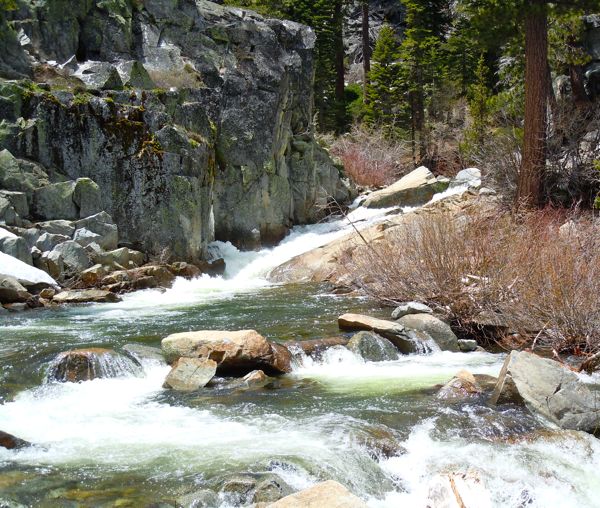
Eagle Creek is running fast. Photos/Kathryn Reed

Eagle Creek is running fast. Photos/Kathryn Reed

With June 11 being National Get Outdoors Day, the $5 parking fee has been waived by the U.S. Forest Service.

This area was revamped in 2005 with a walkway from Highway 89 to the trailhead which means no longer having to contend with vehicles to get to the path. Restrooms were put in at the same time.

We start our Saturday by checking out the lower falls from the other side of the highway. What a perfect lunch spot for one trio as they sit near the flowing water, gazing out at Emerald Bay.

Our destination is upper falls and then Eagle Lake. The Forest Service website says it’s a 20-minute walk to the lake. With all the Kodak moments along the way, we took at least twice that long. For those wanting a longer hike, a sign clearely states when to turn left to reach the three Velmas, Dicks, and Fontanillis lakes.

Starting off we take the loop to the right – which is longer than going directly to the upper falls. We don’t care. Today is about enjoying the scenery and practically pinching ourselves that we live here.

It’s just one of those magical places that even the most jaded person would have to pause to appreciate Mother Nature’s handiwork.

Interpretive signs are on this section. I learn something new – Emerald Bay is 3 miles long and 1 mile wide.

Water is on the trail, making it a good idea to wear hiking boots.

Spanning Upper Eagle Falls is a bridge. Water rushes beneath me. It’s hard to hear my own thoughts because of the thundering falls. Doing a 360, I marvel at the granite above me, the amount of water running on either side, the rocks being pounded by this snowmelt.

To do the loop, the bridge is where you’d turn around. But we aren’t done.

Across the bridge we hit snow. Mostly it’s dirt the rest of the way – but that white stuff is unavoidable at times.

So much snow this winter is causing waterfalls to spill from the sides of the mountain as though pores have opened. A sheet of granite looks like a streak of tears.

Granite is more dominate in this section of Desolation Wilderness than conifers. Spires of jagged rock line one wall of what feels like a canyon at times.

We stop for lunch before reaching the lake. Slabs of smooth granite beckon us to recline – until an aggressive critter smells our food. He reminds me of the “friendly” critters atop Mount Tallac.

Emerald Bay and Lake Tahoe are in the distance. If only there weren’t a controlled burn at Zephyr Cove that day, the view would have been perfect. A touring helicopter flies by. Is it the required 2,000 feet above Desolation? Hard to tell. What point does the FAA start measuring?

Onward we go to the lake. It looks so beautiful, but so uninviting. I won’t even dip my toe in her frigid waters. On a hot summer day people swim and paddle out to the little island. No one is doing that this day. This day we’re still trying to have traction on slick snow.

Getting there:

From South Lake Tahoe, go north on Highway 89. The Eagle Falls parking area is on the left at the end of Emerald Bay before reaching the parking area for Vikingsholm. It costs $5 to park. If going to Eagle Lake, be sure to fill out the permit for Desolation Wilderness.

ngg_shortcode_0_placeholder (Click on photos to enlarge.)