Parks turn Tahoe cattle land into casino, golf course

Publisher’s note: This is the second of three stories about the Park family and Edgewood Companies’ evolution at Lake Tahoe.

By Linda Fine Conaboy

The Park family began to rent what Brooks Park called “parking lot land” to the likes of Harvey Gross and Bill Harrah in the 1950s. His parents still lived at Friday’s Station then, where his dad handled these transactions.

He recalls Gross as a down-to-earth man with a good sense of humor and Harrah as a man of his word. “I admired him for his ability and for his integrity.”

The 1960s

“When we built the golf course in 1965, we stopped herding, but we didn’t stop completely. Up until a couple of years ago (prior to 1992), we still took cows there for sentimental reasons,” Brooks said.

Brooks was proud of the golf course, but interestingly enough, it may not have been built without gentle prodding from a man who knew about such things.

“Del Webb was a friend and he said what we need is a golf course. We built it in 1966 and it opened in 1968. We spend lots of money on that golf course; we like it,” Brooks said.

As an aside, Brooks said he and Webb decided if they ever wanted to build something else, the golf course could always be torn up. He added, “Now we wouldn’t change it; we wouldn’t want to change it.”
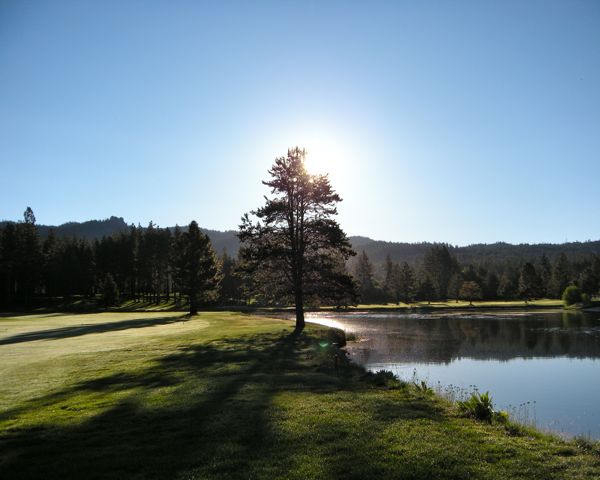
Edgewood Tahoe Golf Course hosts the popular celebrity tournament. Photo/LTN file

Edgewood Tahoe Golf Course has created an international following. Photo/LTN file

In 1965, Brooks said no permits were required, but “the area was brushy and unclean. We thought the least we could do was clean it up!”

In the late 1960s when the George Fazio-designed golf course opened it was among the top 100 courses in the world, according to Golf Digest. Today, it still ranks as one of America’s top courses.

Moving forward

In the 1970s, the Brooks Park family was again on the move, this time with the opening of the trouble-fraught Park Tahoe Hotel Casino, now MontBleu Resort Casino & Spa.

“We thought the higher and better use of the land would be a casino and restaurant. It took a long time to be built because of the injunctions by the League to Save Lake Tahoe,” Brooks said.

That delay turned out to be three or four years, Brooks said.

“The steel was sitting there, it was very costly. If we didn’t have the perseverance, it wouldn’t be there now,” he added.

A check of the records shows the Park Tahoe was dogged by complaints and charges and didn’t open its doors until 1978. Flash forward to 1992, when it appears that it was becoming even more difficult to jump through the various hoops required to get a construction project off the ground.

Park Tahoe Hotel was run by the family. Now Tropicana runs what is called MontBleu.

Park Tahoe Hotel was run by the family. Now Tropicana runs what is called MontBleu.

“We’ve applied for permits to build a new development on the lake shore,” Brooks said. “We’re still interested in improving and developing the property south of Edgewood. We’re not interested in destroying property. It’s hard to get approval. I like to get things done, but you have to have a lot of patience up here today (1992).

“I don’t know how many different people I have to ask to get something done. In the ’50s and ’60s, Gross and Harrah said yes or no.”

When I asked Brooks in 1992 what he does now, his answer was as simple as his home in Gardnerville. “I take care of business,” he said, referring to Park Cattle Company holdings, now Edgewood Companies.

Back then he handled Edgewood Water Company, which did and still does supply water to the casinos at Stateline and Edgewood Golf Course.

He also managed the acreage upon which the Stateline casinos sit, land still owned by Edgewood Companies. Besides that there were cows to be tended at Topaz in California and in the Carson Valley, although it’s a safe bet Brooks had some hired help to assist him with these chores.

Today, much of the land Brooks purchased at Topaz Lake is in the hands of his son, Bruce, and grandson, David. Land holdings have grown and total at least 10,000 acres, according to David and Bruce.

Edgewood Companies owns the land MontBleu and Horizon casinos sit on as well as the structures, but they don’t operate them. The company owns the land Harvey’s parking garage is on as well as Edgewood Water Company.

Additionally, land holdings include 500 acres in the Tahoe basin (Nevada and California) and more than 4,000 acres in the Carson Valley.

Brooks’ grandson, David, said the business model has definitely changed. Now, the family is no longer involved in day-to-day operations, but three family members including David, sit on the board of Edgewood Companies.

In a recent telephone interview, David said times are changing and the economy is suffering.

“Hopefully, the TRPA and other environmental groups will loosen up a bit and give us a break. Look at the downtown core; it’s pathetic,” he said. “Not just for us, but for everybody. We all have to turn over a new leaf. I don’t speak for the company; I speak for myself.

“My grandfather was a mastermind to put all that together at Lake Tahoe. If he were still here, it would probably still be a family-run business,” David Park said.



Body found at Marlette Lake identified

A body that was found on June 20 near Marlette Lake has been identified as being a missing Incline Village woman.

Kelly McGinnis, 43, was last seen leaving her home in the 900 block of Galaxy Way on June 18, Sheriff’s spokesman Armando Avina said in a release. Her vehicle had been found in a parking lot just west of the Thunderbird Lodge on Nevada 28.

Sheriff’s detectives are continuing their investigation, and no foul play is suspected, Avina said.

– Reno Gazette-Journal staff report

  • Share/Bookmark


LTCC training students to be able to work out of college

By Kathryn Reed

Education isn’t just about memorization. It’s not just about getting a certificate or degree. And it’s more than learning.

Lake Tahoe Community College is continually beefing up its career and technical education program to stay relevant with what students and employers want.

The idea behind CTE is when students leave the two-year institution in South Lake Tahoe they will have a skill that will land them a paycheck.

Virginia Boyar, who is in charge of LTCC’s CTE program, updated the board of trustees this month about what is going on.

The college for the 2011-12 academic year expects to receive $66,000 in a grant through Senate Bill 70. The four areas of emphasis for this money are culinary arts, digital media arts, dental assisting, and physical therapy aide.

Some of those programs will tie into the local workforce, as well as to South Tahoe High School. The piece that is missing is better coordination in the dental program between STHS and LTCC.

When STHS builds the sports medicine building and gets that curriculum going, it will be a pathway to the college’s PT program. This fall LTCC be offering a couple courses that will lead to the PT certificate.

The biggest success for career tech ed is the local fire academy, which in its sixth year saw 28 cadets graduate Saturday.

A change coming July 1 is having the work experience/internship program be part of the CTE program.


Washoe County sheriff’s increase help for domestic violence victims

The Washoe County Sheriff’s Office has increased its ability to support victims of domestic violence, sexual assault and stalking with the addition of a grant-funded victim advocate from the Crisis Call Center working directly out of the sheriff’s detective division.

Sally Walker’s position is funded for two years by a federal STOP Violence Grant administered through the Nevada Attorney’s General Office.

Walker is asking the community for donations to help with the operation of the victim’s room and to help sustain victims during the turbulent transition period that follows crimes of this nature.

Items that are needed include diapers, formula, pajamas, jackets and more. If interested in donating, call (775) 325.6454.


Free outdoor concerts at Squaw Valley

The Village at Squaw Valley’s inaugural KT Concert Series begins in July.

The KT Concert Series features Stung, a tribute to The Police; Hollywood Stones, a tribute to The Rolling Stones; and Zoo Station, a tribute to U2.

The KT Sundeck is nestled at the mountain’s base just feet from the chairlifts.

The schedule:

July 1: Stung – A Tribute to The Police, 6-8:30pm

Aug. 5: Hollywood Stones – A Tribute to The Rolling Stones, 6-8:30pm

Sept. 2: Zoo Station – A Tribute to U2, 6-8:30pm.

The outdoor concerts are free.


K’s Kitchen: Perfect dip to share with friends

By Kathryn Reed

With Fourth of July just a week away, it’s time to figure out what to bring to the barbecue or have at your backyard gathering.

k's kitchenThe recipe below is one I made for a group at Memorial Day when I was asked to bring an appetizer. It was well received because the flavor is so robust – and not one you get in grocery store dip concoctions.

I like hummus, but I’m not a huge fan. This recipe is bound to win over the non-hummus likers. It’s not quite as thick as hummus and definitely is more flavorful. But it does have a certain hummus like quality.

I made it two days before it was served – this allowed the flavors to meld even more.

The picture in the November 2007 issue of Cooking Light magazine shows the spread on a bagel chip with fresh rosemary garnish. Yes, it’s pretty.

I didn’t do pretty. I did practical. I served the dip in a bowl with hard crackers (though bagel chips would be perfect) and Wheat Thin Stix. I had never seen the Stix until shopping that particular day. I took a chance they’d be good and appropriate – they were.

Roasted Garlic, Sun-Dried Tomato, and White Bean Dip

Prepare a day ahead; bring to room temperature before serving. Serve on bagel chips garnished with rosemary sprigs.

1 whole garlic head

1 C water

1 (3.5 ounce) package sun-dried tomatoes, packed without oil

2 T extra virgin olive oil

½ tsp chopped fresh rosemary

¼ tsp kosher salt

¼ tsp freshly ground black pepper

1 (15.8 ounce) can Great Northern beans, rinsed and drained

Preheat oven to 375 degrees.

Remove white papery skin from garlic head (do not peel or separate the cloves). Wrap head in foil. Bake at 375 degrees for 45 minutes; cool for 10 minutes. Separate cloves; squeeze to extract garlic pulp. Discard skins.

Bring 1 cup water to a boil in a saucepan. Add tomatoes; cover and remove from heat. Let stand 10 minutes. Drain tomatoes in a colander over a bowl, reserving ¼ cup liquid.

Place garlic pulp, tomatoes, ¼ cup reserved liquid, oil, and remaining ingredients in a food processor; process until smooth.

Makes 2 cups.


Snippets about Lake Tahoe

sup• Stand-up paddle boarders – kids to those with gray hair – are participating in races each Wednesday starting about 6pm at Regan Beach in South Lake Tahoe.

• North Tahoe Public Utility District has hired William Stelter as manager of Planning and Engineering. For the last 10 years he has been a design and project engineer for Gary Davis Group in Tahoe City.

• Douglas County wants feedback on its website. This is the link to the survey.

• El Dorado County has tips for beating the heat.

• A new attraction at the July 29-30 South Tahoe Wooden Boat Classic at Tahoe Keys Marina in South Lake Tahoe will be a kit boat built by Tahoe City Boy Scout Troop No. 266 which will be on display in the entertainment expo area.


The reality of global climate change

By Sharon Begley, Newsweek

Joplin, Mo., was prepared. The tornado warning system gave residents 24 minutes’ notice that a twister was bearing down on them. Doctors and nurses at St. John’s Regional Medical Center, who had practiced tornado drills for years, moved fast, getting patients away from windows, closing blinds, and activating emergency generators. And yet more than 130 people died in Joplin, including four people at St. John’s, where the tornado sucked up the roof and left the building in ruins, like much of the shattered city.

Even those who deny the existence of global climate change are having trouble dismissing the evidence of the last year. In the U.S. alone, nearly 1,000 tornadoes have ripped across the heartland, killing more than 500 people and inflicting $9 billion in damage. The Midwest suffered the wettest April in 116 years, forcing the Mississippi to flood

Snow in Lake Tahoe keeps coming in June. Photo/LTN February 2011

Snow in Lake Tahoe keeps coming in June. Photo/LTN February 2011

thousands of square miles, even as drought-plagued Texas suffered the driest month in a century. Worldwide, the litany of weather’s extremes has reached biblical proportions. The 2010 heat wave in Russia killed an estimated 15,000 people. Floods in Australia and Pakistan killed 2,000 and left large swaths of each country under water. A months-long drought in China has devastated millions of acres of farmland. And the temperature keeps rising: 2010 was the hottest year on earth since weather records began.

From these and other extreme-weather events, one lesson is sinking in with terrifying certainty. The stable climate of the last 12,000 years is gone. Which means you haven’t seen anything yet. And we are not prepared.

Picture California a few decades from now, a place so hot and arid the state’s trademark orange and lemon trees have been replaced with olive trees that can handle the new climate. Alternating floods and droughts have made it impossible for the reservoirs to capture enough drinking water. The picturesque Highway 1, sections of which are already periodically being washed out by storm surges and mudslides, will have to be rerouted inland, possibly through a mountain. These aren’t scenes from another deadly-weather thriller like The Day After Tomorrow. They’re all changes that California officials believe they need to brace for within the next decade or two. And they aren’t alone. Across the U.S., it’s just beginning to dawn on civic leaders that they’ll need to help their communities brave coming dangers brought by climate change, from disappearing islands in Chesapeake Bay to dust bowls in the Plains and horrific hurricanes in the Gulf of Mexico. Yet only 14 states are even planning, let alone implementing, climate-change adaptation plans, says Terri Cruce, a climate consultant in California. The other 36 apparently are hoping for a miracle.

The game of catch-up will have to happen quickly because so much time was lost to inaction. “The Bush administration was a disaster, but the Obama administration has accomplished next to nothing either, in part because a significant part of the Democratic Party is inclined to balk on this issue as well,” says economist Jeffrey Sachs, head of the Earth Institute at Columbia University. “We [are] past the tipping point.” The idea of adapting to climate change was once a taboo subject. Scientists and activists feared that focusing on coping would diminish efforts to reduce carbon emissions. On the opposite side of the divide, climate-change deniers argued that since global warming is a “hoax,” there was no need to figure out how to adapt. “Climate-change adaptation was a nonstarter,” says Vicki Arroyo, executive director of the Georgetown Climate Center. “If you wanted to talk about that, you would have had to talk about climate change itself, which the Bush administration didn’t want to do.” In fact, President Bush killed what author Mark Hertsgaard in his 2011 book, Hot, calls “a key adaptation tool,” the National Climate Assessment, an analysis of the vulnerabilities in regions of the U.S. and ideas for coping with them. The legacy of that: state efforts are spotty and local action is practically nonexistent. “There are no true adaptation experts in the federal government, let alone states or cities,” says Arroyo. “They’ve just been commandeered from other departments.”

Read the whole story


Opinion: Commerce Department nominee deserves the job

Publisher’s note: This editorial is from the June 21, 2011, Los Angeles Times.

John Bryson’s nomination to be President Obama’s next secretary of Commerce has been met with the predictable combination of delusion and obstructionism that characterizes the modern confirmation process. Some Senate Republicans vow to hold him hostage to the passage of several long-sought free-trade agreements; others insist they will reject him based on his presumed politics, which they wish were more like theirs. None has advanced an argument worthy of defeating this nomination, and though sensible people will withhold a final judgment until after Bryson is questioned, his credentials are encouraging, as are the endorsements of those who know him.

Bryson is a familiar figure in Los Angeles. A longtime chairman and chief executive of Southern California Edison and Edison International, he is a pillar of the region’s business community, admired by the Chamber of Commerce and his fellow executives. He also was a founder of the Natural Resources Defense Council, where his work earned him respect and appreciation from California’s environmental movement. He’s been president of the California Public Utilities Commission and even served as a director of Boeing, dipping his toe into the nation’s military-industrial complex. He is thus the rare nominee to present himself to Congress with endorsements from the Chamber, military suppliers and the nation’s leading environmental organizations.

Read the whole story


Book details adventurers explorations of Yosemite

By Lauren Gustus, Reno Gazette-Journal

In his recently released paperback, Matt Johanson compiles 23 little-known stories from one of America’s best-known parks in “Yosemite Epics: Tales of Adventure from American’s Greatest Playground.”

Pictures of the Sierra Nevada’s most challenging climbs and hikes dot the first-person accounts from Yosemite, each of which is introduced by the Castro Valley high school teacher.

Steve Schneider gives a harrowing account of a paraglide in Lee Vining Canyon gone wrong.

Jim Zellers shares the tale of his snowboard descent down the north face of Half Dome. Zeller worked for years on the science of descent and to find the right snow and wind conditions — finally making his five-minute run in 2000.

There are plenty of stories about the climbers who made Yosemite their playground, including Lynn Hill’s free climb of the west face of Leaning Tower and Errett Allen’s New Dawn line on El Capitan in November that included falling ice, hail and a cold waterfall.

Read the whole story