Book signing at Ski Run Marina

Local author Kim Gayner will be signing and discussing her book “Reality 101: A Must Have Guide to Life & Life Skills Survival Manual” at Ski Run Marina in South Lake Tahoe on July 27 at 6pm.

This is part of the Midweek at the Marina events each Wednesday.

The event is free.


S. Tahoe girl rescued from pool still hospitalized

Updated July 21 at 8:10am:

Amy Castillo remained in Renown Medical Center in Reno on Thursday morning. Reports are she did not sustain a spinal injury and there is no blood on the brain.

—————————-

A 12-year-old South Lake Tahoe girl who lifeguards rescued from the bottom of the city pool Wednesday afternoon was flown from Barton Memorial Hospital to Renown Medical Center in Reno.

pool

“Rec center staff told us afterward that she was using the diving board and hit her head when coming down, and then sank straight to the bottom of the pool,” according to a pool user who didn’t want to give her name. “She was down there for approximately 20 seconds, then the lifeguards dove in and got to her.”

Police Chief Brian Uhler told Lake Tahoe News Amy Castillo was unconscious at the bottom of the pool and aspirated water before being rescued.

A city official said the girl was conscious when taken to Barton. She was moved to Reno for “a higher level of care,” according to officials.

The pool was closed for two hours after the 2:30pm incident.

— Kathryn Reed


Snippets about Lake Tahoe

obexer's• Obexer’s Boat Company in Homewood is celebrating its 100th year at Lake Tahoe as a family-owned full service marina.

• Nevada Department of Wildlife is stocking Lake Tahoe with 22,000 Lahontan cutthroat trout this month.

• Washoe County Sheriff’s Office is donating $20,000 from state forfeiture funds to support efforts by the nonprofit Join Together Northern Nevada to increase parent awareness and education about local drug use trends, the signs and symptoms of drug abuse, and effective intervention skills.

• Arcadia Publishing just released two volumes of regional interest — “Donner Summit” and a companion postcard book written by Arthur Sommers.

• You already know about LakeTahoeNews.net, but do your friends and business associates? Consider sharing this press release with them so they can familiarize themselves with Lake Tahoe News.


Whitebark pine tree faces threat of extinction

By Juliet Eilperin, Washington Post

The Fish and Wildlife Service determined Monday that whitebark pine, a tree found atop mountains across the American West, faces an “imminent” risk of extinction because of factors including climate change.

The decision is significant because it marks the first time the federal government has identified climate change as one of the driving factors for why a broad-ranging tree species could disappear. The Canadian government has already declared whitebark pine to be endangered throughout its entire range; a recent study found that 80 percent of whitebark pine forests in the Greater Yellowstone ecosystem are dead or dying.

The Natural Resources Defense Council asked the Fish and Wildlife Service to place the tree on the endangered species list. In its determination, the agency said that it found a listing was “warranted but precluded,” meaning the pine deserved federal protection but the government could not afford it.

The whitebark pine will remain a candidate under the Endangered Species Act and will come under review annually.

An invasive disease, white pine blister rust, along with insects such as mountain pine beetle, has infiltrated the historically colder altitudes where whitebark pines thrive. Fish and Wildlife Service biologist Amy Nicholas said these factors, along with fire patterns and global warming more broadly, are undermining the tree’s viability.

Read the whole story


Hotels using technology to better serve guests’ needs

By Roger Yu, Reno Gazette-Journal

For a night of clubbing in Manhattan on a recent weekend, Seunghee Thomson turned to the iPad in her room at the Mondrian SoHo to ask the hotel’s concierge for a recommendation.

The concierge desk, which received her iPad message, soon called with a name and directions.

“While I was waiting, I was thinking maybe I should call back to see if they got my message, but they called me back right away,” said the fashion stylist from McLean, Va. “It’s the first time I’ve had that experience in a hotel.”

Mondrian is one of several hotels — and airlines, too — that are distributing iPads and similar devices to customers in an effort to tap the buzz surrounding tablet computers.

The effort is the latest by the travel industry to digitize a range of services that once required picking up the phone.

Using third-party software developers, hotels are introducing apps to order food, browse hotel amenities and local attractions, request wake-up calls, schedule housekeeping, message other guests and arrange car service. The apps are available for iPhone, iPad, BlackBerry and phones and tablets using Android and other operating systems.

“It’s a self-service vehicle,” said David Adelson of Intelity, which developed Mondrian’s app and has about 380 hotels using the software. “Most travelers are used to self-service solutions in their daily lives and would rather prefer it.”

Read the whole story


Opinion: Stop Congress from taking Tahoe bike money

To the community,

Tahoe and the nation need your help right now. As I mentioned months ago, members in Congress are seeking to eliminate bike/ped and recreation trail funding from the transportation bill.

bikeFinally, major Tahoe stakeholders have finally got it right about the need to build a bicycle-friendly region with a connected network of bikeways bringing us together more often — without the need for motor vehicles. But is it too late?

Help Tahoe and America stay the course with building a low cost, high-valued, and sustainable transportation system not reliant on motor vehicles. Motor vehicle infrastructure is not sustainable because we can’t afford to increasingly build more as energy costs continue to escalate from unstable governments.

Contact your local and state representatives and tell the Senate to vote for our sustainable future through human powered transportation initiatives — trails.

Keepin it real and rollin,

Ty Polastri, president Lake Tahoe Bicycle Coalition


A year after the lightning tragedy in the Tetons

By Brad Wieners, Sports Illustrated

Those wishing to climb to the top of the Grand Teton set out well before daybreak. It’s safer to travel over any ice and snow then, when it’s still likely to be frozen, and the early departure leaves time to hike all the way back down to the trailhead before dusk. One of the beauties of the Grand, the 13,770-foot signature peak of the sublime Wyoming mountain range and national park, is that it lies less than a full day’s hike from the road. It’s a world-class mountaineering experience that’s also a weekender. There is another advantage to the predawn start: In the dark it is harder to discern the thousand-foot voids beyond the mountain’s edge.

The appeal of the Tetons is obvious, even if you get no closer than a turnout on U.S. 89, 12 miles away. With no foothills, the 40-mile range rises from the earth’s crust in one precipitous sweep, like an ax through a door. Upon seeing the mountains, Teddy Roosevelt is said to have remarked that they were ideal—the way a child draws them—and it’s easy to see his point. The pinnacles are etched like a fever chart into the Western sky.

On Wednesday, July 21, 2010, the handful of parties hoping to summit the Grand Teton all awoke early. They were camped above timberline, some in a seasonal hut, others in tents; a few climbers, taking advantage of the clear night, had unrolled their sleeping bags between boulders and slept out under the stars. The day before, the forecast had been typical for the Tetons in summer: partly cloudy with a chance of thunderstorms by afternoon. But overnight the likelihood of a storm had increased, so the commercial guides hustled their clients out of their sleeping bags at 3:30 a.m. At close to 4:30, three self-guided groups began pulling on their harnesses, helmets and headlamps, and a half-hour later they were making their way with coils of rope up through the talus and bands of cracked rock to the near-vertical terrain below the summit. They were aware of clouds on the horizon but determined to get to the top and back down before they closed in. They had less time than they imagined.

Leading the first of the three groups were two brothers from Newton, Iowa, Greg and Barry Sparks, and their old friend from Worthington, Minn., Bob Miller, all in their 50s. Their group was relatively large—eight in all—and had the widest range of age and climbing experience. The eight were relatives and church friends, such as Greg’s son-in-law Tim Vogelaar, 43, a middle school art teacher. Over the years some of them had been up Devil’s Tower, Gannett Peak and scores of Colorado’s 14ers—mountains over 14,000 feet high. The Sparks group planned to climb via the Owen-Spalding route, the oldest and easiest way up the Grand.

This year Barry Sparks had invited his daughter Katie’s boyfriend, Brandon Oldenkamp. A senior-to-be at Dordt College, a small Christian school in Sioux Center, Iowa, the 21-year-old Oldenkamp was a rally-starting sixth man on Dordt’s basketball team, a three-point threat and an invaluable practice player. The kid hustled and was always there for his teammates and friends. He and Katie weren’t engaged, “but it seemed to be moving in that direction,” Barry said. “I hoped this trip would be a chance for him and I to get to know each other better.” His prospective son-in-law jumped at the offer.

The Sparks group had the whole week to work with and began with climbs of the South and Middle Tetons. Everyone made it to the top of the South Teton, no problem, but the “old guys” decided to conserve their energy and leave the Middle to the younger four, who summited in brilliant sunshine on Tuesday.

The second group, the Tyler party, was a father-and-sons trip. There was dad Steven Tyler; his two sons, Dan and Mike; their brother-in-law Troy Smith; and a work friend of Steven’s, Henry Appleton. Steven, 67, had always been an outdoorsman, taking Dan and Mike backpacking from an early age. Steven had first topped out on the Grand Teton in 1966. In 1983, when Dan and Mike were 13 and 12, respectively, they’d all tried it together; bad weather kept them from the top that time. Still, it wasn’t as if the Tylers felt they had unfinished business. They just wanted to take advantage of the fact that they’d finally found a week in which they could all climb together. Smith, 40, a lawyer with the Department of Defense, flew in from Odenton, Md.; Dan Tyler from Miami; Mike from San Diego. Steven Tyler and Appleton, 31, were already there, both working in Grand Teton National Park. The Tyler party also chose the Owen-Spalding route.

The third group, a couple and two friends from Bozeman, Mont., was led by Alan Kline, a 27-year-old climbing guide originally from Virginia. He had planned to go to Wyoming with only his friend Andrew Larson, 23, but at the last minute Kline’s girlfriend, Betsy Smith, 26, and their friend Matt Walker, 21, rearranged their schedules and joined them. Kline and Smith had met in Yellowstone three years earlier and fallen in love over their shared love of the wilderness. The Bozeman group had climbed together, too, but not in the Tetons.

For their ascent, Kline settled on the Exum Ridge route. The Exum gets a little more sun than the Owen-Spalding, but it’s on a ridge, so there is nowhere to hide, and it’s trickier to descend than other popular routes.

After setting out that Wednesday morning, all three parties made good progress. By about nine or so, the Bozeman group had made it to within a hundred vertical feet of the summit; the Tyler party had made it up through the Owen Chimney, considered the hardest challenge of the route; and the Sparks group, moving a little more slowly because of its size, had just cleared the Belly Roll, a detached, car-sized flake of rock bisecting a narrow ledge that requires one to climb up and over it, or out and around it. The handholds are solid, but climbers are exposed to a sheer drop of 800 to 1,000 feet. For someone new to climbing, it’s terrifying to anticipate and enormously rewarding to overcome. When Oldenkamp made it past the Belly Roll he flashed a wide, goofy smile that made him look as if he had just won a junior high league championship with a shot at the buzzer.

Read the whole story


Lake Tahoe fire districts question where money from Nev. Fire Safe Council is

By Anne Knowles

The Nevada Fire Safe Council is undergoing an audit after Lake Tahoe Basin fire protection districts complained they had not been reimbursed by the organization for hazardous fuels reduction work done as far back as two years ago.

The NFSC, a nonprofit that procures grants and provides funding for fuels reduction projects and other fire safety work, has hired Muckel Anderson CPAs, a Reno-based accounting firm, to audit the last three years. The NFSC’s last audit, completed in January 2009, was for 2006.

The district complaints also triggered a series of payments from the NFSC that Andrew List, the Carson City group’s executive director, said brings them almost up to date.
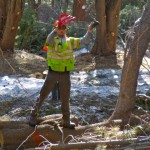
Money for work done in April at Lake Christoper in South Lake Tahoe has not all been paid. Photo/LTN

Money for work done in April at Lake Christoper in South Lake Tahoe has not all been paid. Photo/LTN

“We are in the current calendar year,” said List, meaning the outstanding balance owed is for projects completed in 2011. “We’re waiting to receive grants money and we’re working on it.”

List said in the last week the NFSC sent out about $500,000 to the various fire protection districts and is now less than $200,000 in arrears.

The fire districts say the amount owed is higher.

“It was in the ballpark of $1 million and as much as two years behind,” Duane Whitelaw, fire chief of North Tahoe Fire District, told Lake Tahoe News.

The North Tahoe Fire District received a check for about $100,000, said Whitelaw, but is still owed another $200,000. Lake Valley Fire District received about $80,000, with another $70,000 still outstanding, according to Gareth Harris, Lake Valley’s fire chief.

Mike Brown, fire chief for the North Lake Tahoe Fire District, said the district is awaiting payment for work done in 2010.

Asked if the NFSC has explained the delay in payments, Whitelaw said, “Not to our satisfaction.”

The fire chiefs said fuels reduction work is ongoing and has not been affected by the reimbursement problems, but each said they would like to see the money faster.

“None of us want to float the money on our general ledger,” Whitelaw said. “We’re all anxious to get paid.”

“We’d like to get paid quicker, and we’d love to see the process streamlined,” Lake Valley’s Harris said. “But it hasn’t held us up.”

Harris said Lake Valley fire crews were back at work in the area after spending five weeks in Arizona helping with the state’s historic wildfires.

In an unusual case, the NFSC has declined payment on an approved project.

The Lake Christopher project went close to 75 percent over budget, said List, and the NFSC board of directors has asked the South Lake Tahoe Fire Department for more information explaining the project’s cost overrun.

List said they hoped to resolve the issue when more information is provided.

“I have a lot of respect for the contractor” on the Lake Christopher project, said List. “But we’re trying to see why the project went so far over. It’s a mystery.”

Ray Zachau, South Lake Tahoe fire marshal, said the original estimate for the 48-acre project called for removal of 30 tons of material per acre, but once the contractor started working that grew to about 69 tons per acre. He said they gave the contractor the go-ahead to complete the project.

“We’ve been denied payment on work already done,” Zachau said. “We’re owed about $170,000.”

Zachau is concerned the NFSC is moving beyond what he sees as its charter to act as a financial agent for the fire districts into more of a technical role managing the projects.

“They’ve hijacked the process,” Zachau told Lake Tahoe News.

The NFSC’s audit was initiated last month and should be completed before mid-August, according to List. It will cover 2008, 2009 and 2010.

The NFSC receives the bulk of its money from U.S. Forest Service and the Bureau of Land Management, under the Southern Nevada Public Land Management Act, and has spent about $5 million annually for the last three years, List said.

The Internal Revenue Service requires that a 501(c)(3), the IRS designation for a nonprofit, conduct an audit for any year in which it spends $500,000 or more in federal grant money.

Asked why the group has not kept up with its audits, Joan Presley, chairman of the NFSC’s volunteer board of directors and Reno fire marshal, said it had hired a California firm 18 months ago that never completed the audit, then had trouble finding another firm.

“It was an oversight,” she said. “We made a mistake.”



Money being raised to help find missing S. Tahoe woman

An event to raise money to find a missing South Lake Tahoe woman is scheduled for July 24 fro 5-8pm at Classic Cue, 1961 Lake Tahoe Blvd., South Tahoe.

On July 1, Marie Hanson left with her neighbors to go to the annual Rainbow Gathering near Stevenson, Wash. The last tim she was seen at the gathering was July 6 or July 7. Her neighbors lost track of her and returned to Tahoe without her, bringing her camping gear, her wallet, phone and medicines home with them.

Marie Hanson

Marie Hanson

Hanson is still missing. She is a loving wife, mother and grandmother, who is active in her church and community.

A website has been set up to help get the word out.

The money raised from the event will go to hiring a private investigator.


Palazzo lands job on North Coast as city manager

Gene Palazzo, former Redevelopment Agency director for South Lake Tahoe, has been hired to be city manager of Crescent City. He starts Aug. 8.

Palazzo’s was one of 11 positions eliminated in February.

He was making about $130,000 in South Tahoe and will be making $98,000 a year on the coast. He will be reviewed after six months and one year, with the possibility of a 3 percent raise at each interval. The contract does not have an end date.

Gene Palazzo

Gene Palazzo

Palazzo will receive up to $7,500 in moving expenses. His wife, Ellen, who is assistant city clerk for South Tahoe, told Lake Tahoe News she is not going to Crescent City.

Palazzo is apparently taking several pages out South Lake Tahoe City Manager Tony O’Rourke’s playbook by telling the Crescent City Council he intends in the first year to create a strategic plan, business plan, five-year financial plan and capital improvement plan.

All of this will be new to Palazzo, who did not do any of that type of work while in South Lake Tahoe.

Palazzo is somewhat familiar with the area, having graduated from Humboldt State University in 1987 with a bachelor’s degree in geography.

— Kathryn Reed