Nevadans relying on food stamps more as jobs disappear

By Nevada News Bureau

Nevada experienced the greatest growth among the states in food stamp caseloads between 2007 and 2010 with an increase of 128 percent, according to a recent report from the Urban Institute.

The jump in caseloads is attributable to a nearly 250 percent increase in state unemployment between 2007 and 2010, the report says.

The Unemployment and Recovery Project report said caseload increases across the country are a reflection of high unemployment, as well as increased participation rates and program changes that make it easier for families to get benefits.

Nearly 45 million people currently receive help from the Supplemental Nutrition Assistance Program (SNAP, formerly called food stamps), an increase of about 69 percent since the recession began near the end of 2007.

A recent report said 329,105 Nevadans received assistance from SNAP in March, citing statistics obtained from the state Division of Welfare and Supportive Services.

Today, SNAP reaches about one in seven Americans.

* Over half of SNAP-supported households include children, and one in five include a disabled, non-elderly adult.

* About one in eight SNAP-supported households include elderly individuals.

* 96 percent are U.S. citizens, 1 percent are refugees, and 3 percent are documented non-citizens living in the U.S. long enough to qualify (aliens are not eligible for SNAP benefits).

* In 2009, about 29 percent of SNAP households had some earnings, 5 percent had some unemployment insurance, and many others reported disability or retirement income. Nearly one in five (18 percent) had no countable income.

The current debate over reducing the federal deficit has led some to propose scaling back federal program costs. The House Budget Committee passed a major restructuring that would block grant SNAP to the states with fixed federal resources.

House Budget Committee Chairman Paul Ryan’s budget plan would cut the SNAP program by $127 billion – almost 20 percent – over the next 10 years (2012-21).

In addition to possible cuts to SNAP, thousands of Nevada residents who rely on financial assistance to pay their power bills likely won’t get help this year because of federal funding cuts.

The Division of Welfare and Supportive Services recently said federal funding for Nevada’s Energy Assistance Program will amount to only $4 million this year, down from $15.8 million in the fiscal year that just ended June 30.
Golf tourney helps fund cancer center in Truckee

Tahoe Forest Health System raised more than $119,000 to benefit Tahoe Forest Cancer Center at its annual Gene Upshaw Memorial Golf Classic charity event. The cancer center is projected to open in 2012.

Support for fundraising events like this one assists in gaining awareness for the ongoing need to support local cancer programs.

The Gene Upshaw Memorial Golf Classic originated three years ago to provide a source of funding for pancreatic cancer research through the Tahoe Institute for Rural Health Research, and to honor the death of sports legend Gene Upshaw who died of pancreatic cancer at the age of 63. Upshaw fought his battle with pancreatic cancer at Tahoe Forest Hospital in Truckee. He was a founding member of the golf club at Gray’s Crossing, where the golf tournament is played each year, and was an avid lover of the Truckee/North Tahoe area and lifestyle.


El Dorado County woman ready to compete after near-fatal encounter

By Sam McManis, Sacramento Bee

Such plans Nicole Young made for her 40th year. She could hardly wait. In fact, she chose not to. She ramped up her running and bike training early last October so that, by the time the Big 4-0 hit in March, she’d be in prime shape to dominate her new age group.

“I figured, this is the year I’m on top of my game,” said Young, a distance runner and triathlete. “I’m just really going to go all-out and kick butt.”

Fate, in the form of an overlooked rock on a dirt trail, had other plans. A simple six-mile out-and-back training run near her Shingle Springs home on Oct. 21 changed her life. Nearly ended it, actually.

Young, a two-time defending ironwoman champion of Eppie’s Great Race, had just made the turn on the El Dorado Trail and needed to hustle back to pick up her two kids from school. She tripped on a rock and gouged her left knee. Nothing major, she thought. Didn’t even hurt. Yeah, it took three stitches to close it later at a drop-in clinic. But Young’s an endurance athlete, so she’s used to scrapes.

Four days later, a fast-moving antibiotic-resistant bacterial infection, whose genesis was in that seemingly innocuous knee injury, nearly killed her. She contracted necrotizing fasciitis, more commonly and ghoulishly referred to as “flesh- eating bacteria.” Five surgeries over the subsequent eight days – and an aborted sixth that would’ve resulted in amputation of her left leg – saved her life but left her mostly incapacitated.

Doctors at Mercy San Juan Medical Center told Young, whose kidneys had shut down and whose other organs were compromised during the ordeal, that it might be a year before she could walk again.

Read the whole story


South Shore election season dominated by incumbents

By Kathryn Reed

There is going to be a new face on the South Lake Tahoe Public Utility District board in December.

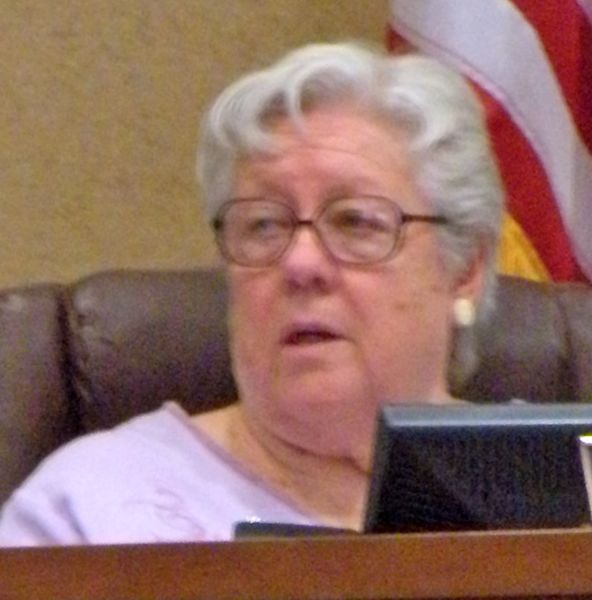
Marylou Mosbacher, who has served for 21 years, is not running for another term. She knows she will miss being on the board, but said at 82 it’s time to focus her attention more on grandchildren and great-children.

Marylou Mosbacher

Marylou Mosbacher

She is, though, hoping a woman fills her seat because she is currently the lone female on the board.

So far three people have filed for what is called seat No. 3 – engineer Randy Vogelgesang, businessman John Runnels and retired STPUD employee Claude Gunsch.

Dale Rise is seeking another term for seat No. 4. He is the only one so far going after that seat.

The three incumbents for the Lake Tahoe Unified School board have filed – Sue Novasel, Mike Doyle and Larry Green. No one has filed to challenge them.

Karen Borges has filed to retain her seat on the Lake Tahoe Community College board. Fritz Wenck, who has been on the board since the college started in the 1970s, has not filed. He did not return to a call to find out what his intentions are.

Student Michael Bischoff has filed for the college board.

The deadline to file for the November election is Aug. 12. If no incumbent files, the deadline is extended to Aug. 17.

On July 29, the three-member board that oversees Measure S, the recreation initiative passed in 2000, massaged ballot language for the revised Measure R. The changes don’t alter the amount property owner pay each year. It changes how money can be spent.

Another item that may be on the Nov. 8 ballot involves the pension plan for South Lake Tahoe employees. The City Council on Aug. 2 will discuss whether voters should have a say in the pension issue.


Nevadans frustrated without representation in House

By Frank X. Mullen Jr., Reno Gazette-Journal

When Democratic President Barack Obama this week urged Americans to contact their congressional representatives about the deadlock over raising the nation’s debt ceiling, Nevadans who live outside Clark County had no one to call in the U.S. House.

With the U.S. House of Representatives’ District 2 seat vacant since the resignation of U.S. Rep. Dean Heller, R-Nev., on May 9, thousands of Silver State voters are experiencing frustration without representation.

Republican Gov. Brian Sandoval appointed Heller to the U.S. Senate after U.S. Sen. John Ensign, R-Nev., resigned in the wake of a sex scandal.

A special election won’t be held until in September to fill the vacancy.

“So who you gonna call?” asked Guy Rocha, former Nevada state archivist, a reference to the theme song for the movie “Ghostbusters. “For the first time in Nevada history, the answer, at least for District 2 constituents, is nobody.”

He said the state has never experienced “a vacancy like this,” and it’s complicated by coming at a critical time in history.

“We’ve never had a debt ceiling controversy like this one,” Rocha said. “This one is going right down to the wire, and the future of the nation’s economic viability could be on the line.”

District 2 residents who want to make their voices heard could call the state’s other two U.S. House members: U.S. Reps. Shelley Berkley, D-Las Vegas, and Joe Heck, R-Henderson.

Read the whole story


Volunteering pays off for LTEF

By Nancy Rollston

Lake Tahoe Educational Foundation and South Tahoe High School teens volunteered at the American Century Golf Tournament on July 15. The teens distributed appreciation plaques to amateur participants in each foursome as they finished the 9th and 18th holes. The amateurs were surprised by the presentations and appreciated the photographic mementos.

Teen volunteers had the opportunity to meet the celebrities and were rewarded with many autographs and kind words as well as having the opportunity to participate in community service.

The Lake Tahoe Educational Foundation will receive a generous donation from Livestrong through LTVA for their participation. This donation will enable the foundation to buy musical instruments for school orchestras in Lake Tahoe Unified School District.

Nancy Rollston is president of the LTEF board.


U.S. teens turning to heroin as a cheaper high

By Tim Johnson, McClatchy Newspapers

EL DURAZNO, Mexico — Mexico’s heroin industry has had a bullish few years, and for traffickers the outlook is as uplifting as the scarlet, orange and yellow poppy flowers from which the narcotic is processed.

What was once a problem largely confined to hubs in California and Texas, Mexican traffickers have expanded into the Midwest and the Atlantic Seaboard, narcotics experts say.

Using savvy marketing tactics, they’ve also repositioned heroin commercially, revamping its image from the inner-city drug of yore, with its junkies and needles, into a narcotic that can be snorted or smoked, appealing to suburban and even rural high school youth.

A coincidental factor has given the drug gangs a tail wind: The epidemic abuse of painkillers has ebbed in the United States, and youth now hunger for a cheaper high.

“We’ve heard around the country of changes away from prescription drugs, because they are either more expensive or more difficult to obtain, and a movement toward heroin, which is less costly,” said Gil Kerlikowske, a former Seattle police chief who’s the White House drug czar.

The U.S. State Department said in March that Mexico has surpassed Myanmar as the world’s second largest poppy cultivator and produces 7 percent of the world’s heroin, mostly for the U.S. market. The State Department and the United Nations say that Mexican poppy production has nearly tripled since 2007, though Mexico strongly disputes that estimate.

What’s indisputable is that drug syndicates that produce black tar and brown heroin in Mexico’s Sierra Madre mountains are pushing aggressively into areas where they haven’t been active before.

Read the whole story


Gnarly mountain bike trails sprouting up across the country

By Jim Carlton, Wall Street Journal

KETCHUM, Idaho — As mountain biking surges in popularity, federal land managers are building dozens of miles of special backcountry trails to accommodate adrenaline-junkie riders and cut down on crashes with hikers.

Dozens of one-way, so-called flow trails allowing bikers to ride downhill at breakneck speeds have been built across the U.S. in recent years, with more in the works. Many of these trails are built on Western public lands managed by the U.S. Forest Service and Bureau of Land Management. They are specially designed with jumps and berms to allow riders to flow unimpeded down the mountain without stopping, making the downhill-riding experience akin to skiing or sledding.

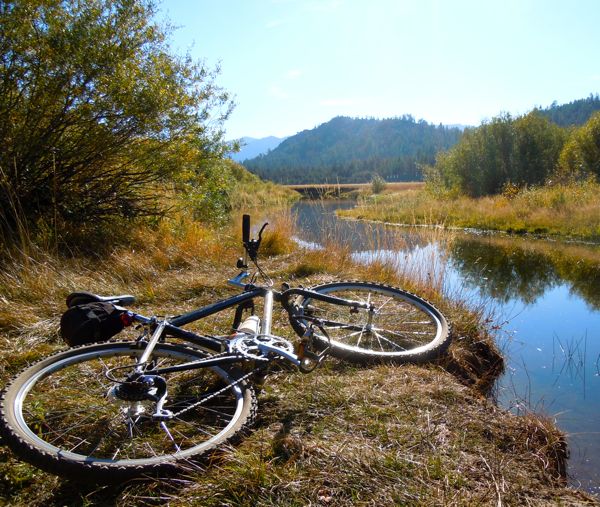
Lake Tahoe is joining the country in expanding mountain bike opportunities. Photo/LTN

Lake Tahoe is joining the country in expanding mountain bike opportunities. Photo/LTN

“It’s like a luge,” said 30-year-old Jeremy Newberg of Hailey, Idaho, after riding a flow trail called “Punchline” in the state’s Sun Valley this month. “It’s just awesome.”

As well as thrilling riders, the trails provide a legitimate alternative to guerrilla trails carved out illegally in some areas. And supporters say the flow trails help solve what backcountry visitors say is a growing problem: bicyclists careening into fellow trail lovers on foot and horseback.

“Most trails, you don’t know if someone is coming around the corner, but this you can trust going down,” says Tiff Koehn, a 37-year-old, Spandex-clad corporate pilot, after hurtling down another Sun Valley flow trail called “Forbidden Fruit.” It takes just three to five minutes to barrel down that 1.3-mile course.

More than two dozen locations nationwide now boast multiple flow trails, according to the International Mountain Bicycling Association.

The expansion in the number of these trails comes as mountain biking has grown from being the obsession of a handful of enthusiasts 30 years ago to a sport with 7.1 million participants, according to the Outdoor Foundation, a nonprofit group in Washington, D.C. Bikers are now the No. 2 users of backcountry trails after the 32.6 million hikers in the U.S., according a 2010 report by the group. Amid this growth, hikers have been struck by cyclists and seriously injured, and horses have thrown riders after being spooked by bikes.

“If [cyclists] are coming downhill, we have to be alert,” says Bob Anderson, a veteran horseman from South Lake Tahoe.

The conflicts have gotten ugly at times. In 2002, someone booby trapped a trail in Santa Barbara County with a wire designed to knock a rider off a bike. No serious injuries were reported, though some riders were shaken up by falls. No arrests were made, according to news reports at the time.

So far, the flow trails are drawing support from a wide spectrum of backcountry users. “The problem is when hikers, bikers and dogs intermix,” says Nick Hilbers, a 55-year-old hiker from Beaverton, Ore., who recently alerted local officials to an illegally made mountain-bike trail in a nearby city park.

These illicit trails have sprung up in several areas in recent years, helping spur the growth in sanctioned runs on federal lands. In the Lake Tahoe Basin, for instance, as many as 150 miles of unauthorized trails ringed the surrounding mountains a decade ago, says Garrett Villanueva, a Forest Service assistant engineer for the basin.

Read the whole story


USFS’ fish testing puts Upper Truckee River off-limits

By Barbara Barte Osborn, Sacramento Bee

Anglers and others wading in South Lake Tahoe’s Upper Truckee River could be in for a shock – literally – if they fail to heed warning signs.

Beginning the first week of August and continuing through the summer, U.S. Forest Service crews will be using electro-shocking equipment to temporarily stun and measure fish in the river.

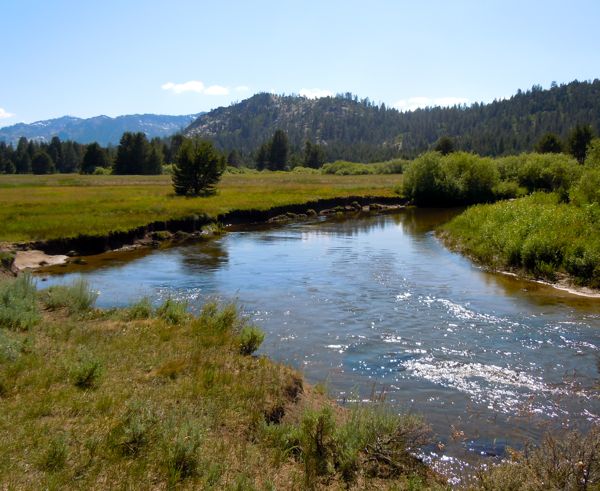
USFS: Stay out of the Upper Truckee River. Photo/Kathryn Reed

USFS: Stay out of the Upper Truckee River. Photo/Kathryn Reed

The project is an effort to record data that will help evaluate the effectiveness of river restoration, said Cheva Heck, public affairs officer for the forest service’s Lake Tahoe Basin Management Unit.

The study will start at the river’s mouth near Tahoe Keys and work toward the Highway 50 bridge in Meyers.

“Members of the public should stay out of the water and keep dogs out of the water where crews are working,” Heck said. “A human or dog could receive a mild electric shock if entering the water while the fish sampling devices are on.”

Read the whole story


Firefighters keep sharp on outdoor rescue techniques

By Leona Allen

Personnel from the Lake Valley Fire Protection District are participating in rope rescue training this month in conjunction with El Dorado County Search and Rescue, South Lake Tahoe Fire Department, Meeks Bay Fire Protection District, U.S. Forest Service, and CalFire.

Due to the recreational atmosphere within the jurisdiction of these agencies, it is necessary for them to train and prepare for these potential hazardous conditions. Agencies in the Lake Tahoe Basin rely frequently on mutual aid from the various fire, EMS and law enforcement agencies, making it important to train together to enhance their skills. Such skills are also considered high-risk, but used with low frequency, and thus need to be practiced often.

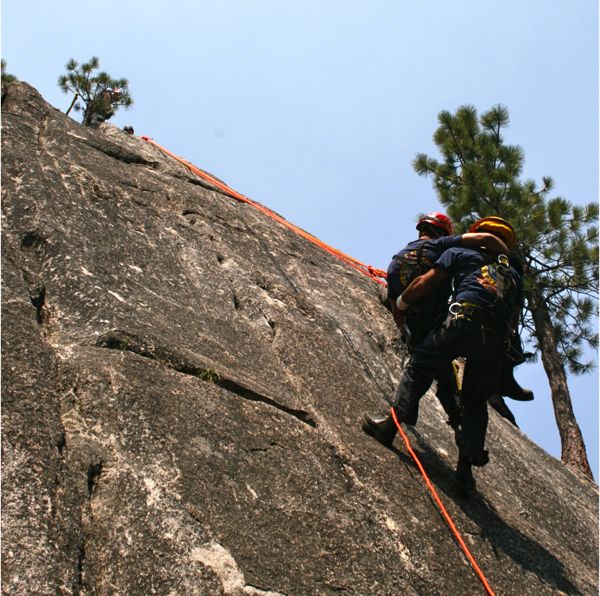
Lake Valley firefighters practice high angle rope rescue. Photo/Provide

Lake Valley firefighters practice high angle rope rescue. Photo/Provided

High angle rope rescue enables personnel to affect the rescue of a stranded and/or injured climber. With the high number of popular climbing areas in the Lake Valley FPD jurisdiction, we would like to remind the public of the following safety tips:

• When enjoying a day climbing or participating in any outdoor recreation, never travel alone. Know the capabilities of your companions (what equipment they have and their ability level), make a plan for your day, and let someone know where you’ll be going and when you plan to return.

• Make sure your equipment is rated for the intended use.

• Check the weather forecast, and be prepared for fast changes in the weather.

Leona Allen is the public information officer for Lake Valley Fire Protection District.