Nevada in cellar in study about entrepreneurial activity

By Sean Whaley, Nevada News Bureau

CARSON CITY – Nevada finds itself at the bottom of another economic analysis, this one related to entrepreneurial activity.

The State Entrepreneurship Index, a nationwide analysis and ranking system that shows how states compare in areas of business formation, patents and related activities, shows Nevada dropping a major 40 spots, from seventh in 2008 to 47 in the newest rankings released in July but using mostly 2010 data.

The index was developed by economists at the University of Nebraska-Lincoln’s Bureau of Business Research and Department of Economics.

The index uses five elements – establishment growth rates, establishment growth rates per capita, raw business starts per capita, gross receipts per proprietor, and patents per capita – to create the rankings.

A state index for each component is assigned based on how much each state’s performance is above or below the average of all state data, which has a value of 1.

Tops in the rankings is New York with a score of 2.34. New York also ranked first in the 2008 analysis. Washington was second, up one spot, followed by Massachusetts, which rose six places.

Nevada’s score was 0.33, beating out Mississippi at 48, Arizona at 49 and South Carolina in last place at 50. No state dropped more than Nevada in the analysis.

Eric Thompson, associate professor of economics and director of the Bureau of Business Research at the university, said Nevada performed poorly in three categories, generating the large drop in rankings.

“Between the 2008 version of our index and the 2010 version of our index Nevada saw a large decline in the establishment growth rate, both in absolute and per capita sense, and also a decline in the gross receipts per proprietor indicator,” he said. “So three of the five indicators fell pretty substantially. That was the reason for Nevada’s drop.”

The index is in marked contrast to a different entrepreneurial index released in March, but Thompson said the reports are compatible.

Nevada and Georgia tied as the two states with the highest entrepreneurial activity rates in the country in the “Kauffman Index of Entrepreneurial Activity,” a leading indicator of new business creation in the United States.

The annual index shows Nevada and Georgia had 510 per 100,000 adults creating businesses each month. They were followed by California at 470 per 100,000, Louisiana at 460 and Colorado at 450.

“They focus on starts per capita, and actually, on that measure, Nevada did do pretty well,” Thompson said. “You were 8th in 2008 among all the states and you were 10th in 2010. So I think the two results are very consistent.”

Despite the results, Thompson said he is optimistic for Nevada’s future.

“I think your economy is going to be back, and back in a big way,” he said.


Anderson dominates women’s slopestyle in New Zealand

By Charlotte Trundle, ESPN Action Sports

Riders from all corners of the globe battled it out this weekend at The Billabong Slopestyle 4-star TTR World Snowboard Tour event at Snow Park New Zealand, with Roope Tonteri of Finland winning the men’s finals and Jamie Anderson dominating the women’s field.

With the highest ever TTR rating and $30,000 in prize money, more than 90 competitors representing 16 countries took to the course, which had a final feature dubbed the Monster Volcano, a channel-gap jump with a giant inflatable Monster can to air over.

This slopestyle contest is the second stop on the 2011-12 TTR World Tour and it’s also the first of its kind on the global calendar since the International Olympic Committee confirmed the discipline for the 2014 Winter Olympics.

Tonteri earned the top spot and a $5,000 check with a score of 89.40. His run included a front board on the round bar, a nose bonk 360 on the pole jam, and two massive 900s to a huge front 7. “I am so happy. It has been so nice to ride with friends at Snow Park,” Tonteri said.

Second place went to American Sam Hulbert, with a score of 84.60, and third place to Finland’s Antti Autti, who scored 84.20. Kiwi Milu Multhaup-Appleton, a first-time entrant into a TTR event, was the sole local New Zealander to compete in an open final, placing seventh overall.

In the women’s field, event favorite American Jamie Anderson did the expected — completely nailing two huge runs to earn the top score in her division. Anderson’s winning run included a tailslide on the down box, a back 180 mute grab, a switch back 5, a backside 360 over the 65-footer, and a tweaked stale grab over the Monster Volcano. Anderson took home a check for $2,500.

Read the whole story


Kings Beach man recognized for his naval career

Placer County Supervisor Jennifer Montgomery recently presented a commendation from the Board of Supervisors to a Kings Beach resident who has risen from his local roots to a stellar career in the U.S. Navy.

Benjamin Heineike grew up in Kings Beach and is a graduate of North Tahoe High School. He graduated from the U.S. Naval Academy at the top of his class in 2002.

He attended Cambridge and Oxford universities, the latter of which was with a Marshall Scholarship, one of 40 given nationwide that year.

He served as an active duty commissioned officer in the Navy from 2002-10 and currently serves as liaison officer in the Navy Reserve.

“He’s done all these incredible things and traveled throughout the world,” Montgomery, who represents Kings Beach, said in a statement. “Yet his commitment to his community, to Kings Beach, remains so strong and his commitment to education and young people and after school education programs like the Boys and Girls Club.”

Heineike’s parents, Marilyn and Ben, still live in the Lake Tahoe Basin.


Fatal accident on Hwy. 50 near Kyburz

Updated Aug. 9 at 7:45am:

The man who died Aug. 8 was Steven John Evans, 50, of Pollock Pines.

———————————-

By Bill Lindelof, Sacramento Bee

A logging truck crashed into the American River near Kyburz this morning, killing the driver.

The crash was reported about 6:15am, the rig ending up partially in the water, spilling logs and fuel. The cab of the truck remained out of the river but the driver was pinned inside the wreckage, said California Highway Patrol officer Rich Wetzel.

The CHP, CalFire, El Dorado County sheriff’s deputies and the coroner have responded to the scene between Kyburz and Whitehall. Also responding was the state Office of Emergency Services and the Department of Fish and Game to check on fuel leakage into the river.

Expect traffic delays on westbound Highway 50.


Tahoe Tails — Adoptable Pets in South Lake Tahoe

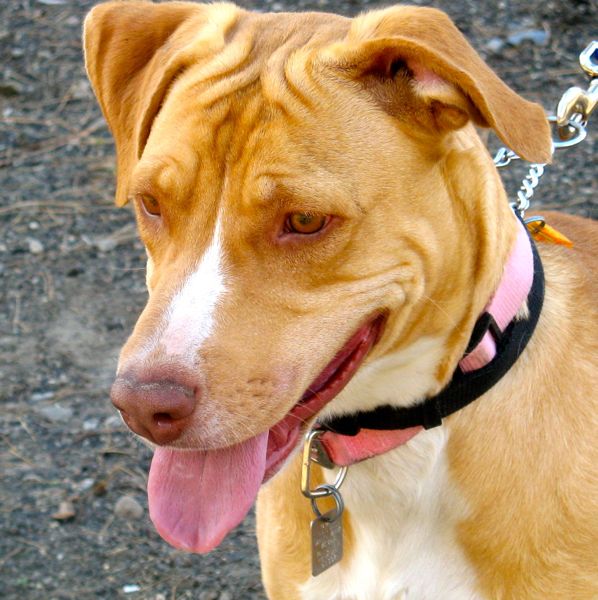
Anna is a 2-year-old Lab-pit bull mix who came to Tahoe looking for a better life than she had in Fallon. She is very affectionate with people, and she likes to play with other dogs, although she should probably be your only pet.

dogShe is house trained and has good manners. Anna is very energetic and would be a great hiking or running companion.

Anna is spayed, microchipped, and vaccinated.

She is at the El Dorado County Animal Services shelter in Meyers, along with many other dogs and cats who are waiting for their new homes.

The 50 percent off special for cat and and kitten adoptions continues through August, please consider adopting a feline companion this month.

Call (530) 573.7925 for directions, hours, and other information on adopting a pet.

For spay-neuter assistance for South Tahoe residents, go online.

— Karen Kuentz


Fire insurance rates for South Tahoe to be reviewed

By Kathryn Reed

What insurance companies charge property owners in South Lake Tahoe may be changing.

Officials with the Chicago-based Insurance Services Office will be in town a week from today to assess the city’s fire rating. This is usually done every 10 to 15 years, with South Tahoe’s last rating being from 1995.

sltfdSeveral things are looked at, including, but not limited to:

• Where the nearest fire hydrant is

• Water flow capacity

• Ability to deliver the water to a fire

• Distance to a manned fire station

• Dispatch center

• Engine company staffing

• Water flow needs

• Number of large occupancies

• Wildland urban interface.

The latter is a new addition of late. This area is where residences border forested areas.

After the 2007 Angora Fire that destroyed 254 houses, some insurance companies stopped writing new policies in the Lake Tahoe Basin.

Each criterion above is not rated equally. The water system is weighted 30 percent, while dispatch is 10 percent.

Division Chief Marty Scheuerman is hoping improvements like increased water flow that have been made in the last 15 years will outweigh the negatives such as fewer people in dispatch and operating a ladder truck that by some standards has outlived its desired life.

South Tahoe is on a two-tier rating with those in the Lukins Brothers Water District an 8, and the rest of the city a 5. The scale is 1 to 10 with 10 being the worst.

“They look at all of our records including maintenance, testing of hydrants,” explained Scheuerman.

A water system map is provided to the rating officials.

But Scheuerman noted that even though the fire department has a good relationship with outside agencies, they don’t have control of them in terms of how they keep records or what they do with water flow.

Several companies provide water to South Lake Tahoe. Besides South Tahoe Public Utility District, which is the biggie, there is Lukins, Tahoe Keys and Lakeside water districts.

The Insurance Service Office will tour the area and review documents, with a score expected in the fall.

The ISO was created after the large-scale fires in Chicago leveled the Windy City and there was a need to quantify fire protection so insurance companies would know what to charge.


Tahoe researcher helping map icebergs

By Alex Forrest

Our departure from Quebec City was delayed for a day, but sailing has been pretty smooth since. We’re now five days out, nearing the northernmost tip of Labrador, and soon will cross over to Baffin Island. For the Autonomous Underwater Vehicle (AUV) team, this means that we’re closing in on our objective of mapping the underside of an iceberg.

For the team, which includes Alexander Forrest (UC Davis), Andrew Hamilton (University of British Columbia), Derek Mueller (Carleton University), and Val Schmidt (Coastal Center for Ocean Mapping – University of New Hampshire), this AUV deployment represents the culmination of several months of working with the Canadian Ice Service in preparation for any envisioned scenario. Although the team has experience with AUVs under-ice in the Arctic and Antarctica, this application has several challenges that haven’t previously been encountered. Unlike shorefast-ice tested before in earlier deployments, the target we are searching for will be moving and rotating while we are surveying. Typical drift rates can be 10 to 15 km per day. Additionally, we will be testing a bathymetric mapping sonar unit that we have only had access to since the day before our departure.

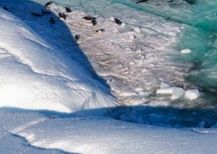
Seals resting on an embayment. Photo/Alex Forrest

Seals resting on an embayment. Photo/Alex Forrest

We had our first taste of the challenges in store for us once we came through the Strait of Belle Isle (in between Newfoundland and Labrador) where the ship made a slight diversion to a fragment of the Petermann Ice Island (PII-A) that has been drifting south from northern Greenland since August 2010. This is the same fragment that has recently been in the news as a result of its size (its long axis is nearly 10 km long and at least half that across).

After debriefing from our helicopter pilot, we were flown across to PII-A to make ice thickness measurements at seven stations. Similar measurements had been made by a Newfoundland-based R&D organization when it had established these stations in mid-June. With these two sets of measurements, it will be possible to produce an estimate of how fast the ice is melting and to examine how this might be related to drift.

On our first foray over to the island we managed to make measurements from two stations. The helicopter was then required to return to the ship to refuel before heading back to find another three stations. Of the last two stations that we were unable to find, one was thought to be on a smaller piece of ice that had detached from the rest of the iceberg. The second was simply never found.

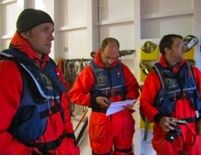
Alex Forrest, Derek Mueller and Andrew Hamilton suited up to fly to PII-A. Photo/Val Schmidt

Alex Forrest, Derek Mueller and Andrew Hamilton suited up to fly to PII-A. Photo/Val Schmidt

As the ship pulled away from PII-A, we found ourselves speculating what the conditions might have been on the underside of the iceberg given the state of the surface. While we might expect similar undulating conditions, there could be significantly greater crevassing in regions where the original glacier had been furrowed by the underlying rock. There is also concern that marginal regions of the iceberg will be worked by wave action that will result in embayments where the vehicle could be trapped.

Our trip then has continued north and the next stop for the AUV team will be Cumberland Sound (southern Baffin Island to the northwest of Iqaluit). Once there, we will take advantage of the fact that we will be in relatively shallow water (50 to 100 m) to conduct a last round of in-water tests of the vehicle. This will be a final chance to do a full systems check before reaching the iceberg we intend to survey next week. This is obviously a far cry different than the systems checks we were able to do in North Hatley (southern Quebec) during the first week of July.

We spend our evenings dreaming up and discussing scenarios that might arise in an effort to be prepared for the unforeseen challenges that lay ahead. We also are struggling to fully understand the nuances of the bathymetric sidescan sonar and the limitations of the rest of the instrumentation we will be working with. While these are relatively normal growing pains for any AUV operation, they are made all the more difficult by being at sea. However we’re making progress and expect to be fully ready to go when the time comes.

Alex Forrest is a post-doctoral researcher at UC Davis Tahoe Environmental Research Center in Incline Village. He is part of a team of scientists mapping the underside of an iceberg in the Arctic using autonomous underwater vehicles. Some of the same instruments being used for this project were recently used at Lake Tahoe to map the locations of Asian clams.


Opinion: Fire tax for rural areas is a good idea

Publisher’s note: This editorial is from the July 24, 2011, Sacramento Bee.

If people choose to live in areas prone to wildfires, shouldn’t they pay their fair share for the escalating costs of protecting their structures from inevitable infernos?

The answer should be a simple “yes,” but state lawmakers didn’t make it part of the budget until this year. That’s when they approved a $150 annual fee on 800,000 structures that sit within the vast acreage where California has firefighting responsibility.

In tight budget times, this fee will raise revenue to ensure that the state’s firefighting capability isn’t excessively cut back, putting rural residents in danger.

Yet that argument doesn’t wash for Sen. Ted Gaines, R-Roseville. Attempting to make himself out as a caped crusader for taxpayers, Gaines has filed papers for a referendum to eliminate the fee.

Gaines claims the fire fee isn’t a legitimate fee but a tax, and as such should have been subject to a two-thirds approval from lawmakers, instead of a majority vote.

Read the whole story


Christian speaker to spend 3 days on South Shore

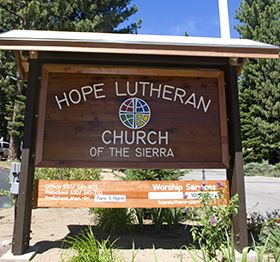
On Labor Day weekend the community of Hope Lutheran Church is hosting internationally renowned Christian speaker and author Anthony Campolo.

churchCampolo will speak Sept. 2-4, from 5-7pm each night.

He is a speaker, author, sociologist, pastor, social activist, and passionate follower of Jesus. During his many years of Christian service, Campolo has challenged millions of people all over the world to respond to God’s love by combining personal discipleship, evangelism, and social justice.

The cost is $5 per evening or just $12.50 for all three nights. Tickets may be purchased online by clicking on the Tony Campolo link. The event will be at Hope Lutheran Church, 930 Julie Lane, South Lake Tahoe.

For more information, call (530) 541.1975.


Mayo Clinic doctor to lead sports medicine on South Shore

By Kathryn Reed

Understanding your patients’ lifestyle can be critical to getting them to being in top shape after an injury.

As someone who has competed in cross country skiing and mountain biking, Jon Finnoff knows what an active lifestyle is about. It’s one of the reasons he moved to South Lake Tahoe.

Even though he does not start at Tahoe Orthopedics and Sports Medicine until next week, he has been on his bike, closed on a house and has his 2011-12 pass for Heavenly Mountain Resort.

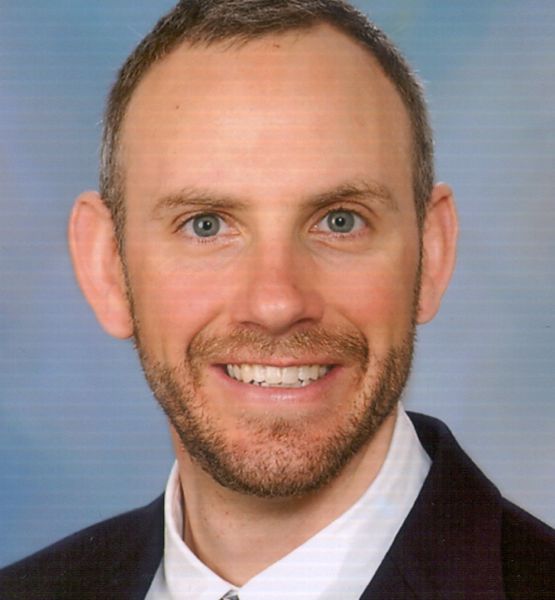
Jon Finnoff

Jon Finnoff

Now it’s a matter of him, his wife and their 4-year-old daughter getting settled and learning where to play outdoors.

His position is new for Barton Health. Finnoff will be medical director of sports medicine, working with the physician team of Keith Swanson, Terry Orr, Steve Bannar, Robert Rupp, Dan Robertson, Kyle Swanson and William Cottrell.

Like Orr, Bannar and Kyle Swanson, Finnoff is also a doctor with the U.S. Ski Team.

“Sports medicine is not just orthopedics. I’d like to create a multi-disciplinary team for sports medicine,” Finnoff told Lake Tahoe News. “I want to find out what we have, what we have that needs to be improved and what we don’t have.”

While he comes from the esteemed Mayo Clinic in Minnesota, it’s growing up in Boulder and living in Bend, Ore., that fueled him with the desire to return to the mountains.

Finnoff met Orr at a conference a few years ago, which led to building a relationship and his eventual move to head the center.

He has been an associate professor at the Mayo Clinic, is still on the faculty at the University of Utah, and often gives lectures internationally. He has also contributed to more than 60 publications.

This month he will be traveling to Chile and China to give presentations.

Finnoff is aware of the missed opportunity by Barton to have Richard Steadman pursue his dream of an orthopedic clinic. He eventually did so in Vail, leaving South Lake Tahoe decades behind the curve. Finnoff shrugs that off.

On the South Shore he intends to create a sports concussion program like he did at the Mayo Clinic. He will create a multi-disciplinary team that incorporate the schools and ski resorts.

“For the concussion program, the baseline tests people who are at risk. If you don’t know how the person functions prior to injury, you don’t know how they are functioning after the injury,” Finnoff said.

In other words, cognitive skills differ in everyone. If they weren’t a rocket scientist to begin with, then there should not be the expectation that recovery will make them one.

“If you are participating in a sport at high risk for concussion, that includes snowboarding and skiing, you should get a baseline (concussion test),” Finnoff said.

He says concussion are “somewhat of a hidden injury” because blood and broken bones are not usually part of the trauma. Finnoff is well aware of second-impact syndrome and the need for better education about it.

Finnoff wants to turn this area into a hub for sports medicine – not just in terms of treating patients.

Education, research, and tracking clinical outcomes are key goals of his.

He also said, “It’s important to create a strategic alliance with other medical centers to create a high level of care here.”

Finnoff is also tasked with continuing Barton’s goal of becoming a destination health care facility. This is also part of the basin’s prosperity plan.

After he gets acquainted with the community and facilities in the area and region, Finnoff intends to create a one-, five- and 10-year action plan.

And when Finnoff isn’t in scrubs or a lab coat, expect to see him dressed to hike, bike, climb or ski.