Zephyr Cove doesn’t have fuel for private boaters

By Kathryn Reed

Boaters beware – don’t expect Zephyr Cove Resort to be able to fill your tank.

The fuel leak discovered earlier this summer at the South Shore marina is making fueling difficult even for the resort’s fleet.

“Right now, the fuel is being used to fill our fleet of recreational watercraft. If we are unable to accommodate private boaters, we will direct them to one of the other marinas,” David Freireich, spokesman for Aramark, told Lake Tahoe News.

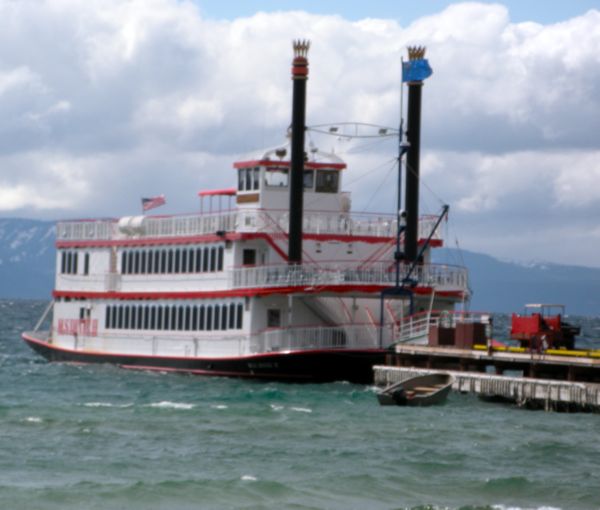
The Dixie is having to fuel up at Lakeside Marina, but still leaves from Zephyr Cove. Photo/LTN file

The Dixie is having to fuel up at Lakeside Marina, but still leaves from Zephyr Cove. Photo/LTN file

Boaters are telling Lake Tahoe News they are being turned away. This can be a bit precarious for boaters with the fuel needle near empty.

Aramark is the concessionaire on the U.S. Forest Service owned property.

This is where the M.S. Dixie II is docked. While the paddle-wheeler is still operating, the fueling schedule has changed. Now the vessel is going to Lakeside Marina to fill up on thousands of gallons of diesel.

The leak was discovered during the replacement of fuel pumps to two tanks that are a part of the underground storage tank system.

“A smaller, temporary fuel storage system has been installed at Zephyr Cove, until a permanent solution is finalized,” Freireich said. “We apologize for any inconvenience and are working with the Forest Service and NDEP (Nevada Department of Environmental Protection) to finalize plans for a new storage system, so that we can resume normal fueling services as soon as possible.

The financial impact of the leak to the resort is unknown. There has been no evidence of drinking water being impacted. Soil samples continue to be taken, with cleanup under way.


Route, fare changes planned for BlueGo

BlueGo bus routes and fares are likely to be tweaked by the Tahoe Transportation District board of trustees at their meeting this morning.

The changes, if approved, would go into effect after Labor Day. One of the big changes is stopping the significant subsidy to the on-call service for the general public. The rate is going to be about triple what it was – to be $10 a ride.

Tokens for the South Shore-based bus system are being eliminated. This will save money in the long run.

Another piece to the streamlining is making the routes in Carson Valley and Carson City function better.

The board meets this morning at 9:30 at Sierra Nevada College in Incline Village.

— Kathryn Reed


Reading, signing of book about Fallen Leaf Lake

Author Janet Kaidantzis will sign her book “Fallen Leaf, A Lake and its People: at the Lake Tahoe Museum on Aug. 19 form 3-6pm.

The cover says, “From the Washoe to the pioneering families of Nathan Gilmore, Lucky Baldwin and William Price to the artists, academics and craftsmen of the early community, Fallen Leaf Lake drew people to its natural beauty who left a legacy in stories, legends and land.” Kaidantzis and Bill Craven will answer questions about the past at Fallen Leaf Lake.

The museum is at 3058 Lake Tahoe Blvd., South Lake Tahoe.


Opinion: New governance vital to balance Tahoe’s future

By Ross Miller

Conflicts between California and Nevada over how to manage Lake Tahoe are severely hindering effective management of a unique resource shared by the two states.

It has been widely suggested that the issue is simply a battle between Nevada’s desire for more growth and California’s desire to protect the environment. The reality is that the different perspectives of the two states are considerably more nuanced, and deserve greater explanation and examination. As Nevada’s secretary of state, one of my duties is to serve as a member of the Tahoe Regional Planning Agency board. In that capacity, I feel a responsibility to work toward developing a renewed commitment on the board to develop a comprehensive plan that will make Lake Tahoe a sustainable resource for all its users.

It is important to consider the history of the TRPA and its formation as a response to the unrestrained growth of earlier decades. Its formation effectively put the brakes on that growth, and ostensibly provided the two states an opportunity to work together to repair the environmental damage caused by that growth with an eye toward more well-planned, responsible projects. As governor of Nevada during the 1990s, my father, Bob Miller, worked closely with California Gov. Pete Wilson, our congressional delegation and President Bill Clinton to obtain significant federal funding aimed at repairing the effects of unrestrained growth before TRPA was formed. Through the creation of the Lake Tahoe Summit and the Environmental Improvement Plan, we cooperated and made significant progress.

Today, irrefutable science tells us that Lake Tahoe’s clarity and environmental sustainability are threatened by the same fine sediment runoff from urban areas that were developed in the 1950s and 1960s, as well as significant near-shore nitrogen and phosphorus contaminants.

The current board structure and the inability to update a comprehensive plan have resulted in a failure to address this threshold issue. Instead, we are left with an endless and seemingly intractable process that prevents even the most environmentally responsible private restoration efforts. A policy of responsible redevelopment, using technology that has evolved during the subsequent decades, could provide a sustainable economic climate and effectively protect the Lake Tahoe environment.

We can no longer rely on big federal earmarks to restore any damage to Lake Tahoe. The only way that we are going to realize the environmental goals we seek is by tearing down the urban development of earlier decades, and rebuilding in an eco-friendly manner. Doing so will require broad-based cooperation between the public and private sectors, and a recognition that sustaining Lake Tahoe environmentally will require sustaining it economically as well.

Ross Miller is Nevada’s secretary of state and a member of the board of the Tahoe Regional Planning Agency.

Read the whole story


A filling lineup for North Shore food and wine festival

The 26th Annual Lake Tahoe Autumn Food and Wine Festival, considered one of Lake Tahoe’s premier gourmet events, is scheduled for Sept. 9-11 at the Village at Northstar in Truckee.

The three-day event kicks off Sept. 9 with the 8th Annual Village Grape Stomp and Vineyard Luncheon, with costumed teams furiously stomping fresh-from-the-vineyard grapes trying to extract the most juice. The team entry fee ($200 for four and $50 for those solo) includes grape stomping, wine and beer tasting and alfresco luncheon. For those not wanting to get their feet dirty, lunch/tasting only tickets are $40/person.

Day two of the festival showcases some of the best culinary programs in the region, including three free outdoor seminars in the heart of the Village at Northstar. Mark Estee, chef and owner of Truckee-based Moody’s Bistro & Lounge and Burger Me, which was featured on the Food Network’s Diners, Drive-Ins and Dives, hosts “Outdoor Grilling” at 11am. Chef Jason Gronlund, senior director of culinary and the executive chef for Hard Rock Café International, hosts “Cookin’ Hard Rock Style” at 12:15pm. Local legend Douglas Dale of Wolfdale’s Cuisine Unique in Tahoe City wraps up the free programs with “Cuisine Unique Cooking Demo” at 2:45pm as he guides attendees in finding new elements, ingredients, techniques and unconventional food combinations.

Also free to the public is the Gourmet Marketplace Trade Fair, where festival-goers can sample and purchase olive oils, tapenades, olives, vinegars and gourmet products. There will also be artisan jewelry makers, photography exhibits and the North Tahoe Plein Air Art Show and Sale throughout the Village.

Saturday’s ticketed events are many and include wine and food events, as well as a distillery party.

Day Three (Sept. 11) is the pinnacle of the festival with the Culinary Competition and Grand Tasting. It’s a gastronomic dream as 30 of the area’s finest restaurants, caterers and chefs from the Lake Tahoe region are paired with premium world-class wineries charged with creating the best marriage of food and wine. Tickets are $75/person online through Sept. 9 and $90/person at the door.

For a complete list of festival programs, event descriptions, cost and to purchase tickets, go online.


Rail festival in Carson City and Virginia City

The 6th Annual Virginia City/Carson City Railfest – a celebration of trains and the Virginia & Truckee Railroad is Aug. 13-14.

Events take place all day both days in Virginia City and Carson City.

Ride the historic rails on a steam train from Carson City to Virginia City and back. Train departs at 10am and returns at 4:20pm. It’s a diesel train on Friday and Steam on Saturday and Sunday.

For tickets and reservations call (775) 687.7410.


Tahoe Fund aims to be conduit to bring cash to basin

By Katherine E. Hill

The nonprofit Tahoe Fund will announce funding for its first basin project at a fundraising dinner on Lake Tahoe’s West Shore next week. The Tahoe Fund, formed about a year ago, plans to raise much-needed funds for projects in the Lake Tahoe Basin identified by TRPA’s environmental improvement program that would otherwise go unfunded.

The Tahoe Fund’s kick-off dinner at West Shore Café will feature guests of honor Sen. Dianne Feinstein, D-Calif., and her husband Rick Blum, one of the original contributors who sparked the formation of the fund, said board chairwoman Cindy Gustafson, who is general manager of the Tahoe City Public Utility District.

The idea behind the Tahoe Fund was to look at the basin as a whole and identify projects that need funding and then work to raise those funds, Gustafson said.
The Tahoe Fund is designed to bring money to the basin for environmental and recreation projects. Photo/LTN file

Tahoe Fund is designed to bring money to the basin for environmental and recreation projects. Photo/LTN file

“There’s the Tahoe Rim Trail Association fund raising for the Tahoe Rim Trail, and there’s SWEP (Sierra Water Education Partnerships) raising funds for education projects in schools, but there’s not one doing a broader spectrum for the TRPA’s EIP,” Gustafson said.

The EIP, or environmental improvement program, was formed following the 1997 Presidential Forum that brought a renewed commitment to preserving Lake Tahoe’s ecosystem. EIP projects target watersheds, forestation, air quality, transportation, recreation and much more through a $2.45 billion plan to protect Lake Tahoe, but much of the projects lack the funding to make them a reality. The Tahoe Fund’s goal is become that funding partner, Gustafson says.

“We thought a nonprofit focused on those sort of projects would resonate with donors, with locals, and with foundations that would fund a nonprofit, but not a government agency,” she said. “We could be the intermediary to donate to large projects.”

Projects targeted by the Tahoe Fund will come from three areas: conservation, recreation and environmental education/stewardship, which could translate to projects like bike trails, interpretive programs, lakeside parks and restoration work. The fund will not perform any of the work on the projects, rather it will raise funds to pay for the projects through private donations, grant writing and other fundraising methods.

“People want to fund something that they can see and touch and feel,” Gustafson said about the types of projects the Fund will target.

The board was already identified a laundry list of projects in its Project Portfolio that lack the necessary funding. The portfolio, which can be found online, includes basinwide projects such as restoration work in Glenbrook; boat parking and accessibility work at Sand Harbor; Lake Tahoe bike projects around the lake; an ADA-accessible path and fishing platform at Spooner Lake; interpretive signage; a Tahoe Atlas that will be a collection of scientific information; Upper Truckee River and Incline Creek restoration; Tahoe Rim Trial projects; and much more.

The first projects identified for initial funding will be announced at the Aug. 15 $300-per-plate dinner.

Gustafson credits the idea behind the Tahoe Fund to Patrick Wright, executive director of the California Tahoe Conservancy and a board member of the fund. His idea was to form a “sister nonprofit group” to a government agency, in this case the Tahoe Regional Planning Agency, to fund projects in the basin. The Tahoe Fund is modeled after similar nonprofits like The Yosemite Fund.

“When I first arrived in the basin about five years ago, it struck me that the Conservancy didn’t have a nonprofit partner,” Wright said, citing similar nonprofit partnerships with Yosemite and Golden Gate national parks. “I said let’s see if we can pull something together in the basin.

“The Tahoe Fund can focus on a broad range of conservation and recreation projects,” Wright said. “There’s been a tremendous interest and people are attracted to on-the-ground projects. We’re going to focus on projects that are ready to go, that are visible and that have support … projects that people can use and enjoy.”

Years of discussions about a way to see basinwide projects funded led to a meeting about a year ago that became the kick off for the Tahoe Fund with a significant contribution from Blum, and a challenge from Feinstein to “provide her with the private part to partner with the federal agency to fund these projects,” Gustafson said.

The first year has been focused on logistics, Gustafson said, with the naming of the board, which includes many high-profile Tahoe residents and second homeowners, business people and conservationists, along with significant fundraising and identifying projects for the fund’s initial funding cycling.

The 17-member board of directors includes many high-profile board members, but Gustafson stresses that its draws from a broad spectrum of the community.

“The board has both private individuals, private business people, as well as public officials, conservationist and environmentalists … we’re trying to balance the board,” she said. The board also includes second homeowners and people with public policy background.

Among the board members are Allen Biaggi, the immediate past chair of the TRPA Governing Board; Art Chapman, president of JMA Ventures, which owns Alpine and Homewood ski areas; Jim Boyd, who serves on the California Energy Commission; Blaise Carrig, co-president of Vail Resorts, which owns Heavenly and Northstar-at-Tahoe; entrepreneurs Dan Eaton and Roger Wittenberg; Jim Lawrence, administrator of the Nevada Division of State Lands; Andy Wirth, CEO of Squaw Valley; and environmentalists Cory Ritchie and Trish Ronald, among others.

The fund has been in a major fundraising drive since May, Gustafson said, and the board hopes to close its Founders’ Circle campaign by the end of the year. And, with donations from board members and a grant from the California Tahoe Conservancy, the Fund should have operating expenses for the next two to four years, which will then allow them to focus on funding projects in the basin. The Tahoe Fund currently has a few part-time staff members and hopes to eventually add full-time staff, but the goal is to keep overhead low, Gustafson said.

Lake Tahoe Summit

The Tahoe Fund also is the organizing sponsor the 15th Annual Tahoe Summit on Aug. 16 hosted by Feinstein at Homewood Mountain Resort from 9 to 11:30am. California Gov. Jerry Brown and Nevada Gov. Brian Sandoval are expected to attend this year’s summit; the first time governors from both states have attended since 1997. Along with Feinstein, speakers will likely include Sens. Harry Reid, D-Nev., and Dean Heller, R-Nev., as well as other federal, state and local officials.

The theme of this year’s Tahoe Summit is “Stewardship and Sustainability in Challenging Fiscal Times.” Family oriented activities including a youth art contest and interactive displays will take place at the summit. The summit is free to attend and is open to the public.



7,000 acres near Truckee off-limits to developers

By Jane Braxton Little, Sacramento Bee

TRUCKEE – Conservationist groups and Sierra Pacific Industries have reached a first-of-its-kind agreement that protects wet meadows and wildlife habitat in the headwaters of the Little Truckee River.

A conservation easement on 7,085 acres near Jackson Meadows Reservoir in Sierra County will permanently limit development along Henness Pass Road while allowing recreation and selective logging in the mixed conifer forest.

The deal announced last month is the first conservation transaction negotiated with Sierra Pacific, an Anderson-based timber company and the state’s largest private land holder.

Truckee Donner Land Trust worked with the Trust for Public Land, a national conservation organization, to set the terms of the agreement and raise $3.25 million to purchase the development rights from Sierra Pacific, said Perry Norris, executive director of the land trust based in Truckee.

Read the whole story


South Tahoe murder suspect released from jail

The South Lake Tahoe man accused of murdering his roommate has been released from jail.

A spokeswoman for the El Dorado County District Attorney’s Office told Lake Tahoe News her office is waiting for the police department to finalize reports before they would contemplate issuing a criminal complaint.

Because of this, Brad Macewan is currently a free man. He had been kept in jail as long as legally possibly on a probation issue, according to a police spokesman.

— Lake Tahoe News staff report


Nevada may expand audio-visual use in courtroom

By Sean Whaley, Nevada News Bureau

CARSON CITY – The Nevada Supreme Court could soon open the doors of Nevada courtrooms wider by allowing witnesses and others to appear at civil and criminal trials through audio-visual links rather than in person.

The court already allows attorneys, litigants, and witnesses to appear in certain routine court hearings by telephonic link, but the proposal to allow trial testimony through a video link would be a major step beyond that.

“With the technology available today, it is very feasible for witnesses and litigants to appear in trials and other court hearings through video links,” Chief Justice Michael Douglas said. “Use of such technology would greatly expand access to justice, particularly for residents in rural Nevada, where a limited number of attorneys practice law and access to expert witnesses is difficult.

“Through the use of audiovisual technology, judges, juries, defendants, and litigants would have the ability to interact with the person at the other end of the video link just as if they were in the courtroom,” he said. “The Supreme Court and many other governmental entities already use video links to take comments in administrative matters or hold meetings. Using today’s technology for courtroom trials and hearings is simply the next logical step.”

Under the proposed rules, adequate video equipment would have to be available in both the courtroom and the location where the witness or other individual would be appearing. If a video appearance was deemed to be inappropriate or not feasible, a judge could order a personal appearance.

A public hearing on the proposed rules contained in ADKT 424 is scheduled for Sept. 8 at 3:30pm in the Supreme Court’s Carson City courtroom. The hearing will be videoconferenced to the Supreme Court courtroom at the Regional Justice Center in Las Vegas. Individuals wishing to comment may do so from either location.

The new rules, proposed by Justice Mark Gibbons, are intended “to improve access to the courts and reduce litigation costs.”

The proposed rules would establish a policy favoring audiovisual appearances and direct the trial courts to “permit parties, to the extent feasible, to appear by simultaneous audiovisual transmission equipment at appropriate proceedings.”

Appearances by video would not be allowed at juvenile or appellate proceedings.

The decision by the Supreme Court to explore the possibility of remote appearances was prompted, in part, because of the vast distances between communities and the additional costs rural residents must incur for attorneys and expert witnesses.

Lawyers who practice in courthouses throughout the state have frequently complained about the costs and time demands of traveling to other counties for court hearings. Many times lawyers have not taken cases because clients cannot pay for all the travel and time involved for the numerous court appearances that many cases require.

The complaints come most frequently from attorneys who work in Reno or Las Vegas and wish to practice at the other end of the state. The result is that in some cases clients do not get the attorneys they want.

In rural counties, where few attorneys practice, litigants are often left to fend for themselves because they cannot afford the travel costs for an out-of-county lawyer.

On March 1, 2009, a Nevada Supreme Court rule resolved much of the problem by allowing attorneys and others to appear for routine matters in civil cases via conference telephone or other electronic device, such as a videoconference link.

That rule also opened the door for attorneys in urban areas to fulfill their pro bono duty by assisting financially strapped rural residents at no cost through telephonic links.

But the telephonic appearance rule did not allow attorneys to appear in court for trials or other lengthy matters. Douglas said the proposed audiovisual rule would make such long distance pro bono work possible.