Lake Tahoe’s famed clarity getting substantially murkier

By Katherine E. Hill

Lake Tahoe’s world-renowned water clarity dropped 3.7 feet in 2010 from 68.1 feet to 64.4 feet, the second-lowest clarity level ever recorded.

The drop in clarity is the result of climate change and increased algae growth, according to the UC Davis Tahoe Environmental Research Center in the annual State of the Lake Report released Friday.

Lake Tahoe’s famed clarity can increase or decrease based on any number of factors such as fine articles, algae growth, sediment runoff, snowmelt and others. Researchers say the decrease between 2009 and 2010 in clarity is the result of climate change that may have allowed for the growth of a tiny, free-floating algae named Cyclotella. These tiny algae, which proliferate in warmer temperatures, have grown significantly in recent years.
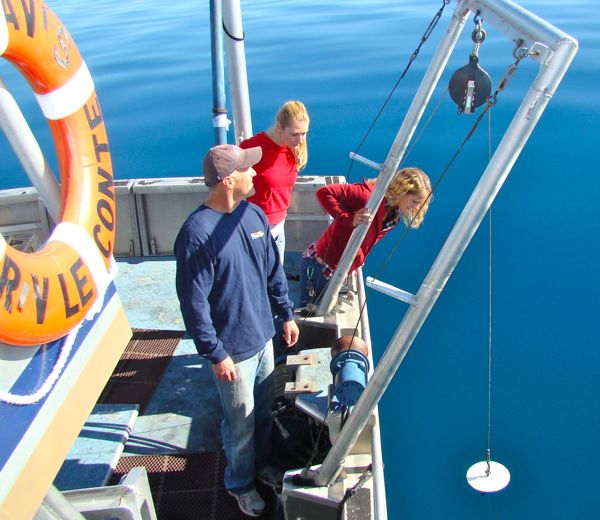
The Secchi disc is lowered into Lake Tahoe for one several readings. Photo/Katherine E. Hill

The Secchi disc is lowered into Lake Tahoe for one of several readings. Photos/TERC

“This year, in particular, these single-cell algae were concentrated very close to the surface, strongly scattering light and thereby impacting lake clarity,” said John Reuter, associate director of TERC in a release about the decline in clarity.

The State of the Lake report also calls for continued joint efforts by California and Nevada to manage the health of Lake Tahoe. The Nevada Legislature passed a bill in June to pull out of the Tahoe Regional Planning Agency Compact by 2015 unless the Regional Plan is amended.

“While land use activities, resource management activities and policy can be controlled to conform to geopolitical boundaries, the waters of Lake Tahoe are not constrained by these human boundaries,” the report states. “What happens in the waters of Lake Tahoe is a direct reflection of activities in both states. If a concrete example of why Lake Tahoe needs to be managed jointly by the two states is needed, then this is one.”

Optimism despite decline

The clarity report also reports a trend in increased clarity during the winter months, with decreased clarity occurring during the warmer, summer months. Researchers stated in the report that improvements in winter clarity measurements may be due to recent efforts to reduce urban stormwater flows, but that those gains are being lost in the summer, which sees higher than normal temperatures due to climate change.

“There is every reason to believe that if it were not for the decades of watershed management, development policy and water quality restoration projects, the lake’s transparency would be worse than it is today,” Geoffrey Schladow, TERC’s director, said in the release.

Despite the drop in clarity, researchers remain positive about the overall health of the lake. The lake clarity chart shows the measurement through the years.

“Taken alone, that decline in clarity is unusual, but it is within the range of normal fluctuations,” Schladow said.

For the first time, researchers also have gleaned a bigger picture of Lake Tahoe’s clarity using remote sensing to record data from around the lake. Most notable in the remote sensing findings is that clarity on the East Shore is lower than the West Shore for most of the year, according to the report. As well, clarity generally improves 1 mile off the shoreline than at points closer to the shore.

How clarity is defined

Lake clarity is measured by several scientific means, but it has been continuously measured since 1968 using a Secchi disc, a 10-inch white disc that is lowered into Lake Tahoe throughout the year to come up with a yearly average. The Secchi measurements are the longest continuous measure of Lake Tahoe’s water clarity.

The Secchi disc was developed in 1865 for use by ships to measure the depths of harbors, but has been used in modern times to measure the clarity of water.

The Secchi disc is the main means to measuring lake clarity. Photo/Provided

The Secchi disc is the main means to measuring lake clarity.

The Secchi disc measurements are taken by researchers every 10 days at solar noon at the same two locations – off the Tahoe City shelf and off Homewood toward the middle of the lake, according to Heather Segale, TERC’s Education and Outreach director.

The disc is lowered from the boat by a metered wheel and the researcher marks the point on the wheel at which the disc disappears from view, Segale explained, and then marks the point at which the disc reappears as it is raised. The distance between these two points is averaged for the day’s reading.

Since the researchers rely on their eyesight to mark the points at which the disc disappears and reappears, they are required to have their eyesight checked regularly, cannot wear sunglasses, and measurements are performed only during smooth waters, according to Segale. The annual clarity measurement is an average of about 20 to 25 measurements; about 10 are thrown out due to anomalies such as inclement weather, wind and other factors.

While the Secchi disc measurements represent the longest study of the lake’s clarity, researchers also rely on other measurements to gauge clarity. Researchers use several high-tech instruments mounted on a Seabird profiler: a transmissometer that measures how much light of a certain wavelength is received over a fix path; an optical backscatter sensor that measures how much light from a LED is scattered backward by particles; a photosynthetically active radiation sensor that measures solar radiation; and a turbiditimeter that measures the cloudiness of water.

In addition to the annual clarity report, the State of the Lake report also addresses efforts to control aquatic invasive species, such as the Asian clam that were first reported in Lake Tahoe in 2002. The report also addresses the impact of climate change on precipitation, changes in the lake’s water temperature and effect of lake warming on circulation.

To view the report, go online.


Dropout rate in California on the decline

Publisher’s note: In Lake Tahoe Unified School District, South Tahoe High reports 13 dropouts for a rate of 1.1 percent; Mt. Tallac High had 18 drop out for a 18.8 percent rate. In the Tahoe-Truckee Joint Unified District, Tahoe Truckee High lost six students for a rate of 0.8 percent; North Tahoe High had two drop out for a rate of 0.6 percent; and Sierra High lost one student for a rate of 2 percent.

By Phillip Reese and Melody Gutierrez, Sacramento Bee

The high school dropout rate fell sharply in Sacramento and across California during the 2010 school year, as roughly two-thirds of the state’s school districts showed improvement, according to state data released Thursday.

Despite the one-year decline, education leaders say too many students are dropping out of high school, especially among blacks and Latinos.

This year report is billed as the most accurate picture of student graduation rates because they were tracked for four years by the state’s California Longitudinal Pupil Achievement Data System, or CALPADS.

In previous years, school district officials expressed skepticism over the four-year dropout rates, which were calculated using assumptions because the system had yet to collect four years of data.

In releasing the data Thursday, state Superintendent of Public Instruction Tom Torlakson said the conversation about dropout rates now can move from how they were calculated to how to lower statewide figures.

Read the whole story


8th annual Trails and Vistas

Experience a unique blend of art and the natural world during the eighth annual Trails and Vistas art hike on Sept. 17-18.

The hike, modeled on the theme of “Reflections and Rhythms,” takes place at Spooner Lake in Lake Tahoe Nevada State Park.

Expect to hear the beats of REMO Endorsed Drum Circle facilitator Norman Jones from the Rhythm Child Network, a group that helps children and adults connect with their inner rhythms through drumming. Also, new for Trails and Vistas are dancers from Marin-based Terpisicor D’Amour Dance and Lorna Danton, a visual artist from Reno.

Emmy-award winning Chris Spheeris, a musician and poet from Sedona will be returning to perform at Spooner Lake for this year’s art hike. Enjoy the fluid movements and strength exhibited by acrobats and dancers from San Francisco-based Capacitor, an interdisciplinary dance company obsessed with the mechanics of the human body and machines that propel the body through space. These performers are known for the expertise in rigging systems, wearable sculpture, and engineers of large-scale props. Appreciate the sculpture, movement and mythology created by dancer Lesley Ehrenfeld Chapman. Delight in the exquisite painting by Cathee vanRossem-St.Clair, famous for her magnificent egg art – one of eggs, The California Thrasher was created for the Whitehouse Christmas Tree and is now in the National Archives. Another Tahoe-Truckee resident, Emily Tessmer of Orenda Blu Music, will share sacred chants. Dancers from InnerRhythms Dance Theatre will spark your imagination.

Additional artists are Truckee-based artist Caree Bragg, local poet Kira Yannetta who recruited her brother, Benjamin Hall, a musician from Southern California to participate in this year’s event.

The list keeps going with an impressive group of creative minds and hearts including Angelika’s Healing Music, Angelique Benicio and Deborah Kelly. Attend one of the Saturday hikes and hear Reno Taiko Drummers led by Rieko Shimbo. As a young girl in Japan, Shimbo saw taiko performed at many festivals. Her formal training began with a professional company based in Tokyo. Today she has her own group in Reno with 15 students who practice weekly and perform throughout the year.

There will be a variety of specialty hikes including family hikes designed for walking with children at 2pm Sept. 17 and 10 and 10:15am on Sept. 18; leisure hikes suitable for anyone not acclimated to high elevation at 4pm Sept. 17 and noon and 3:30pm on Sept. 18; and adult-only meditative hikes will be available at 3:30pm Sept. 17 and 2:30pm Sept 18.

The art hike is a collaboration between artists and nonprofit organizations including the main sponsor, Trails and Vistas, and the Truckee Donner Land Trust, InnerRhythms Dance Theatre and the KidZone Children’s Museum.

For more information and ticket prices, go online.


Survivor of Rwandan genocide speaks

On Sept. 17, experience Immaculée Ilibagiza, storyteller, author and inspirational speaker, who will present “Left To Tell: Discovering God amidst the Rwandan holocaust” at the Truckee Community Recreation Center from 7 to 9pm.

Ilibagiza, a survivor of the genocide that took most of her family members, is a powerful example of one woman’s spirit. She and seven other women spent 91 days huddled together in the cramped bathroom of a local pastor’s house during the 1994 Rwandan genocide. She entered the bathroom a lively, 115-pound university student with a loving family and emerged weighing just 65 pounds to learn that most of her family members had been brutally murdered. Ilibagiza credits her salvage mostly to prayer.

Ilibagiza’s first book “Left to Tell; Discovering God Amidst the Rwandan Holocaust” quickly became a New York Times Best Seller. She was featured in “Architects of Peace” which honored other legends including Mother Teresa, Jimmy Carter, Nelson Mandela and the Dalai Lama, and she recently signed a contract to produce a major motion picture. Ilibagiza is a leading speaker on peace, faith and forgiveness.

The cost is $30 adults, $15 for those 18 and under. For tickets, call (530) 550.8981.


Squaw Valley disc golf tournament

Squaw Valley is hosting the resort’s first PDGA-sanctioned professional and amateur disc golf tournament Aug. 20-21.

The tournament will consist of two rounds of 18 holes, one round per day.

The only lift-accessed disc golf course in the Lake Tahoe region, Squaw Valley’s course is of championship caliber. Holes 1, 2 and 18, located directly behind the High Camp complex, account for the easier holes on the course, while holes 3 through 17 offer a more extreme challenge as the course winds down and up Squaw Valley’s Rainbow Bowl under the Solitude chair lift.

Registration for the Squaw Valley’s Pro/Am disc golf tournament ranges from $40 to $80, depending on bracket level, with $10 off for PDGA members. Discounted Cable Car tickets are included in the entry fee. Participants can go online for further details and registration forms.


Organized bike ride in South Tahoe

On Sept. 18, Lake Tahoe Bicycle Coalition’s board of directors will lead a recreational bike ride along South Lake Tahoe’s bicycle path system.

The ride starts and ends at Blue Dog Pizza at the north end of Raley’s Shopping Center near Stateline.

The ride begins at 1pm and is expected to last 3 to 4 hours and travel 15 to 20 miles. The ride is free and open for everyone interested in a relaxed pace ride, stopping for photos, and chatting about the bike paths and surrounding areas.

RSVP to biketahoe@aol.com.


Vail Resorts looking for nonprofits wanting some money

Vail Resorts’ corporate stewardship program Echo has money to give to South Lake Tahoe nonprofits.

Echo encompasses environmental stewardship, charitable giving and community engagement and is aimed at protecting the natural resources that surround the resorts and helping to build stronger communities. This is the third year the Vail Resorts Echo program has awarded grant money in the South Lake Tahoe community.

For its grants – cash and in-kind, Vail Resorts Echo focuses on two main areas that enhance the quality of life in South Lake Tahoe:

• Education and youth programs.

• Innovation for and implementation of environmental stewardship practices.

The Vail Resorts Echo Heavenly Giving Council, comprised of Heavenly leadership, reviews the grant applications and award cash grants and in-kind donations once a year. Local nonprofits based in the South Lake Tahoe area and that have a focus on youth programs and environmental initiatives are encouraged to apply. Applications for potential grantees are due Aug. 24.

New this year, the application process is completely online to streamline operations. The Vail Resorts Echo website outlines the program criteria, provides examples of programs supported and outlines how to apply.


South Shore fireworks

Fireworks on the South Shore start at 8:30pm on Sept. 4.


Positive earnings report for Liberty Energy’s parent firm

Liberty Energy’s parent company Algonquin Power & Utilities Corp. today announced financial results for the second quarter ended June 30, 2011, with results showing increased revenue, earnings before interest, taxes, depreciation, and amortization and earnings compared to the previous year.

For the second quarter of 2011, revenue was $66.8 million as compared to $42 million in the second quarter of 2010.

Liberty Energy provides electricity to the California side of the Lake Tahoe Basin as well as to Alpine County.

Officials said the increase in revenue over 2010 is primarily the result of a subsidiary of Liberty Utilities Co. acquiring a California-based electricity distribution utility and related generation assets at the beginning of 2011, increases at the end of 2010 due to the results of rate case approvals for revenue increases in Liberty Utilities water distribution and wastewater treatment business, and the Energy-from-Waste facility being operational as compared to the same time last year when it was undergoing repairs.

— Lake Tahoe News staff report


Alleged kidnapping of 93-year-old woman ends in S. Lake Tahoe

By Kimball Bennion, Great Falls Tribune

A South Dakota man accused of kidnapping his elderly mother from an assisted-living facility in Great Falls, Mont., was arrested, along with his daughter, Wednesday while trying to secure legal guardianship of his mother in South Lake Tahoe, police announced Thursday.

Great Falls Police had been searching for James Wainscoat, 70, since Saturday, when he allegedly drove away with his mother from Renaissance Senior Care at 2000 16th Ave. S. Police classified the action as kidnapping because Wainscoat did not have power of attorney for his 93-year-old mother, Troy Wainscoat, who police say has Alzheimer’s disease. One of James Wainscoat’s siblings and that sibling’s mother-in-law are the only ones who can legally make decisions for Troy Wainscoat.

Court documents state that James Wainscoat showed up at the facility with three of his children, including 18-year-old Ishayah Wainscoat. James Wainscoat told facility workers that he had gifts for his mother, which included a cake that read “Bon Voyage Grandma Troy.”

According to a charging affidavit, workers told them that they didn’t know anyone by the name of Troy Wainscoat, and Ishayah Wainscoat responded by saying: “You can’t keep me from my grandma, I need to see her.”

James Wainscoat allegedly pushed a worker out of his way and led his mother out the door, even though facility personnel said he couldn’t take her. James Wainscoat and Ishayah Wainscoat drove away, allegedly leaving Troy Wainscoat’s walker in the parking lot.

Read the whole story