Toccata performances

Tahoe Symphony Orchestra and Chorus (Toccata) commemorates the 10th anniversary of the 9-11 tragedy with a concert series that features famed violinist Elizabeth Pitcairn performing Mozart’s Concerto for Violin No. 3 in G Major on the legendary Red Stradivarius

Violin. The program concludes with Beethoven’s Symphony No. 9.

Performances are:

Sept. 11 at 3:30pm at St. Theresa Catholic Church in South Lake Tahoe

Sept. 13 at 7:30pm at St. Thomas Aquinas Cathedral in Reno

Sept. 16 at 7pm at Trinity Episcopal Church in Reno

Sept. 17 at 3pm at the North Tahoe Events Center in Kings Beach.

Tickets are $30 adults, $25 seniors, (62 and up), and $5 students. Preferred seating is available for $40 and can be reserved online.

Tickets may be purchased in advance by credit card online or at the door by cash or check. For more information, call (775) 313.9697.


2-year-old, father found dead in El Dorado County

By Rick Daysog, Sacramento Bee

The search for 2-year-old Madeline Samaan-Fay ended tragically Saturday night after FBI agents found the toddler’s remains in a remote area of El Dorado County.

Federal officials issued an Amber Alert on Friday after the curly-haired child was abducted by her father, 49-year-old Mourad “Moni” Samaan.

FBI agents discovered Samaan’s vehicle, a green Toyota 4Runner, Saturday night along with the bodies of the little girl and her father near Grizzly Flat Road and Cosumnes Mine Road southeast of Placerville.

The site is just a few miles away from the Eldorado National Forest.

The car was discovered about 8pm by the El Dorado Sheriff’s Department based on a tip to the FBI.


Images of iceberg edges help with calculating their thickness

By Val Schmidt

We arrived in Cumberland Sound on the evening of July 25 and the ship immediately commenced an SX90 sonar acoustic fisheries survey for Arctic Cod that they hoped to find in this area. This was not part of our own effort, but rather that of the chief scientist for this leg, Louis Fortier. That said, the SX90 is a new addition to the Amundsen and we are greatly interested in its operation.

The main reason for our own interest is that it also has the capability to image the edges and estimate the thicknesses of icebergs. While the resolution is coarse, we hope it will provide ancillary data during our own effort at iceberg mapping in the next few days.

The morning of July 26 began with an early 5am start. As the ship commenced a water column and benthic habitat sampling station, we departed the Amundsen aboard the “barge” for a few short hours of AUV and EM3002 sonar testing. While we will be running the AUV underneath the iceberg, the EM3002 will be mounted at a 45-degree angle to image the side of the iceberg. The barge is a small landing craft carried by the Amundsen, useful for calm weather science and operations to shore when required.

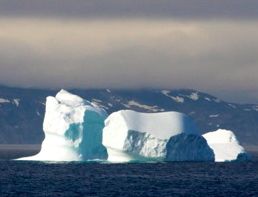
Smaller iceberg drifting in Cumberland Sound. Photo/Alex Forrest

Smaller iceberg drifting in Cumberland Sound. Photo/Alex Forrest

Our plan was to find calm water near shore in the vicinity of Cape Mercy, NU (about 25 nautical miles from where the CCGS Amundsen was collecting other samples) in which to ballast the AUV with the new SwathPlus sonar module, conduct a short test mission and also conduct a patch test for the EM3002 shallow water multibeam. The team from the University of New Brunswick (UNB) has installed the EM3002 aboard the barge for the season and Travis Hamilton of UNB will operate the EM3002 during our iceberg-mapping event. A special mount has been manufactured that tilts the sonar toward the surface allowing the system to capture a high-resolution swath around the periphery.

We set out for Cape Mercy, to the only inlet with any soundings on the chart. We would later learn that this foreboding looking location was once part of a Cold War era Defense Early Warning Station (“the DEW Line”). The enclosed area afforded calm water for our ballasting tests. After these tests, two short AUV missions were run and data was collected for the EM3002 patch test. The next step is to reproduce what we were doing here upside down.

The opportunity to test the AUV was fortunate as the vehicle was unable to successfully complete a mission, stubbornly refusing to dive beneath the surface. In addition, the CTD (conductivity-temperature-depth) sensor mounted on front of the AUV failed to collect data during our test – a recurring problem that we had thought had finally been resolved in our pre-cruise testing. This was of significant concern for those on the team interested in studying the mixing dynamics associated with the iceberg. These issues made for a solemn return to the ship as we pondered our next step. We took some time to warm up and take a short nap before having a closer look at the log files being stored by the AUV during the in water tests. The ship had also been busy while we were away, conducting various casts and box-core samples, which had brought up several hundred species of benthic critters.

After a careful inspection of the log files of the AUV we determined our Acoustic Doppler Current Profiler (ADCP) – an instrument used to measure water currents – to be malfunctioning, such that the AUV was unable to reliably measure the distance to the bottom. This would result in the vehicle frequently measuring zero meters when the bottom was in fact more than 14 meters. Altitude measurements are critical to operation, as the AUV will initiate evasive maneuvers to prevent collision with the bottom when values near zero are returned.

This behavior prevented the AUV from diving beneath the surface. Investigation of the ADCP data showed beam 3 of the 4-beam array to contain no useful data. With no further recourse we opened the ADCP module to see if we might be able to test or isolate the problem. No immediate options to do so were apparent, but we took the opportunity to ensure all connectors were firmly in place.

On reassembly and testing we found beam 3 to be producing data comparable to the other beams. While the solution is not wholly satisfactory, we hope to have an opportunity to test the system in the water later this afternoon.

Excitement increases for the real event. We expect to be above 70 degrees north within the next day or so. Once above this latitude, the search will begin in earnest to find a suitable target. While smaller ones like this one in Cumberland Sound are scenic, they are too small for our needs.

Val Schmidt is with the Coastal Center for Ocean Mapping at the University of New Hampshire. He is part of team that includes a researcher from UC Davis TERC in Incline Village studying icebergs.


Snippets about Lake Tahoe

tada• Celebration of Education by the Lake Tahoe Educational Foundation is Aug. 26 from 5-7pm at South Tahoe High School. Tours of the Theater Arts & Design Academy will be given. This event is free and open to the public.

• Employees from the San Francisco and Silicon Valley offices of California Technologies took a road trip to Lake Tahoe to help build sections of the Rim to Reno Trail System on Aug. 13.

• Money is available for those with cycling interests. Grant deadline is Aug. 26.

• Barton’s Skilled Nursing Facility is seeking energetic and enthusiastic volunteers to lead an hour of enjoyment and entertainment for their residents from 4 to 5pm. If interested, call Maureen Froyum at (530) 543.5533.

• South Tahoe is conducting a Bijou neighborhood meeting on Aug. 23 at 6:30pm Bijou Community School.

• Here is Caltrans’ Sierra roadwork schedule for next week. And this is the Tahoe roadwork schedule.


Cocktail contest raises money for Barton Foundation

Barton Foundation’s annual Signature Cocktail Contest is Sept. 8 from 5:30-8pm at Riva Grill in South Lake Tahoe. Must be at least 21 to attend.

The contest is the kick off to the Festival of Trees and Lights which is the first weekend in December at MontBleu in Stateline. Both events benefit the expansion and renovation of Barton’s Community Clinic.

Taste specialty cocktails by local mixologists, heavy appetizers, music from Cool Black Kettle. Watch our local “celebrities” ham it up while they vote for “Best Cocktail,” and then cast your ballot for “Most Congenial Bartender.”

Tickets are $25 through Sept. 7 and $30 at the door. Purchase them online or call (530) 543.5614.


Wildflowers a bonus treat on hike to Dardanelles Lake

By Kathryn Reed

Pretty face, cow parsnips, California valerian, forget-me-nots, lupine, columbine, Indian paintbrush, larkspur, groundsel – these are just some of the flowers flourishing in a kaleidoscope of color along the trail to Dardanelles Lake.

It’s helpful to have someone on the trail telling you what you’re looking at instead of just saying – ooh, look at that pretty red or yellow or purple flower. They actually have names besides colors.

This splash of color was an added bonus to the hike Sue and I took my mom on two weeks ago. I don’t often think of this trail as a wildflower destination, but instead I like it for the magical alpine lake at the end of the 3.5 miles.
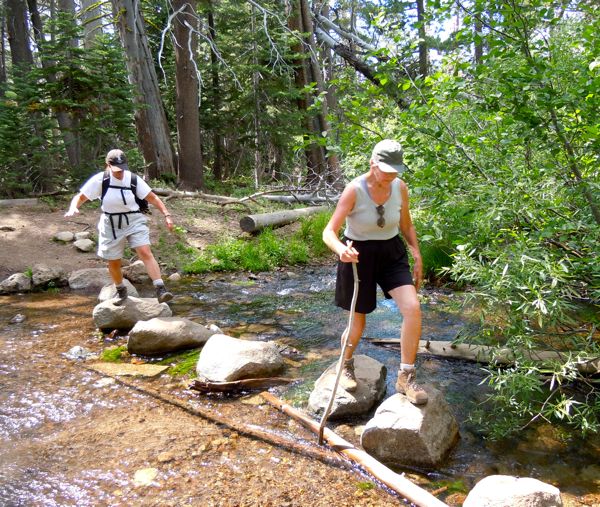
Sue Wood and Cleo Reed cross a stream on hike to Dardanelles Lake. Photos/Kathryn Reed

Sue Wood and Cleo Reed cross a stream on a hike to Dardanelles Lake. Photos/Kathryn Reed

With the abundance of moisture this season, not only are the flowers prolific, so are the mosquitoes. Even with bug juice, we had plenty of souvenirs to itch.

Another consequence of the snowfall and water is the bridge leading into Big Meadow has collapsed. While the water was still tumbling over it on the last Saturday of July, it was crossable without getting wet.

But that’s not the only water crossing. Fairly stable rocks have been strategically placed in other sections to make stream crossings do-able.

It was magical on this particular Saturday to see the array of wildflowers. Some are so tiny, some are like groundcover, while others go above my knees. I just want to pick them to have for a bouquet – but instead I take their pictures.

We pause to marvel at their beauty. But soon we are hitting ourselves to swat at the skeeters.

Big Meadow is so aptly named. The tall grasses make me channel Julie Andrews – but I don’t sing out loud. The hills really do seem alive, though.

We carry on. After all, the meadow is just the beginning.

Plenty of shade covers the trail – which is welcome. Mostly it’s dirt at a moderate climb. We start at 7,200 feet, with the maximum elevation being 7,760 feet.

The worst part of the hike is leaving the lake. It’s a good descent at the end to Dardanelles Lake, so climbing out is no fun. We certainly didn’t appreciate the downhill enough since we were whining going out.

Oh, but that lake. It shimmers in a way that it looks like it is dancing. Granite walls line one side. People are swimming to rocks; others wade closer to the shore.

I think cold water is for drinking, not dipping into. After all, snow dots the far shore as well as the peaks.

Flat granite provides an ideal spot for lunch. While there are several people doing the same, we still have our own spot in the Sierra.

Color on this trail is not limited to the wildflowers. In the fall, the aspens come alive in their array of yellows and oranges.

Getting there:

From South Lake Tahoe, go west on Highway 50.

Pass the bug station, then turn left onto Highway 89. Before reaching the summit of Luther Pass, Big Meadow trailhead parking is on the left. Park.

Follow the trail from the lot that crosses the highway. You passed the trailhead marker on Highway 89 on your right.

Follow the signs to Dardanelles Lake. Signage is good for the most part. But about a quarter mile from the sign that has you go right, you need to make a sharp left. The trail is obvious, but it also goes straight – so it’s not obvious turning left leads to Dardanelles.

Part of this is the Tahoe Rim Trail.

The route is 7 miles roundtrip. The U.S. Forest Service rates it as moderate. My 76-year-old mom says it’s a wee bit more than moderate.

ngg_shortcode_0_placeholder (Click on photos to enlarge.)


Tips for coping with financial volatility

By Jane Honeck

The recent budget crisis catapulted us into this week’s stock market turmoil and reaffirms the consequences of ignoring Sir Francis Bacon’s 400 year old words, “The only thing we have to fear is fear itself.” Those sage words were echoed during FDR’s inaugural speech and still ring true today.

We clearly see how the fear of future failures and potential losses drives down expectations so we operate from a place of weakness instead of strength. It’s the proverbial bogeyman in the closet. The more we focus on him, the bigger, more ferocious he gets.

So how can we as individuals move beyond today’s economic anxiety and fear and get on with our lives? How do we keep our own stability and help build this economy instead of tear it down?

Like it or not, we’re all in this together and it’s clear what happens when we tackle today’s problems as a house divided. Frustration and mistrust grow and the solution seems out of reach and certainly nothing we can influence. But, our own grass-roots efforts can make a difference in moving us and the country out of fear back into possibility.

The following are simple steps anyone can take to step out of financial paralysis and into building new money muscles:

1. Talk it up: Ignoring your anxieties and keeping fear bottled up only makes them fester and grow. Share your feelings with someone and get their perspective. Without shared perspective, we magnify negative speculation, mix it with past failures, and the financial bogeyman grows. With sharing, things become more balanced and, at the very least, two of you will be shouldering the load instead of just you.

2. Stay in the moment: Affirm your own financial reality now. Did you make it through yesterday, last week, last month? Have things changed that much? Do you have enough today? None of us know what’s really ahead—but we can be certain about today. Staying in the moment and not getting too far ahead of ourselves puts a stable foundation back in place.

3. Choose your battle: Be honest about what’s underneath your concern — is it mistrust, lack of control, powerlessness? Today’s financial fears keep us worrying about things we can’t change. But, we become empowered by transforming those we can. Can we stop the stock market slide? Probably not, but we can make changes in our own financial world.

4. Take the next step: Don’t worry about all the steps from here to your own financial stability—you only need worry about the next step. Keep your eye on your financial goals and begin shifting from emotion to motion. Pay a bill; start a savings account; cut up a credit card—any next step will start the momentum. Ultimately, the culmination of those next steps will build trust in yourself and your ability to meet your future goals.

5. Do it again: When the next negative headline appears (and it will) go back to No. 1. Fear is a part of life, but it doesn’t have to take over our life. It may feel like a lot of effort the first time you tackle these steps. But, use them often and eventually you’ll slip right through fear and into empowered action with a blink of an eye.

There you have it, a simple plan responding to time-tested sage advice. Five easy steps that move us from emotion to motion, paralysis to possibility, fear to trust. And, when we trust, all things are possible.

Jane Honeck is a CPA, PFS, and author of “The Problem With Money? It’s Not About the Money!”, is a money coach specializing in tax and financial planning for small businesses, individuals and couples.


Millions of tax dollars unclaimed by Californians

By Claudia Buck, Sacramento Bee

The IRS may have “missing money” waiting for you.

Millions of dollars in refunds owed to thousands of California taxpayers haven’t been claimed, says the IRS. There are two kinds of refund monies: undelivered and unclaimed.

If your paper refund check was returned to the IRS as “undeliverable” by the U.S. Post Office, you need to claim it. The IRS uses a taxpayer’s last known address, but if you moved and hadn’t notified the IRS, your check may be waiting. Undelivered refunds don’t expire.

As of last fall, there was $23.4 million in undelivered refunds sitting unclaimed for some 15,700 California taxpayers, including more than 900 in the Sacramento area, said IRS spokesman Jesse Weller.

The other category is unclaimed tax refunds by those who didn’t file a return.

Read the whole story


Joan Bamberger — 1943-2011

Joan Bamberger, who taught at South Tahoe High School from 1967-2003, died Aug. 12 in Desert Hot Springs after a lengthy illness.

She was 68.

She taught business and typing to thousands of students and took great interest in their future accomplishments. She coached the high school girls’ vollyball team during the 1970s.

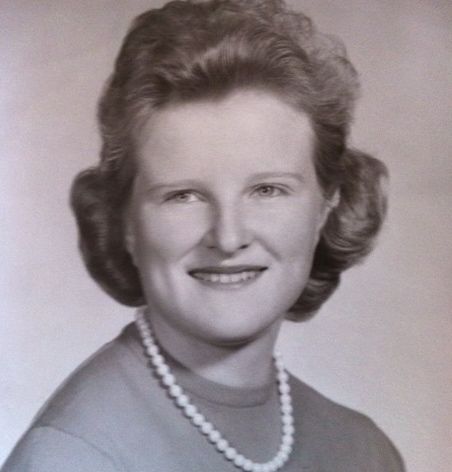
Joan Bamberger

Joan Bamberger

Ms. Bamberger enjoyed golf, bridge and most important, cherished her many friendships.

Ms. Bamberger requested no service.


Squaw Valley woman barely survives falling through snow into water

By Marek Warszawski, McClatchy-Tribune

There was no time to react. One instant, Marcia Rasmussen was walking on snow. The next, she was engulfed by icy water and being swept downstream.

“There was no way,” says Rasmussen, the tone of disbelief in her voice still fresh. “I didn’t hear the ice crack or groan. No way. It all happened amazingly fast.”

It was a sunny and warm June afternoon at Mineral King, the glacial valley in southern Sequoia National Park in California. For the 51-year-old ultramarathon runner from Squaw Valley, it was one of her usual training jaunts.

Running and hiking alone, Rasmussen was on her way back to the car when she came to the spot where the Farewell Gap Trail crosses Franklin Creek on a snow bridge.

Snow bridges are a common sight during early summer in the Sierra backcountry, formed when snowdrift fills in the opening around a creek. This one appeared sturdy. In fact, Rasmussen had thoroughly checked it out before crossing without incident on her way up. She even carried an 8-foot-long branch with her for safety.

“It felt very firm and was about 4 feet thick,” she says. “I poked at it with a stick, to see if it had softened any.”

Rasmussen was about two-thirds of the way across when the section she was walking on gave way. She remembers her head going underwater, gasping for breath and feeling helpless as the current carried her over a small waterfall and farther down the snow tunnel.

After about 40 feet, Rasmussen managed to grab onto a bush. It took all her strength to pull against the current and drag herself out of the water.

“There was an alcove just big enough for me to stuff my body into,” she says.

Cold and shivering, Rasmussen took a minute to gather herself. Her decades of experience as a mountaineer one who used to teach search and rescue courses in Virginia taught her not to panic. Despite being trapped beneath several feet of snowpack, she knew she was lucky to be alive.

Read the whole story