Chili fundraiser for SITS
Chili sales at Coyote Grill in Roundhill on Sept. 29 starting at 5pm will benefit Soroptimist International Tahoe Sierra.
Chili sales at Coyote Grill in Roundhill on Sept. 29 starting at 5pm will benefit Soroptimist International Tahoe Sierra.
The 8th annual Barn Dance and BBQ hosted by Al & Patty Moss in Markleeville is Sept. 10 from 4-9pm.
Proceeds benefit the Eastern Alpine County Fire Department (Woodfords and Markleville) and also the South Tahoe High School football team.
Al Moss and the Rip Tides will be the entertainment.
Tickets are $35 per person and kids under 12 are free. Call Al Moss at (530) 694.2508 for more information.
Kiwanis Club of Tahoe Sierra’s annual SeptOberfest is Sept. 23 at 6pm at MontBleu in Stateline.
Tickets are $35.
The inaugural Climbing Festival & Bouldering Competition in Meyers is Sept. 17.
Joshua Welch of Safe Haven Chiropractic in Meyers is spearheading the event so people can watch and learn about the beauty and athleticism of playing on granite.
He says Lake Tahoe bouldering has exploded in the last few years.
The event is free to attend,with a small fee to compete.
Many climbs will be included in the contest ranging from 5.6 to V10 and beyond. Limited guides will be included in the competition format. The contest is for all ability levels. More than $2,000 in prizes will be awarded.
The free climbing festival starts at 2pm. Get some food, check out climbing booths and meet the athletes. Listen to great music and hang out in the beer garden.
The awards ceremony starts at 4pm, with a bouldering demo competition at 5pm.
More information is online, including how to sign up to compete, or call (530) 577.5433.
By Kathryn Reed
Easing into her new environment isn’t exactly Liz Niven’s style. Instead of a small production, maybe even one that wouldn’t be well attended, Niven is going all out when it comes to breaking in South Tahoe High School’s new theater.
“42nd Street” with all of its music and dancing will be the first performance in the theater that is still having finishing touches done to it even with school starting Monday.
“I was looking for a well-known play – something that is a big, exciting blockbuster that would involve a large school population,” theater arts instructor Niven told Lake Tahoe News. “Most musicals can be as big as you want.”
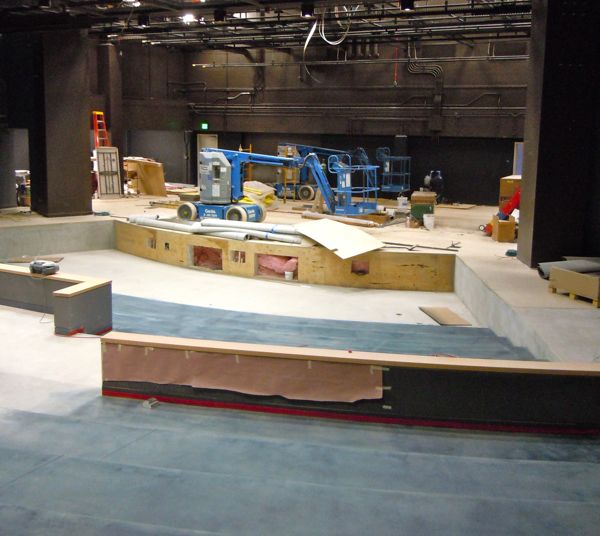
In June the theater at South Tahoe High didn't even have seats. Photo/LTN
When the school put on “Crazy for You” it had a cast of 60. She will begin casting for “42nd Street” the third week of school.
“It’s an educational program. Part of the education is you have to give people a chance to discover what they love or don’t love,” Niven said of allowing so many to participate. “The only problem with a big cast is finding costumes for everyone. The more people you have, the more shoes you have to find.”
Right now it’s all about finding where everything is and how it works.
While those who attend tonight’s Celebration of Education put on by the Lake Tahoe Educational Foundation from 5-7 may think the Theater Arts & Design Academy is complete, work will practically continue until the first bell rings. (Tonight’s event is free and open to the public.)
The TADA building, as it is better known, looks like a cutting-edge theater production facility – some have called it leading edge.
While this stage outshines others on the South Shore, it is smaller than what was there. This is because by the time all the agencies weighed-in compromises needed to be made. There are even fewer seats.
Still, the enthusiasm in Niven’s voice is unmistakable.
“It has cool side stages. I’m looking forward to trying and playing with those as well,” Niven said.
Niven usually does three plays a year. With teachers and students figuring out how everything works, she will do two this year, with the musical being the first. “42nd Street” will be staged the first two weekends in December.
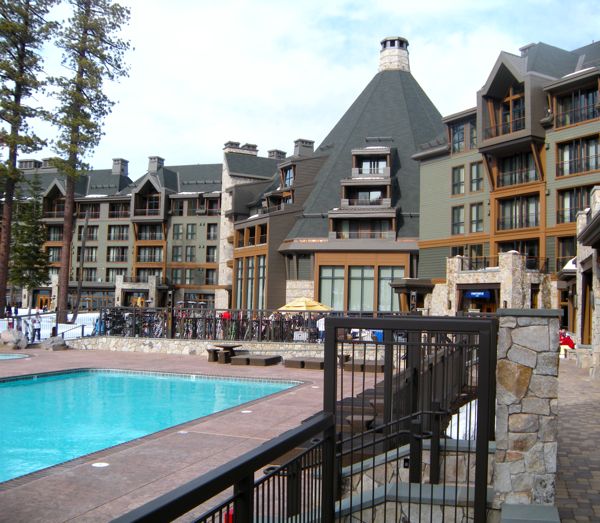 • AAA has given its five diamond designation to the Ritz-Carlton at Northstar.
• A tribute to Olga Hopkins will be Sept. 16. Click on flyer for more details.
• Tahoe Keepers is a free training program designed to help non-motorized watercraft operators guard against inadvertently transporting aquatic invasive species.
• Kiwanis Club of Lake Tahoe is having a pancake breakfast Aug. 27 at 7:30am at Lake Tahoe Airport as the first event of the annual air show on the South Shore.
• Lake Tahoe Unified School District has released a map of what the traffic pattern around South Tahoe High School will be like when classes start next week. Click on STHS info for the map.
By Casey Schwartz, Newsweek
On a sweltering August morning, in a classroom overlooking New York’s Hudson River, a group of 3-year-olds are rolling sticky rice balls in chocolate sprinkles, as a teacher guides them completely in Mandarin.
This is just one toddler learning game at the total–immersion language summer camp run by the primary school Bilingual Buds, which offers a year-round curriculum in Mandarin as well as Spanish (at a New Jersey campus) for kids as young as 2.
Bilingualism, of course, can be a leg up for college admission and a résumé burnisher. But a growing body of research now offers a further rationale: the regular, high-level use of more than one language may actually improve early brain development.
According to several different studies, command of two or more languages bolsters the ability to focus in the face of distraction, decide between competing alternatives, and disregard irrelevant information. These essential skills are grouped together, known in brain terms as “executive function.” The research suggests they develop ahead of time in bilingual children, and are already evident in kids as young as 3 or 4.
While no one has yet identified the exact mechanism by which bilingualism boosts brain development, the advantage likely stems from the bilingual’s need to continually select the right language for a given situation. According to Ellen Bialystok, a professor at York University in Toronto and a leading researcher in the field, this constant selecting process is strenuous exercise for the brain and involves processes beyond those required for monolingual speech, resulting in an extra stash of mental acuity, or, in Bialy-stok’s terms, a “cognitive reserve.”
Bilingual education, commonplace in many countries, is a growing trend across the United States, with 440 elementary schools (up from virtually none in 1970) offering immersion study in Spanish, Mandarin, and French, in that order of popularity.
For parents whose toddlers can’t read Tolstoy in the original Russian, the research does offer some comfort: Tamar Gollan, a professor at University of California, San Diego, has found a vocabulary gap between children who speak only one language and those who grow up with more. On average, the more languages spoken, the smaller the vocabulary in each one. Gollan’s research suggests that while that gap narrows as children grow, it does not close completely.
By Tom McClintock
Federal spending has ballooned 28 percent during the Obama presidency, while the government has amassed more debt than it acquired from the first day of George Washington’s administration to the last day of George H. W. Bush’s.
Our nation is racing toward a fiscal cliff. Yet, as Sen. Jim DeMint noted, instead of hitting the brakes, Congress and the president just set the cruise control.
“The Budget Control Act of 2011” offers an object lesson in exactly the sort of empty compromise that has gotten our nation into its present mess. Faced with the devastating consequences of unprecedented and unsustainable federal spending, both parties agreed on only one thing: to lock in that spending for at least the next two years.
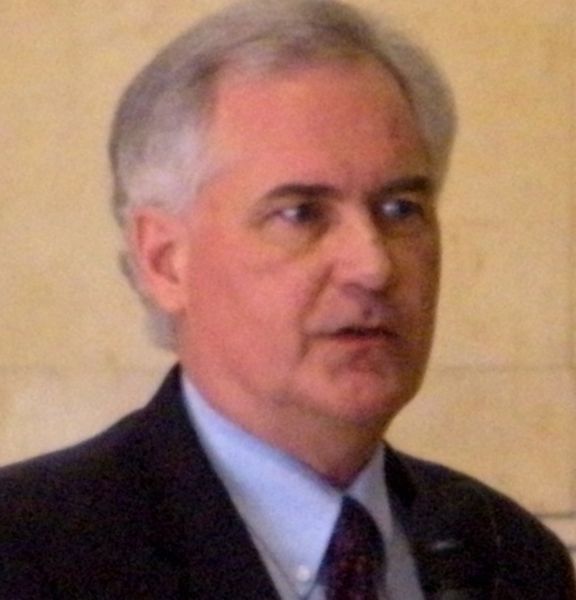
Tom McClintock
Bypassing the normal legislative process, the deal was written behind closed doors and dumped it into the laps of both houses under the threat that failing to pay the government’s bills would jeopardize the nation’s triple-A credit.
Unfortunately, the deal didn’t just pay our current bills – it gave the most spendthrift administration in history an open credit line to continue its spending spree beyond 2012. Ironically, it ended up costing the United States its triple-A credit rating by failing to rein in spending significantly.
Indeed, Standard and Poor’s had explicitly warned for the last two months that $4 trillion had to be cut from the projected ten-year deficit to preserve the nation’s credit. Even if the plan works perfectly, it doesn’t come close.
Yet the same politicians who ignored these warnings were shocked-just-shocked when Standard and Poor’s lowered the boom four days later. Instead, they blamed the “Tea Party” that has been sounding the same alarm for more than two years.
Apologists for the debt deal claim that they “cut a dollar of spending for every dollar of debt increase.” Actually, Congress voted to “cut” annual federal spending from $3.7 trillion this year to $5.4 trillion by 2021, and to “cut” the national debt from $14.3 trillion down to $22.7 trillion. Washington defines this as a “cut” because it would rather spend that much more.
Even adjusting for such charming Beltway colloquialisms, most of the “cuts” don’t take place until after 2017 while the debt increase all happens this year. In the words of the great economist J. Wellington Wimpy, “I will gladly pay you a dollar of cuts 10 years from now for a dollar of debt today.”
At least we didn’t get any tax hikes, right? We’ll see. The so-called “super-committee” that does the heavy lifting is charged not with cutting spending but with reducing the deficit – two very different things.
In Washingtonese, “tax increase” means the same as “spending cut” when referring to deficits. Since the debt deal already assumes restoring Clinton-era tax rates, it’s a good bet that tax increases are on the way. After all, since Congress has essentially frozen spending at record levels for the next two years, we’re going to have to pay back the trillions of dollars of new borrowing somehow.
Central to the deal is the success of the bipartisan super-committee (the 18th bipartisan commission since 1982 to solve the deficit, for those keeping score).
Set aside, for a moment, the constitutionality of sidelining 523 elected representatives of the people while 12 handpicked appointees of the legislative leaders convene in their place. If a bipartisan group of current members of Congress (which we often call, ‘the Congress’) can’t summon the political will to reduce spending to sustainable levels, why would we place far greater confidence in the proposed bipartisan panel of – wait for it – current members of Congress?”
To its credit, the House adopted two plans that met Standard and Poor’s criteria for preserving the nation’s triple-A credit rating: the House Budget Resolution (also known as the Ryan Plan) passed in April, and the Cut, Cap and Balance Act passed in mid-July. Both would have eventually balanced the budget, both would have ultimately paid off the national debt and both died in the Senate.
This simple fact highlights the unfinished work remaining before the American people. Ultimately, they must decide whether they want to restore the traditional American principle of constitutionally limited government, or whether they are content to summarize this generation’s stewardship of the American Republic with the chilling epitaph of Louis XV’s reign, “After us, the flood.”
Tom McClintock represents the California side of Lake Tahoe in House of Representatives.
From 12:01am Aug. 19 through Aug. 25, officers from the South Lake Tahoe Police Department arrested six individuals for driving under the influence of alcohol or drugs.
This is part of the Summer/Labor Day National Anti-DUI crackdown.
On Aug. 24, a DUI checkpoint was conducted in South Lake Tahoe with officers from SLTPD, CHP and El Dorado County Sheriff’s Office. That checkpoint resulted in four adults being arrested on suspicion of driving under the influence, one minor cited for allegedly driving with alcohol in her system, one arrest for reportedly possessing a dangerous weapon and four for allegedly being unlicensed or driving with a suspended licenses. Four vehicles were impounded.
DUI arrest data collection will continue through Labor Day midnight Sept. 5.
By Linda Fine Conaboy
With each book I read about Lake Tahoe and its early settlers, I am reminded that this lovely region isn’t made up of just a few parts: Lake Tahoe, Fallen Leaf Lake, Desolation Wilderness and all the bodies of water there, Glen Alpine Springs, Mt. Tallac, Homewood, Freel Peak, Emerald Bay and so many more intriguing places. It’s all intertwined and the early tales let us know that the sum of these parts made, and even now if you look at the whole scheme of things, still makes a perfect whole.
Janet Beales Kaidantzis, in her just-published book “Fallen Leaf: A Lake and its People 1850-1950,” presents this beautifully. And she was wise enough to enlist the memories of Bill and Barbara Craven, among others, who, after many years at Fallen Leaf Lake still reside there.
In his forward, Bill Craven says: “Fallen Leaf Lake’s happiest years occurred during the one-hundred-year period of this book. For most of that time, the Lake was unknown and sparsely populated. It took great effort to get here; those who made the trip were hardy types who appreciated nature and simple living.”
Amen.
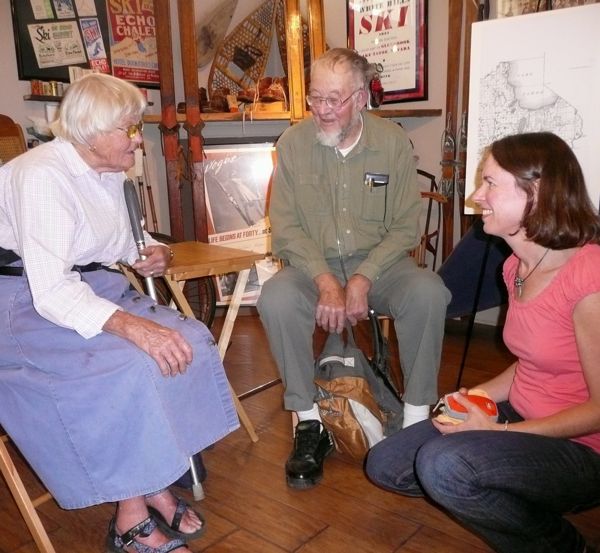
Barbara and Bill Craven with Janet Kaidantzis at the Lake Tahoe Historical Society book signing. Photo/Tom Beales
As I read this book, I wondered, how did they do that, those early settlers? And where did they get the pluck, the resolve to make a life there? And best yet, from Kaidantzis’ viewpoint, it seems they actually had a good time mucking out a life in some incredibly harsh conditions.
During a recent book signing at Lake Tahoe Museum, I had the good fortune to interview Kaidantzis and the Cravens. Kaidantzis’ family goes back five generations to her great-grandpa Arthur Steadman, who helped subdivide a tract of land on the east side of Fallen Leaf Lake in 1925.
“He built a cabin and that cabin has been cherished and passed down from year-to-year,” Kaidantzis said. “We go every summer and winter. In the old days we cross-country skied; I was brought up there as a baby.”
Kaidantzis said her grandparents met at Fallen Leaf, as did her parents, Tom and Marcia Steadman Beales. Additionally, her father’s parents honeymooned at the lake; in the mid-40s, Bill Craven met his future wife, Barbara Granger, at Fallen Leaf.
A book’s beginnings
“This book started as a family project,” Kaidantzis said. “It started when I wrote an essay for my mom’s birthday about our experiences at Fallen Leaf, starting in 1925, and the history of our cabin.”
That’s all it took. Kaidantzis was hooked; there was more to be said. When she finished the essay and realized all that remained to explore, her enthusiasm and motivation for the project spurred her to write more expansively.
“I wanted to share with a wider audience so I spoke to everyone I knew at Fallen Leaf — the old-timers.” She said the support she received from the Lake Tahoe Historical Society was invaluable as was the information she gleaned from Tahoe Heritage Foundation.
Bill Craven, who was a good knowledge source for the book and the grandson of Bertha and William W. Price, founders of Fallen Leaf Lodge, is an authority on all things Fallen Leaf. It doesn’t hurt that he isn’t stingy with his knowledge. Bill and Barbara managed the lodge from 1972 to 1985.
The book begins with Fallen Leaf Lake’s earliest inhabitants — the Washoe people, who also maintained summer camps at Taylor Creek, Camp Richardson and Glen Alpine Springs. In fact, history shows the Washoe inhabited these areas as many as 10,000 years ago.
Their seasonally adjusted lives continued until just beyond living memory, Kaidantzis reports, which is a good way of saying some of the old-timers at the lake still recall “a small group of Washoe women, children and elderly men camped for the summer in the 1930s between Glen Alpine Creek and the shoreline.”
Fallen Leaf’s vibrant settlers
Bill Craven recalls in the book that his grandparents, William and Bertha Price, employed Washoe women and men at Fallen Leaf Lodge.
From the discovery of Fallen Leaf Lake by Col. John Calhoun Johnson and his Delaware Indian guide, Capt. Falleaf sometime between 1850 and 1858, to the discovery of Glen Alpine Springs by Nathan Gilmore the history is nicely detailed and obviously carefully researched.
Kaidantzis reports in depth on the often-heated rivalry between Lucky Baldwin and Gilmore, a feud lasting until Gilmore’s death. She details not only Gilmore’s vast influence on the area as well as those of the colorful, if not always honorable, Baldwin and his legacy of wild exploits.
She includes Lucky’s daughter, Anita, and her impact on Fallen Leaf, including the rise and fall of her estate on the lake’s west shore. Under the provisions of the property’s transfer to the U.S. Forest Service, Anita’s home and most of the outbuildings comprising the estate were demolished in 1953.
Craven, during my interview, said the Anita Baldwin house, which she named Nid Ji Eh Wa Ri (a Hopi Indian word meaning “House on the Lake”), would have made a memorable museum. If you’re up for an easy hike along Fallen Leaf’s west side, not far from the lake’s damn at Taylor Creek, you’ll come across the foundation of Anita’s home and one or two of the outbuildings. It’s worth the walk, and if you sit for awhile on the old foundation, you may find yourself imagining what life was like for a woman of privilege at Fallen Leaf Lake.
There are chapters on John Steinbeck’s sojourn at Fallen Leaf; a nice overview of Glen Alpine Springs; Angora Lakes Resort and the fire lookout at Angora Ridge; Camp Richardson and its founder Alonzo Richardson, as well as several of the other early inhabitants, all of whom made their mark on this area.
Read the book as you would a novel, but watch out, tomorrow you’ll find yourself hiking to Glen Alpine Springs (a tough trek), or at least making the trip on the once oiled, now paved, but always breathtaking road into the lake and its environs.
Oh, and don’t forget to visit the little chapel constructed by William Price and described by Kaidantzis in Chapter 10. He named it for the patron saint of wild birds and animals, Saint Francis of the Mountains. It’s a fitting place to contemplate Fallen Leaf Lake and the folks who left their marks here.
The book
“Fallen Leaf: A Lake and its People 1850-1950” sells for $18.50 plus tax and is available at Lake Tahoe Historical Society and Museum. It can also be purchased at the Fallen Leaf store, Angora Lakes Resort store, the Baldwin Museum store at Tallac Estates, the USFS Visitor’s Center at Taylor Creek and the LTBMU office in South Lake Tahoe, and online.