When property values rise, expect tax bills to increase faster

By Loretta Kalb, Sacramento Bee

Hundreds of thousands of Sacramento-area residents have experienced one upside of falling real estate prices: lower property taxes.

When the market recovers, however, their tax bills could rise much faster than they fell.

That’s because the normal limits on tax increases established by Proposition 13 no longer apply as long as a property’s assessment remains below its maximum taxable value, generally its last sales price plus annual inflation.

In good times, Proposition 13 allows the assessed value of a property to rise by no more than 2 percent a year – even though the actual market value may have gone up much more. There are no such limits on properties worth less than taxable value.

How much could taxes rise?

That’s not a question people are in hurry to ask. Home prices in the region are about 50 percent below the peak of 2006, and most resales in the Sacramento market are bank-owned or short sales. Recovery still seems out of reach.

Read the whole story


Private golf courses supplement income with non-member play

By Dan Hinxman, Reno Gazette-Journal

It used to be that if a country club’s management suggested the golf course be opened to public play, its members would revolt.

That is still the case at established clubs such as Hidden Valley, but in this unique financial environment — that of a recession coming on the heels of the dot.com boom — some are taking that route with membership’s blessings. And the result has been good news for both the club and public-course golfers who yearn to try new places.

“It seems to be doing well for us,” said Rob Young, vice president and general manager of Grizzly Ranch near Portola, about 45 minutes north of Reno.

Grizzly Ranch is in a crowded boat — private courses that were built in the late 1990s and early 2000s to cater to a population that saw its discretionary income skyrocket. Others in the region that fit that description include Reno’s ArrowCreek (Challenge), Montreux, Red Hawk (Hills) and Somersett; Washoe Valley’s Thunder Canyon; and Truckee-area courses Gray’s Crossing, Lahontan, Martis Camp and Schaffer’s Mill (originally Timilick).

All have dealt with tough times. Some are doing well enough to maintain their fully private status, including Somersett, whose membership recently took over management of the course. Others, such as Gray’s Crossing, Grizzly Ranch and Schaffer’s Mill, are balancing budgets and exposing their courses to potential members.

And if there’s a poster child for the movement, it might be Grizzly Ranch.

Read the whole story


Opinion: Fire is not a toy to play with

Publisher’s note: This editorial is from the Aug. 25, 2011, Reno Gazette-Journal.

As the fire that raged through the wildlands south of Gardnerville clearly demonstrated, this can be a very dangerous time of year for Northern Nevada.

That fire reached more than 3,800 acres before firefighters were able to get it under control, burning an unoccupied home, a guesthouse and a handful of outbuildings in the tinder-dry pinion-juniper forest in rural Douglas County.

One resident mourned the loss: “All those trees are gone. They won’t ever look again like they did in my lifetime.”

As bad as the damage to the landscape was, however, of even more concern was the injury of two firefighters fighting the blaze.

Yet, longtime residents of this area who have seen the kind of devastation that a wildfire can cause know that it could have been much worse. In 2007, the Angora Fire in South Lake Tahoe burned 3,100 acres but destroyed 254 homes.

The two 15-year-old Gardnerville boys who were accused of starting the Ray May Fire by leaving a smoldering campfire at a makeshift fort can take some solace that the consequences of their foolish actions weren’t significantly more damaging. It will be costly for them and their parents, but not as costly as it could have been.

Read the whole story


Gloria Steinem: Now is not the time to settle

By Nancy Hass, Newsweek

Mention the name Gloria Steinem to many women under 30, and if there is a flash of recognition at all, they put her in Florence Nightingale’s league—an admirable figure from the history books. To them, feminism was a war won before they were born, the miniskirted 1970s revolution that freed their mothers and grandmothers from drudgery and discrimination, paving the way for their own generation’s unfettered freedom.

But in the living room of the funky Upper East Side duplex where she has lived for more than 35 years, Steinem, 77, is still on the front lines of a fight she considers barely half finished. Every day, the news pours in—from the Middle East, Africa, India, and Washington, D.C.—jamming her inbox and filling up her speaking schedule. The media haven’t paid her much attention in the past 15 years (so many Kardashians, so little time), but the woman who has been the enduring face of feminism for nearly half a century insists her hands are as full as ever.

“Obviously we’ve come a long way on many fronts, at least for some women in this country,” says the activist and founder of Ms. magazine as she curls her bare feet beneath her on a green velvet sofa she’s had for decades, sipping a lukewarm cup of coffee and leaning against a needlepoint pillow that reads “Being on the Bestseller List Is the Best Revenge.” “But then you have Anders Breivik,” the Norwegian man who massacred 77 people in late July. “He was clearly motivated by woman-hating and the cult of masculinity. His own manifesto made super-clear that he hated his mother and stepmother for being feminists and ‘feminizing’ him, that feminists made ‘men not men anymore.’ How far have we come if that part of it barely got any coverage?”

Don’t get her started on Dominique Strauss-Kahn, the former IMF chief who has been accused of sexual abuse by an African-born chambermaid assigned to clean his New York hotel suite. Even though the case may never be prosecuted because it is muddled by inconsistencies in the woman’s story and background, Steinem considers the skirmish a victory. “Anyone can see this is a pattern of behavior,” she says in her measured Midwestern tones, pointing to other women who have claimed Strauss-Kahn harassed them. “And now that has been exposed. He’s gone from the job, disgraced. No matter what happens, it’s a net win for us.”

As for Michele Bachmann and Sarah Palin, women who wouldn’t be riling up the Tea Party faithful had Steinem not paved their way out of the kitchen, she sees them as inevitable, as was (ERA opponent) Phyllis Schlafly at an earlier time. “You know what you’re saying is important when the power structure brings in people who look like you and think like them.”

Read the whole story


Snippets about Lake Tahoe

wine• Drink Up magazine is about all things related to wine in the Sierra foothills.

• A meeting Sept. 7 at Lake Tahoe Community College is designed to talk about the needs of those between the ages of 18 and 26. For more information, contact Vonnie Shane at ShaneV@flc.losrios.edu or (530) 642.5682.

• When asked the question: Would you recommend Barton ER to others? Respondents who said “definitely yes” in the first quarter came in at 55 percent, while 79 percent those who were at the South Lake Tahoe hospital in the second quarter said “definitely yes” .

• Alan Barichievich is now director of Rehabilitation and Sports Medicine at Tahoe Center for Orthopedics.

• With construction at South Tahoe Middle School, students will be re-routed a bit. Here is the STMS logistics plan


Weaving — a shared love among various cultures

By Virginia Matus-Glenn

CUZCO, Peru — I first learned how to weave way back in the early-70s when I was living in the Los Angeles area. I took several classes and began a lifelong involvement with the world of textiles.

When I moved up to Lake Tahoe in 1982 to take a position as a school principal in Lake Tahoe Unified School District, I soon realized that I wouldn’t have much time for weaving. In spite of that reality, when we bought our home here I carefully set up my floor loom and discovered that it was a great place to hang clothes that I didn’t have time to put away.

I wasn’t weaving, but we did make time for traveling whenever we could, and I collected textiles and weaving related books from all over the world. I had traveled to Peru with an anthropologist friend in 1980 so I was particularly taken with Latin American weaving and read everything I could about it. I have taught a cultural break out session on Latin American Textiles at the Intensive Summer Spanish Institute at Lake Tahoe Community College for several summers.

Peruvians share their culture and love for textiles. Photos/Virginia Matus-Glenn

Peruvians share their culture and love for textiles. Photos/Virginia Matus-Glenn

Once I retired in 2002, I was able to begin weaving again and I have taken lots of classes and done lots of weaving in the last nine years.

But I have always longed to return to Peru to learn firsthand more about their textile traditions. So last June, when I saw the ad for the Tinkuy de Tejedores (Gathering of Weavers) that was going to be held in Cuzco, Peru, in November, I really wanted to go. Luckily I’m blessed with a wonderful husband who encouraged me to go. He read the info on the tour and decided he didn’t want to go with me – especially after he read the part that said that “most of the tour would be at altitudes over 11,000 feet in remote villages far from medical care”. I didn’t care – I was willing to risk it in order to see all the places and things that the tour had to offer.

So on Oct. 31, I flew off to Lima, Peru – almost tingling with excitement and expectation. I spent three days on my own having a wonderful time exploring Lima. Lima is a bit dreary. It is notorious for being cloudy and gray most of the day and it definitely was while I was there. They call it a garúa. The Lonely Planet book says “… a mist that turns the sky an alabaster white and leaves the city draped in a melancholy pall.” Herman Melville, who visited there in the 1800s called it the “strangest, saddest city thou can’st see. For Lima has taken the white veil; and there is a higher horror in this whiteness of her woe.”

I didn’t really experience melancholy or sadness, but it was indeed gray – all day long. Maybe they get used to it like people in LA get used to the smog.

When we finally boarded the plane for the flight from Lima to Cuzco at the official start of the tour, I was quite ready to leave the garúa behind.

The Tinkuy de Tejedores was in the Urubamba valley – about an hour from Cusco and slightly lower – only 9,000 feet as opposed to Cusco’s 11,000 feet. The first two days were an amazing conference – really a gathering – of weavers from all over the world. There were about 400 in attendance – two thirds were indigenous weavers, mostly from Peruvian communities, which are affiliated with the Center for Traditional Textiles in Cuzco, the hosts of the Tinkuy. But there were also indigenous weavers from Bolivia, Mexico and Guatemala along with our group of a North American weavers and aficionados from Canada and the U.S.

Weaving transcends languages.

Weaving transcends languages.

For two days we listened to an array of interesting presentations from internationally renowned experts on many aspects of weaving. In addition to these experts, we also heard from representatives from each of the communities affiliated with the CTTC. They told us of their experiences working with the Center to revive the weaving traditions in their communities. They spoke of the classes they’d taken, the changes brought about in their lives because of the Center and their plans for the future. One of the amazing aspects of the Tinkuy was that every presentation was done in 3 languages – English, Spanish and Quechua. The presenter would speak his or her native language and have a PowerPoint in a second language and a translator would give the third. Remember that most of the Peruvian weavers lived in remote areas with few modern conveniences – like electricity or computers on which to learn PowerPoint. Nor have they ever been asked to speak from a stage before 400 people. The center made a tremendous effort to make everything accessible to everyone and they definitely succeeded.

We learned and experienced way too many things during those two days than I could ever cover in this article. It would take a book. However, I’d like to share one particularly touching ceremony that took place on the second day. The center encourages young weavers and they brought in young student weavers along with their mentors or elders from many of the communities and after telling us of their accomplishments, they gave each one of them the pieces necessary for their very own back strap looms. There wasn’t a dry eye in the place.

The next two days the center offered us a choice of four possible classes – Back strap weaving, knitting with 5 needles, natural dying, and Peruvian tubular edging. I had already taken a class in back strap weaving and I didn’t want to learn to knit with 5 itsy bitsy needles so I chose the dying for the first day and tubular edging for the second and loved them both.

The classes were at the center’s main location in the town of Chinchero, which is at 12,500 feet. In order to dye the wool they had to start boiling the huge pots of water very, very early in the morning.

We learned about all the various twigs, leaves, berries and bugs that are used to get the wonderful colors of wool that are used in their textiles. We helped with the dying and each got to take home skeins of each of the seven different colors that we dyed.

After dying the yarn we rinsed and hung it up to dry – and almost immediately it began to rain. So it stayed up there for two days and then hung in our hotel rooms for several days. Some skeins are just lying on the lawn. They are quite casual about handling the yarn and when I got mine home it took three washes and three rinses to clean out the flora (and maybe some fauna) that came home with it.

I’ll be making a presentation to the Reno Fiber Guild on Sept. 8 at 6:30pm at the community room at the Wolf Run Golf Club, at 1400 Wolf Run Road, Reno. The room has limited seating so if you would like to attend, notify the guild president, Suzanne Woodhead, at woodcats@sbcglobal.net.



Opinion: California education bill gets an A

Publisher’s note: This editorial is from the Aug. 24, 2011, Los Angeles Times.

California’s system for measuring improvement in schools was always better than the federal government’s, and a bill by state Senate leader Darrell Steinberg (D-Sacramento) would enhance it in some long-overdue ways, perhaps providing a national model for school accountability.

SB547, which has passed the Senate and deserves to become law, would still use test scores as one of the major yardsticks for improving schools, but it would add other important factors: graduation rates and the readying of students for college or careers. If implemented correctly, the bill also could encourage schools to shift away from what has become an overemphasis on test-oriented “drill and kill” in basic subjects.

The lack of emphasis on dropout rates has been the shame of school accountability systems. The single-minded focus on testing actually gives schools an incentive to encourage their lowest-achieving students to leave so they won’t drag down schoolwide results. This bill would fix the problem; schools could not get high ratings for raising test scores while dropout numbers were increasing.

Read the whole story


Heavenly Mountain proves it’s not just a one-season resort

By Kathryn Reed

I kept feeling like I was going backward even though I wasn’t. And I was a bit disoriented, not to mention I felt small.

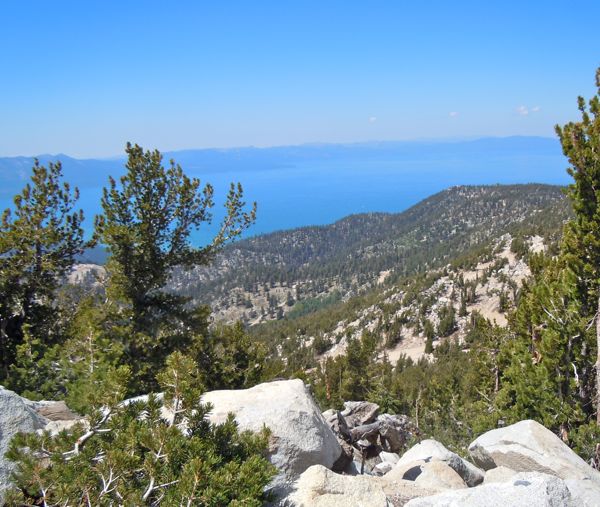
Such are the hazards of hiking up Skyline Trail at Heavenly Mountain Resort in the summer. Going to the top of Sky Chair via foot instead of the lift means going in the opposite direction I normally ski the trail. I knew where I was (because I could see Lake Tahoe), but at the same time I felt like I didn’t know where I was. And the signs everywhere – they are so tall when there aren’t several feet of snow on the ground. I had to crane my neck to read them – making me feel super short.

Heavenly has opened more hiking trails that are easily accessed from the gondola in the village near Stateline.

Hiking at Heavenly provides stunning views of the Lake Tahoe Basin. Photos/Kathryn Reed

Hiking at Heavenly provides stunning views of the Lake Tahoe Basin. Photos/Kathryn Reed

I never get tired of that ride.

If only the windows let in more air. It was a bit stifling last weekend. I understand all the precautions to prevent people from flicking a cigarette out so there isn’t a repeat of 2002 when more than 600 acres burned because of a smoker on the gondola, but it was uncomfortable.

When I’m skiing I don’t take the time to get out at the midway station. But on this leisurely Saturday it was great to see that 360-degree view of the Lake Tahoe Basin from 9,123 feet. Signs point to the various sites – Emerald Bay, Cave Rock, Mount Tallac.

It’s like a kids’ playground at the top – and not just little kids.

Christine and Daniel Rock barely had time to answer a couple questions before dashing off to take the conveyer belt to the top of the tubing hill. This is what the Bay Area resident wanted to do to celebrate her 53rd birthday.

Instead of snow, the hill looks more like artificial turf. A Heavenly employee said this is just the second hill like this in the world.

For Susy Corriea, she was enjoying sitting in the shade watching her 10-year-old son, Brayden, scamper up the climbing wall.

Plenty of people were parked in the Adirondack chairs in front of the Tamarack Lodge that opened last ski season. It allows the resort to have a year-round on-mountain dining facility.

Before we kickback in one of the chairs we take the Tamarack Lift ($8).

While we knew we wanted to follow the map we had gotten in village that said we could hike to the top of Sky Express, for those who didn’t think about it or are not familiar with ski areas, they would be apt to follow the “ski” sign for Sky Express. That takes people to the “lift line” – not the top.

In other words, better signage for hikers is needed.

This 1.92-mile roundtrip is listed as “most difficult” by Heavenly because of its steepness. I’d say anyone who is used to this elevation and who is in good shape can make it without difficulty.

Of course, the end of the trail is at 10,040 feet. Bring water. The trail is exposed.

The nice thing about it in summer is it’s not crowded with people stopping at the gorgeous views of Lake Tahoe and the surrounding area. I’ll admit, though, I stopped more on that hike to gaze and take photos than I do in an entire ski season.

It’s always so weird to see a ski resort without snow – to know in three months I could be skiing above those rocks and logs; to know that dirt trail will be a wall of white.

More information about the Heavenly Gondola is online. Various ticket prices exist. And the activities at the top are individually priced.

ngg_shortcode_0_placeholder (Click on photos to enlarge.)


Donner Summit visitors center to close after Labor Day

By Barbara Barte Osborn, Sacramento Bee

The U.S. Forest Service’s only Donner Summit-area visitor center, Big Bend, will permanently close its doors Sept. 5, following the Labor Day weekend.

Part of the visitor’s center roof collapsed in March under the weight of last winter’s heavy snowfall and because of the extent of the damage, it will not be reopened, said Ann Westling, public affairs officer for the Tahoe National Forest.

Instead, construction of a new fire station is planned to begin on the site this fall or early winter, Westling said.

“Previously, we applied for and received funds to build a new fire station at the site,” she said. “The old fire station was built in the ’30s and is not functional and too small for current fire equipment.”

Read the whole story


Community service detail to include ridding park of noxious weeds

Washoe County Sheriff’s Office community service crews will help battle a noxious weed invasion at the county’s Crystal Peak Park next week by pulling poison hemlock and other weeds that are trying to establish a foothold in this riverside park.

Crystal Peak Park is located off Old Highway 40 in Verdi.Crews are scheduled to be at the park Aug. 29-30. The crews begin work from about 8:30am-1pm each day.

Funding for the crews’ equipment and supervision is provided by a grant from the Community Foundation of Western Nevada’s Truckee River Fund.

The Sheriff’s Community Work Program requires sentenced defendants to perform a specific number of hours or days of community service. Participants are typically low risk offenders with no violent felony charges, no current violent misdemeanor charges, no record of escape and no open charges.

Since 2008, the Truckee River Fund has awarded the Sheriff’s Office more than $90,000 in grants to fund projects that address local quality of life and public safety issues. These grants support the hiring of a work crew supervisor and the purchase of equipment needed for a number of river bank projects such as weeding invasive plant species, removing debris left along the river from homeless camps, and helping to protect trees from beaver damage.