Tahoe Tails — Adoptable Pets in South Lake Tahoe

Misty is a talkative 9-year-old Singapura who likes other well-mannered cats.

catShe has a beautiful coat and would like to be an indoor cat.

Misty is spayed, microchipped, and vaccinated. She is at the El Dorado County Animal Services shelter in Meyers, along with many other dogs and cats who are waiting for their new homes.

Call (530) 573.7925 for directions, hours, and other information on adopting a pet.

For spay-neuter assistance for South Tahoe residents, go online.

— Karen Kuentz


STPUD candidates try to distinguish themselves

By Kathryn Reed

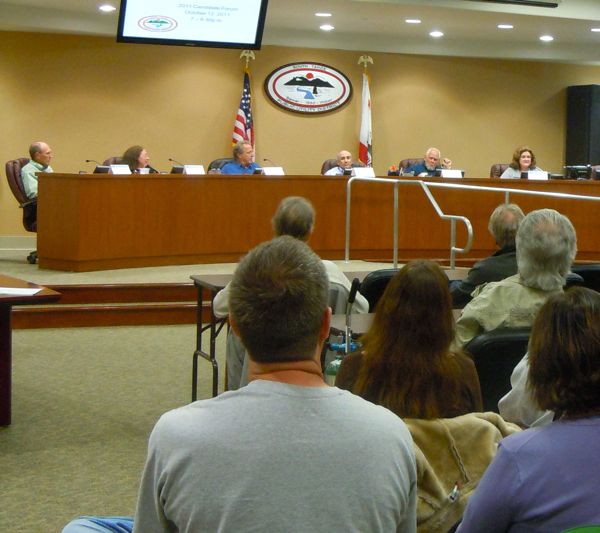
Not much separated the six South Tahoe Public Utility District board candidates in terms of their responses to questions posed to them Wednesday night. They politely sparred for 2½ hours before more than 40 people – mostly employees.

All will hire qualified disabled employees, all would prefer local contractors be hired if that were possible and is in the district’s best interest, all wish the water meter issue were more equitable, all want to make sure the district’s capital improvement projects are prioritized, and none wants to raise rates.

STPUD candidates answer a dozen questions Oct. 12. Photo/LTN

STPUD candidates answer a dozen questions Oct. 12. Photo/LTN

While the six were seated where the board normally sits, only two will be there in December when they are sworn in. They were positioned based on how their names will appear on the Nov. 8 ballot: Claude Gunsch, Mary Kortge, John Runnels, Randy Vogelgesang (all vying for the seat being vacated by Marylou Mosbacher); and Dale Rise and Kelly Sheehan.

Jimmy Hoggatt, engineering department manager, asked the six with all the prioritizing they want to do, where fire flow fits into their plans. The consensus was the district is not mandated to provide fire flow, what fire departments require is more than what’s really needed, the areas closest to the forest have the larger water lines and the district will do what it can to make upgrades when it can.

What set them apart Oct. 12 based on answers to questions from the audience:

• Gunsch: As a former employee, he would hit the road running – is a nuts and bolts guy, not a politician.

• Kortge: The district should look into a possible class-action lawsuit against the state because she believes the equal protection law has been violated when it comes to how water meters are being installed and billed.

• Runnels: Salaries of district employees should to be more on par with what the average ratepayer living in Lake Tahoe is making.

• Vogelgesang: Supports the 10 percent cut department heads have been asked to make, but added staff cuts may be needed.

• Rise: Postpone the $7.1 million project in Alpine County. Change the district’s health care plan.

• Sheehan: Does not advocate for a rate freeze.

The Employee Communication Committee at South Tahoe Public Utility District sponsored the forum. Soroptimist International of South Lake Tahoe is having a noon lunch forum Oct. 19. Reservations are required. For more information, call 866.801.8652.


Opinion: TRPA thankful for successful community event

To the community,

The Tahoe Regional Planning Agency would like to thank the many organizations and individuals that contributed to our recent Community Appreciation and Lake Spirit Award event including:

• Members of the community for joining us in celebrating all those who work to protect Lake Tahoe;

• Red Hut for donating the ice cream for our ice cream social;

• SWEP and Tahoe RCD for their fun kid-activity booths;

• Bison, for performing great bluegrass music;

• Lake Tahoe Catering for the delicious barbecue;

• Our Lake Spirit Award winners, Ruth Dworsky and Mahmood Azad for their incredible contribution to protecting Lake Tahoe and our Basin environment;

• Our Lake Spirit Award judges;

• TRPA staff.

More than 100 people joined us in honoring all the individuals in our community who work to preserve this special place. As proud members of this community, we appreciate these collective actions to protect Lake Tahoe for future generations.

Kristi Boosman, PIO Tahoe Regional Planning Agency


S. Tahoe campground becomes ghoulish at night

Terror in Tahoe returns — this year at the Campground by the Lake — the dead center of South Lake Tahoe.

It is open Thursday-Sunday from 7pm-midnight throughout October.

Tickets are $15, children under 12 are $7.50. The haunted trail is not recommended for those under 12. There are things for younger kids to do.

Terror in Tahoe is hosted by South Lake Tahoe Community Services Department (Parks and Recreation) and South Tahoe Chamber of Commerce.


Carbon monoxide alarms are the law in California

By Teri Mizuhara

Carbon Monoxide, aka CO, is widely known as the “silent killer” because you can not see it, taste it, or smell it.

Annually, more than 400 people die and another 20,000 are hospitalized due to CO poisoning.

So what exactly is carbon monoxide? CO is the result of combustion (burning) of a fuel such as wood burning fireplaces, gas furnace, gas water heaters, gas stoves and ovens, portable generators, barbecue grills and even your running car or truck.

The fumes from the combustion contain CO gas and when a person breaths this gas in they are subject to CO poisoning.

CalFire Amador-El Dorado Unit Chief Kelly Keenan said, “If you are exposed to high levels of CO, you may feel flu-like symptoms such as a headache, nausea, shortness of breath, dizziness/light headedness because the CO replaces the oxygen in the red blood cell and won’t allow oxygen to reach your organs. A person’s red blood cells actually bond with CO easier than it bonds with oxygen. High levels of CO can kill a person in minutes and it is the No. 1 cause of unintentional death by poison in the U.S.”

If you suspect CO poisoning, get the person or persons to fresh air immediately, then call 911. In some cases CO poisoning can cause permanent brain and heart damage.

As of July 1, carbon monoxide alarms in single family dwellings are required by state law. Minimally, you should have CO alarms outside each sleeping area and on each level of your home including the basement.

If you can afford it, put a CO alarm in each sleeping bedroom. Check the batteries monthly and change the battery twice a year. If they are plug-ins, test them once a month and if they have a battery backup, change that battery twice a year.

Don’t forget to vacuum the alarms often to keep them in proper working order.

Key points:

Never use a barbecue or outdoor space heater in your home or garage.

Do not leave your vehicle running in your garage, even for a few minutes.

Never heat your room or home with your kitchen oven.

Have your home heating system checked by a professional annually.

Have your wood burning stove or fire place professionally cleaned annually.

“If your CO alarm sounds: Get everyone out of the house and call 911. If you can’t physically leave the house, move to an open doorway or open a window and stay there. Call 911. Do not close the window or door,” Keenan said. “Never reenter the structure until the fire department has said it is OK, that is our job and we are more than happy to do it.”

Teri Mizuhara works for CalFire in the Camino office.


Public-private deal stops tons of silt from clouding Tahoe

By Anne Knowles

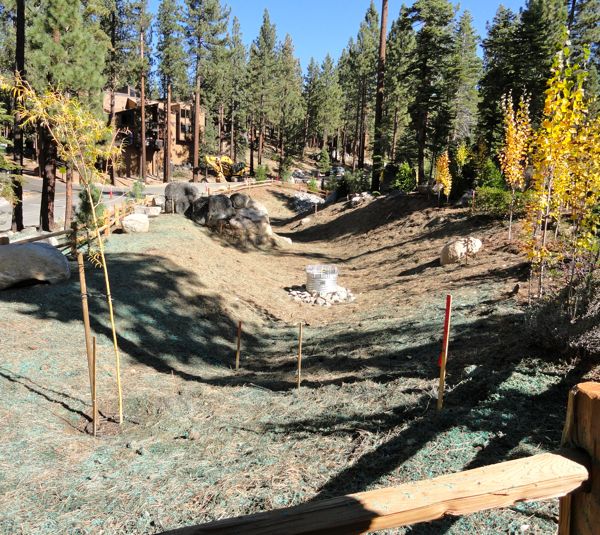
Installation of a stormwater treatment system at the Sierra Colina Village development site this week marks the completion of the first private-public partnership project many say is the kind of work that is key to Lake Tahoe’s future.

The system will filter, treat and store runoff from the development and from Echo Drive. It is part of a larger, Burke Creek watershed facility being built by Douglas County to treat stormwater runoff from Lake Village Drive.

According to Douglas County, the entire project will reduce sediment loads into the lake by 74 tons annually.
Environmental improvements are being made to Sierra Colina before construction begins. Photo/Steve Kenninger

Environmental improvements are being made to the Sierra Colina site before construction begins. Photo/Steve Kenninger

The Sierra Colina portion of the water quality improvement project (WQIP) is being paid for by the developers of the 18-acre site, Steve Kenninger and Gail Jaquish, who plan to build 41 market-rate and nine moderate-income, deed-restricted dwellings that will be Leadership in Energy and Environmental Design certified.

The private developers funded the initial $25,000 study conducted by Northwest Hydraulic Consultants of South Lake Tahoe and used by Douglas County to plan the system, and spent $250,000 for the construction of the Sierra Colina portion and will likely spend another $250,000 to maintain it. (Per agreement, the county will maintain the entire system and invoice Sierra Colina for its portion.)

The county, through an $878,600 grant from the Nevada Department of State Lands and an $876,600 grant from the U.S. Forest Service, is spending $1.76 million to design and build the rest of the WQIP. The WQIP was designed by Nichols Consulting Engineers in Stateline and built by Peek Construction, which has an office in Stateline.

“The entire project would not be as efficient or as effective if the Sierra Colina group had not decided to partner on it,” said Mahmood Azad, principal engineer/fisheries biologist for the Nevada Tahoe Conservation District and the former Douglas County engineer who is managing the project for the county. “If we’d both done separate projects, we would have spent more money and it would not be as efficient.”

With the cost of restoring Lake Tahoe clarity to 80 feet by 2025 estimated at $1.5 billion, while public funds continue to dry up, everyone from Nevada Gov. Brian Sandoval to Tahoe Regional Planning Agency Director Joanne Marchetta has been saying that the only way to achieve the clarity goal is through private-public partnerships like the WQIP project.

One obstacle, though, may be convincing private parties that the cost of such endeavors is in their best interest. The Sierra Colina project price tag, for example, was $525,000 — or more than three times the $160,000 coverage mitigation fee the developers could have paid instead.

“The TRPA code gives us two options,” Kenninger told Lake Tahoe News. “We could pay the coverage mitigation fee or create a new public water quality project if you can show you completely mitigate the runoff from the private project’s coverage.”

Kenninger said they studied the issue and found that the land, even undeveloped, was creating problems.

“The status quo was hurting water quality,” said Kenninger, and the development as planned would create an additional load.

Kenninger said he wanted to completely mitigate the load caused by the new project rather than pay the mitigation fee.

“Public-private partnerships haven’t happened before because of the cost,” Kenninger said. “We wanted to show everybody we can work together. This project is a model because future federal and state EIP funds are going away. In return, they’ll allow redevelopment to happen. And the revenue from that pays for the private contribution to treat public stormwater.”

Kenninger and Jaquish went forward with environmental improvements even though the development is tied up in court.

Azad said the county is now looking for potential other projects to work on with private parties, but that nothing has been indentified yet.

“The lesson I’ve learned from all this is it takes longer and requires more manpower upfront,” Azad said. “But it ends up being more efficient and cheaper in the end.”



Nev. bear season half over, 10 killed — none in Tahoe

By Jeff Delong, Reno Gazette-Journal

Ten bears have been killed in Nevada’s first black bear hunt, bringing the number of animals than can be taken to the halfway point.

A female bear was killed Sunday and a male bear on Monday, the first since Sept. 18. The other seven bears were all killed during the first eight days of a hunting season that commenced Aug. 20, according to officials with the Nevada Department of Wildlife.

No more than 20 bears can be taken during a season ending in late December. The season will end earlier if six females are killed, and four of the bears killed thus far have been females.

Hunting activity appears to be picking up with cooler fall weather, said Chris Healy, spokesman for the Nevada Department of Wildlife.

Read the whole story


Prescribed fire coming on Highway 431

North Lake Tahoe Fire Protection District is planning on conducting a prescribed burn on Oct. 14 depending on proper weather conditions and fuel moisture content.

The 7 acre prescribed burn will be in the upper Apollo subdivision area, off Highway 431.

Smoke resulting from the prescribed burns will affect the surrounding area for approximately 24 to 36 hours. People who are smoke sensitive are advised to stay inside and close their windows and doors as much as possible until the smoke dissipates.

For further information, call (775) 831.0351, ext. 0.


Bat lecture completes chamber mixer in Tahoe City

UC Davis is hosting a Haunted Halloween Chamber Mixer with Masters of the Night bat lecture immediately following at Historic Fish Hatchery.

The event is Oct. 20, with the mixer from 5-6pm and lecture from 6-7pm.

The cost is $10. There will be a no-host, cash-only bar. All proceeds go to UC Davis Tahoe Environmental Research Center Education Center and the Nor Cal Bats foundation.

The UC Davis Tahoe City Field Station (Historic Fish Hatchery) at 2400 Lake Forest Road, just east of Tahoe City off the bike path.

This event is open to the public and intended for adults.


USFS burning piles throughout South Shore

U.S. Forest Service fire and fuels management crews will be conducting prescribed fire operations in the Andria Drive area off Kingsbury Grade in Stateline through the rest of the week.

If conditions allow, the Forest Service also may resume operations in the Angora area, focusing on the area below Angora Ridge Road and west of Mule Deer Circle. The number of acres will depend on weather conditions and other factors.

Forest Service fire and fuels management staff monitor weather conditions closely prior to prescribed fire ignition. They are looking for conditions that will carry smoke up and out of the Lake Tahoe Basin. Crews conduct a test burn before igniting a larger area, to verify how effectively fuels are consumed and how the smoke will travel. If crews light a significant number of acres at one time, the project may produce a smoke plume resembling that of a wildland fire.

Remember that fire appears larger at night.

The Forest Service strives to minimize the impacts of smoke on local communities. Smoke-sensitive residents should consider staying indoors and keeping doors, windows and outside vents closed. To directly receive prescribed fire updates, send an email to pa_ltbmu@fs.fed.us. Forest Service staff will post road signs around areas affected by prescribed fire, and update the local fire information line at (530) 543.2600, ext. 6.