Nevadans’ inventions reach beyond the state

By Susan Skorupa, Reno Gazette-Journal

Nevada has a serious history of invention.

Gaming, mining, science and technology all have benefited from the state’s inventive output. But a few inventions born in Nevada have had huge impacts worldwide.

Try these on for size:

Jacob Davis, born near the Baltic Sea in 1831, came to the United States in 1854 and ran tailor shops in New York City and in Augusta, Maine, former Nevada state archivist Guy Rocha wrote in an article for the Nevada State Library and Archives. Davis moved to the West and ended up in Reno in 1868, opening a tailor shop on Virginia Street the next year.

In January 1871, a woman asked him to make a sturdy pair of pants for her husband who was too big to wear ready-made clothes. Davis said the woman paid $3 for pants made of white duck material he bought from Levi Strauss & Co. For reinforcement, Davis used small copper rivets to fasten the pants pockets, a device still used today in Levis 501 jeans and other jeans.

The pants Davis made — some made of denim — proved popular, and Davis asked Levi Strauss to help him with a patent application. The full patent was granted on May 20, 1873. By then, Davis had been named San Francisco production manager, and he sold his tailor shop property to Levi Strauss on May 27. The frame building was destroyed on Oct. 29, 1873, in Reno’s first great fire, Rocha wrote.

On May 20, 2006, a historic marker was dedicated at 211 N. Virginia St. where the shop once stood.

What’s interesting, Rocha said in an interview earlier this month, is that the first copper-riveted pants were considered work pants until after World War II, when, thanks to stars such as Marlon Brando and James Dean, who popularized blue jeans in their movies, the pants became a symbol of teenage rebellion.

“You had to have a pair to be cool, to be young, rebellious,” Rocha said.

Read the whole story


Ex-Placerville mayor faces more criminal charges

By Cathy Locke, Sacramento Bee

Former Placerville Mayor David Machado’s legal woes increased Monday.

A grand jury indictment unsealed in El Dorado County Superior Court adds a new felony conspiracy charge and two misdemeanor charges to allegations filed against Machado in a criminal complaint in August.

He now faces a total of three felony counts and two misdemeanor counts in an alleged cover-up of his property dealings in Placerville.

Machado, 53, was arrested Aug. 18 for investigation of felony perjury and conspiracy after the El Dorado County District Attorney’s Office filed a criminal complaint accusing him of 30 “overt acts” of misconduct.

He did not enter a plea at an arraignment Monday, which was continued to Nov. 28. Machado’s attorney, James S. Clark of Placerville, asked for the continuance, saying he has not received documents he had requested from the District Attorney’s Office in August.

“I’m punching in the dark right now,” Clark said following the brief court appearance.

Read the whole story


Food swap in Truckee

Truckee River Winery with Slow Food Lake Tahoe is hosting a food swap Oct. 30 from 2-4pm.

A food swap is where your homemade, homegrown, and foraged creations become your own personal currency for use in trading. All swap items must be homemade, homegrown or foraged by you.

Jams, pickled anything, honey, olive oil, backyard eggs, baked good, fruits, pasta – get creative. This is an opportunity to bring in a large amount of something you love to create, and leave with an array of new items from your neighbors. You can bring as little or as much as you like.

Feel free to bring a combination of items (loaves of bread and spice blends).

If possible, bring a few samples for participants to try.

Make sure to package well. We encourage earth-friendly packaging whenever possible.

Also, leaving an email address on a label is a great way to stay in contact with anyone you may meet throughout the trade.

This event is open to everyone, however you must register for the event. To register, click here.

The winery is at 11467 Brockway Road, Truckee.


Douglas County looking beyond traditional TMDL solutions

By Kathryn Reed

STATELINE – Connectivity. That is the word being used on the Nevada side of the Lake Tahoe Basin when it comes to total maximum daily load.

“The big water year really helped educate us about what is connected,” Mahmood Azad, Douglas County TMDL representative, told county commissioners. “If it is not directly connected (to Lake Tahoe), it does not need a water quality project.”

Some water that never connected to another source did last winter, while others stayed to themselves.

This is significant because the theory behind the federally unfunded TMDL mandate is all bodies of water need to be part of the treatment program. It’s the Environmental Protection Agency pushing down the policy to reduce fine sediment. In the Silver State, it’s the Nevada Department of Environmental Protection that is the overseer.

What Azad and other are discovering is not every puddle of water ends up in Lake Tahoe and therefore it probably should not have an expensive filtration system associated with it.

“With the issue of connectivity, it is disconcerting we don’t know what makes it into the lake,” Commissioner Greg Lynn said at the Oct. 20 meeting. “The state of water quality at the lake after 40 years of TRPA is still very primitive.”

Azad said, “Neither TRPA nor NDEP are leaders in connectivity.”

A major concern of the five counties and city in the basin is how to pay for the projects and then where does the maintenance money come from.

Grants secured by the Nevada Tahoe Conservation District will fund the public portion of the Nevada TMDL projects, but maintenance is an unknown.

“It’s an open ended budget and that’s scary,” Azad said of the maintenance component.

Azad said he is looking at getting grants to study ways to reduce fine sediment form reaching Lake Tahoe. One idea is use rock chips on roads because they don’t breakdown. The problem is they can’t be used on roads where the speed limit is more than 35mph because of the damage that can be done to vehicles.

Another possible study is looking at how iron naturally occurs in some waterways and how those bodies of water don’t deliver sediment to the lake.

With fine sediment from roads said to be a major contributor to diminished lake clarity, that is an area entities are focused on.

Warrior Way improvements are expected to happen next year. Bids should go out in November.

The remainder of Lake Village will also be bid next month, with work commencing in 2012.

Azad told commissioners the stormwater infrastructure mapping is continuing, with two people in the field every day.

“We will translate this into a maintenance management system,” Azad said.


Veterans Tribute Concert at STMS

Veterans Tribute Concert features 200 students from the Lake Tahoe Unified School District Performing Arts Program.

The free concert is Nov. 10 starting at 7pm in the multipurpose room of South Tahoe Middle School.


Opinion: Feds’ pot crackdown bad medicine

Publisher’s note: This editorial is from the Oct. 22, 2011, Orange County Register.

In the design of America’s founders, the states are supposed to be centers of democratic experiment. They’re not supposed to be uniform. For example, even though alcohol Prohibition ended in 1933, local laws restricting sales exist in 33 states. In Arkansas, more than half of 75 counties prohibit alcohol sales.

This design is why it is disturbing to us that the Obama administration has launched a crackdown on medical marijuana, which is legal in 16 states and the District of Columbia, the home of the federal government. California led the way with Proposition 215 in 1996, which passed with 56 percent of the vote. It allows a patient, according to state law, to use medical marijuana with a prescription from a medical doctor. The Register supported Prop. 215 in editorials, primarily written by our late colleague, Alan W. Bock.

There have been numerous controversies pitting medical marijuana users and dispensaries against state and local authorities. But overall, things have worked fairly well. The dire consequences of critics – of a state lost in a pot haze – never happened. In 2002, the California Supreme Court upheld Prop. 215. And when San Diego and San Bernardino counties challenged Prop. 215 in federal court, the U.S. Supreme Court declined to hear the case in 2009, allowing Prop. 215 to stand.

The Bush administration, despite cracking down in many areas of the “war on drugs,” never seriously challenged Prop. 215 or other states’ medical marijuana laws. There was great hope that the Obama administration would normalize the matter by formally letting states set their own policies. In 2006, Barack Obama admitted to using marijuana. “I inhaled frequently,” he said in a televised interview. “That was the point.”

In his 2008 campaign, Mr. Obama pledged, “I’m not going to be using Justice Department resources to try to circumvent state laws on this issue.” After Mr. Obama became president, Deputy Attorney General David W. Ogden wrote in an Oct. 19, 2009, memo to U.S. attorneys in states that had legalized medical marijuana, “As a general matter, pursuit of these priorities should not focus federal resources in your states on individuals whose actions are in clear and unambiguous compliance with existing state laws providing for the medical use of marijuana. For example, prosecution of individuals with cancer or other serious illnesses who use marijuana as part of a recommended treatment regimen consistent with applicable state law … is unlikely to be an efficient use of limited federal resources.”

Why the change? Jeffrey A. Miron, a Cato Institute scholar specializing in the economics of illegal drugs, said the Obama administration may be trying to offset its liberal image by “doing some things on the right,” such as cracking down on drugs. “But this is alienating a lot of people in the middle, the independents.”

“We saw this coming,” Steve Kubby told us of the tougher stance by the Obama Justice Department. Mr. Kubby was a co-author of Prop. 215, and has used medical marijuana for more than 25 years to keep in remission an otherwise fatal form of adrenal cancer. Mr. Kubby disputes a 2005 Supreme Court decision, Gonzales vs. Raich, green-lighting a federal ban on medical marijuana on the basis of the Constitution’s interstate commerce clause. He cites the 10th Amendment, which stipulates, “The powers not delegated to the United States by the Constitution, nor prohibited by it to the States, are reserved to the States respectively, or to the people.”

Read the whole story


Tahoe City crews moving out of 50-year-old fire station

By Katherine E. Hill

TAHOE CITY – Chief Duane Whitelaw’s eyes light up as he talks about the new, modern fire station being built on a hill above Tahoe City. The 22,000-square-foot facility spread over three levels is in stark contrast to the antiquated fire station that was built in 1961 for an all-volunteer fire department.

“Most facilities during that era were designed for people to drive in to the station” to respond to calls, says Whitelaw, who heads the North Tahoe Fire Protection District. “With growth and development in the district, we needed to take a more permanent approach to providing emergency services.”
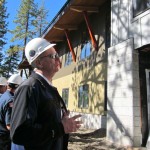
North Tahoe Fire Chief Duane Whitelaw will move his crew into the new station by the end of the year. Photos/Katherine E. Hill

North Tahoe Fire Chief Duane Whitelaw will move his crew into the new station by the end of the year. Photos/Katherine E. Hill

The new Station 51, being called a public safety center rather than a fire station due to its multi-use design, has been designed to meet the growing demands of the district, which stretches from Tahoe City to Alpine Meadows, Homewood and Kings Beach.

The center will not only house the fire department, it also will serve as the region’s emergency command center in case of disasters.

One of the most important things about the new facility is its location – on Fairway Drive off Highway 89. The current station was built in the heart of Tahoe City. In the 50 years since it was built, Tahoe City has become a popular tourist destination, drawing a steady stream of pedestrian and automobile traffic through the small town year-round. In the summer, traffic is often at a crawl through Tahoe City, making for potentially dangerous conditions for firefighters to leave the station to respond to calls.

“We’ve outgrown the current building and it’s a real safety problem,” Whitelaw says.

Work has been progressing quickly on the station since construction began in May 2010, and it will be completed by the end of the year. The NTFPD financed the $10 million cost for the project, which includes $6 million for construction. The station has been designed to be a silver LEED building, which is an international system for green building. The station is being built using a mix of cement fiber board, metal, wood and plaster, and will use solar panels for hot water and to offset its energy use.

The new station features five bays, including room for a $1.4 million aerial ladder truck that will be needed to respond to calls at taller structures in the works in the district including the proposed village at Homewood Mountain Resort, the affordable housing project under construction in Kings Beach, as well as the Kings Beach Town Center. There also are expanded administrative offices, conference rooms that will be open for use by the public, and sleeping quarters, a fitness area, living room, dining room and kitchen for the fire crews that will be living at the station during their shifts. The new station also will be ADA accessible; the current station is not.

Station 51 crews average four to seven people per shift and respond to fire and medical emergencies, with 80 percent of their work devoted to medical calls, Whitelaw says. Firefighters, however, are cross trained to respond to fires, water rescues, forest fuel reductions such as the chipping program, and hazardous materials, as well.

Future of the old fire station

While work continues to complete the new facility by the end of the year, local officials are trying to decide what to do with the site of the current fire station. The station is part of the West Commons Beach area, which sits on a
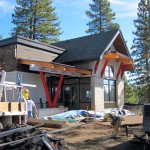
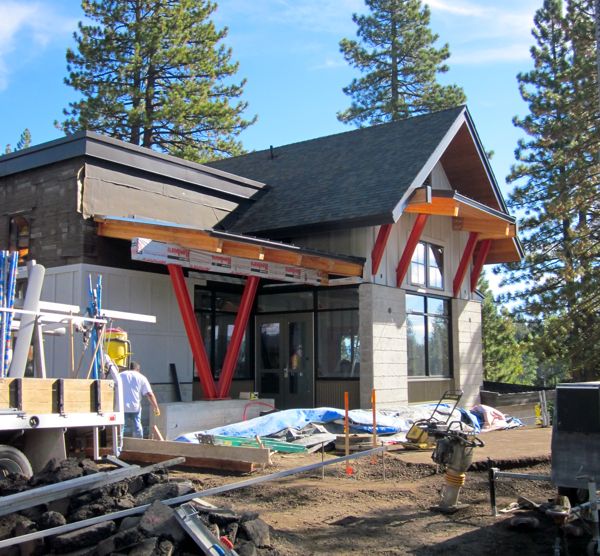
The entrance to the new station.

The entrance to the new station.

bluff overlooking Commons Beach. The site includes the visitors’ center and the Tahoe City Community Center, which is home to the North Tahoe Arts Center. Last week, officials unveiled four proposed alternatives for public use of the site that ranged from using the fire station’s footprint for a park to razing all of the structures to build an interpretive center that would become a regional attraction.

“Our concerns were using the building for community uses,” TCPUD General Manager Cindy Gustafson said. “There are a wide range of opportunities that are nowhere near reality.”

The proposals presented raised concerns from many in the community who attended the meeting. People raised questions about the lack of on-site parking and concerns over the removal of the Community Center, which houses the only public art center in the North Tahoe-Truckee region.

Bill Briner, who has served in countless public offices through his decades residing in the region and was on the Placer County Board of Supervisors when the fire station was built, was most vocal in his opposition to any plan other than razing the fire station.

“We committed to tearing down the firehouse when they were done, and I don’t want to spoil it by building multi-story buildings,” Briner said. “That’s the whole idea of tearing the fire station down … opening up the view.”

More than a dozen people in the audience applauded Briner’s call to open the view to Lake Tahoe. Since the fire station was built in 1961, however, landscaping with tall trees and brush on Commons Beach obscure a clear view of Lake Tahoe from the fire station site.

Briner also said he was opposed to any plans that would conflict with existing businesses in Tahoe City, citing three of the proposals that call for food and rental concessions.

The site on which the three structures were built was given to the “people of Tahoe City” by President Ulysses S Grant in 1872 and eventually became the responsibility of the Tahoe City Public Utility District. The Community Center was built in 1938 and the fire station in 1961.

When the new station was built, the fire district committed to tearing down the station once it no longer needed the building, which spurred the need for local officials to address the future of the site. As well, neither the station nor the Community Center is ADA accessible. The Community Center also operates at a $50,000 deficit each year and is in need of more than $100,000 in repairs to the roof, siding and heating system.

A steering committee has been tasked to work with consultants to come up with proposals for the site and the project is being spearheaded by the TCPUD and the North Lake Tahoe Resort Association. The committee is made up of representatives from local government agencies, the fire district, the North Lake Tahoe Historical Society, U.S. Forest Service, California Tahoe Conservancy, California State Park and others.

The consultants presented four proposals for the site. All of the proposals call for razing the fire station and adding an elevator for ADA accessibility. None of the proposals calls for adding any additional parking to the site, but rather call for shuttle drop-off locations.

Plaza least costly

The first, and least costly, would be to demolish the station and visitors’ center and to build a plaza on the fire station site, dubbed the Lake Welcome Plaza. The Community Center would be renovated and a new two-story addition built to house the visitors’ center and expand exhibit space for the Arts Center. There also would be an ADA accessible path leading down to Commons Beach. It would cost between $4 million and $6 million.

Theater would serve community

A Community Center Plus option at $7 million to $8 million calls for renovating and expanding the Community Center into a multi-use facility that could house exhibit space and an interpretive center, as well as food and kayak and paddleboard concessions to offset operation costs. A basement level would be added to provide space for the concessions. The fire station and visitors’ center would be torn down and a 165-seat theater would be build to be used for performances, conferences and other uses.

The last two proposals take a different approach to the site, with options that would develop a destination attraction in Tahoe City to draw in tourists.

Tahoe Experience at pavilions

The third proposal calls for four enclosed pavilions connected by a center corridor to be built on the site dubbed as Tahoe Experience Pavilions at a cost of $11 million to $13 million. All of the existing buildings would be torn down and the Community Center could be relocated to another, unspecified location. The pavilions are inspired by the Tahoe City waterfront in 1900 and would provide space over three levels for exhibits, administrative offices, a store, multi-use facility, and food and rental concessions, with outdoor courtyards between each pavilion. The bottom floor would be situated at lakeside with Commons Beach.

Hydrarium most radical proposal

The fourth proposal, The Hydrarium, is the most costly and the calls for the most radical change for the site. At a price tag of $23 million to $25 million The Hydrarium concept calls for a four-story interpretive, state-of-the-art center that could attract hundreds of thousands of visitors each year to Tahoe City and be a revenue source, said Barry Howard, one of the project’s consultants. The Hydrarium stands one story taller than the current structures on the site; the bottom level would be below street level at lakeside.

The modern, circular design of the build would provide exhibit space with interactive exhibits and a multi-use theater with Lake Tahoe as the central theme of the facility. There also would be space for food and rental concessions, and could provide jobs in the community.

The steering committee passed out a community survey at the meeting, which also is available online, to get public feedback on the proposed alternatives before moving forward. The committee will likely meet within the next month to evaluate public input before deciding how to proceed, said Kelli Twomey, TCPUD spokesperson. The committee will also have to evaluate construction costs and potential funding sources before making any decisions, she said.

A video of the meeting, along with the community survey, will be available online this week, or call (530) 583.3796 for more information.



Dogs bite people on both sides of El Dorado County

By Cathy Locke, Sacramento Bee

El Dorado County Animal Services officials are searching for dogs that bit people in two separate incidents, one in South Lake Tahoe and the other in Grizzly Flat.

On Oct. 16, a 17-year-old boy was bitten about 6:30 p.m. on the South Tahoe Middle School soccer field on Al Tahoe Boulevard in South Lake Tahoe. The teenager and his brother began playing soccer with the dog’s owner and another man, and the dog suddenly bit the youth, according to an El Dorado County Public Health Department news release. The dog owner left the area and no information was exchanged.

The dog is described as a larger size dog, possibly a golden retriever-boxer mix. The dog’s owner is described as white, in his late 20s with light-colored hair.

Read the whole story


Ski swap in Tahoe City

The 11th annual Tahoe Cross County Ski Swap is Nov. 12 form 10am to 3pm.

Skate ski equipment, classic, light touring, backcountry, snowshoes, kid’s sleds, kid’s ski gear, clothing and accessories will be available. Also for sale will be used rental gear, demos, samples, everything you need for the season.

Selling? Register your sale items Nov. 11th from 2-9pm. Commission on sold items is 15 percent.

For more information, call (530) 583.5475.


Mount Rose-area property raises access issues

By Jason Hildago, Reno Gazette-Journal

A case involving a seemingly obscure easement law is raising questions about the interpretation of public access rights through other people’s property, including whether Washoe County has a bias that favors developers.

At the center of the dispute is a parcel map drawn by the Washoe County surveyor’s office in 2007.

The parcel map became the basis of a suit filed by Incline Village resident Scott Spittler in 2008 against neighbors John Routsis, Christine Haberstroh — formerly Christine Routsis — and Lawrence Purdon.

Spittler filed the complaint to obtain access from his neighbors’ properties to a 58-plus-acre parcel he bought near Fawn Lane, just off Mount Rose Highway. According to the parcel map from Washoe County, Spittler was allowed to use public easements through his neighbors’ properties to access his parcel.

But a Washoe District Court judge ruled against Spittler in 2010 — while also delivering a stinging rebuke against the county surveyor who drew up the map.

Now Spittler is being forced to sell his land plus his Incline Village home via a court-mandated sheriff’s sale to pay the $148,366.40 judgment against him.

The case is under appeal at the Nevada Supreme Court. Spittler, who was reached by phone while packing at his Incline Village home, declined to be interviewed for this story and referred all comments to his lawyer.

“This sets a very bad precedent,” said Jeffrey Dickerson, Spittler’s lawyer. “If this precedent carries forward, it’s possible that a lot of public easements across the state will be declared void.”

Read the whole story