Snippets about Lake Tahoe

hyatt• Hyatt Regency Lake Tahoe expects its $20 million renovation of its guestrooms, Sierra Café and the Spa Terrace Conference Center to be done by the end of April.

• Squaw Valley has hired Jessica Richitelli as the resort’s terrain park manager.

• The 2012 Reno-Tahoe Open will use the same scoring system the American Century Championships uses – Modified Stableford.

• The annual Tahoe City Cross Country Fall Cleanup Day is Oct. 29 from 10am-2pm. Free lunch for volunteers.

• Placer County is collecting old medications on Oct. 29 from 10am-2pm at the Tahoe City Fire Department, 300 North Lake Blvd.

• Heavenly and Northstar are Tweeting that the snowmaking guns will be fired up today for the first time this season.


Artists’ connection to the work matters first

By Robert Schimmel

Right in the middle of a perfectly eloquent description to a client of how many artists work, I notice a disconnected, puzzled or glazed look that begs, “No kidding, must be a French pastry. Just what are you talking about?” And thus begins an enlightening exchange to edify me on presumption and my client on the purpose and discipline of plein air painting.

In my days of gallery sales I often rode the fence of saying too much and conversely blowing right by details the embarrassed or timid clientele would bluff, avoid or not realize they should request. Hence, the often subliminal query, “What does it mean so I can decide to care or not?” Fair enough. Plein air means “full of air” literally and “outside, on-location, and in the presence of one’s subject” more practically. This stands in stark contrast to art done strictly from reference material (usually photos), imagination or both.

Robert Schimmel

Robert Schimmel

“But who cares?” you ask with a hint of indignation. After all, you just want something beautiful on your wall. OK, that’s legit and appreciated from a sales point of view. But for one who enjoys a back-story or the sizzle that makes fillet preferable to London broil, plein air has a history that literally gives us the foundational verities of light, form and recession (no, not our economic indicator, but how objects recede or appear more distant). Most often this truth and the emotional, physical connections between artist and subject are what energize, permeate subconsciously, and completely describe the artwork in ways unplanned or anticipated.

Let’s face it, every day or vantage point at any location will be unique due to dozens of constantly changing influences (weather, direction of light, growth, season, etc.) that only the first-hand, caring, inquisitive eye will detect and record. Thus, plein air art will generally have myriad, unnoticed subtleties not included in studio work that the casual buyer needs to be aware of or taught. (Now, before anyone thinks I am favoring one kind of creative process over another, let me assure you that I am not judging anything here.) This certainly applied to me, not as a collector, but as an excited young artist in pursuit of understanding and accuracy.

I began my art career and courtship of nature (or perhaps she of me) from the painter’s viewpoint with just a sketchbook and all the influence I could muster from my father’s tutelage. Like too many relationships, ours became dependent on convenience and conditions not to mention the element of attraction … hey, I’m a guy; what can I say? And like any self-respecting femme fatale, her whims and wiles challenged and enticed my sincerity and devotion. On a perfect day it’s easy to just sit and focus on the miracles of creation and practice rendering all the nuances of form and light laid out like a tasty buffet. But add the not-so-perfect elements – wind, heat/cold, bugs, nowhere to sit and the passersby with endearing critiques and helpful comments – and one’s powers of loving, accurate observation begin to deteriorate.

Suddenly the cool drink, bug spray-free finger prints and odor, seductive chair and absence of sweat/chills are all lecturing your sensitivities about the wonders of your camera and how a “digital moment” is far better than anything you can duplicate, much less create! Yet nothing could be further from the truth. You know the adage “adversity builds character” or some such painful cliché. Well, the artist must feel, smell, and taste the bitterness as well as the sweetness in order to produce or evaluate his own work at a depth beyond just the visual. And this is what will be transformed and transmitted to the viewer ultimately through the plein air process.

So why do I digress with part of my background? Because this is the basic, requisite encounter any artist encumbers who seeks a very personal relationship with the landscape, in particular, and desires to pass along that intimate connection and experience to the public. More important to today’s commentary, this is the very story that the art enthusiast, buyer, collector and investor need to know in order to look with appreciation, sensitivity and acumen into, and not just at, any given artwork. (By the way, notice the word “artwork”; it is two words that combine creativity and effort, for you rarely get anything of value without both.)

Robert Schimmel is a professional artist and teacher in South Lake Tahoe as well as host of “Lake Tahoe Art Scene” on KTHO radio on Thursdays at 5:15pm.


Opinion: Denial will not heal what ails South Lake Tahoe

To the community,

I watched and listened to Mayor Hal Cole’s state of the city speech. There are two parts to any speech, substance and tone.

On substance, Mayor Cole outlined the city’s needs and problems comprehensively. He said the city is solvent and will keep a 25 percent general fund reserve. He said we need to fix the streets, clean the city up, attract more tourists, and increase city revenues.

Bill Crawford

Bill Crawford

On revenues, he said the city will seek a TOT tax increase in the future. And he clearly said the city’s economy depends on resources of others. Those others are agencies such as the Forest Service, the CTC, Caltrans, and grants. Mayor Cole favors more BIDs, business improvement districts like the Ski Run BID. Partnerships between private businesses and the city.

Mayor Cole defended past Redevelopment Agency action. He said redevelopment tax increment revenue, new higher property taxes stay in town. That’s false. By law it goes to serve redevelopment debt, to pay the bondholders.

On tone, he simply recited what was written. The tone was flat. It lacked enthusiasm. That’s understandable considering the city’s fiscal pain.

Mayor Cole made a plea for peace. Please, no finger pointing. The past is the past. It was denial of any consequences of decisions that led to failure(s) such as the convention center. It’s a plea to forget, to erase memory so there can be harmony.

So where is the city now? Mayor Cole said the city must have outside financial support to rebuild the city. If so, the city’s a charity case chasing the rainbow’s pot of gold. And there can’t be peace and harmony until Mayor Cole atones for errors like the convention center. Soon he will have served 16 years on the council and been the mayor many times. He has played a big role in creating the political and economic plight of the city. Atonement heals. Denial does not.

Bill Crawford, South Lake Tahoe


Train to become a basketball referee

Kahle Community Center in Stateline is hosting its annual basketball referee-training clinic in November for this season’s youth and adult basketball leagues.

Cost is $40 for instruction and rule book.

Ages 16 and older may participate. No experience necessary.

Participants must attend all trainings sessions.

The class trainings are from 9am-noon on Nov. 5, Nov. 6, Nov. 11, Nov. 12, Nov. 19 and Nov. 20.

Game scrimmage training is 5-8pm on Nov. 28 and Nov. 29.

People successfully completing Referee School will be assigned games at Kahle Community Center and/or Gardnerville.

For more information, contact Anthony Davis at (775) 586.7271. Pre-registration is required.


If you had the chance to speak with a presidential contender, what would you say?


STATA’s bumblings seeping out in court documents

By Kathryn Reed

Who owns the name BlueGo?

The trustee appointed to oversee the lawsuit involving MV Transportation and the bankrupt STATA is asking that and many other questions.

Based on David J. Thompson’s 15-page report submitted this month to the bankruptcy court in Reno, the tide is turning in MV’s favor.

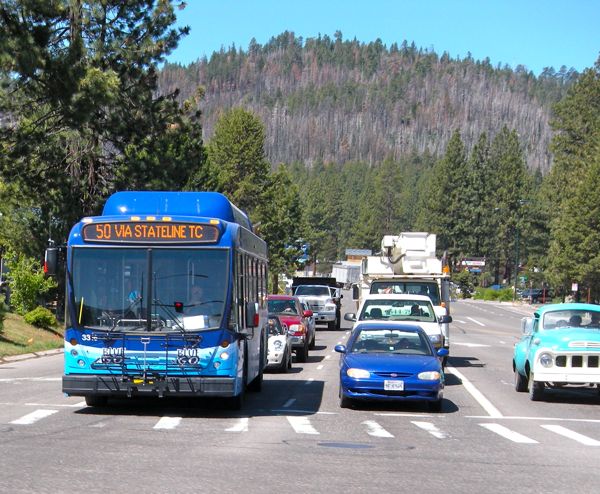
It's not known who owns the BlueGo brand. Photo/LTN file

It's not known who owns the BlueGo brand. Photo/LTN file

South Tahoe Area Transit Authority’s board voted to file for bankruptcy in August 2010. MV filed a lawsuit a couple months before that after the STATA board severed the transit operator’s agreement for it to run the South Shore bus system known as BlueGo.

“I have reconciled MV’s claimed damages for unpaid invoices of $1,979,227.52 to STATA’s records. I preliminarily find it to be accurate,” Thompson wrote in the report.

Also in the report, Thompson says, “For the two years ended June 30, 2010, STATA received approximately $2 million in operating grants. In spite of this, operating expenses consistently exceeded revenues including these grants.”

Thompson admits he still has a number of documents to review. There are 20 boxes of accounting records. What he isn’t able to discern is how STATA ended up with all the liability and Tahoe Transportation District with all the assets. TTD is now the umbrella entity – the STATA so to speak – to coordinate transit on the South Shore.

Jessica Woelfel, who represents Fairfield-based MV, would not comment on pending litigation.

South Lake Tahoe Assistant City Attorney Nira Feeley refused multiple requests for comment.

South Lake Tahoe was part of STATA, so it is part of all of the hearings. El Dorado County settled its portion of the case months ago. STATA was made up of public and private entities – from local governments to the casinos to Heavenly Mountain Resort to Ridge Tahoe.

While the lawsuit naming board members of STATA has been dropped, they are not without blame for running the agency into the ground, according to court records.

“According to the Participation Agreement, a certain level of funding based on an operating budget was to be paid quarterly in advance by the participants. It also provided that in the event of any operating shortfalls the participants would make additional contributions or suffer reduced services. The board of directors, who were also the representatives of the participants/customers, was obligated by the agreement to execute on this provision. It appears that they neither cut the services nor secured additional contributions for the shortfall,” Thompson wrote.

The report outlines how the STATA board ignored warnings of financial weaknesses in the system, as well as not having an adequate amount of staff.

At the hearing this month the adversary part of the lawsuit was stayed, with motions needing to be filed in November. Ultimately what needs to be decided is if MV’s case against STATA will remain part of the bankruptcy hearing or if it will be decided separately.

And a twist not before made public is that it’s not clear who owns the rights to BlueGo.

“Not listed on the petition is the BlueGo brand name which has some worth if it can be determined who owns it,” Thompson wrote.


Fundraiser to help South Tahoe family

Carlos Loyola, a longtime employee of the Fresh Ketch restaurant and member of our South Lake Tahoe community, has inoperable cancer and his family (young wife, and 2-year-old daughter) need help.

The Ketch a is having a benefit Oct. 26 at 7:30pm.

Tickets are $10, which includes a raffle ticket.

There will also be drink specials, food specials, silent auction, door prizes.

For those who cannot make it and want to help the local family, make checks out to: Carlos Loyola and either drop off at the Fresh Ketch, or mail to: Fresh Ketch, 2435 Venice Drive, South Lake Tahoe, CA 96158.


Halloween happenings at Kahle Community Center

Celebrate the spirit of make believe, a sense of community and “Spooktacular” happenings all under one roof at Kahle Community Center on Halloween.

Festivities include carnival games, ooey gooey station and lots of treats for a “bootiful” fun, safe and “ghoulishly” good time for all ages.

The event is Oct. 31 from 4-6:30pm. Come dressed in a costume and bring an empty bag for treats.

Kiwanis of Lake Tahoe Sunrisers sponsors this event.

To volunteer to help or for more information, call Kahle Community Center at (775) 586.7271.


Holiday Craft Bazaar

The Tahoe City PUD and Recreation Department’s annual Holiday Craft Bazaar is Nov. 5 from 10am-3pm inside the Rideout Community Center, 740 Timberland Lane, Tahoe City.

The event will feature a variety of artists and craftsmen from around the Lake Tahoe Basin selling fine handmade products. Included will be fine jewelry, photography, handmade wood products, pottery, glass items, and much more.

For more information, contact Shaunat (530) 583.3440, ext. 14.


Decline in habitat reducing number of martens in Sierra

By Science Daily

The reclusive American marten is getting even harder to find in the Sierra Nevada, according to a study by a team of researchers from the U.S. Forest Service and Oregon State University. A new study at the Sagehen Experimental Forest found that marten detections have dropped 60 percent since the 1980s — a decrease that may be caused by a degradation of the wooded areas in which they live, researchers say.

Their findings appeared in the current issue of the Journal of Wildlife Management.

“Previous work had revealed that marten populations in the northern Sierra and southern Cascades in California have become more fragmented since the early 1900s, but the current work at Sagehen may help explain the mechanism for this pattern,” says co-author Bill Zielinski, research ecologist for the USDA Forest Service’s Pacific Southwest Research Station in Arcata.

In the early 1900s, American marten could be found in many continuous areas in the higher elevations of the northern Sierra Nevada. Today, populations of the small mammal, which is related to the weasel family and looks like a cross between a mink and a fox, are isolated and discontinuous. Causes for this phenomenon are unclear, but researchers believe that timber harvesting and thinning — the removal of downed woody material on the forest floor — may play a part in the population decline.

The Sagehen Experimental Forest is located in the Tahoe National Forest about 30 miles north of Lake Tahoe and is managed by the Pacific Southwest Research Station and the University of California, Berkeley. Researchers recorded marten detections using track plates — long, baited rectangular boxes which martens enter and leave their tracks on contact paper. The data, which was collected in 2007 and 2008, was then compared to survey results from 1980 to 1993.

Read the whole story