Diagnostic hearing services available in South Tahoe

By Rebecca Wass

South Lake Tahoe now has a diagnostic hearing service through Barton Health. Danielle Knowlton was recruited to offer testing and treatment for those who have potential and current hearing issues. In partnership with Ronald Roth of Barton Ear, Nose and Throat, audiologist, Knowlton brings more than 25 years of experience to Barton Audiology.

Together Roth and Knowlton have created a full-service E.N.T. and hearing center in South Lake Tahoe. While promoting healthy hearing, communication competency, Knowlton is assessing and improving quality of life for persons of all ages.
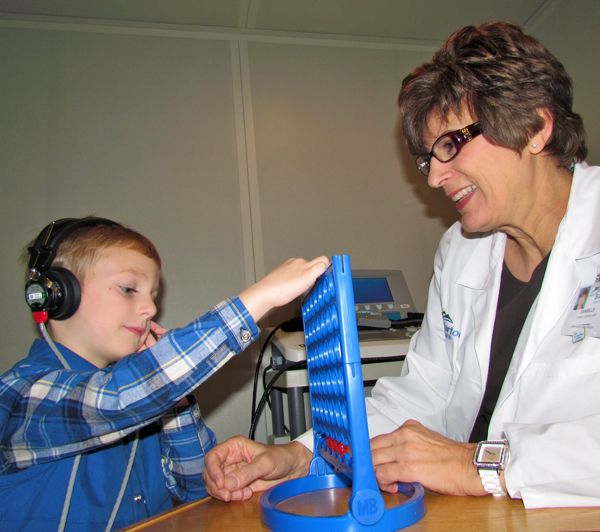
Brayden Blackwell, 6, has his hearing checked by Danielle Knowlton. Photo/Rebecca Wass

Brayden Blackwell, 6, has his hearing checked by Danielle Knowlton. Photo/Rebecca Wass

“I hope to bring greater awareness of hearing loss to the community, so those who have hearing difficulties or children at risk for hearing loss will reach out, seek evaluation and obtain help for themselves and/or their children,” Knowlton said.

The Better Hearing Institute reported in 2010 that three in 10 people older than 60 have hearing loss. At least 1.4 million children (18 or younger) have hearing problems and it is estimated that three in 1,000 infants are born with serious to profound hearing loss. Many others have lesser degrees of hearing loss that can impact their development.

“The critical language learning years for children are from birth to 3 years of age,” Knowlton said. “If a hearing loss is missed or diagnosed after this age, it can have a devastating impact on a child’s language, learning and emotional development. If we can help to provide earlier identification and intervention in this age group, we can make a huge difference in the lives of so many children.”

Knowlton provides education on prevention, identification, assessment, and rehabilitation of hearing, auditory function and other related systems. She graduated from Holy Names College in Oakland, where she received a bachelor of arts degree, cum laude in speech correction and has a Master’s Degree in Audiology from CSU Sacramento. She also is a Fellow of the American Academy of Audiology.

“My area of expertise has been in the evaluation and testing of very young and challenging children,” she said. “I also have been involved in implantable hearing technology such as cochlear implants and bone anchored hearing systems in both the clinical setting and as a clinical specialist for a manufacturer.”

Her unique education and training enables her to assess and diagnose hearing loss, auditory disorders and counsel regarding intervention and options. Knowlton’s experience spans from a clinical director role at Children’s Hospital & Research Center Oakland, to a clinical applications specialist with Cochlear Americas in Centennial, Colo. She began her career at St. Luke’s Hearing and Speech Center in San Francisco where she served all age groups. Her broad experience has enabled her to bring the latest techniques and technology to the Lake Tahoe area and its surrounding communities.

“I look forward to my work here at Barton, and hope that I can make a difference.”

Rebecca Wass works for Barton Health in the public relations department.


Nothing common about S. Tahoe’s lakeview project

By Kathryn Reed

While the hum of men and their machines permeate the air, so does the anticipation of what Lakeview Commons will be when the work is completed in a month.

The $6 million project in South Lake Tahoe on the waterfront at El Dorado Beach is winding down. A TRPA extension is allowing dirt to be moved through Friday, though that may need to be extended into next week. (Usually dirt in the basin can’t be moved past Oct. 15.)

The eyesore is gone and the dream of a team of community activists is nearly a reality.

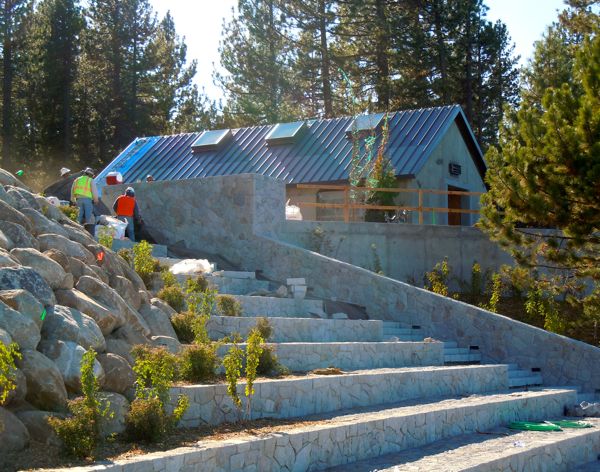
Work on Lakeview Commons in South Lake Tahoe should be done in November. Photos/Kathryn Reed

Work on Lakeview Commons in South Lake Tahoe should be done in November. Photos/Kathryn Reed

Hand-cut rock quarried from the Carson City-Mound House area is still being placed. But most of the terraced area closest to Lake Tahoe is done. What was once a steep hill of unattractive dirt is now seating for those who want to stare into the emerald water.

While the beach was always popular with tourists, especially with Campground by the Lake being on the other side of Highway 50, it’s likely locals will frequent this area in the future.

Even in its raw form, the beauty is evident. From the highway the transformation is not obvious. The dirt that can be seen at street level will be covered with paving stones.

The 27 picnic tables and 20 barbecues still need to be installed. A double built-in barbecue with cooktop is near the boathouse. This will be open to the public.

In that area will be a stone gas fire pit with seating area. The city or its concessionaire will power up the pit.

While it has not been decided if the construction fence will come down for the winter (fine tuning needs to be done in the spring), it is from the water that the renewal of this area is most dramatic.

This has become a one-of-a-kind place on the South Shore.

“It takes a team,” Steve Jessop with Clark and Sullivan construction firm told Lake Tahoe News during a private tour Wednesday. “It’s been a fast-paced project.”

While the project is a year late because of legal issues, the city has been pleased with the company’s professionalism and speed (especially with winter lasting into June) to accomplish what it has to date.

Jim Marino, who is overseeing the project for the city, is a bit like a kid showing off a new toy. And he’s a bit like a proud father showing off his adopted baby. After all, he has not been part of the project since Day 1.

Walking through the site Marino talks about how he envisions events being staged at Lakeview Commons – concerts, kids programs – he sees no limit to the possibilities.

Not in the original design was power at the beach. This was added so if events were to be staged there, electricity is in place.

While the Tahoe Regional Planning Agency allowed overhead lights at Sand Harbor and Tahoe City Commons, the bi-state regulatory agency nixed that from Lakeview Commons. So, instead, the lights are built into walls.

Other lights will be installed in the railing at the east end of the project. A stainless steel railing that is part of the structural wall still needs its cedar cap. Under that cap will be LED lights.

Native plants, under the direction of landscape architect Brett Long, are still being put into the ground. Part of the landscaping is designed to help stabilize the slope.

As with any project, surprises and changes were part of the process. Concrete footing were buried – and had to be removed. Marino said they could have been there since the 1940s or ’50s.

The boathouse

Finishing touches are being put on the bi-level building that will provide food up top and house non-motorized boats below. Cooking apparatuses will not be installed so the concessionaire does not compete against local businesses, Marino said.

It’s expected the city this winter will put out a request for proposal seeking a concessionaire to run the whole operation. There is still some question as to what the original deed that gave the property to El Dorado County says is an allowable use in terms of for-profit entities. Recreation and open space are what the original group of property owners from the 1920s wanted the land to always be used for.

In the beginning when Lakeview Commons was just a concept the idea was for the boathouse to store boats for the public. It may be that boats could also be rented from there – canoes, kayaks, paddleboards – nothing with a motor.

It has been built to LEED gold standards. Solar panels should help generate enough electricity that it will be self-sustaining.

Bathrooms are part of the facility.

Across Lakeview Avenue the existing restrooms will be demolished next year and new ones built with a Department of Boating and Waterways grant.

What’s next?

The steel railing is the end point of phase one. Phase two goes to Rufus Allen Boulevard and will include a cantilever bridge. While TRPA is OK with that, it will be Caltrans that needs to be convinced an encroachment permit should be granted and that the bridge is a good idea.

A grant from the California Tahoe Conservancy supplied the funding for phase one. But the $2.4 million to $2.7 million needed for phase two remains elusive.

Nor is there money to complete the improvement on the campground side of the highway. All of this at one time was called the 56-acre project – because it is 56 acres. El Dorado County owns 40 of those acres, which is leased by South Lake Tahoe. The city owns the remainder.

Peter Eichar with the Conservancy said the ball is the city and county’s court in terms of how things proceed. With the state agency without dollars, it is not in a position to help at this point.

A dilapidated pier is swimming distance from shore. One day the city wants to replace it. While safety and aesthetic reasons call for its removal, TRPA rules are such that if a pier is removed, the owner has two years to replace it or they lose the right to do so. The city doesn’t want to take that chance.

It’s possible as the city plots out its list of capital improvement projects each year, that phase two of Lakeview Commons will become a priority. Some of the council members will be touring the site today.

ngg_shortcode_0_placeholder (Click on photos to enlarge.)


4.8 temblor felt in South Lake Tahoe

It was an earthquake, not a burglar trying to get in — is what South Lake Tahoe police dispatchers told people Wednesday night.

An earthquake measuring 4.8 struck 23 miles northwest of Truckee in Plumas County at 11:37pm Oct. 26.

People are reporting they felt it as far away as Redwood City – 276 miles from the epicenter.

In South Lake Tahoe it was a slight rocking that lasted for a few seconds.

A series of aftershocks have been recorded by the U.S. Geological Survey in the Whitehawk area — a 1.9 at. 11:41pm, a 2.4 at 11:51pm, and a 1.5 at 11:54pm.

— Lake Tahoe News staff report


Tips for a safe Halloween

I would like to encourage everyone buying costumes for Halloween to check the labels and make sure they are made of flame retardant materials. Materials made of 100 percent polyester are best suited for Halloween costumes.

These costume materials may be purchased at most local fabric stores.

sltfdThe use of commercial flame retardant sprays is not recommended.

Avoid Halloween costumes that are loose or baggy to prevent fabric from coming in contact with any open flames. Children should carry flashlights or use battery operated lights.

Jack-o-lanterns that have an open flame device should be placed up off the ground so that long or full costumes and young trick-or-treaters’ hands cannot come in contact with the flames. The use of masks which obstruct vision should be avoided.

Costumes should incorporate reflective tape in their design so children can be easily seen at night.

Trick or Treat while it’s still light outside, and stay in your neighborhood, visiting only the homes you know. Finally, always check your children’s candy before allowing them to eat any of it.

Have a fun and safe Halloween.

— Sallie Ross-Filgo, SLTFD


TRPA inching toward a workable Regional Plan

By Kathryn Reed

KINGS BEACH – More time was spent discussing who should be on the Regional Plan Update Committee than where the plan is.

Considering the Tahoe Regional Planning Agency’s document dictates what the five counties and one city, along with other landowners can do in the Lake Tahoe Basin and the fact the document was due in 2007, the sense of priorities seemed skewed at Wednesday’s meeting.

What was resolved after everyone seemed to have his or her turn to talk (Governing Board member Nancy McDermid was absent) is the committee would grow by one. South Lake Tahoe’s rep Claire Fortier is now on the Regional Plan Update Committee.

Arlo Stockham on Oct. 26 gives the TRPA Governing Board an update on the Regional Plan. Photo/Kathryn Reed

Arlo Stockham on Oct. 26 gives the TRPA Governing Board an update on the Regional Plan. Photo/Kathryn Reed

While the staff report listed when the twice monthly committee meetings will be, committee Chairman Clem Shute made it clear they are likely to change so to not put them down in ink. The meetings will be on TRPA’s website and they are open to the public.  The next one is Nov. 2 when the committee will likely take action on what staff brought to the board Wednesday – which was for discussion purposes only.

Arlo Stockham, who was brought in last month to breath life into the Regional Plan Update that everyone says will be ready for a vote in December 2012, went over the basics of where things are.

“We need to get out of detailed design issues. We need to spend our limited resources on environmental gain,” Stockham said.

Board member Byron Sher called the removal of all reference to transect zoning “a bombshell”. His colleague Tim Cashman was a bit miffed as well, saying, “I’m a fan of transect.”

To this Stockham said, “It’s a term no one understands. We don’t plan to mandate transect.”

Jennifer Merchant, who works in Placer County’s Tahoe office, voiced her frustration with transect going away because she said her staff has jumped through hoops to accommodate TRPA for years, with about $700,000 spent on developing a plan and transect is the path they were told to pursue.

Shute is concerned about the county going through the process without a Regional Plan Update. Stockham said it would not be a problem.

It turned out to be a big problem for South Lake Tahoe. The League to Save Lake Tahoe is suing the city because its General Plan does not conform to the current TRPA Regional Plan.

Although the word transect is out, it isn’t gone in theory. The plan is to promote smart growth, mixed use vibrant centers. Essentially it’s transect without calling it that. It also allows for more flexibility.

Flexible – that’s the word TRPA is trying to embrace and be associated with.

The talk is local jurisdictions will have a greater say in what is built or rebuilt in their communities. Of course, it still must fit into whatever big picture the Governing Board approves so it won’t ever be a free for all.

Local plans would be adopted to conform to the TPRA Regional Plan.

While the goals are to remove redundancy, increase delegation to local government and create one-stop shops, the details are far from in place. Enforcement is an issue that needs to be addressed.

Already on the books are more than 175 descriptions of land use for each plan area. Ideally, much of that will go away.

Land use classifications will go from five to seven, with wilderness and backcountry being added. Commercial/public service will be called mixed-use. The other existing categories are conservation, recreation, residential and tourist.

While everyone seems to have a hand in the Regional Plan Update, simultaneously the environmental documents are being prepared. The goal is the draft EIS will be out in March.

Executive Director Joanne Marchetta said it is possible to study the five alternatives while the update is under way because it’s been set up to look at the “broadest range of possibilities so we analyze the full range of impacts.”

Also on Wednesday was a workshop with the Governing Board and Advisory Planning Commission to go over the Code of Ordinances. It will be before the Governing Board for adoption in November.

The goal is to make it less cumbersome – so someone might understand it without hiring an attorney. With people understanding what to do, it might mean the consulting business in the basin will be less robust.

But it is not designed to eliminate the need for each property to have a $1,000 site analysis done to document coverage and other TRPA-isms. It’s the requirement of those types of regulations that make deck extensions so expensive and why there are so many illegal ones.

Then there are board members like Sher, who has never lived in the basin, who wants to force homeowners to do their BMPs before they can sell their property. That is a possibility in one of the alternatives being studied.

In other action:

• The board accepted the $35,000 settlement agreement with Tamara Fritz who extended her West Shore pier without a permit and installed a boat lift on the property. She will also have to clean up the vacant lot next door.

• The board resumes its meeting Thursday at 9:30am at Stateline, with the South Tahoe Greenway bike trail on the agenda along with tourist accommodation units at the Nugget.


Nevada public records policy under review

By Sean Whaley, Nevada News Bureau

CARSON CITY – A panel of lawmakers agreed today to review its new policy on responding to public records requests after concerns were raised by the ACLU of Nevada.

Rebecca Gasca, legislative and policy director for the organization, told the Legislative Commission on Oct. 26 that the new policy says those seeking public records from the Legislative Counsel Bureau need to explain why they want the information when making requests.

The policy, adopted in August, improperly shifts the burden to the person requesting the public records to show that the need for the information is stronger than any public policy interest in keeping the information confidential, she said.

Gasca had already sent a letter to the commission from ACLU General Counsel Allen Lichtenstein explaining the concerns with the policy in detail.

Assemblyman Ira Hansen, R-Sparks, a member of the commission, asked that the new policy be reviewed at its next meeting.

“We did kind of, as I recall, went through it kind of quickly,” he said. “And there is some verbiage in it that I think we probably ought to review to see if it is a little too vague and a little too open ended.”

Gasca said the new policy would incorrectly apply a Nevada Supreme Court ruling in Donrey of Nevada v. Bradshaw and impose a “balancing test” to determine if the public interest in disclosing the information outweighs the public interest served by not releasing the information.

The balancing test referenced in the court case applied to requests for criminal information, not general public records requests, she said.

“The policy of LCB that you passed at the last commission meeting actually broadly expands upon that and specifically states that requestors need to put in why they are requesting something so the LCB can balance those interests,” Gasca said.

While there was a comment from LCB Director Lorne Malkiewich that the requirement will not be used as a basis for denying requests, this statement of intent was not included in the new policy, she said.

Concerns about the policy have also previously been expressed by Barry Smith, executive director of the Nevada Press Association.

In response to the ACLU letter, Malkiewich said the new policy, “was not proposed in an effort to restrict public access, but rather to reflect the state of the law and allow us to continue our practice of prompt, complete response to requests for public records.”

“In summary, the policy that I proposed and the Legislative Commission adopted does not conflict with state law; it reflects what the Nevada Supreme Court has recognized to be the state of the law,” he said. “We will not reject a request for failure to include such a statement, but a clear explanation of a particular public interest may tip the balance in favor of disclosure of a document that might not otherwise be disclosed.”


Carson City IHOP rampage sparks call for changes to gun laws

By Martha Bellisle, Reno Gazette-Journal

Law enforcement leaders, a shooting victim and some lawmakers are calling for a review of Nevada’s gun laws after a mentally ill man shot 11 people with an assault weapon at a Carson City restaurant last month, leaving five dead.

Some states have responded to mass killings by banning assault weapons, outlawing high-capacity magazines or requiring gun owners to get licenses and release their mental health records.

And now, after the IHOP shooting, some in Nevada have called for similar state-level restrictions and bans on some firearms. But others oppose new firearm restrictions based on what they say is a knee-jerk reaction to a tragedy, and say the call for tougher laws is simply an effort to curtail the right to bear arms.

Nevada National Guard Sgt. Caitlin Kelley, one of the victims in the IHOP attack, responded to the shooting by calling for a ban on assault weapons, which can be purchased without a background check at many gun shows or through private sellers.

“I can’t imagine why we are even selling assault weapons to civilians,” said Kelley, who was shot in the foot and still uses a wheelchair. “There’s no reason for an AK-47 or an M-16 or an M-4 to be in a civilian’s home.”

Washoe County Sheriff Mike Haley agreed, saying: “I don’t see any logic to having assault weapons available to the public.” But he said banning such weapons would spark a sharp response by gun-rights advocates.

Robert Smith, president of the Nevada State Rifle and Pistol Association, said guns are not the problem — the problem lies with the people using them.

“It isn’t the weapon that’s bad, it’s the person” who commits crimes with the weapons, he said. “If you keep them away from private citizens, you’re making the private citizens unarmed targets.”

Semi-automatic assault weapons can easily be converted into automatic weapons — which are the same thing as machine guns — with a simple kit available online or at gun shows, officials said.

What happened at the IHOP “was as close to a war as most people will ever come, and they were helpless to defend against it,” Haley said. “But because of our love affair with weapons, we are subjecting the public to this type of violence. If this is going to change, the public has to stand up and demand change.”

Read the whole story


Empty fields fill farmers’ pockets

By Felicity Barringer, New York Times

BRAWLEY — Three generations of Al Kalin’s family have worked their 2,000 acres of carrots and sugar beets, wheat and alfalfa for almost a century in the Imperial Valley, a scorching swath of Southern California desert that was unfit for farming until water from the Colorado River was diverted here in 1901.

But now Mr. Kalin and his brother enjoy a choice that their parents and grandparents never had. They can continue to farm all their land, or they can stop farming some of it and earn more than $500 an acre — more than the market value of a crop like alfalfa in a given year — simply by not using the water required to nourish those crops. Water saved is sent on to thirsty cities and suburbs to the west: San Diego, Los Angeles and Palm Springs.

With water increasingly scarce in the West, some other communities are allowing farmers to sell their allotment of it for whatever price they can find, in some cases thousands of dollars for the amount it takes to grow an acre of a crop. But this comes with a hitch. Working farms provide jobs and income to their many suppliers. There are 450 farmers in the Imperial Valley, but half the jobs held by the 174,000 residents are tied to agriculture.

When land is idled, the communities around the farms can wither. Residents here point to the neighboring Palo Verde Valley, where farmers can sell more than a quarter of their water supply at much higher prices in a process they control. As a result, nearly a third of the agricultural land was not farmed this year; over time, businesses and workers have suffered.

Imperial’s fear is that a century after Colorado River water allowed this land to be a cornucopia, unfettered urban water transfers could turn it back into a desert. So the deal that Imperial water managers struck limits how much water can be sold and for what price, and it controls how much acreage is enrolled in the program and for how long.

Many farmers, including the Kalins, have resisted the temptation to sell. “There is something about that fallowing, it just doesn’t sit well with my brother and I,” Mr. Kalin said.

The Imperial Irrigation District, where they farm, controls more water than any other place in the West — about 20 percent of the annual flow of the Colorado. “It’s built into the DNA here that water is a birthright,” said Kevin Kelley, the irrigation district’s general manager.

Read the whole story


Rags to riches story for former Tahoe logger

By Carly Flandro, Bozeman Daily Chronicle

Tim Blixseth, former billionaire and founder of the Yellowstone Club, has written 250 pages of his autobiography, which is to be titled: “You couldn’t make this up.”

But he’s waiting to finish it until next year.

“It’ll be a journey about my life and some of the interesting things, the hardships, the joys, just life,” he said. “Neither you nor I know the ending yet.”

Blixseth is known for envisioning and creating the Yellowstone Club, a private club in Big Sky for the ultra-rich that features a golf course and ski area, where members have access to “private powder.”

He’s also known for his messy divorce from Edra Blixseth and the series of lawsuits he’s been involved with since.

But before coming to Montana and making millions, Blixseth grew up in a poor family in Oregon. His father was a Norwegian immigrant who Blixseth said came here for the “American dream.”

“My father’s American dream never came to fruition, I don’t think, but mine sure has,” Blixseth said in an interview with the Chronicle. “I’m thankful I was born in America.”

After learning young that he had a knack for making deals, Blixseth would eventually make millions from the timber industry.

He told CNN Money in 2008 that when he was about 13, he bought three donkeys for $25 each after seeing a classified ad for them. Then, he turned around and sold them for $75 after rebranding them as pack mules.

“So he gives me the $225, and a light bulb went on and I went, ‘Huh, okay,” he said in the CNN Money article, “Paradise Lost” by William D. Cohan.

Blixseth went on to make a series of timber deals that made him millions, and he retired in North Tahoe Lake, Nev., at the age of 40, according to the article. But he got bored and decided to tour 164,000 acres of Plum Creek Timber Co. land that was for sale in southwest Montana.

Read the whole story


Momentum to eliminate social promotion in LTUSD

By Kathryn Reed

It’s going to get tougher to be passed from one grade to the next in Lake Tahoe Unified School District without knowing the material.

ltusdThe board on Tuesday night agreed to direct staff to begin the legwork to revise the promotion-acceleration-retention policy.

Today’s policy allows parents to have the final say if their child is held back. What is proposed is the district – through teachers and other staff – would have the ultimate say.

Early intervention is the key so students will progress with their classmates. The idea is by October educators have a good idea who is falling so far behind that it may be impossible to make up the work. South Tahoe Middle School Principal Beth Delacour at the Oct. 25 meeting relayed the story of a boy who had more than a dozen math assignments outstanding. He found out if he doesn’t pass, he probably would be a year behind his buddies. He’s turning in the work.

Superintendent Jim Tarwater said the threat of being retained is often enough to get some kids to apply themselves.

Two age groups often are most likely to be held back – at kindergarten because of emotional issues more than learning issues. This is one reason Preppy K has been successful; it eases youngsters into the rigors of school. The other level is middle school where youths start to make choices for themselves, pull away from parents and sometimes end up making the wrong decisions.

Board members agreed consequences need to be in place if kids decide to slack off. A consequence could be repeating the grade. But they also want to make sure a safety net is there to catch them and spur them along, including providing academic help.

“You don’t want them to go through middle school and be three grades behind,” Tarwater said. “There has got to be some work ethics in this world.”

Delacour echoed that sentiment – saying school is a student’s job.

Four students at STMS were held back this year; all are doing well now.

Then there are the kids who for reasons that go beyond their control need support that doesn’t involve academic tutoring. Tarwater spoke about being at the middle school earlier in the day when a sixth-grader told him her friend was suicidal and needed help. The student told him the only place she feels safe is at school.

Those are the students who need to be reached so not only do they understand the importance of an education, but also that they are important.

Another issue that keeps coming up when standardized test results come out is those students classified as English learners at the elementary level are the same EL students at high school.

“Long-term English learners is a national problem,” Ivone Larson, South Tahoe High School principal, said. “Part of it is cultural. It’s such a complex issue.”

She equated it to anyone in that room moving to China and eight years later only being at a conversational level with Mandarin instead of at an academic level. It depends on what language is spoken at home, the education level in the home and the individual’s desire to learn.

The next step is for Tarwater to meet with the leadership team and staff to come up with a plan that essentially wipes out social promotion in LTUSD. Then the board will vote on the policy.