Tahoe’s transportation vision outpaces implementation

By Kathryn Reed

If only transportation improvements moved as fast as technology.

No need to use paper or stickers, a computer program can collect the same information more efficiently.

Analysis

But where was the bus to get people to that technology?

Instead, the parking lot was full. And this, at a meeting about transportation where bike trails were heralded. But, then again, it was snowing by the time the meeting wound down.

This is a reminder that no matter how many bike trails are built or rehabbed, they are not even as seasonal of a resource as a ski resort. After all, those places can be transformed into hiking and biking meccas in their off season. Tahoe bike trails don’t even become cross country or snowshoe trails in their off season.

The Tahoe Metropolitan Planning Organization, an arm of TRPA, rolled out its plan for the future to about 50 people who attended a meeting Nov. 3 at Inn by the Lake in South Lake Tahoe. (No South Lake Tahoe City Council members attended; El Dorado County Supervisor Norma Santiago was a speaker.) About a dozen people attended the North Shore version of the meeting two nights earlier in Kings Beach.
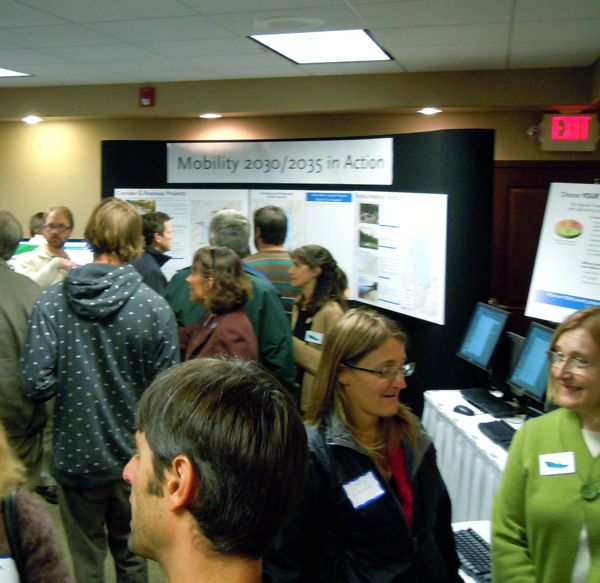
Dozens of people attend the Nov. 3 transporation meeting in South Lake Tahoe. Photo/LTN

Dozens of people attend the Nov. 3 transporation meeting in South Lake Tahoe. Photo/LTN

While the Regional Transportation Plan must be updated every four years, the bigger plan is looking out to 2035.

It’s hard to embrace what were called the accomplishments since the last plan was put together in 2008 because most of the ideas had been on the books for longer than four years. Transit shelters that are going in this month; the Highway 50 road-water quality project; lighting for Ski Run/El Dorado Beach; Sawmill, Stateline demo, and Greenway bike projects were touted.

The reality that was not stated by any official is the lighting at El Dorado Beach/Lakeview Commons is not what South Lake Tahoe wanted because TRPA said no to overhead lighting. Phase two of Sawmill is a year behind. While the Greenway project is in the permitting phase, there is no money to bring it to fruition.

Much like all the placed based planning sessions for the TRPA Regional Plan that were started in 2005, this had a similar feel. Instead of having to put stickers on white pieces of paper, people could use CrowdBrite to do it electronically. People not at the meeting may log in to CrowdBrite for the next 30 days to contribute ideas. Access is also via the TMPO website.

One of the interactive components allowed computer users to spend $650 million on South Shore projects and another $475 million on North Shore. The categories to choose from included stormwater, bike-pedestrian, road revitalization, transit, and managing transportation demand.

It showed maintenance of existing and future bike paths on the South Shore with a $6 million price tag.

Those million dollar figures are what the TMPO expects to have to spend through 2035. The sources are evenly split between local, state and federal entities. It was not explained any further where the money specifically comes from.

The same ideas that have been written or mouthed for eons came spewing forward – have a free bus system, create a class 1 bike trail from Meyers to the Y, clear the bike paths in the winter.

Part of the big picture is contending with California mandated green house emission reductions. By 2020 the amount of emissions is supposed to drop by 7 percent per person and another 5 percent by 2035.

Karen Fink, TMPO transportation planner, said this is the equivalent of everyone not driving one day per month.

A project list will be created based on public input. The draft plan should be out for review in March, with the final plan ready in August 2012.

Staff is working on the premise of complete streets being the No. 1 policy goal. The three programs it is likely to pursue are: reducing employee trips via shuttles or flexible scheduling, real time traveler information via electronic signs, and parking management where entities may share asphalt. Projects will be ones that can be funded in a reasonable future.

How all this public input being collected will be incorporated remains to be seen.

More information is on the Tahoe Metropolitan Planning Organization’s website.


Treetop adventure park in the works for South Lake Tahoe

By Kathryn Reed

Monkeying around is being encouraged.

“I went through a Go Ape course in England. We went through it twice because we liked it so much,” Sherry Miller, who runs Lake Tahoe Airport, said. “It’s a high-rope course. It’s a fantastic outdoor activity for everybody.”

Such a course, which includes ziplines, is expected to open at the South Lake Tahoe airport next year. The city’s Airport Commission approved the idea at its Nov. 3 meeting. The City Council is expected to approve the contract at its Nov. 15 meeting.

A treetop adventure park is expected to open at Lake Tahoe Airport in 2012. Photo/Go Ape

A treetop adventure park is expected to open at Lake Tahoe Airport in 2012. Photo/Go Ape

It’s essentially a high-wire forest adventure course.

“Our first interest is to create an opportunity for our guests to enjoy something unique, something that supports and symbolizes the natural environment here,” City Manager Tony O’Rourke told Lake Tahoe News.

Officials from the Maryland-based company were not available for comment late Thursday. While they were not at the meeting this week, representatives have been at previous Airport Commission meetings touting how they could transform several acres of the airport into an eco-adventure for locals and tourists.

The tentative 15-year agreement has Go Ape leasing 12 acres of the airport starting near the tower. (That would mark the south end of the course.) The contract start date would be Nov. 15 if council approves it. Rent would likely start being collected April 1, 2012, in the amount of $2,000 a month, going up based on the Consumer Price Index. The city will also be paid a part of the gross revenues, with the plan calling for 2 percent in year one and maxing out at 11 percent in year six.

Estimates are the city could make more than $100,000 a year off the adventure by the fifth year.

It would probably be open six to seven months, and not in the winter to begin with.

It takes six weeks to set up the course. They are considered semi-permanent, so they can be taken down if need be. Trees are protected so their growth is not stunted.

Platforms will be built into the trees. These launch pads are where people jump from or start their trek along wobbly ropes.

Miller was almost giddy describing the fun she has had on one of Go Ape’s courses in the U.K. Wearing a harness and strapped to a cable, people are not going to fall no matter how sweaty their palms get.

Four to six sections are in each course. It’s expected one course will be built in South Lake Tahoe. Each of Go Ape’s courses occupies 6 to 9 acres.

With the company limiting the number of people who can use the course at any given time, it’s not expected to add tremendously to traffic issues on Highway 50. At its other facilities, reservations are the norm.

Parking is not solidified. It will likely either be near the non-functioning control tower or in the main lot of the airport.

While Go Ape cannot fell any trees without the city’s permission, this area is slated to be thinned. Miller said the Go Ape officials will be notified which trees are likely to removed so as its design team creates the course, they know which trees will be standing when it comes time to build the apparatus.

The airport tower, which has not been used in years by the FAA, could become Go Ape’s offices and storage site.

The Federal Aviation Administration still has equipment there, so that would need to be removed. Plus, the FAA must sign off on the idea once the council gives its blessing.

“Typically the FAA doesn’t like park-type things on airport property, but this is land that cannot be used by aircraft,” Miller told Lake Tahoe News. “In our land use plans this is an approved use.”

Miller said Tahoe Regional Planning Agency staff has been part of discussions and is working with everyone to make this become a reality.

“We can’t wait until they get here. We’re fighting over who is the first one to go on course,” Miller said.


Nevada not alone in bear hunt controversy

By Jeff Delong, Reno Gazette-Journal

Hunters might be quietly stalking Nevada’s woods, but the policy decision that put them there was decidedly noisy.

It packed meeting rooms, led to candlelight vigils and marches on the governor’s mansion.

Nevada’s first black bear hunt, now under way and possibly nearing an end, is described as the state’s most contentious wildlife issue in recent memory.

“It’s been mega-controversial,” said Chris Healy, spokesman for the Nevada Department of Wildlife.

Nevada’s inaugural bear hunt is one sow away from the end of the season after a fifth female was killed over the weekend. Regulations adopted by the state Wildlife Commission set a limit of 20 bears that can be killed; of those, no more than six can be female. Since the season opened Aug. 20, hunters have killed 12 bears — five females and seven males.

But Nevada is far from unique. The issue of bear hunting, now allowed in at least 33 states, has brought impassioned debate in plenty of places.

It happened in California, where a proposal to allow as many as 2,000 bears to be hunted quickly found opposition, forcing plans to be scaled back. It happened in Kentucky, where a proposal to allow harvest of only half the 20 allowed killed in Nevada still stirred up some folks.

It’s happened in New Jersey — like Nevada, a flash point for the debate.

The Garden State is now gearing up for its 2011 bear hunt after 592 bears were killed in December 2010, said Lawrence Hajna, spokesman for the New Jersey Department of Environmental Protection.

Read the whole story


Another study to confuse alcohol drinkers

By Rob Stein, Washington Post

Here’s some news that might make a lot of women feel as if they need a drink: The compound in red wine suspected of having a host of health benefits has for the first time shown promising test results in people. But a new Harvard study indicates that indulging in as few as three drinks a week may boost a woman’s risk for breast cancer.

So, should that be a glass of Merlot? Or just plain water?

Scientists, of course, say: It depends.

“If you are someone with a family history of breast cancer but are healthy, at a good weight, exercise regularly, have a healthy diet and don’t have a risk for heart disease, then you may make one decision,” said Wendy Y. Chen of the Harvard Medical School. “Another woman who has some cardiovascular risk factors and no history of breast cancer may make a different decision.”

The findings, both released Tuesday, are the latest seemingly head-spinning medical advice about alcohol. For years, doctors advised that women could safely consume about a drink a day. Men could get away with two. More servings have long been known to have more risks than benefits, especially for breast cancer among women. Scientists think alcohol can cause breast cancer by raising estrogen levels.

Many experts urged caution about overreacting to the new findings. The slight increased risk for breast cancer from such low alcohol consumption was probably still outweighed for many women by a possible reduction in the risk of heart disease, which kills far more women than breast cancer.

Read the whole story


Missing Reno man found in embankment near Markleeville

By Reno Gazette-Journal

A Reno man reported missing Thursday morning to the Reno Police Department was rescued late Thursday morning after his vehicle was found over an embankment in  Alpine County.

Few details were available about the case, but the California Highway Patrol reports the man was found in the vehicle at about 10:48am in the area of Highway 4 and Wolf Creek Road about six miles southeast of Markleeville.

CHP officer Jeff Gartner said the vehicle was over an embankment just west of Chambers Mansion off a road that was closed by mid-afternoon because of an approaching snow storm.

Read the whole story


Opinion: Vogelgesang’s experience will benefit STPUD

To the community,

Randy Vogelgesang is blessed with great common sense and a belief in service to his community. He and his family are long-time South Lake Tahoe residents. He provides professional structural engineering services with his company, Tahoe Engineering Inc.

He has served on the city building code board of appeals, helping make sense out of health and safety technical code issues. He is the president of the local Tahoe Engineers, Architects and Surveyors group, promoting education and coordination with governmental agencies on local, regional, county and state levels.

I have had the pleasure of working with Randy on many building projects. He has an eye for detail, while keeping the big picture in focus. I feel comfortable in recommending your support for him in any elected position.

Keith and Mary Ann Klein, South Lake Tahoe


November — a monthlong recognition of American Indians

The first American Indian Day was celebrated in May 1916 in New York. Red Fox James, a Blackfeet Indian, rode horseback from state to state, getting endorsements from 24 state governments to have a day to honor American Indians. In 1990, President George H.W. Bush signed a joint congressional resolution designating November as “National American Indian Heritage Month.”

As of the 2010 Census, the nation’s population of American Indians and Alaska Natives, including those of more than one race totaled 5.2 million. They made up 1.7 percent of the total population. Of this total, 2.9 million were American Indian and Alaska Native only, and 2.3 million were American Indian and Alaska Native in combination with one or more other races.

The projected population of American Indians and Alaska Natives, including those of more than one race, is 8.6 million on July 1, 2050. They would comprise 2 percent of the total population.

The nation’s American Indian and Alaska Native population between the 2000 Census and 2010 Census increased by 1.1 million.

The states with more than 100,000 American Indian and Alaska Native residents as of the 2010 Census were: California, Oklahoma, Arizona, Texas, New York, New Mexico, Washington, North Carolina, Florida, Michigan, Alaska, Oregon, Colorado, Minnesota and Illinois.

There were 334 recognized American Indian reservations in 2010. This total excludes Hawaiian homelands. All in all, there are 617 American Indian legal and statistical areas for which the Census Bureau provides data.

The federal government recognizes 565 Indian tribes.


Convention center site may move out of bankruptcy court

More time. That’s what Randy Lane has been given by a bankruptcy court judge in Sacramento.

January is the next scheduled court date for the convention center debtor and creditors.

Last month Lane asked for more time to come up with a plan for the 11-plus acre site that has languished in bankruptcy since October 2009. At that time he was asking for 270 days. At the hearing on Nov. 1 he was given until Jan. 10 to resolve the property tax issue. In other words, figure out a payment plan.

It could be years before work resumes on the would-be convention center. Photo/LTN file

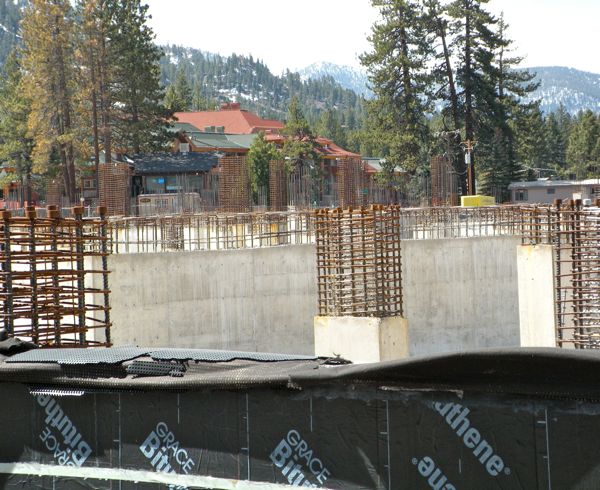
It could be years before work resumes on the would-be convention center. Photo/LTN file

One of the creditors is contemplating filing a motion to dismiss the case from bankruptcy court. This, too, is likely to be heard in January.

“It would remove the bankruptcy court from the proceedings, and the parties could either foreclosure, sell, reach agreements, etc., without needing the bankruptcy court’s approval,” South Lake Tahoe City Attorney Patrick Enright explained. “The bankruptcy court has certain powers under the bankruptcy code to impose a plan, but without a plan and no real hope of a plan from the debtor, there is little point in the bankruptcy court keeping the case indefinitely.”

— Kathryn Reed


Bijou neighbors gathering to spruce up the area

South Lake Tahoe is looking for people who live in the Bijou neighborhood who want to give back to the area.

The Bijou Neighborhood Cleanup Day is Nov. 8 at 10am.

Meet at Bijou Community School in front of the Family Resource Center at 10am, where collection bags and gloves will be dispersed.

For more information, click on flyer.


Lake Tahoe not chosen for 2012 Tour of California

By Kathryn Reed

Lake Tahoe will not be part of the 2012 Tour of California.

The 13 host cities for the prestigious bike race in May were announced early this morning. Santa Rosa, hometown of three-time Amgen Tour of California Champion Levi Leipheimer, long ago had been picked as the start city.

Amgen cyclists will not have to contend with Tahoe snow in 2012. Photo/Lisa J. Tolda

Amgen cyclists will not have to contend with Tahoe snow in 2012. Photo/Lisa J. Tolda

The route for next year is:

• Stage 1: May 13 – Santa Rosa

• Stage 2: May 14 – San Francisco to Santa Cruz County

• Stage 3: May 15 – San Jose to Livermore

• Stage 4: May 16 – Sonora (new for 2012) to Clovis

• Stage 5: May 17 – Bakersfield (Individual Time Trial)

• Stage 6: May 18 – Palmdale to Big Bear Lake

• Stage 7: May 19 – Ontario (new for 2012) to Mt. Baldy

• Stage 8: May 20 – Los Angeles/L.A. LIVE.

Lake Tahoe was one of the more than 100 places wanting to be part of the race in 2012.

Before today’s announcement, Carol Chaplin who heads LTVA, had told Lake Tahoe News she would not be surprised if Tahoe were not on the list of host cities for next year, but that would not preclude the area from trying to be on the map in the future.

This year the race was supposed to start on the South Shore, with the first day ending in Northstar. The second leg was to start in Squaw Valley.

Snow prevented the riders from doing either section. It came down to the last second before the race was called. The cyclists had been dressed on their bikes for the start.

Securing the event had been a joint endeavor by the Lake Tahoe Visitors Authority and North Lake Tahoe Resort Association.