South Tahoe, Whittell, Truckee volleyball teams headed to State

South Tahoe, Whittell and Truckee high school volleyball teams are head to the state championships in Las Vegas next weekend.

South Tahoe will be up against Truckee in the Class 3A division at 6:20pm on Nov. 11 at Silverado High in Vegas. Whichever team wins will play for the championship at 4pm Nov. 12.

Whittell, in the Class 2A division, as the No. 2 ranked school from the north will take on Calvary Chapel, the No. 1 ranked school from the south. They play at Silverado High in Vegas to 4:40pm Nov. 11.

If Whittell prevails, the championship round is at Chaparral High at 10am Nov. 12.

— Lake Tahoe News staff report


Water districts raise rates as consumption declines

By Loretta Kalb, Sacramento Bee

It doesn’t seem fair – and to some it doesn’t make sense.

If you’re worried about water bills and you use less water, you should get a lower bill, right?

But that’s not happening in the Carmichael Water District.

The district has announced it wants to raise water rates 18 percent starting Jan. 1 – on top of an even bigger rate hike already imposed through mid-2014.

The reason: Water use in the district has fallen below historical average by an astonishing 25 percent, thanks to a mild and wet weather year, foreclosed homes and ratepayers using less water because of rising water bills.

With the cut in use, the water district’s revenue has dropped sharply.

It’s a curious turnabout in an industry long worried about having sufficient water supply for a growing population.

The state is requiring water suppliers to achieve a 20 percent reduction in urban per capita water use by 2020, a goal established in 2009 that has received plenty of public attention.

Not so well known outside water circles, however, is what it means for the finances of California’s water districts, which traditionally have high fixed costs.

“It really wasn’t until 2009 that we said, ‘OK, everybody is going to try to conserve,’ ” said Chris Brown, executive director of the California Urban Water Conservation Council, a group that includes about 130 of California’s largest water suppliers.

Read the whole story


Auditions for ‘The Tortoise Versus the Hare’

Auditions for the Missoula Children’s Theatre production of “The Tortoise Versus the Hare” are Nov. 14 from 4-6pm at South Tahoe Middle School multipurpose room.

If cast, there will be a fee of $35 per child.

Auditions are open to students in grades K-12, must be at least 5 years old.

A limited number of scholarships are available..

The performances are Nov. 19 at 2pm and 6pm at STMS. Cost is $10 for adults, $5 for children.

Call Peggy Thompson with Tahoe Arts Project at (530) 542.3632 for more information.


Child safety seat inspection in Stateline

On Nov. 12 from 9am-1pm, Douglas County sheriff’s deputies will inspect child passenger safety seats and install new ones at their Lake Tahoe station in Stateline.

Child passenger safety seats will be available to Nevada residents who cannot afford one. (Proof of residency required.)

For further information, contact the department at (775) 586.7251.


Opinion: S. Lake council violating federal drug laws

Publisher’s note: The following is a letter written to the South Lake Tahoe City Council that is reprinted with permission.

Dear City Council Members,

The California Court of Appeal for the Second Appellate District issued an opinion on Oct. 11, 2011, in Pack v. City of Long Beach, that federal law preempted certain provisions of the city’s marijuana ordinance.

Steve Kubby

Steve Kubby

As a result, it is clear that the South Lake Tahoe City Council is prohibited by federal drug laws and the Controlled Substances Act, from creating and regulating conditions which facilitate the cultivation of marijuana. In Pack v. Long Beach, it was decided that such ordinances are beyond the powers of any city or county, due to the fact that only the federal government can regulate marijuana.

State law is not in conflict with the CSA or federal drug laws, as it merely decriminalizes possession and cultivation of marijuana statewide, for certain individuals, in a defined medical class.

The SLT Cultivation Ordinance and its goals are in direct conflict with the federal CSA, and places each member of the SLT City Council at personal risk of criminal prosecution.

I strongly suggest you consult with legal experts to review whether or not this council has violated Federal law with its cultivation ordinance. Furthermore, I would suggest that any and all fees, fines and penalties that are collected by the city under this ordinance could be considered as serious violations of federal drug laws regarding money laundering and facilitating federal crimes.

In the meantime, you should definitely consider protecting yourselves from federal prosecution and possible prison time by immediately suspending the SLT Cultivation Ordinance, while you obtain competent legal advice.

Let freedom grow,

Steve Kubby, South Lake Tahoe


Backcountry ski swap at LTCC

Time to find some outdoor gear or sell what you are done using.

The Nov. 19 Backcountry Ski and Gear Swap is being put on by Hope Valley Outdoors and Future Business Leaders of Lake Tahoe.

The swap is located at Lake Tahoe Community College from 9am-3pm that Saturday. Gear can be dropped off on Nov. 18 from 5-8pm and Nov. 19 from 7-9am.

Unsold gear must be picked up from 3-5pm Nov. 19.

Organizers are looking for: Alpine touring skis, boots and bindings; telemark skis, boots and bindings; cross country skis, boots and bindings; splitboards; skins; collapsible poles; snowshoes; snow safety gear, avalanche probes, shovels, study kits, backpacks and newer transceivers; clean and modern clothing; winter camping gear. .

For more information, contact Geoff at (530) 307.0225.


Report: Nevada pension liabilities vastly understated

By Sean Whaley, Nevada News Bureau

CARSON CITY — Nevada’s public employee pension system is one of the better funded plans around the country, but its financial health is far poorer than taxpayers may realize because of the way the long-term liabilities are calculated, a new analysis released this month says.

The report by Andrew Biggs, a resident scholar at the American Enterprise Institute in Washington, D.C., was prepared for the Nevada Policy Research Institute, a conservative think tank.

Titled “Reforming Nevada’s Public Employees Pension Plan” the analysis says that when the long-term unfunded liabilities of the plan are calculated using a “market-based” valuation, a measure endorsed my most professional economists, the shortfall is actually closer to $41 billion than the $10 billion cited by Public Employees’ Retirement System (PERS) and its actuary.

The funding ratio of the plan falls from 70.5 percent to about 34 percent, Biggs said in his analysis.

“Nevada PERS is far from the worst-funded or worst-managed public-sector pension system in the country,” Biggs concludes in his report. “However, this merely highlights the worrying state of public-pension financing around the nation. Using market-valuation methods – which are consistent with economic theory, the practice of financial markets and the rules under which private-sector pensions must operate and which have recently been endorsed by the Congressional Budget Office – PERS is very poorly funded.”

In a telephone interview, Biggs said: “Whether you agree or disagree with the angle I took on it, I think it is helpful for people to know how the financial health of their pensions is being calculated. What they don’t know is how much of their plan’s funding rides on market risk.

“So there is a lot being staked on winning in the market here,” he said. “And whether you think the government can do that or you think the government can’t do it, it’s good to know exactly what’s at stake.”

Report could be issue for policymakers

Geoffrey Lawrence, deputy policy director for NPRI, said the report should encourage Nevada policymakers to take a serious look at making major reforms to the state public pension plan.

“We really felt that his expertise could lend a lot to the debate here in Nevada, where, as in most states, we have kind of a major pension liability,” he said.

The huge differences in the unfunded liability are due to the method used to make the calculation.

Nevada PERS, which covers nearly all state and local government public employees in the state, uses an accepted accounting method based on the actuarial value of its assets, valued at $24.7 billion as of June 2010, according to Biggs’ analysis. With liabilities of $35.1 billion, the retirement system reports its unfunded liability at about $10 billion. This figure will be updated later this month through June 30, 2011.

This long-term unfunded liability relies on an estimated rate of return on its assets, which are invested mainly in stocks and bonds.

Biggs acknowledges that the valuation under this approach is consistent with rules set out by the Governmental Accounting Standards Board (GASB), which sets nonbinding disclosure rules for public pensions.

But Biggs argues the actuarial valuation masks the true liabilities that taxpayers could ultimately end up having to cover because it does not factor in the risk of achieving an 8 percent return, a rate PERS officials note has been exceeded over the past 28 years.

Using a market-based valuation, which assesses the liabilities based on the much lower interest rate paid on government bonds, provides a more accurate assessment of the long-term unfunded liability, he said.

Lawrence said the report by Biggs shows what is at stake for public pension plans and taxpayers.

“Because under the actuarial approach you are allowed to understate your liabilities, it allows politicians to make bigger promises than they can afford, and then to underfund the pension account at the same time,” he said. “So in the long run they accrue this unfunded liability, which officially here in Nevada is reported at $10 billion, but of course Andrew is showing that it is really closer to $40 billion. So that is a huge gap.”

Nevada PERS officials say the plan is actuarially sound, and that the unfunded liability will be covered over time. They also note that the contribution rates required to keep the plan healthy are set by an independent actuary and are fully funded by the Legislature.

Biggs said the current housing crisis was a decade in the making and was the result of taking on too much risk. Public pension plans, with trillions of dollars at stake, are also taking on a lot of risk to deliver on their promises, he said.

Biggs published a similar analysis for public pension plans nationwide in 2010, concluding that the shortfalls facing the plans are much larger than most people realize.

In commenting on that report last year, Dana Bilyeu, executive officer of PERS, did not dispute Biggs’ method of calculating the shortfall, but said the actuarial method now being used is the accepted practice for public pension plans.

Possible reporting changes

The Governmental Accounting Standards Board has been evaluating some changes to the way public pension liabilities are calculated, but Biggs said he does not expect to see it embrace the market-based approach he and other economists advocate.

“To be honest I think they just don’t get it,” he said. “I don’t think they’re willing to make the kinds of changes that would be needed to bring pension valuation in line with what economists think makes sense and in line with what financial markets think makes sense. It would be such a drastic change I just don’t think they’re capable institutionally of doing it.”

GASB said in July it had approved the proposed standards, dubbed exposure drafts, which would lead to “significant improvements” in the usefulness of pension information. The latest guidance would require governments to report the unfunded portion of their retirement plans as a liability on their balance sheets, among other changes.

There has been a growing call nationally to move public pension plans to a state to a defined contribution plan, similar to a 401(k)-type plan, from the current defined benefit plan, where retirees are paid a set amount per month based on salary and years of service.

Gov. Brian Sandoval has advocated such a position, although the concept did not see any serious discussion in the 2011 legislative session.

Lawrence said an issue with making such a change is the big upfront cost of fully funding the current defined benefit pension plan in an accelerated fashion. But Utah got around that challenge last year by crafting a modified plan that allows employees to choose whether to participate in a defined benefit or defined contribution plan. It could be a good model for Nevada, he said.

Lawrence said one often overlooked benefit of such a plan is that it is portable, allowing public sector workers to move into the private sector if they wish and not remain trapped in jobs they no longer want.

The PERS board has not endorsed any such major change to the state public pension plan.


Sierra eliminates the hike to resort’s extreme terrain

By Kathryn Reed

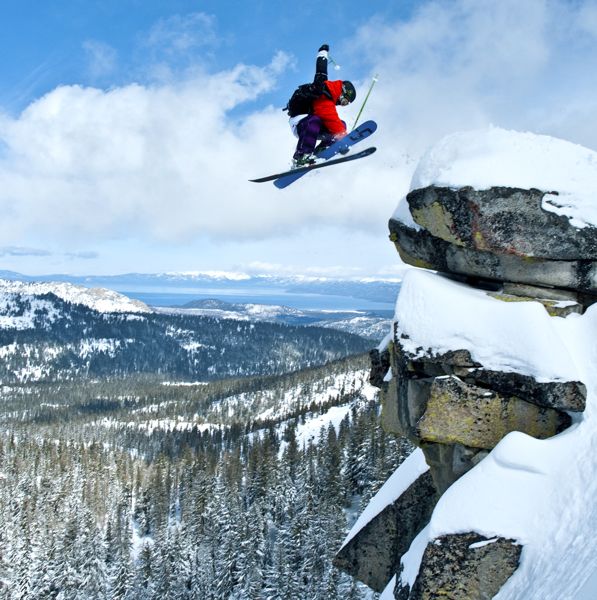
Adrenaline junkies will want to head to Sierra-at-Tahoe this winter because of the exclusive snowcat-guide provided trek to and through Huckleberry Canyon.

These 320 acres of expert terrain first became patrolled with avalanche prevention measures put in place for the 2008-09 season. Now, three years later, the resort near Echo Summit is making it a bit more accessible.

Huckleberry Canyon at Sierra will be easier to get to this season. Photo/Provided

Huckleberry Canyon at Sierra will be easier to get to this season. Photo/Provided

Gate 5 is about a 1½-mile hike for the more intrepid skier or boarder. Paying $79 (not including lift ticket) will get riders to the starting point via snowcat. The 10am-2pm Friday-Sunday excursions include lunch, avalanche beacon, probe and a guide for seven people. One cat will go out each of those days when conditions permit.

“The idea behind it is to get people out to the backcountry for the joy of floating through powder,” Steve Hemphill, spokesman for the resort, told Lake Tahoe News. “Some people are not sure they want to hike for their turns.”

Cliff drops, shoots, gladed trees – Huckleberry’s terrain runs the gamut.

On the other spectrum of the industry, Sierra is creating a snowboarding program for ages 3 to 6. Riglet Park, which will be operated in conjunction with Burton, will be near the base of the Grandview chair.

Hemphill said there has been a void in the industry in regards to getting the younger kids on snowboards.

The Burton Riglet Wheel looks like a hockey puck on the front of the snowboard. Instructors use it to pull the their charges.

“It gives them the feel for sliding on snow while the instructor does most of the work. It teaches them balance control and movement of what it is like to snowboard,” Hemphill said.

Robert Alward has taken over as director of the school.

With little snowmaking at the resort, Sierra depends on Mother Nature to set the opening date. Usually it’s as close to Thanksgiving as possible.

To spur things along, the annual Pray for Snow Party is Nov. 10 at MontBleu in Stateline. The free event is open to passholders at 6pm, and to everyone else at 7pm.

A variety of season passes exist, but just to Sierra. This is the first time in decades the resort is flying solo. With Northstar being acquired by Vail Resorts a year ago, the Double Whammy pass is a thing of the past. But Sierra still has its three-pack of tickets that through Dec. 16 are $51 per ticket – which can be used any day. Then they go up to $54/day. This compares to the regular lift ticket of $74 a day — $77 during peak times.

Sierra has a slew of events planned for the 2011-12 season. Details are online.

Don’t be surprised to see snowboarder Jaime Anderson cutting it up at the resort. Sierra remains her home resort. She often Tweets when she’s at her home mountain.

Sierra is negotiating with snowboarder Hannah Teeter as to whether the Vermont native will keep training at the South Shore resort.

For those who aren’t into strapping a plank or two to their feet, Blizzard Mountain is a snow play-tubing area at Sierra that has been expanded to include a bounce house, snack bar, fire pits, picnic tables and sledding.


Officials keeping eye on high water levels in region

By Paul Nelson, Channel 2 News

We’re still seeing the effects of last winter that kept our reservoirs full and the Truckee River moving fast for much of the summer.

But now officials tell us that water supply could be too much of a good thing as we move into what could be an unpredictable winter.

Trout Creek is higher in October than it has been in years. Photo/LTN

Trout Creek is higher in October than it has been in years. Photo/LTN

Water is still being released into the Truckee River from the Lake Tahoe Dam. That’s because Tahoe is still much higher than normal.

As we move deeper into fall, the lake levels are still at 73 percent of capacity.

“Any higher than this and we get a little nervous but we’re looking good as far as having a lot of storage in there but not being too high going into the winter,” says Chad Blanchard, chief deputy water master.

That’s because the lake and our reservoirs don’t just serve as storage — they also serve as flood control.

Read the whole story


El Dorado leads coalition to make overseas absentee voting easier

By Cathy Locke, Sacramento Bee

A $1.8 million grant to enhance the absentee voting process for military personnel and other U.S. citizens living overseas has been awarded to a coalition of 13 California counties led by El Dorado County.

The California coalition was among the first six recipients of the Electronic Absentee Systems for Elections grants awarded by the Federal Voting Assistance Program. The coalition will begin transmitting ballots electronically to up to 20,000 American voters stationed or living overseas in time for the June 2012 primary election, according to a news release from El Dorado County Registrar of Voters William Schultz.

Read the whole story