Officers not tolerating parking violators

By Kathryn Reed

With two part-time employees needing to make their job pay for itself, more parking tickets are being issued in South Lake Tahoe.

“Absolutely, we are writing more tickets because we are going from nonexistent to a full blown program,” Police Chief Brian Uhler told Lake Tahoe News.

The city has parking restrictions in various locations that go beyond the rule of not parking on the street during snowy conditions so plows can clear the road. And those “no parking” signs are now the law.

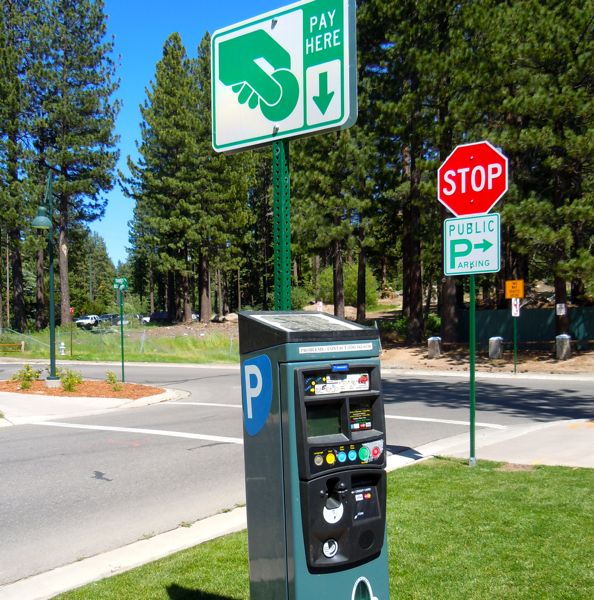
Parking meters are new to South Lake Tahoe and more are coming. Photo/LTN

Parking meters are new to South Lake Tahoe and more are coming. Photo/LTN

No warnings are issued. No outreach to residents or businesses in affected areas is part of the program. Enforcement – that’s the new rule of the road, so to speak.

“I can understand how some people feel this is a crackdown because this is something where there wasn’t any (enforcement) before,” Uhler said.

The idea is the employees working 30 hours a week will enforce parking to pay for their jobs and then some. South Tahoe for years has lost money on its parking program – which includes the garage at Heavenly Village. The loss was an anomaly among cities across the country.

Mike Keck is one of those people who has gotten a ticket. Ironically, he and neighbors lobbied for the city to post signs along their streets a few years ago so the overflow from Heavenly Mountain Resort would not be a problem.

“The point is no one can stop by the house without getting a ticket at this point,” Keck said. “It has now made our neighborhood unusable.”

He understands rules are rules, but he doesn’t understand why the city wouldn’t work with residents.

The city is using parking as a revenue source – with $300,000 expected to be collected in 2011-12. Tickets will add to that figure.

Earlier this year parking meters were installed near Heavenly Village. Nearly $14,000 was collected from them from June 24-Sept. 30.

More meters are expected to up in the beach areas – Venice Drive, the Al Tahoe neighborhood. A residential permit program is still being developed. It might need to be expanded to areas with no parking signs like the Heavenly neighborhood.

From June 1-Sept. 30 there were 857 citations issued in the city, with 61 being disabled parking violations and 173 paid parking infractions. Basic parking violations are $55.


Snippets about Lake Tahoe

trta• Tahoe Rim Trail volunteers this season put in more than 12,000 hours to build 2.4 miles of new trail on the Daggett/Van Sickle State Park project and 1.75 miles of new trail on the Rim to Reno project.

• On Nov. 28 from 4-6pm will an early care and education/transitional kindergarten/kindergarten articulation training at the Lake Tahoe Unified School District’s board room. The flyer has more info.

• Switchback PR + Marketing is donating $4,000 to Girls on the Run-Sierra, the nonprofit beneficiary for this year’s Downtown Truckee Wine, Walk & Shop.

• Improvements at South Tahoe High School are featured in the October newsletter of the Coalition for Adequate School Housing.

• Here is the El Dorado-Tahoe road work schedule for Caltrans for this week, as well as the Sierra schedule.


Tahoe Tails — Adoptable Pets in South Lake Tahoe

Snoopy is a goofy, entertaining, and smart little puppy. He probably has some Shetland sheepdog in him, considering his long and slender muzzle, but he’s already a little bigger than most Shelties.

dogHe is affectionate, and just wants to be around people. He has been at the shelter only a few days, but he’s eager to get to his new home.

Snoopy is neutered, microchipped, and vaccinated. He is at the El Dorado County Animal Services shelter in Meyers, along with many other dogs and cats who are waiting for their new homes.

Call (530) 573.7925 for directions, hours, and other information on adopting a pet.

For spay-neuter assistance for South Tahoe residents, go online.

— Karen Kuentz


Opinion: Saying thank you to veterans

By Ted Gaines

In 1943, an 18-year-old Bob Gaines left California and months later found himself a world away, flying as a tail-gunner on a B-17 bomber on 35 sorties across Europe. The combat was consistently terrible and terrifying, with white-hot anti-aircraft fire and clouds of heavy flak clogging the sky.

He lost many comrades and had one close call where flak grazed so close under his chin that it severed the communications wire of his headset, leaving him unable to communicate with the cockpit, who assumed he was dead until they touched ground for a happy reunion.

Ted Gaines

Ted Gaines

Bob Gaines, World War II tail-gunner, is my father, and on this Veterans Day I want to thank him and all the other brave men and women who have similar stories of risking their lives to keep America safe and free.

My dad fought in Europe, but the legacy of the American soldier is stretched across time and across the globe, from the frigid winter camp at Valley Forge to the blazing deserts of Iraq, to the steaming jungles of Vietnam and the arid mountains of Afghanistan. Wherever threats to American security arise, the warriors of freedom answer the call.

But regardless of when or where they served, our veterans are united in their commitment to their country. Theirs is not a shallow, fair-weather patriotism. It is expressed by their willingness to fight and sacrifice so we can all enjoy the liberty that is promised in our Constitution but guaranteed by our military.

They all deserve our profound respect and gratitude. On Veterans Day, I encourage you to offer your thanks to any and all veterans. They have earned it. If you have a chance, take the extra time to do something — anything — to show them that you understand the depth of sacrifice they were prepared to make on your behalf.

And don’t forget about the families of active duty military, who serve right along with their loved ones as they spend many lonely, nervous hours waiting for them to come home from outposts around the world. Helping these families, however you can do it, is another way of letting our veterans know that they are not forgotten.

I am hosting my 3rd annual Salute to Veterans Pancake Breakfast, free for veterans and their families on Nov. 11 from 8:30-10am at the Veterans Memorial Hall in Roseville. I hope to see hundreds of people there enjoying a little hospitality from me and my staff. It is my small way of recognizing their service.

To the men and women of the greatest military the world has ever seen, I say once again, thank you.

Ted Gaines represents the 1st Senate District, which includes all or parts of Alpine, Amador, Calaveras, El Dorado, Lassen, Modoc, Mono, Nevada, Placer, Plumas, Sacramento and Sierra counties.


Highway 50 may be routed through neighborhoods

By Kathryn Reed

STATELINE – Turning Highway 50 near and through the casino corridor into a city street and the roads from Pioneer Trail behind Raley’s at the state line into a state highway may one day be a reality.

Known locally as the Loop Road project, officials are now trying to get people to call it the Highway 50 South Shore Community Revitalization Project.

Highway 50 going east beyond Pioneer Trail near the state line could become a city street. Photo/LTN

Highway 50 going east beyond Pioneer Trail near the state line could become a city street. Photo/LTN

There was a time when the highway was to be rerouted behind all of the main Stateline casinos. Now the project only involves the mountainside of the loop road – what goes behind Harrah’s and MontBleu.

The thinking is it would not be wise to keep the state highway between the lake and casinos; that’s why it is not taking a western loop.

Also originally talked about was starting the realignment at Heavenly Village Way/Park Avenue. That has been scrapped to now start at the intersection of Highway 50 and Pioneer Trail. The alignment would somewhat follow the shortcut locals take to avoid driving through the casino corridor.

This would mean turning what are now city streets into a five-lane highway – two lanes in each direction, with a middle turn lane. The casino area would be three lanes – one in each direction with a middle turn lane.

Where Lake Parkway hooks up with Highway 50 near MontBleu could become a roundabout.

Reasons for the change

Highlights of the project were touched on by Carl Hasty, executive director for Tahoe Transportation District – lead agency on the project, at the Nov. 4 joint South Lake Tahoe City Council-Douglas County Commission meeting at Edgewood Tahoe.

Hasty told that group one advantage to the preferred alternative is the street in front of the casinos could more easily be closed off for special events. This would avoid nightmares like a few years ago when Highway 50 was shutdown for Opening Days Lake Tahoe.

Michael Olson, chairman of the county commission, said he likes the idea. “It would create a Tahoe experience.”

Hasty said studies show two-thirds of the highway traffic has a destination other than the casinos or Heavenly Village, so rerouting them would not take them away from their end point.

People would still be able to access the casinos as they do now – on either side of the structures.

While three alternatives are proposed (one is to do nothing), the above scenario is what transportation officials’ support.

Meetings begin this week to gather input from the public. Written comments will be taken until Dec. 16. The scoping document provides more details.

All of this ties into the South Shore Vision Plan – making the area from Ski Run Boulevard to Kahle Drive more user friendly. But the Loop Road project has been talked about for decades, while the former is a new concept.

Eliminating people’s homes

To do what proponents want would mean displacing a number of people, along with businesses at the corner of the highway and Pioneer Trail. It’s a residential community on the back roads that would become a state highway.

Hasty said when the time comes property owners would be offered fair market value.

When asked about how South Lake Tahoe’s eminent domain policy plays into their thinking, he told Lake Tahoe News, “It could stop the project.”

He also added, “Do you pay more than market value or do you not do the project?”

The City Council in 2007 passed a resolution, with an addendum added in March 2008, that essentially bans eminent domain from being used in the city limits. While there was talk of requiring the issue be taken to the voters for the policy to be overturned, that never got written into the resolution. But the council could still make it be a contingency factor for the project to go forward.

Mayor Hal Cole told Lake Tahoe News when Hasty made a presentation a year ago to the council, the eminent domain issue came up.

“They know how the city feels,” Cole said of project proponents.

The city resolution specifically talks about not using eminent domain to displace low- and moderate-income residents living in any type of dwelling.

Property owners have been mailed information about the project. Tenants are expected to receive a flyer this week. But that is just days from the Nov. 10 TTD board meeting – not giving people much time to rearrange their schedule if they were wanting to attend.

Relocation law demands people displaced via eminent domain be relocated. Hasty said that is the plan. Specifics have not been detailed, but Hasty said housing would be found for people in the general area. After all, many of those people have limited incomes and walk to work.

Hasty also said the project is still a long way from being a reality.

It’s estimated to cost close to $70 million. That price tag includes acquisition and relocation expenses. TTD would like to apply for federal grants in a year if the project is shovel ready by then. That would mean having the environmental documents completed.

Besides getting the city to agree to the project, Douglas County will have to say yes. So will Caltrans and the Nevada Department of Transportation.

Hasty said the two state transportation agencies have been approached and have participated in discussions. But this is a local project, not something either state is spearheading.

Dates to know:

• Nov. 10 at 1pm, Tahoe Transportation District board meeting at the Tahoe Regional Planning Agency board room, 128 Market St., Stateline.

• Dec. 7 at 9:30am, TRPA Advisory Planning Commission meeting at the TRPA board room, 128 Market St., Stateline.

• Dec. 16 is the last day to submit comments on the scoping document.


Opinion: Bighorn sheep in N. Nevada a welcome return

Publisher’s note: This editorial is from the Nov. 4, 2011, Reno Gazette-Journal.

Return of bighorn sheep to Northern Nevada is a reason to celebrate a wildlife milestone.

For the first time in more than a century, bighorn sheep are back in the Virginia Range of Northern Nevada.

Just days ago, eight of them were released into Virginia mountains east of Reno in the Reno Tahoe Industrial Center.

This marks the first step in an effort to re-establish a population of Nevada’s state animal there for the first time since the 1880s. Nevada is home to nearly 10,000 bighorns, the most of any state in the lower 48.

“It’s exciting to think that they’re going to be this close to Reno,” Steve Field, president of the conservation group Nevada Bighorns Unlimited, told RGJ reporter Guy Clifton. “We’ll be able to go out with a pair of binoculars and see sheep on the mountains.”

The release of the desert bighorns on the sprawling grounds of the Tahoe Reno Industrial Center 10 miles east of Reno marks the first time the agency has reintroduced the animals on private property, Nevada Department of Wildlife spokesman Chris Healy told the Associated Press.

The department is conducting the effort with the help of industrial center principal and exclusive broker Lance Gilman, Nevada Bighorns Unlimited and the Wild Sheep Foundation.

Read the whole story


CHP class for teen drivers in South Tahoe

Start Smart is aimed at helping newly licensed and future licensed teenage drivers become aware of the responsibilities that accompany the privilege of being a licensed California driver. The program was created in an effort to pre-emptively reduce the incidence of teen injuries and deaths resulting from motor vehicle collisions.

Teen drivers and their parents/guardians are invited to attend and participate in a Start Smart class Nov. 8 from 6-8pm at the South Tahoe High School library.

Recent statistics have shown that in California teenage drivers are injured and are dying in automobile accidents at an alarming rate. Through candid conversations, officers in attendance will address these facts and provide examples of driving tendencies that put young drivers at risk. This program will help you understand that driving is serious and a poor choice behind the wheel of a car can put your life and the lives of others in jeopardy.

To reserve a space in this Start Smart Class contact the California Highway Patrol at (530) 577.1001.


Federal Advisory Committee to meet in South Tahoe

The Lake Tahoe Federal Advisory Committee will meet Nov. 18 from 10am-3pm at the Lake Tahoe Basin Management Unit, 35 College Drive, South Lake Tahoe.

LTFAC will address issues related to federal activities at Lake Tahoe.

Items on the agenda include a facilitated workshop to discuss a strategic work plan for fiscal year 2012, and a public comment period.

LTFAC consists of 20 members representing a broad array of constituencies.

All Lake Tahoe Federal Advisory Committee meetings are open to the public.

For more information on the Lake Tahoe Federal Advisory Committee, go online.


Information meeting about biomass facility on North Shore

Placer County is having an open house Nov. 15 from 3-7pm to present information on biomass energy production.

The open house will be at the Squaw Valley Public Service District offices.

Private and public specialists in air emissions, biomass energy technology, sustainable biomass supply assessments, biomass logistics planning and forest management will be present at this informal open house to discuss the latest concepts of biomass energy production. While there will be no formal presentations, the meeting will feature displays and graphics and will provide opportunity for one-on-one or small group discussions with the specialists.

Placer County will release an environmental document that discusses a possible biomass energy facility at Placer County’s Cabin Creek property in 2012. The Notice of Preparation is expected to be available by year’s end. Public comment for this proposed project will not be taken at the Squaw Valley meeting.


Fluoride in water becoming less common

By Lizette Alvarez, New York Times

MIAMI — A growing number of communities are choosing to stop adding fluoride to their water systems, even though the federal government and federal health officials maintain their full support for a measure they say provides a 25 percent reduction in tooth decay nationwide.

Earlier this month, Pinellas County, on Florida’s west coast, voted to stop adding fluoride to its public water supply after starting the program seven years ago. The county joins about 200 jurisdictions from Georgia to Alaska that have chosen to end the practice in the last four years, motivated both by tight budgets and by skepticism about its benefits.

Eleven small cities or towns have opted out of fluoridating their water this year, including Fairbanks, Alaska, which acted after much deliberation and a comprehensive evaluation by a panel of scientists, doctors and dentists. The panel concluded that in Fairbanks, which has relatively high concentrations of naturally occurring fluoride, the extra dose no longer provided the help it once did and may, in fact, be harmful.

It is a view that also was shared by four out of seven commissioners in Pinellas County who first raised the proposal as a cost cutting measure.

“I’m in opposition to putting a medical treatment into the public drinking water supply without a vote of the people who drink that water,” said Norm Roche, a newly elected Republican county commissioner who spent 10 years doing policy research for the county Water Department and who led the turnaround effort. “We had a dozen to 15 doctors, dentists, dental hygienists and chemists here who want us to continue this practice but who could not agree themselves on how best to use fluoride.”

Some 700,000 people — 75 percent of the county — will be affected by the vote. The rest receive water from a different source.

Read the whole story