S. Tahoe library plots monthly book club selections

On the third Wednesday of each month at 3pm the Friends of the Library read and discuss a variety of critically acclaimed books.

Meetings are in the library conference room; 1000 Rufus Allen Blvd., South Lake Tahoe.

Dates and books:

Dec. 21: Bring your favorite poem to share

Jan. 18: “Triangle: The Fire That Changed America” by David Von Drehle

Feb. 15: “The Big Burn” by Timothy Egan

March 21: “Tahoe Beneath the Surface” by Scott Lankford

April 18: “Art of Racing in the Rain” by Garth Stein

May 16: “The Irresistible Henry House” by Lisa Grunwald

June 20: “Sarah’s Key” by Tatiana de Rosnay.

For additional information, call Jeanne Benin at (530) 541.1371.


Crustaceans to be commercially harvested from Lake Tahoe

By Jeff Delong, Reno Gazette-Journal

A Nevada man could begin pulling crayfish out of Lake Tahoe’s waters by next spring following action by state wildlife officials.

On Saturday, the Nevada Wildlife Commission unanimously approved regulations authorizing the commercial harvest of crayfish from Tahoe’s Nevada waters.

While approval from other agencies is required, the action should clear the way for Fred Jackson of Yerington to pursue his plan to harvest crayfish in 2012. Others could also apply for permits to do so at a cost of $500.

“I think it’s great for everybody,” Jackson said. “It’s a win for the lake and a win for the economy.”

Millions of crayfish skitter along Tahoe’s bottom in what Jackson views as an untapped, tasty resource. Crayfish, also known as crawdads, are not native to the lake and were first introduced there in the late 1800s, according to research conducted by scientists at UNR and UC Davis.

By 1932, crayfish were “thriving in the lake and its tributaries” and numbered about 55 million in 1967, scientists estimate. Today their numbers are put at 220 million or more.

Crayfish may be associated with algae blooms at Tahoe and could also be linked to a 72 percent decline in the population of mayflies, stoneflies and other native invertebrates in the lake, said Sudeep Chandra, a freshwater science expert at UNR.

Read the whole story


Precautions urged to deal with ongoing cold temps

The California Emergency Management Agency is urging residents throughout the state to accelerate their winter weather preparedness efforts in response to a forecast by the National Weather Service for temperatures in the 20s to low 30s and possibly lower later this week.

It’s not just the Lake Tahoe area that is feeling the big chill. Freezing temperatures striking throughout much of Northern California.

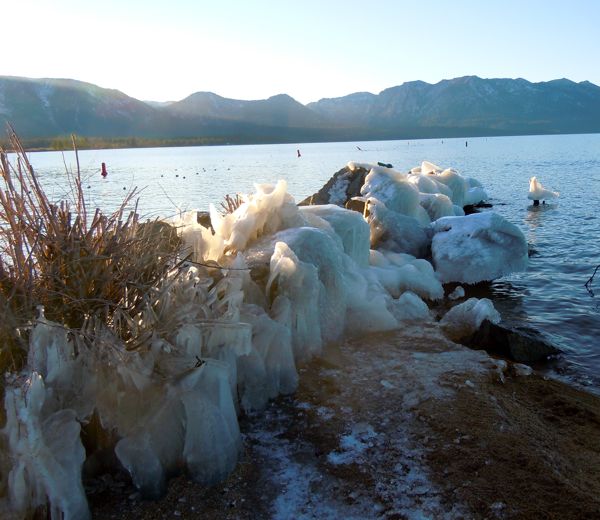
After last week's high waves, ice now covers the rocks leading to the Tahoe Keys Marina. Photo/Kathryn Reed

“According to the National Weather Service, residents in much of Northern California can expect extremely cold temperatures during the next several days,” Cal EMA Acting Secretary Mike Dayton said in a press release. “As this weather tends to be the norm throughout the winter months, it is critical that Californians recognize the risks associated with freezing temperatures and take necessary steps to prepare if they have yet to do so.”

Prolonged exposure to cold temperatures can cause hypothermia and other serious health problems, particularly for seniors, infants and people with chronic conditions such as asthma and other respiratory conditions. Cold temperatures also threaten pets that are left unprotected.

Residents of areas with expectations for freezing temperatures should be aware of the following:

  • Learn the signs of hypothermia, frostbite, dehydration and carbon monoxide poisoning.
  • Review and update emergency plans, including out-of-town contact information.
  • Store plenty of drinking water, food and medications.
  • Obtain and maintain a sufficient supply of heating oil.
  • Make sure portable radios and flashlights are operable and there’s an adequate supply of extra batteries.
  • Listen to the radio or watch television for the latest information on the weather as well as instructions from local officials.
  • Eat regularly.
  • Drink plenty of fluids.
  • Avoid caffeine and alcohol.
  • Regularly charge devices and have back up options available if someone is dependent on equipment needing power.
  • Teach relatives, co-workers, classmates or neighbors to operate life-safety equipment, including fire extinguishers, breathing machines, oxygen, suction or home dialysis equipment.
  • Disabled or elderly may need assistance establishing support teams of people who can assist them at home, work or school
  • Pre-identify options (e.g., paratransit, dial-a-ride, taxi, friend, neighbor) for transport to warming centers if assistance with transportation is needed.
  • Protect pets from the weather. Move pets indoors or into an enclosed structure.
  • Do not use barbecues and other cooking equipment designed for outdoor use for cooking indoors.
  • Wear several layers of clothing that is loose, lightweight, warm and water repellent.
  • Weather mittens, rather than gloves.
  • Wear a hat if outdoors.
  • Stretch before going outside.
  • Move plants indoors or cover with plastic to protect them.
  • Avoid overexerting if shoveling snow or doing other outdoor activity; overexertion is a major cause of winter deaths.
  • Protect your lungs from extremely cold air by covering your mouth while outdoors and avoid speaking unless it’s absolutely necessary.
  • Prevent your body from losing heat by changing from wet clothing to dry clothing as frequently as possible.
  • Watch for symptoms of frostbite, including the loss of feeling, white or pale appearance in the fingers, toes, ear lobes and other extremities. Get medical attention immediately if symptoms are noted.
  • Watch for signs of hypothermia, including uncontrollable shivering, memory loss, disorientation, incoherence, slurred speech, drowsiness and apparent exhaustion.
  • Travel by car during the day only and ensure the car is fueled with sufficient gas.
  • Don’t travel alone.
  • Let others know your schedule.
  • Stay on main roads.

Additional safety tips and information about state response activities are available online.


‘Sing Christmas’ choral performance in Squaw

The Truckee Tahoe Community Chorus of Sierra College, directed by Susan Horst, Chris Nelson and Tom Acord, will present its holiday concert “Sing Christmas” at the Resort at Squaw Creek on Dec. 10 at 7pm and Dec. 11 at 2pm.

“Sing Christmas” is an eclectic array of delightful, celebratory seasonal music, spanning the globe as well as the centuries. A little gospel, Latino, baroque, and contemporary arrangements are part of the mix.

The chorus will be accompanied by a string ensemble comprised of Tahoe and Reno musicians, and will again bring the kids up for the traditional audience sing-a-long.

Tickets are $15 for adults and may be purchased online, from chorus members, or at the door. Students and children are admitted free. Group rates are also available.


Tahoe Tails — Adoptable Pets in South Lake Tahoe

Angel is a lovely purebred Persian cat who was relinquished to the shelter because of her owner’s poor health.

Angel is affectionate, and she even likes to be brushed – to her, any attention is better than none.

She is declawed on her front paws.

Angel is spayed, microchipped, and vaccinated. She is at the El Dorado County Animal Services shelter in Meyers, along with many other dogs and cats who are waiting for their new homes.

Call (530) 573.7925 for directions, hours, and other information on adopting a pet.

For spay-neuter assistance for South Tahoe residents, go online.

— Karen Kuentz


Ideas for how not to go broke at the grocery store

By Toni House

This year, our holiday feasts will cost more than ever, says the U.S. Department of Agriculture. Food prices jumped a whopping 4 to 5 percent in 2011 and are expected to continue climbing next year.

But you can have your fruitcake and eat it, too, without breaking the bank. My book, “Savvy Shopping: How to Reduce Your Weekly Grocery Bill to $85 Per Week – or Less!” is a start. As a mom with executive-level experience in accounting and the restaurant industry, I pared the monthly grocery bill for my family of four to $250. And nobody complained.

It takes savvy shopping. Worried about going broke serving big holiday meals? Forget it. You can save on the Christmas trimmings and trim the 2012 household budget with planning, patience and grocery shopping “guardrails” to keep your cart in line.

Follow these tips:

• Be patient – wait for good deals. Save pricier purchases for double coupon days, and with the holidays coming up, save now so you can splurge a bit on the holiday meal. The more you rush, the less you save.

• Be detail-oriented. There is a lot of fine print involved in being a savvy shopper, from expiration dates to special offers to asterisks. Know exactly when a coupon expires, how much it’s for, how much more it will be worth on double coupon days and whether or not it’s worth the price in the first place.

• Plan ahead. Plan a menu for at least three meals in advance; combined with leftovers; that should give you five days or more of meals, depending on the meal. This puts you in control of your shopping list; and not the other way around. Instead of always playing catch-up, replacing what you’ve run out of, you buy only when it’s on the menu. Same goes for cereal, yogurt, bananas, fresh herbs and spices, etc.

• Instead of making expensive foods (meat) the centerpiece of each meal, design menus that use the most expensive foods less often. For instance, from now on at least twice a week, try using meat as more of a filler than a main dish. Instead of making spaghetti with meat balls, or sausage, or chicken breasts, make spaghetti with a meat sauce of ground turkey, ground sausage or ground chicken breakfast sausage.

• At the grocery store, buy only what you can eat. That means no paper plates, toilet paper, plastic cups, Army men, toothbrushes, jar candles, greeting cards. Grocery store prices for non-food items are higher than you’ll pay almost anywhere else, so make a hard-and-fast rule and stick to it.

• Do use coupons, but only for products you actually need. Let’s say you just bought twice as many hot dog buns as you needed last week and now you’ve run across a two-for-one coupon for more hot dog buns? Do you really have room in your freezer for all those buns?

My $85-a-week budget does require tossing out some pricey products your family may have grown accustomed to (brand-name cereals, pre-packaged snack cakes) and changing the way you plan meals. But there are plenty of delicious, often healthier, and less expensive substitutes.

You are the leader of your family unit, not just at home but at the grocery store. Your new quest to become a savvy shopper might meet with some resistance at first. Take the bull by the horns and lead the family in the right direction.

Toni House has a bachelor’s in accounting and a master’s in business administration and was most recently the senior consultant and owner of an accounting firm.


Budget gift: Friends of the library membership

Publisher’s note: Lake Tahoe News is looking for gift ideas that are less than $20. Find out how to make a suggestion.

Buy your friends a membership for the Friends of the Library.

It not only helps support the El Dorado County Library, but also gives members early access to great book sales.

It is $10.

More information is online.


Opinion: Suggestions for how to fix South Lake Tahoe

By Steve Kubby

South Lake Tahoe should be one of the greatest destinations in the world. Aside from the stunning beauty of the lake, we are blessed with amazing writers, athletes and artists in this community. Meanwhile, Heavenly Mountain Resort is quickly becoming one of the best ski resorts in the world and their claim to the best tree skiing on planet Earth is no exaggeration.

Unfortunately, our fair city looks less like a world class destination and more like a ghost town these days. Even the bank can’t afford decent landscaping. Hard times have hit South Lake Tahoe and much of it, like the huge 12-acre crater near Stateline, can be traced to the sins of local government and redevelopment.

Steve Kubby

The city of South Lake Tahoe was incorporated in 1965 by combining the previously unincorporated communities of Al Tahoe, Bijou, Bijou Park, Stateline, Tahoe Valley, and Tallac Village. The stated purpose for creating the city was to provide its own snow removal, road repairs and policing, since it was felt that El Dorado County was not providing adequate services. Within a year, the city council had already abandoned their original mission and granted $40,000 to their supporters on the local tourist bureau.

Since then, the city council has all but abandoned the roads and focused the bulk of its time and money on redevelopment schemes that assume the need for a centrally planned economy and a regulatory environment that is one of the worst in the country. Just this year, the city council will spend $1.8 million on redevelopment, while spending a pathetic $100,000 on road repair. Since beginning redevelopment 15 years ago, the city has stopped nearly all funding for road repairs, accumulating over $100 million in damage to the existing city roadways, according to its own estimates.

Fixing South Lake Tahoe isn’t that complicate, if we can just go back to those original three priorities of snow removal, road repairs and policing.

But first, the voters need to make some decisions:

— Do you really want to live in a city where traffic and parking enforcement has been stepped up in order to pay the salaries of the enforcers?

— Do you want snow removal done by outsiders who have submitted the lowest bids and will replace our local dedicated and experienced crews?

— Is it fair that everyone who rents has to pay the TOT and $200 million in bonded debt, money that was used to benefit Marriott and Vail?

— Do you want a city council that believes in police powers to seize property and incur massive debts without a general vote?

If your answer to these questions is no, then here is what we must do to end this failure in local government:

— Forget about redevelopment and focus on basic services.

— Hire an outside accounting firm to perform a forensic audit of the city’s finances.

— Stop aggravating tourist with aggressive enforcement of traffic and parking ordinances.

— Stop squandering money on studies, consultants and tourist promotions.

— Stop retiring city officials at 100 percent of their salary.

— Stop hiring new city officials with astronomically high salaries and benefits.

— Stop electing city council members who don’t believe in free markets, personal freedom or private property.

Of course, there are those who will tell you that everything is under control and not to listen to those who have sounded the alarm. They will tell you to ignore the findings of the El Dorado Grand Jury of wrongdoing and malfeasance by the city council. Instead, they will steadfastly claim that redevelopment has been a great success and that the free market can’t be trusted to provide affordable housing and controlled growth. However, why is it that no other city in the Basin has undertaken redevelopment?

Certainly, the North Shore looks a whole lot better than the South Shore, so those who advocate for redevelopment have a lot of explaining to do.

In the meantime, an honest appraisal of the financial crisis facing the city has yet to be made by city officials. Until that happens and the city admits it is broke, nothing is going to get fixed. Like an alcoholic who is in denial, the city council needs to admit to past failures, its current debt and the enormous unfunded liabilities it has incurred. Only when we have faced the true magnitude of the unfunded road and retirement liabilities, will we be ready to slash all the fat and get back to basic services.

Steve Kubby is a resident of South Lake Tahoe.


Financial cracks emerge in South Tahoe ice rink deal

By Kathryn Reed

Even though the South Lake City Council in August voted to change the recreation bonds from non-taxable to taxable to allow the private ice rink operators to legally make a profit, the board with the ultimate power to ensure that happens didn’t have its first meeting about the issue until Monday.

And now it’s a race to get the legal, financial and political agreements in order so the bonds are sold before March 1. Changes can only take place March 1 and Sept. 1 – the debt payment dates.

Discussion was delayed by Measure R proponents (aka the JPA board) because they did not want voters last month to confuse rewriting the original Measure S to allow a different disbursement of funds with changing the actual bonds. The two are completely separate issues.

The recreation JPA board (Hal Cole-Norma Santiago-Debbie Henderson) listen to county Auditor Joe Harn. Photo/LTN

But not trusting the voters to understand the difference has created this accelerated pace to not only refinance the bonds, but to make them taxable.

Even though Dec. 5 was the first time the JPA board officially heard the proposal, the financial advisor who was officially hired that same day is already on the Dec. 13 agendas for the South Lake Tahoe City Council and El Dorado County Board of Supervisors.

While there is no proving meetings occurred between John Upton, the lone paid employee of the South Lake Tahoe Recreation Facilities Joint Powers Authority, and the three board members, Hal Cole (South Lake Tahoe rep), Norma Santiago (El Dorado County), and Debbie Henderson (Tahoe Paradise Resort Improvement District) seemed well versed about the issue. Had Upton spoken to each member individually, it would be considered a serial meeting and thus a violation of California’s opening meeting law. The public’s business is supposed to be conducted in public.

With Cole showing up 35 minutes late – saying he didn’t know about the meeting until someone called him when he was a no-show at 1pm Dec. 5 and that he hadn’t seen the agenda – he was the most adamant the financial advisor be paid a fixed price over the discounted hourly rate that was proposed at the meeting.

Mark Northcross with Northcross-Hill-Ach in Marin County was the financial advisor in 2001 when bonds for the South Shore recreation measure were first sold. He’s the guy being used this time, too.

Northcross told Lake Tahoe News he was first contacted by Upton this summer. Northcross said he is the one who brought up the issue of the IRS having a problem with a private entity making a profit off tax-exempt bonds and that they would need to be changed.

The board on Monday agreed to hire Northcross on a $37,500 contingency fee. This means he only gets paid if the bond sale goes through. Stradling, Yocca was hired as bond counsel at $50,000 under the same contingency agreement.

However, County Auditor Joe Harn told the board the county shies away from these types of agreements, and instead opts for time and materials contracts.

“The fewer people who have a financial interest in the bond closing, the better,” Harn said. Harn is also the JPA’s treasurer.

Cole said he prefers knowing what the cost will be upfront; believing the financial advisor will operate within set parameters (that will be decided at the Jan. 20 JPA meeting) and therefore the JPA has no risk involved.

However, Northcross at the meeting said his excitement for being back in South Tahoe made him want to reduce his hourly fee. Normally it’s $300/hour. He said he’d charge $275/hour, with a cap of $15,000. The cap, he later told Lake Tahoe News, could then be negotiated if more work were needed.

Despite this offer of a reduced price, the JPA board didn’t even discuss it, nor did the members do any math to figure out how many hours might be needed to do the job and what the better deal would be. The JPA was more concerned with knowing the price than getting the best price.

South Lake Tahoe’s city attorney, Patrick Enright, and finance director, Christine Vuletich, were in the audience. They didn’t offer any advice.

Northcross and Harn had a brief conversation while waiting for Cole to arrive – knowing they were within earshot of this reporter. Northcross said to Harn that while refinancing may save 3 to 4 percent, or $15,000 annually, many in his field say not to go forward until the benefit is 5 percent. He didn’t share that with the JPA board.

The current interest rate on the bonds is a bit more than 5 percent.

All of this work could save property owners about 75 cents a year on their $18 bill for Measure S/R.

But City Manager Tony O’Rourke followed Harn at the podium, saying it’s not just about the JPA taxpayers to consider.

“We want to enable private investment at the ice rink – that benefits the taxpayer,” O’Rourke said. With the city losing $100,000 on the rink in some years, it wanted to unload it, even though taxpayers paid for it through Measure S property fees.

The JPA board also agreed to allocate up to $15,000 to have a current bond rating secured – a necessary requirement to go forward. The last rating was AA-minus. That money comes out of the JPA’s administrative budget – though it’s still taxpayer money.

Another big question mark is what entity will sell the bonds. Northcross said going with BBVA Compass bank might be the best option instead of the traditional bond market.

Northcross pointed out that depending on what deal is struck, it’s possible the city will have to come up with $400,000 to pay down the debt in order to make it all work. There are certain legal requirements with reissuing the bonds and the taxpayers not incurring a financial burden.

O’Rourke said if it came down to that, “We’ll have discussions with the operator (of the rink).”

If there is a buy down cost, that wouldn’t be known until February – which would leave only a matter of days for the city to come to a deal with the ice rink operators.

And if the city is left footing the bill, that would be those same taxpayers incurring the costs that O’Rourke said are saving money with the ice rink not being controlled by the city.

“We wouldn’t be here if the ice rink contract weren’t a problem,” Cole said early in the meeting.

——————–

Dates to know:

• Dec. 13: South Lake Tahoe City Council and El Dorado County Board of Supervisors at their respective meetings hear presentation from Mark Northcross

• Jan. 17: South Lake Tahoe and El Dorado County discuss and vote on legal documents and official financing

• Jan. 19: Tahoe Paradise board votes on legal documents and official financing

• Jan. 20: JPA board votes on legal documents and official financing

• Feb. 28: Bond sale expected to close.


Registration under way for annual Nature Bowl

By Cathy Locke, Sacramento Bee

The California Department of Fish and Game is accepting registration for the 28th annual Nature Bowl, an activity-based competition for elementary school students in third through sixth grade.

The event, held each spring, is open to students from any school, group or organized youth club in the Sacramento Valley and foothills. Participants employ teamwork, creativity and critical thinking in group-learning activities centered on local and regional natural environments, according to a Department of Fish and Game news release.

The initial daylong event is held in Sacramento, Placer, El Dorado and Yolo counties in March and April. Teams consist of three to seven children each. Several groups will advance to the finals, scheduled for May 5.

Teachers, youth group leaders and parents can sign up to coach a team. The entry fee is $20 per team and includes materials.

Read the whole story