Budget gift: Taking away pain

Publisher’s note: Lake Tahoe News is looking for gift ideas that are less than $20. Find out how to make a suggestion.

A massage may be what the person on your list would prefer, but a less expensive alternative is a tube of Biofreeze. It’s one of the best topical pain relievers for the sports nut on your list, the computer worker whose neck and shoulders are tight, the shovelers out there, the parents carrying young kids — you name it.

A tube is $15 at A Massage at Tahoe in South Lake Tahoe. Call (530) 318.4806 to get a tube or two.


TVES students help set Guinness World Record

Tahoe Valley Elementary School students helped set a Guinness World Record then they were part of a jumping jack contest in October.

Put on by National Geographic Kids between 3pm Oct. 11 and 3pm Oct. 12, 300,265 jumpers all over the world took part in the event. The old record for the most number of people jumping for 24 hours was 20,425.

The South Lake Tahoe school will soon receive a certificate from National Geographic.


Opinion: Successful tree lighting in South Lake Tahoe

To the community,

The Lake Tahoe Visitors Authority would like to thank a number of people and partners for making this year’s Community Winter Tree Lighting on Dec. 2 such a great success.

Special thanks to Liberty Energy for providing additional lighting and labor to make this the best and most energy efficient year ever. Also thanks to the city of South Lake Tahoe, Derek Tarpey Lake DJ, Borges Sleigh Rides, Rabbi Evon Yakar and Temple Bat Yam, Lake Tahoe Historical Society Museum, Tahoe Art League Gallery, South Lake Tahoe Optimists, Jody Filgo, Arline June Gordon, and all the special elves who contributed to the evening.

At this annual event, more than 450 people enjoyed cookies, hot cider and cocoa, were treated to free CFL bulbs from Liberty Energy, free sleigh rides from Borges Sleigh Rides, tours of the 1930s cabin and an up-close look at the decorated fire truck while festive music played. Santa posed with good girls and boys inside the senior center, while each building glowed with LED lights provided by Liberty Energy.

Caps for Kids were collected inside the senior center and Christmas Cheer (food, toys, and monetary) donations were accepted at the visitors centers in Nevada and California.

This year’s community winter tree lighting was big and bright, thanks to so many who participated.

Alison Green, LTVA


LTUSD, LTCC brace for their share of $1 bil. in midyear cuts

By Kathryn Reed

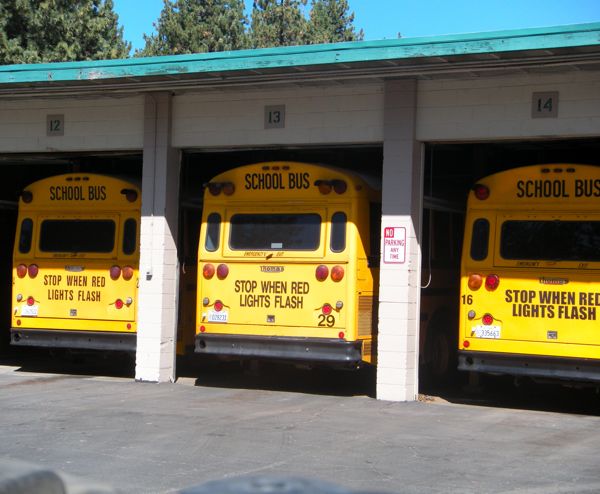
Money for teachers, textbooks and lights for the classrooms remain – for the most part – but there may be no students sitting at the desks. That’s because school bus funding has been cut throughout California.

Gov. Jerry Brown on Tuesday pulled the trigger to slice millions of dollars from K-14 education.

When the state budget was passed last summer a number of assumptions came with it – like how much revenue would flow to Sacramento. Those predictions are so far off — $4 billion short – they forced the governor to implement midyear cuts.
State budget cuts could force LTUSD buses to sit idle in the garage. Photo/LTN file

For Lake Tahoe Unified School District it means losing $382,000 in transportation dollars.

“Our fear is what do the cuts look like next year,” Superintendent Jim Tarwater told Lake Tahoe News after the Dec. 13 school board meeting adjourned at 10:30pm. “We have to bus people.”

The state isn’t saying if these are one-time cuts or ongoing for 2012-13.

And that bus money is  just what is used to get students to and from school. Athletic and special education busing expenses are separate categories.

Students can’t drive their friends to school until they’ve had a driver’s license for at least a year. The price of a gallon of gasoline is also filling up bus seats instead of the student parking lot. LTUSD buses 1,800 students, while about another 2,000 get to school some other way.

CFO Deb Yates was slated to give her first interim budget report to the board Tuesday night before it was known Brown would be dropping the hammer on education.

Throughout the state K-12 is about to lose $79.6 million in general funding, plus another $248 million in transportation. Community colleges will lose $102 million.

“It could have been worse,” Yates said.

Education officials knew when the state budget was passed that midyear cuts could occur. K-12 could have been hit with a $1.5 billion loss.

In addition to the bus dollars being whacked, the governor is taking about $14 per pupil, or roughly $56,000 from LTUSD.

To bridge the gap, reserves will be used. This was anticipated when the board approved its budget. But it will bring the reserves below the desired 3 percent minimum.

If the cuts are ongoing, this will drastically affect future budgets. As it stands, LTUSD is forecasting a shortfall of more than $416,000 for 2012-13.

But there is enough in reserves to survive the next two years with the known cuts.

Earlier Tuesday night the Lake Tahoe Community College board met.

LTCC President Kindred Murillo anticipates the college will face a $50,000 loss for this academic year. More than four times that amount was set aside for anticipated midyear cuts.

The big change will be the increase statewide of semester units going from $36 to $46 (which would be adjusted for LTCC’s quarter system). This fall semester fees went from $26 to $36.

All told, the governor came up with $1 billion in cuts. But that barely touches the projected 2012-13 deficit of $13 billion.

Other entities taking a hit include:

• $100 million each to the UC and CSU systems. (They each were cut by $650 million in the state’s current budget.)

• $100 million to In-Home Supportive Services.

• $15.9 million to county libraries.

• $100 million to services for people with developmental disabilities.

• $102 million to public safety services, including prisons.

• $8.6 million to Medi-Cal.

Most of the reductions announced Tuesday will be implemented Jan. 1, with more cuts likely to be declared by Brown after the first of the year.

One way to generate revenue is raising $6.8 billion through increasing the sales tax and raising rates on wealthier Californians. The governor wants voters to approve those taxes next November.

———–

In other action:

• Molly Blann is president of the LTCC board and Karen Borges the clerk.

• At LTUSD, Wendy David will serve as president of the board another year, with Sue Novasel the clerk.



Red Hut burger night benefits Heavenly Foundation

Red Hut on Ski Run Boulevard in South Tahoe will host a Burger Night fundraiser to benefit the Heavenly Ski and Snowboard Foundation’s Scholarship Fund on Dec. 14 from 4-9pm.

The Red Hut will be serving combos that include a burger, homemade chips and a fountain soda for a $10. Ice cream treats and shakes will be $1 off and all apparel items will be 20 percent off.

There are 500 tickets for the event, with an opportunity for the foundation to raise $5,000. Tickets are available at the foundation building Wednesday from noon to 4pm or by calling (530) 314.9285. Tickets will also be available at the door.


Opinion: U.S. workers getting a raw deal

By Robert Reich

For most of the last century, the basic bargain at the heart of the American economy was that employers paid their workers enough to buy what American employers were selling.

That basic bargain created a virtuous cycle of higher living standards, more jobs and better wages.

Back in 1914, Henry Ford announced he was paying workers on his Model T assembly line $5 a day – three times what the typical factory employee earned at the time. The Wall Street Journal termed his action “an economic crime.” But Ford knew it was a cunning business move. The higher wage turned Ford’s autoworkers into customers who could afford to buy Model Ts. In two years, Ford’s profits more than doubled.

That was then. Now, Ford Motor Co. is paying its new hires half what it paid new employees a few years ago.

The basic bargain is over – not only at Ford but all over the American economy.

New data from the Commerce Department show employee pay is down to the smallest share of the economy since the government began collecting wage and salary data in 1929. Meanwhile, corporate profits now constitute the largest share of the economy since 1929. That, by the way, was the year of the Great Crash that ushered in the Great Depression.


In the years leading up to the Great Crash, most employers forgot Henry Ford’s example. The wages of most American workers remained stagnant. The gains of economic growth went mainly into corporate profits and into the pockets of the very rich. American families maintained their standard of living by going deeper into debt. In 1929, the debt bubble popped.

Sound familiar? It should. The same thing happened in the years leading up to the crash of 2008.

Robert Reich Robert Reich, former U.S. secretary of labor, is professor of public policy at UC Berkeley and the author of “Aftershock: The Next Economy and America’s Future.”

Read the whole story


Child safety seat event

The California Highway Patrol South Lake Tahoe area will conduct a Child Safety Seat Check-Up event Dec. 17 from 11am-3pm.

Certified car seat technicians from the CHP will be available to show parents how to properly and securely install a child safety seat in their vehicle.

National studies show three out of four car seats are not being used correctly, making children at risk of serious injury or death.

A California law that takes effect Jan. 1, extends the length of time a child must use a child passenger restraint or safety seat by two years while riding in a motor vehicle. The new law means child passengers must ride in either a car seat or booster seat until the age of 8 or until they are 4 feet 9 inches tall.

The CHP will also be collecting toys, non-perishable foods and new or lightly used jackets as a part of their annual CHiPs For Kids Holiday Drive. tems donated will be kept locally and given to Christmas Cheer for distribution.

The event is at the Y in South Lake Tahoe in the Raley’s/Kmart center.


Doolittle goes from disgraced congressman to lobbyist

By Michael Doyle, McClatchy

WASHINGTON – Meet John Doolittle, working stiff.

Sacramento-region residents once called him Republican state senator, then congressman. He was Lake Tahoe’s congressman, too.

Federal prosecutors once called him, ominously, Representative 5. Now, starting over at the age of 61, he unashamedly calls himself a lobbyist.

John Doolittle

“It’s funny,” Doolittle said. “That’s such a negative term, but if people ask, that’s what I say I am.”

He laughed. He laughs easily, which is saying something, given all that’s transpired.

“I know,” said his former colleague Rep. Dan Burton, R-Ind., “that he and his wife went through a great deal.”

Doolittle was one of several lawmakers caught up in the turbulent wake of Jack Abramoff, the Republican uber-lobbyist who was released recently after serving 3 1/2 years in prison on mail fraud and conspiracy charges. More than a dozen other individuals were convicted or pleaded guilty to assorted charges, though no charges were ever brought against Doolittle or his wife, Julie, who did event planning for Abramoff’s firm.

Doolittle’s former legislative director Kevin Ring was among those convicted of corruption-related charges. Ring’s indictment referenced an email in which he told Abramoff that Doolittle was a “good soldier, doing everything we asked of him.”

The Doolittles watched Ring sob as he was sentenced to four years in federal prison.

John and Julie Doolittle estimate they paid more than $400,000 for attorneys’ fees during the long-running corruption investigation, which left them poorer but in the clear. They endured what was essentially the involuntary end of John Doolittle’s 28-year career in elective office.

“It was painful to leave” Congress, Doolittle acknowledged, but “I’m going forward. Honestly, I don’t look back.”

Read the whole story


South Shore law enforcement not tolerating impaired drivers

South Lake Tahoe police, Placerville police, El Dorado County sheriff and the CHP will be out in force during the holiday season from Dec. 16-Jan. 2 to arrest anyone caught driving drunk behind the wheel.

“‘RUOK?’ is the text message version of the often heard question, ‘Are you OK to drive?’ If you have to ask someone the question, you already know the answer,” SLTPD Sgt. Shannon Laney said in a press release. “You know they have had too much to drink or are showing signs of being “buzzed.” You know that they are not OK to drive. Asking the question doesn’t relieve you of the responsibility. Call them a cab, take them home yourself, offer your couch.”

DUI/ driver’s license checkpoints, multi-agency DUI task force deployments and roving DUI patrols are scheduled locally in partnership with law enforcement statewide and around the county during the Winter Holiday Anti-DUI Campaign. DUI checkpoints are placed in locations that have the greatest opportunity for achieving drunk and drugged driving deterrence. Officers will be contacting drivers passing through the checkpoint for signs of alcohol and/or drug impairment. Grant funded drug recognition experts will be staffing most of the checkpoints.

DUI Checkpoints, along with regularly scheduled high visibility DUI enforcement, are proven strategies with the goal of removing impaired drivers from the road and heightening awareness of the dangers of driving under the influence of drugs and alcohol. According to the National Highway Traffic Safety Administration, sobriety checkpoint programs can yield considerable cost savings: $6 for every $1 spent.

Laney recommends these tips for a safe holiday season:

• Plan a safe way home before the festivities begin;

• Before drinking, designate a sober driver and leave your car keys at home;

• If you’re impaired, use a taxi, call a sober friend or family member, or use public transportation;

• If you happen to see a drunk driver on the road, don’t hesitate to contact your local law enforcement, Call 911; and

• And remember, “RUOK?” is a ridiculous question. If you think they’ve had too much, they probably have. Help him or her make other arrangements to get home safely.


Incline startup helps gaming firms attract mobile audience

By Yun Long, Reno Gazette-Journal

Almost everyone seems to have a mobile app. And if not, they’re working on one.

JoinGo, an Incline Village startup established in 2008, offers gaming properties a mobile product that puts them on the ground floor of the smartphone trend — without the substantial investment in technology or workforce that application development typically demands.

“We have “» a one-stop shop solution for the gaming industry in taking care of their mobile needs,” said Alex Kanwetz, JoinGo cofounder and vice president of business development.

The company’s mobile application menu allows casinos to customize smartphone apps, and to target and interact with customers in loyalty programs.

Tamarack Junction in south Reno is one of the first clients to launch an app developed from the JoinGo program.

“We wanted to get involved with the upcoming technology to talk to our customers,” said Casey Sullivan, general manager of Tamarack Junction. “JoinGo seems to be one of the better technologies out there.”

JoinGo’s program is applicable for any-sized operation, especially for smaller casinos.

“If (the smaller operations) were to go out and build these applications on their own, it would be economically infeasible to do that,” JoinGo CEO Steve Boyle said. “They just wouldn’t do it.”

Read the whole story