Budget gift: Just about everything at Adidas

Publisher’s note: Lake Tahoe News is looking for gift ideas that are less than $20. Find out how to make a suggestion.

It would be hard to find much above $20 at the Adidas store in South Lake Tahoe. Everything is half off already discounted prices.

Shoes, shirts and sweats are all more than reasonably priced.

The store at the Y is closing for good on Christmas Eve.


Audition for LTCC spring play

Auditions for “Tartuffe: Born Again,” a contemporary adaptation of Moliere’s classic French comedy, will be Jan. 3 at 7pm in the Duke Theatre at Lake Tahoe Community College in South Lake Tahoe.

Scripts are available on reserve in the LTCC library. Opportunities to work in the scene shop building sets or to be on backstage crew are also available.

Performances are: March 9, 10, 15, 16, 17 at 8pm; March 11 and 18 at 2pm.


Conflicting info clouds South Tahoe ice rink bond sales

By Kathryn Reed

Private operators of the South Lake Tahoe Ice Rink may be frozen out of being able to make a profit any time soon.
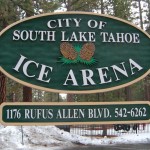
With the need to have all agreements finalized in January so the bonds could be converted from non-taxable to taxable by March 1, questions unresolved, and the season of little government work accomplished approaching, the deal is teetering on thin ice.

Conflicting letters delivered to El Dorado County Board of Supervisors is part of the problem. That board at its meeting last week directed the chief administrative officer and auditor to craft a letter to the city for clarification.

While the South Lake Tahoe Recreation Facilities Joint Powers Authority this month agreed to change the designation of the bonds, the three member agencies must do so as well. Those agencies are South Lake Tahoe, El Dorado County and Tahoe Paradise Resort Improvement District.

The city and county on the same day – Dec. 13 – at their respective meetings heard a presentation by the private financial advisor hired by the JPA (Mark Northcross with Northcross-Hill-Ach) and JPA staff member John Upton.

The city wants to convert the bonds to taxable because IRS rules prevent a private entity from benefiting from non-taxable bonds while the bonds are outstanding. The ice rink was paid from Measure S funds, now called Measure R. That South Shore recreation measure will sunset in 2030.

In a letter dated Dec. 6 from Upton to the county it says, “If the refinancing results in greater debt service, the city will be obligated to pay the JPA that difference. Bond counsel will create the necessary agreement and manner for assured collection. … The cash contribution is currently at $415,000.”

In a letter dated Dec. 8 from City Manager Tony O’Rourke to the county it says, “The ice arena operator and TSE [Tahoe Sports Entertainment], will need to bear any cost obligation associated with the refinancing of the Measure S outstanding debt from tax-exempt to taxable.”

The conflicting information about what entity is responsible for the more than $400,000 is what has the county concerned. The board wants this cleared up before it is slated to vote on the refinancing in late January.

After the county meeting, Supervisor Norma Santiago told Lake Tahoe News, “The only motion was that the auditor work with the CAO to write a letter to the city manager asking for clarity on a statement included in this letter.” Then she quoted the conflicting message from O’Rourke.

Santiago added, “As you are well aware, during the course of our discussion at the JPA meeting, the city said that they would be bearing the costs. Obviously, things are changing and this refinancing of the bond to a taxable bond is a ‘moving’ target. Everyone, however, agrees that refinancing the tax-exempt bonds would provide additional savings to the taxpayers that then could be further invested in projects supported by both Measure S and R.”

At the City Council meeting, O’Rourke said, “We have made it crystal clear the JPA won’t pick up the cost or the city.”

Van Oleson and Chris Cefalu, who operate the rink under the business name Tahoe Sports Entertainment, were out of town and unavailable for comment. Despite the uncertainty, TSE is going forward with trying to obtain a beer and wine license.

In other action from the Dec. 13 City Council meeting:

• The council agreed to take $21,613.70 from the General Fund Undesignated Reserves to pay bills for outside legal counsel for the 2010-11 fiscal year. The bulk of that — $14,096 – went to an attorney to deal with labor negotiations.

• Agreements with the remaining city labor groups have been reached so all employees are paying their share of PERS retirement funds.

• The city will put out a request for proposal to hire a firm to monitor vacation home rentals, with the idea it would generate income.

• The council allocated up to $10,000 to be spent on a feasibility study regarding the South Shore Vision Plan.



Marriott to be headed by a non-family member

By Michael S. Rosenwald, Washington Post

J.W. Marriott Jr., who built the company his parents started as a District root beer stand into a global lodging giant, is stepping down as chief executive, ending a storied 39-year run that ushered in a new standard of dependable, middle-class hospitality for travelers around the region, the country and then the world.

The word “Marriott,” in red letters on buildings from Bethesda to China, came to signify home for weary families making their way to Disney World, for traveling salesmen careening around the Midwest and lately for weary road jockeys keeping pace with globalization.

In the process of building the 3,600-hotel empire, including two properties in South Lake Tahoe, Marriott’s family became one of the richest and best-known in the region. The family and the firm donate millions every year to philanthropic efforts, particularly for people with disabilities.

The company employs 15,000 people locally, but its influence stretches beyond its hotels and its Bethesda headquarters. Many in the industry say Marriott was critical to seeding the region’s strength in hospitality. A host of former Marriott executives have run some of the largest hotel companies, including Hilton Worldwide, RLJ Lodging Trust, Choice Hotels and Host Hotels & Resorts — all of which are based in the area.

Throughout the growth of his family’s company and the industry, there was Mr. Marriott, as his devoutly loyal employees call him, espousing his family’s simple maxim that if you take care of your employees, your employees will take care of your customers, and your customers will come back.

Read the whole story


Meyers Landfill site to stay closed through 2012

Hazardous conditions are keeping Meyers Landfill site off Pioneer Trail near South Lake Tahoe off-limits to snowmobilers, snowshoers, cross country skiers, mountain bikers, off-highway vehicle users and other recreationists.

Construction at the site will continue next summer. The site has been winterized, but safety hazards remain, including steep, irregular slopes with a slippery plastic cover, rock-lined channels, partially buried fencing, metal standpipes, concrete bollards, and roped-together sandbags, according to the U.S. Forest Service.

The Meyers Landfill has been under a closure order since 1997. In June 2010, the Forest Service expanded the closure to include the area from Garbage Dump Road to Saxon Creek. The Forest Service has extended this closure through Dec. 31, 2012.


Pollution in China altering weather in Western U.S.

By John Blackstone, CBS News

A U.N. conference on climate change ended Sunday without a major deal to cut toxic emissions. No country emits more carbon dioxide than China — a byproduct of its booming economy. And, as CBS News correspondent John Blackstone reports, those Chinese emissions are having a big impact in the U.S.

Chinese officials insist the murky air over Beijing this month is just fog. But measurements taken at the U.S. embassy there show dangerously high levels of air pollution — so bad that traffic has been disrupted and flights have been delayed or cancelled.

“It’s no longer just their problem; it’s our problem,” said Kim Prather of the Scripps Institution of Oceanography.

Prather studies atmospheric chemistry. CBS News met her at a scientific conference in San Francisco, where she was presenting research that shows what’s in the air over China can affect the weather in America.

“The atmosphere has no walls,” she said. “So pollution on this side of the world can make it the other side of the world in about five days.”

The Chinese pollution is carried by the jet stream across the Pacific. In the atmosphere over this country, it can stop the clouds from producing rain and snow.

In general, Prather said, the equation is more pollution equals less precipitation.

The particles of air pollution from China collect moisture in the clouds. But the particles are so small and numerous they don’t get heavy enough to fall as rain or snow. So the water stays in the clouds.

Read the whole story


Douglas County increasing the number of miles of trails

Groups like the Carson Valley Trails Association are making trail access a reality in Douglas County. Volunteers contributed more than 4,000 hours building trails and installing signs and kiosks, mostly on the Genoa Trails Project, which now boasts 16 miles of new trail almost ready to open in the spring. When complete, the Discovery Trail will stretch about seven miles along the base of the Carson Range above Genoa.

The Sierra Canyon Trail will climb the range with 3,500 feet of elevation gain in less than 10 miles of tight switchbacks to connect Genoa with the Tahoe Rim Trail.

Besides locals enjoying the trails, coordinated systems can help boost the economy. A 2009 study for the University of Minnesota found that trail users in the northeast region of that state spent $628 million, and that spending supported thousands of jobs. Nearly three-quarters of that money was spent by visitors from outside the area.


El Dorado County receives money for carpool lane

The California Transportation Commission this week allocated $401 million in funding to 39 projects, including one in El Dorado County.

Proposition 1B, the 2006 voter-approved transportation bond, will supply $327 million in funds to 10 projects, including $42 million toward the purchase of 42 passenger rail cars. They will be put into service on all three state-supported Amtrak California routes – the Capitol Corridor, San Joaquin and Pacific Surfliner. This supplements $168 million from other sources, including $68 million from the American Recovery and Reinvestment Act of 2009.

To date, the state has allocated more than $11 billion in Proposition 1B funds for transportation purposes statewide.

El Dorado County is getting $9.5 million for the Highway 50 bus/carpool lane project. This project is will add 2.3 miles of bus/carpool lanes from Bass Lake Road to Cambridge Road.


Economy a factor in what happens to California’s water bond

By John Howard, Capitol Weekly

The most ambitious and expensive water program to confront California voters since the State Water Project was approved more than 50 years ago may wind up getting reduced by billions of dollars, a victim of politics and the economy.

The assumption is that recession-weary voters won’t approve a big-ticket bond, so the problem is this: How do you cut back a complex, $11.1 billion package that was put together — barely – with a fragile agreement in which each piece needed a signoff by rival political forces? If one piece is removed, does the whole structure start collapsing?

“There’s a lot of head-scratching right now,” said Assemblyman Jared Huffman, D-San Rafael, the chair of the Assembly water committee.

When the economy is weak, California voters traditionally reject big borrowings. The water bond, approved in 2009, had been planned to before voters last year. As the recession took hold, nervous lawmakers decided – again, with two-thirds votes — to push the measure back to November 2012.

On paper, at least, November 2012 would appear to be a good choice. Democrats tend to favor bond borrowings more than Republicans, and next November is a presidential election in which a high-than-average turnout of Democrats is likely. Turnout for Democrats also will be driven by a Republican-backed move to block unions from automatically deducting dues from paychecks – a hot-button issue for unions, the core of the Democratic base.

The public has been supportive of water development in the past. A $5.4 billion borrowing was approved in 2006 as Proposition 84, part of a larger infrastructure-improvement plan. At the time that Proposition 84 went before the electorate, California voters had approved some $11 billion for water projects during the previous decade.

“The public is well aware that California has a serious water-supply problem,” said Timothy Quinn of the Association of California Water Agencies, “and that it will take investments in infrastructure and local resource development to solve that problem.”

Quinn’s group represents some 450 agencies that together deliver about nine out of every 10 gallons of water delivered to farms, cities and businesses.

But the November ballot also is fraught with peril: A spate of other borrowings and taxes may be on the ballot, too, including Gov. Brown’s $7 billion-a-year plan to raise sales taxes and impose new levies on the rich, then use the money for schools and public safety.

Read the whole story


3 years later — Red Hawk Casino a financial disappointment

By Dale Kasler, Sacramento Bee

The Shingle Springs Band of Miwok Indians battled for more than a decade to build a casino along Highway 50, a gambling palace that would lift the tribe out of poverty.

It hasn’t worked out that way.

Three years after it opened, Red Hawk Casino is performing well below expectations, can’t pay all its debts and has failed to enrich its owners.

Despite a sea of slot machines and elegant trimmings worthy of Las Vegas, the $535 million casino continues to be dwarfed by its wildly successful rival, Thunder Valley Casino near Lincoln, in the battle for Sacramento-area gamblers.

Some of Red Hawk’s woes have been made public before, including the debt problems. Now, testimony in an El Dorado Superior Court lawsuit provides the most vivid picture yet of how badly the Shingle Springs casino is lagging.

Red Hawk took in $214 million in gambling revenue last year, testimony shows. That was 10 percent below 2009, its first full year of operation.

More importantly, that was about $100 million less than what was expected in a forecast the tribe made in 2007, according to court records. Gambling revenue is the amount the house wins, not the amount wagered.

“I think it’s strictly the economy,” said Nick Fonseca, chairman of the Shingle Springs tribe. “This is a new reality, and tribes are going to have to adjust to it.”

Normally kept secret, details of Red Hawk’s performance have spilled out in a lawsuit against the tribe by a company that once supplied it with slot machines and contends it is entitled to a cut of the profits.

Executives with the casino and the company that manages it for the tribe, Lakes Entertainment Inc. of Minneapolis, declined to comment further on Red Hawk, citing the ongoing court case.

But in an interview outside the courthouse during a break in the trial, Fonseca said the tribe is getting just $6 million a year in profits – the bare minimum guaranteed by Lakes.

Individual tribal members are receiving $800 a month in profit distributions, he said. Half of his 500 members continue to live below the poverty line.

By comparison, the 300 members of Thunder Valley’s owner, the United Auburn Indian Community, reportedly get $30,000 a month apiece in casino profits.

Red Hawk and Thunder Valley are just 40 miles from each other but might as well inhabit different planets.

Read the whole story