Nevada cracking down on campaign ads

By Anjeanette Damon, Las Vegas Sun

Skip Daly chuckled the first time he saw the website erected last year to anonymously attack his credibility during the Democratic assemblyman’s campaign.

“It was just so over the top, of course, no one would believe it,” Daly said.

TheUnionBoss.com was filled with ugly clichés about burying bodies in the desert and sending jobs to brothers-in-law.

It was an attempt to mock Daly, who as secretary-treasurer of the Laborers Union in Northern Nevada is an actual union boss.

Daly didn’t laugh for long.

“I sat back and said, ‘You know, this really isn’t very funny. And it’s not true,’” he said. “But it was a shadow group. I didn’t have anybody I could confront. And that’s not fair.”

Daly filed a complaint with the Secretary of State’s office but quickly found there was little that could be done to discover the identity of who had funded and created the website, which is still up .

“That just dumbfounds me,” Daly said.

As Nevada heads into another election year, an onslaught of such third-party campaign ads — many of them paid for by anonymous donors — are sure to come, particularly in the presidential and U.S. Senate races as federal third-party groups ratchet up fundraising in the wake of court decisions loosening campaign finance restrictions.

But on a state level, Secretary of State Ross Miller has been fighting anonymous third-party groups — taking some to court, investigating complaints made to his office and successfully pursuing legislation that will make it easier to compel such groups to disclose where they get their money and how they spend it.

Thanks to a bill sponsored by Daly, the Legislature gave Miller limited subpoena power to obtain documents from Internet hosts and the post office to help determine who’s behind the anonymous groups.

Read the whole story


Even small amount of exercise is good for the heart

By Janice Lloyd, USA Today

More research shows that even small amounts of aerobic exercise help lower coronary heart disease risk, according to a review published Monday in Circulation, the journal of the American Heart Association.

The mega-study is part of a growing body of research showing that some physical activity provides health benefits — even when levels fall below the recommended federal guidelines of 150 minutes of moderate-intensity physical activity a week. For the first time since 1998, the American College of Sports Medicine updated its exercise guidelines in June, including information on how little exercise is needed to achieve health benefits.

“The biggest health benefits we saw were for those who went from doing nothing to those doing something small,” says Jacob Sattelmair, author of the new AHA study. “Even a little bit of activity makes a significant difference.”

A little bit means 10 to 15 minutes a day. Sattelmair says the new findings are the first to make quantitative assessments of the amount of physical activity a person needs to reduce risk.

Read the whole story


Don’t allow holiday decorations to become fire hazard

Now that the holidays are over, the South Lake Tahoe Fire Department would like to remind everyone that they should be aware of the potentially explosive hazard of a dried out Christmas tree in your home.

Do not try to burn your tree in the fireplace, even if it is chopped into small pieces. Trees left next to curb on trash pick up day will be removed free of charge by the South Tahoe Refuse.

Outdoor Christmas lights look great during the holidays, but should also be removed to prevent damage from freezing weather that could cause short circuits.

Thanks for continuing to be fire safe.

— Sallie Ross-Filgo, South Lake Tahoe Fire Department


Opinion: Pension reform hindered by contract protections

By Daniel Borenstein, San Jose Mercury News

When it comes to public-employee pensions in California, what goes up usually can’t come down.

At least that’s the prevailing legal theory, severely restricting reform options across the state. As the state pension squeeze intensifies, we soon could see those limits tested.

Pensions typically are based on the number of years an employee works. Each additional year adds to future retirement payments. Starting in 1999, most public agencies in California increased that annual accrual rate.

For example, pensions for some police and firefighters were increased from 2 percent of final salary for each year worked to 3 percent. Thus, the pension for a 30-year employee went from 60 percent of final salary to 90 percent.

But what if pension benefits become too costly? In the private sector, the answer is simple: Reduce the formula. For future years of employment, the multiplier might be cut to 2 percent, or lower.

Note: Benefits already earned for past labor are protected, as they should be. The issue is the future rate of accrual. Smart business people know that when they are in a financial hole, they should stop digging.

The California public-sector rules are different. Once employees start working, they usually are guaranteed that initial multiplier their entire careers, many lawyers say. If, for example, that 2 percent per year is increased to 3 percent, it cannot be subsequently reduced.

The protection stems from the state and federal constitutions, which say government agencies shall not impair contract obligations. In California, the state Supreme Court ruled that a public employee with a pension holds a “vested contractual right” that is “in effect not only when employment commences, but … thereafter conferred during the employee’s subsequent tenure.”

Read the whole story


Author to speak about book on Tahoe and Twain

Lake Tahoe author David Antonucci presents an illustrated talk on his newest book on Lake Tahoe, “Fairest Picture: Mark Twain at Lake Tahoe” on Jan. 18 at 6pm as part of the Explore Tahoe Winter Speaker Series.

The event is at Explore Tahoe: An Urban Trailhead located at 4114 Lake Tahoe Blvd., South Lake Tahoe.

A $5 donation is requested. A $5 flat rate fee is offered in the Heavenly Village Parking Garage after 4pm.

For more information, contact Explore Tahoe at (530) 542.4637.


Where do you like to take people who visit the Lake Tahoe Basin?


State panel to reconsider Washoe Meadows decision

By Kathryn Reed

Second thoughts are what the California State Park and Recreation commissioners are having regarding the October decision to approve the final EIR for the Upper Truckee River restoration project, and to swap land between Washoe Meadows State Park and Lake Valley Recreation Area to allow Lake Tahoe Golf Course to be reconfigured.

Commissioners at their Jan. 27 meeting in the Bay Area are having another public hearing on the state park in Meyers.

The agenda item says: Reconsideration of, and upon reconsideration, action on approval and findings for the Environmental Impact Report, General Plan Amendment & Classification Adjustment related to the Upper Truckee River Restoration & Golf Course Reconfiguration Project.

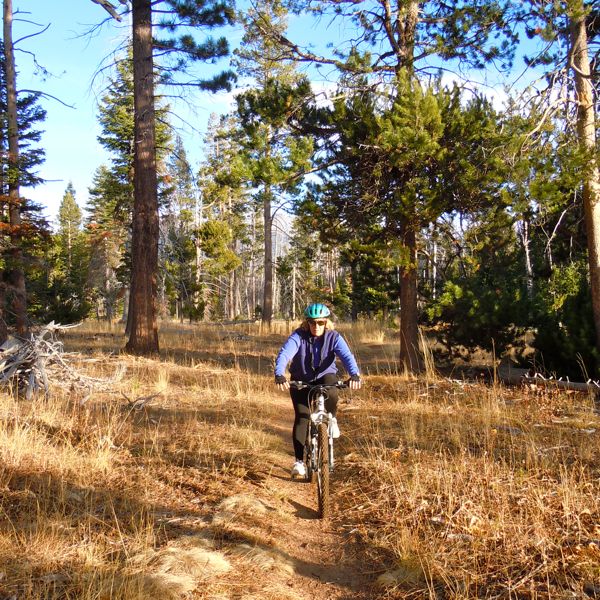
Without snow, Washoe Meadows is still good for mountain biking -- though if the decision is not overturned, this section will become a golf course. Photo/Kathryn Reed

No one from State Parks or the commission was available for comment Tuesday night. So it’s not known who asked for the issue to be heard again or how often this happens by the state commission.

At the Lake Tahoe meeting two months ago the decision was unanimous to accept staff’s recommendations.

The decision by the commissioners came as Ruth Coleman, director of the Department of Parks and Recreation, sat to their left. She is now in jeopardy of losing the job she was appointed to in 2002 by then-Gov. Gray Davis.

The State Parks Peace Officer Management Association sent a letter Dec. 14 to Gov. Jerry Brown that said 93 percent of the 56 percent of the members polled want a new director.

Whether her tenuous situation played a roll in rehearing the Washoe project is not known.

Before the public items are addressed next month the commission will go into closed session to discuss the lawsuit filed by the Washoe Meadows Community. This group filed a lawsuit Nov. 23 in Alameda County Superior Court on various grounds in an attempt to halt the project as approved.

Both sides have agreed to push back some of the deadlines regarding filing of papers in the case.

Washoe Meadows Community supports Alternative 3 – which would take the 18-hole course down to nine holes or convert it to an 18-hole executive course.

The reason the golf course would be altered is to accommodate restoration of the river – an ongoing project by all parties who own property where the river runs through it. It’s all about reducing sediment that reaches Lake Tahoe and restoring the ecosystem.

The Tahoe Regional Planning Agency Governing Board still needs to vote on the Washoe Meadows section, but that has been pulled indefinitely at the request of State Parks.

Lynne Paulson, a member of the Washoe Meadows Community, said her group would be present at the January public hearing.

She had not been given a heads up about the issue being on the January agenda; learning about it when notification of the meeting was sent via mass email Dec. 27.

“I hope this leads to a better alternative,” Paulson told Lake Tahoe News of the Jan. 27 meeting.

Regarding the lawsuit, Paulson does not expect a settlement conference to be scheduled before the commission meets.

—————

Meeting info:

• Jan. 27 at 9am in the Community Room of the Brentwood Community Center, 35 Oak St., Brentwood.

• To comment on agenda items, write to State Park and Recreation Commission, Box 942896, Sacramento, CA 94296-0001, or email LNastro@parks.ca.gov, or call (916) 653.0524.

• The meeting agenda is online.


Blackwood Canyon project on Lahontan’s agenda

Lahontan Regional Water Quality Control Board at the Jan. 11-12 meetings in Apple Valley will consider a resolution regarding the California Tahoe Conservancy restoration project in lower Blackwood Creek.

Comments on the Blackwood Canyon proposal will be taken until Jan. 9.

Anyone with questions or wanting to discuss the project should call (530) 542.5439 or email RLarsen@waterboards.ca.gov.


Winter Film Series

In spring 2011, local mountain guide Adrian Ballinger became the first person to summit three 8,000-meter peaks within a three-week period.

Ballinger summitted Mount Everest (29,029 feet) twice in two weeks, first while fixing ropes to the summit with an elite group of the world’s strongest sherpa, and then again while guiding a group of climbers to the top of the world’s largest peak.

Alpenglow Sports’ third installment of the annual Winter Film Series is Ballinger’s tales of his Himalayan adventure.

The event is Jan. 12 at 7pm at Sawtooth Ridge Cafe in Tahoe City.

With one week left in the season, Adrian, Phurba and Tashi again left basecamp to guide and summit Lhotse (27,940 feet), Mount Everest’s neighbor and the fourth highest mountain in the world.

From deep within the Himalaya, this story is one for the climbing history books.

The free event will be a night of photography, video, and stories from the roof of the world.

Call Alpenglow Sports at (530) 583.6917 with questions.


Court: Tahoe beaches do not have to be open to the public

By Cy Ryan, Las Vegas Sun

CARSON CITY — A general improvement district that purchased four beaches on the Nevada side of Lake Tahoe in 1968 is not violating the U.S. Constitution in barring the public from the areas, a federal court has ruled.

The U.S. Ninth Circuit Court of Appeals has denied the petition of Frank Wright, who contends the ordinances of the Incline Village General Improvement District are invalid.

The appeals court, in a decision Tuesday written by Judge Milan D. Smith Jr., quoted a prior ruling that said, “The First Amendment does not guarantee access to property simply because it is owned or controlled by the government.”

Smith wrote, “The government may limit the use of properties under its control to the uses to which the properties are lawfully dedicated.”

Read the whole story