Opinion: Time to control marijuana odor in South Tahoe

By Steve Kubby

A citywide voter initiative to control marijuana odor and set rules for cultivation was filed Dec. 29 with the city clerk. The city attorney has 15 days to issue a Title and Summary so the signature gathering process can begin.

The new initiative requires 856 valid voter signatures to qualify for the Nov. 6 ballot.

Steve Kubby

When people come to South Lake Tahoe, they expect to smell pine trees and fresh air. Odor from marijuana cultivation has a negative effect on visitors’ experience and on property values, which should not be tolerated in a residential setting. Responsible marijuana growers control their odor emissions out of respect for their neighbors and out of the need for security from home invasions. This initiative will make the abatement of marijuana odor an enforcement priority.

Unfortunately, frustrated and frightened patients who are trying to comply with the current South Lake Tahoe Cultivation Ordinance are finding that it is impossible to get their landlords to sign notarized letters giving permission for them to grow — even though they already know and allow their tenants to do so. Apparently, landlords are reluctant to sign something that would incriminate them for violating federal law and the Controlled Substance Act.

Patients must also register in public records that they are growing, a clear violation of their Fifth Amendment rights. Too bad if the city decides you are not in compliance, their ordinance allows them to publish patient’s name and fine them $1,000 per day. As a result, few patients have registered and now live in terrible fear that the city will raid them, cut off their power and turn their lives upside down.

The current cultivation ordinance punishes bona fide patients by creating expensive and difficult barriers to rights already granted to them by the voters of California. In contrast, the city rewards illegal growers, because nearly anyone can qualify, provided they have enough money and time to jump through all the hoops, give their landlords money under the table, and get a medical recommendation for the right price.

Under the current system that was adopted, illegal growers and out-of-towners will be flocking to the city of South Lake Tahoe by the thousands, something none of us wants.

It is not the job of the City Council to serve as property managers. That is the legal responsibility of property owners and rental property managers. It is their responsibility to clearly spell out the terms of their lease, to screen their potential tenants and perform whatever inspections are required to maintain their property. Absentee owners should take responsibility and hire a local property manager. If tenants are in violation of their lease, then owners and managers have ample legal remedies ranging from eviction to civil and even criminal actions in court.

It is also not the job of the City Council to thwart state law and the will of the voters. Medical marijuana patients have legal rights. This voter initiative will ensure that the rights and privacy of patients is respected, while marijuana odor is brought under control and illegal growers are no longer protected by the City of South Lake Tahoe.

The South Lake Tahoe Marijuana Odor Control and Cultivation Ordinance

The People of the City of South Lake Tahoe, California, do enact as follows:

Section A. Purpose and Finding

The People of the City of South Lake Tahoe find that marijuana cultivation in homes can create a number of problems that need to be addressed. Number one among these issues is the odor of marijuana plants, which many people find offensive. At the same time, bona fide medical marijuana patients and caregivers find themselves facing a new city ordinance which creates difficult, expensive, illegal procedures and barriers to rights already granted to them by the People of California. As a result, many patients cannot comply and now live in fear, while the more pressing issue of marijuana odor goes ignored. This initiative is intended to make marijuana cultivation odor abatement the key issue, while leaving matters occurring within a dwelling up to owners, landlords, their lease agreements and existing real estate law.

Section B. Orders

(1) Odor from the cultivation of marijuana is hereby deemed a serious problem within our city and any complaint of odor issues should be investigated and acted upon.

(2) Any property or dwelling which is found to be emitting marijuana cultivation odors should be tagged on the front door or gate, with a notice that odor has been detected, and the city requests appropriate actions be taken within 72 hours to remove or sufficiently suppress the odor, such as the purchase of a charcoal filter unit specifically designed to remove odors.

(3) Any property or dwelling which is found to be emitting marijuana cultivation odors 72 hours after being tagged can be fined up to $50 per day until the odor is removed. Odor from the smoking of marijuana shall not be cause for any action.

(4) Adults 21 years and older, who are bona fide medical marijuana patients, may produce up to 6 mature outdoor flowering plants, or up to 12 mature indoor flowering plants per person; or a total number of plants cultivated per household not to exceed 12 mature flowering plants outdoors or 24 plants indoors. The cultivation shall take place in an indoor or outdoor space or area not visible from a public street or sidewalk.

(5) No taxes, fees, laws, rules, regulations, zones, local city or county zoning requirements may be adopted or enacted to defeat, deny, or prohibit the purposes of this Act, or to defeat, deny, or prohibit adult medical marijuana patients, 21 or older or from engaging in the activities authorized and protected by this Act, unless passed by the state or local voters.

(6) Nothing in this section shall prevent a property owner from prohibiting marijuana cultivation on their property or conduct that damages their property, so long as that is clearly stated in their rental agreement or lease.

(7) This Act repeals, preempts and nullifies any and all conflicting local regulations, but allows for a greater number of plants than authorized by this measure, if a physician has written a letter or recommendation that states that these limits are insufficient for their patient.

(8) No regulations, taxes, permits or fees shall be enacted or imposed upon marijuana for qualifying patients or their caregivers.

(9) Elected, appointed, hired employees, officers, and officials of the City of South Lake Tahoe shall not directly or indirectly cooperate with or assist federal, state, or county officers or officials, volunteers, or employees who eradicate marijuana, act for seizure or forfeiture, or demand entry without a warrant or to defeat any liberally construed purpose of this Act, nor may any state or local agency contract to eradicate marijuana that is being grown, manufactured or stored under the provisions of this Act. Violation of this clause shall be a misdemeanor, punishable by fine and up to one year in prison.

(10) The City of South Lake Tahoe is ordered to protect and defend all provisions of this Act from any and all challenges or litigation, whether by persons, officials, cities, counties, the state or federal governments.

(11) South Lake Tahoe City Police are hereby enjoined from arresting anyone age 21 or older for any marijuana related offense, which is protected by this Act.

(12) This Act shall become effective immediately upon passage and may be applied retroactively to protect patients or caregivers from civil or criminal prosecution.

(13) Patients and caregivers shall have the right to transfer their marijuana to other patients or collectives and be paid a remuneration for their out of pocket expense and their time.

(14) The City of South Lake Tahoe is hereby enjoined from banning or limiting the number of medical marijuana collectives, dispensaries or delivery services operating within the City. However, the City shall have the power to regulate or even ban any signage by dispensaries and to ban the location of any dispensary within 600 feet of a school.

Section C. Severability

If any of the provisions of this Act, or any part thereof, is for any reason held to be invalid or unconstitutional, the remaining provisions shall not be affected, but shall remain in full force and effect, and to this end the provisions of this Act are severable.

Steve Kubby is a resident of South Lake Tahoe.


LAO: Ballot proposals to reform pensions may cost California taxpayers more

By Jon Ortiz, Sacramento Bee

Two ballot proposals aimed at cutting government pension costs could wind up increasing them, are fraught with legal and fiscal uncertainty and would put pressure on governments to increase public employee pay, according to new analyses of the measures.

The nonpartisan Legislative Analyst’s Office on Tuesday released its takes on two public pension reform plans filed by Dan Pellissier, president of California Pension Reform. The group hopes to put one of the proposals to a statewide vote next November.

Steve Maviglio, spokesman for labor coalition Californians for Retirement Security, issued a statement calling the pension plans “sloppily drafted and extreme” initiatives that “will be an economic disaster for our state.”

Pellissier, meanwhile, released a statement that focused on pension abuse and governance provisions common to both plans and the LAO’s conclusion the proposals will eventually cut pension costs: “Californians are ready to vote for this type of pension reform to help get our fiscal affairs back on track.”

The law requires that the nonpartisan legislative analyst review the fiscal impact of ballot proposals before they go before voters.

Read the whole story


Panda experience to be retold by Tahoe resident

Tahoe local Jenn Mendonca will share the details of her recent journey deep into the mountains of China’s Sichuan Province to visit a secluded panda sanctuary with her daughter.

Join members of the South Lake Tahoe branch of the American Association of University Women for this heartwarming glimpse into the lives of these rare and endangered animals on Jan. 14 at 10am in the Aspen Room at Lake Tahoe Community College. This event is open to the public.

An optional continental brunch will be available for a small donation and an RSVP is requested.

For more information, call Candy Kelly at (530) 541.2799 or email Christy Slocum at slocumsrus@msn.com.

And if you can’t attend the event, you can relive Lake Tahoe News’ experience with pandas from earlier this year.


LTCC grooves to the beat of 3-day outdoor music festival

By Kathryn Reed

One day SnowGlobe might legitimately be used in the same sentence of Woodstock or Day on the Green. More than 9,000 people – mostly younger than 30 – swayed, danced, bounced and moved to the sounds of bands like their parents’ and grandparents’ generations did decades ago.

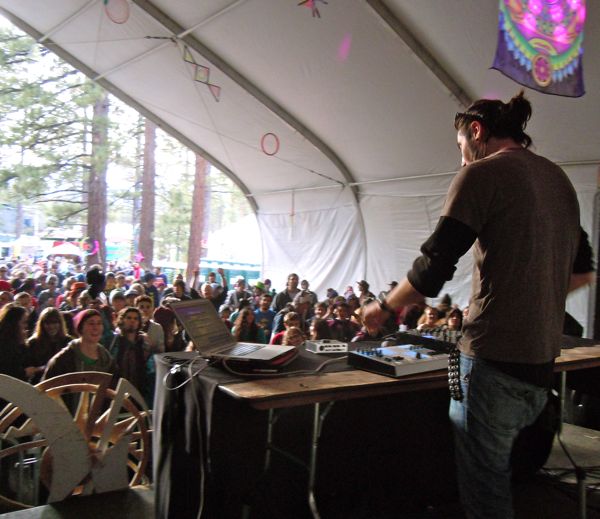
Only this music isn’t rock ’n’ roll. It’s techno. It’s hip-hop. It’s crunk. It’s a whole lot of drum machine and bass. Sometimes a band isn’t even on stage – it’s a disc jockey putting the sounds together in a mix that becomes original music. They are artists in their own right, not like the disc jockey putting someone else’s song on the radio.

Stephan Jacobs keeps a throng of SnowGlobers moving to the music. Photos/Kathryn Reed

It’s got a beat that makes everyone listening want to dance. It’s a party. It’s people having fun.

South Tahoe evolves

Kindred Murillo has a smile on her face as she surveys the crowd. She is used to this age group. After all, she is president of Lake Tahoe Community College; which is doubling as a concert venue for two more nights.

“It’s better than I expected,” she said looking at a line of people waiting to get in.

On the job less than six months, she is doing something no one in the history of the 30-plus-year-old college has done – turning the campus into a music venue. If everyone determines SnowGlobe was successful, Murillo envisions the college being more of a partner in the future.

She’s well aware of the publicity the event has already brought to the campus and hopes to be able to capitalize on it in the future.

The college is getting about $10,000 from the concert promoters for use of the site. The city will get about the same from the business license fee and reimbursement of hard costs like overtime for employees.

It’s a potential shot in the arm to local businesses, too – money in pockets of hotels, vacation rental owners, and other businesses that are smart enough to tap into the needs of this crowd. Like food when the festival is over. Souvenirs to take home. Warm clothes for these flatlanders.

Tickets: Dec. 30 $65, available at Horizon in Stateline noon–6pm; Dec. 31 $75, available at Horizon in Stateline noon–6pm Age: Anyone Times: Dec. 30 2:15-11pm; Dec. 31 4:15pm-1am Info: SnowGlobe online

It was South Lake Tahoe City Manager Tony O’Rourke who shook his head a year ago when he heard the city did nothing on New Year’s Eve except pay police officers overtime to help patrol the Stateline casino corridor. His idea was give those twenty-somethings something to do and get them to open their wallets.

They are here and they are spending money. Three-day tickets cost about $150, with Saturday-only being $75.

Vendor Village is a tented area where jewelry, hats, glasses, clothes, leather goods and organic food are being old. On the outskirts of the shopping area is SpiritHoods. They sell those animal hats with long ears, so to speak, that can be scarves of sorts. At the concert they sell for $100 — $35 less than online or at their Los Angeles headquarters.

A slew of women and men have this style of hat on. They seem to be everywhere.

SnowGlobe is giving people who might usually stand around in the cold at Stateline on New Year’s Eve something to do other than question why they are standing around in the cold. It will give people who can stay out past 9pm on New Year’s Eve a place to be on the South Shore – which includes a fireworks show.

It’s about putting South Lake Tahoe on the map as a place to be this time of year that doesn’t involve being in a casino.

It may even be good business for the three marijuana dispensaries in South Tahoe.

With the smell of pot wafting between the three stages on opening night of the three-day event and no line for Sierra Nevada brew, it was obvious the drug of choice for this crowd is weed.

The cops are ignoring them. After all, it’s just an infraction in California – like getting a speeding ticket.

But South Lake Tahoe police officers make their presence known at the get-go. And SnowGlobe officials alerted their followers that undercover cops would be on the grounds, too.

“Their security handles everything,” Sgt. Shannon Laney told Lake Tahoe News as he watched people funnel in. “They bring the problems to us.”

It’s all about the music

Dillon Francis – on the Sierra stage – is who Robert Bunnett, 19, was most excited to see Thursday.

He and 14 friends made it a road trip from Los Angeles for three days of music. They are staying – all of them – in a one-room cabin. Usually it’s the LA-San Bernardino music fests they follow. The lineup and the opportunity to be in Tahoe for New Year’s led them north.

Even though Sherose Renck, 17, and Serena Gafford, 16, didn’t have to drive far, the best friends from Gardnerville are staying in a hotel overnight on the South Shore – going to SnowGlobe all three days.

They are moving to the beat of Stephan Jacobs who is making techno music on the Igloo stage. This is the biggest music event either one has been to.

It’s the atmosphere that captivates Renck. “I love the energy,” she says.

With goggles on her forehead, Lorene Carlston of Santa Cruz waits to get in. She’s most excited to see Pretty Lights, one of the headliners on the SnowGlobe stage Dec. 29.

Frustrated with the people who work at the Horizon casino in Stateline for not knowing where the shuttle to LTCC was, this led her and a friend to a hitch a ride.

At 28 and her friend 31, she says, “We find it to be a young crowd.”

Despite their hiccup, most people were getting to LTCC via the 30 buses bringing them to and from LTCC for free.

Eran Afmer, 34, of Seattle is a bit disappointed with no fresh snow, especially considering she left powder in the Cascades. Still, she’s excited to be in Tahoe – a first for her – with friends from various states. They rented a huge house for the long weekend.

South Lake Tahoe local Anthony Davis put in six hours volunteering at the event Thursday.

“I did it so I can get a feel for the event and know what it’s all about before I judge it,” Davis said. “I’m liking it. I like the vibe.”

ngg_shortcode_0_placeholder (Click on photos to enlarge.)


Law enforcement will be out in force for New Year’s Eve

Douglas County sheriff’s deputies are preparing for the New Year’s Eve celebration at Stateline; where some years about 50,000 people have closed down the casino corridor.

While some of the usual participants may be at Lake Tahoe Community College for the SnowGlobe concert that night, law enforcement on both sides of the state line still expect a large contingency at the casinos.

Even though no ball drops, a mostly twenty-something crowd meanders around in the cold.

Close enough to walk to will be the festivities at Heavenly Village, where a lighted gondola will “drop” and fireworks will go off at 9pm — the New York New Year.

Douglas County will beef up its patrol starting Thursday — in large part because the three-night SnowGlobe event starts late that afternoon.

Due to the ordinarily high volume of pedestrian traffic expected within the casino core area during New Year’s Eve, Highway 50 is likely to be closed to vehicle traffic. If that occurs, traffic will be diverted around the Stateline casino core area using upper and lower Lake Parkway Drive.

Besides Douglas County and South Lake Tahoe officers near Stateline on Dec. 31, expect to see personnel from

Nevada Highway Patrol, Carson City Sheriff’s Office, El Dorado County Sheriff’s Office, California Highway Patrol, Nevada Department of Prisons, Placer County Sheriff’s Office and the FBI.

As in years past, a non-confrontational approach will be used, with the idea more citations are handed out than arrests made.

Incidents that will most likely result in an arrest include acts that place celebrants or law enforcement officers in jeopardy; including acts of rowdy behavior, fighting, throwing projectiles, vandalism, theft, narcotic violations, severe public drunkenness, possession of or discharge of fireworks, minors consuming or possessing alcohol, or any other act that disrupts the goal of achieving a peaceful and safe environment for all in attendance.

Glass and metal containers, regardless of contents, are prohibited in the casino core area on New Year’s Eve. Alcohol or other liquids shall be in a plastic cup, paper cup or other similar vessel.

The curfew in Douglas County on Saturday for people younger than 18 is midnight.


Gray wolf returns to California after nearly 84 years

By Cathy Locke, Sacramento Bee

A gray wolf that has been monitored in its wanderings through southern Oregon has entered California.

The California Department of Fish and Game announced today that the animal has crossed the border. The last confirmed gray wolf in California was killed in Lassen County in 1924, according to a department news release.

The Oregon Department of Fish and Game has monitored the travels of the 2 1/2-year-old male, which was collared with a Global Positioning System device in February. The wolf, formerly from a pack in northeast Oregon, is now more than 300 miles from where his journey began.

Read the whole story


Tales of hiking Mount Everest

In spring 2011, local mountain guide Adrian Ballinger became the first person to summit three 8,000-meter peaks within a three-week period.

Adrian Ballinger will talk Jan. 12 about climbing Mount Everest. Photo/Provided

Ballinger summitted Mount Everest (29,029 feet) twice in two weeks, first while fixing ropes to the summit with an elite group of the world’s strongest sherpa, and then again while guiding a group of climbers to the top of the world’s largest peak.

Alpenglow Sports’ third installment of the annual Winter Film Series is Ballinger’s tales of his Himalayan adventure.

The event is Jan. 12 at 7pm at Sawtooth Ridge Cafe in Tahoe City.

With one week left in the season, Adrian, Phurba and Tashi again left basecamp to guide and summit Lhotse (27,940 feet), Mount Everest’s neighbor and the fourth highest mountain in the world.

From deep within the Himalaya, this story is one for the climbing history books.

The free event will be a night of photography, video, and stories from the roof of the world.

Call Alpenglow Sports at (530) 583.6917 with questions.


DOJ opinion ‘important day’ in efforts to legalize online gaming

By Karoun Demirjian, Las Vegas Sun

WASHINGTON — A Department of Justice opinion released last week declares that Internet gaming transactions are legal between states where gambling is legal.

The opinion appears to open the door for multiple states with legalized gaming to band together and create online gambling zones across state lines — provided they don’t involve sports betting.

Advocates for legalizing online gambling have focused on getting Congress to overturn the 2006 Unlawful Internet Gambling Enforcement Act (UIGEA), which made it illegal for banks to process Internet bets for prohibited forms of gaming. The 13-page opinion by DOJ Criminal Division Assistant Attorney General Virginia Seitz does not discuss how the Wire Act intersects with UIGEA.

But Richard Bronson, chairman and co-founder of California-based U.S. Digital Gaming, called the opinion a sea-change in the federal government’s approach to online gaming.

“This is a very important day,” said Bronson, whose company develops online gaming technology. “It has always been considered to be illegal under the Wire Act.”

Seitz reviewed the 1961 Wire Act to address whether state lottery operators in New York and Illinois could sell tickets online if the routers and networks processing those transactions were out of state, in places like Texas, Maryland and Nevada.

Read the whole story


Changes to South Shore bus schedule for New Year’s Eve

BlueGo — the bus system on the South Shore — is altering service a bit on New Year’s Eve to help accommodate party-goers.

Here is the bus schedule. It is also posted in the buses and at the transit center.

Expect some delays because traffic that night can be a nightmare.

Also, the Stateline transit center will be closed Saturday night.


Plans to ‘tax the rich’ hold risks and rewards for California

By Kevin Yamamura, Sacramento Bee

Fueled by a backlash against the wealthy, Gov. Jerry Brown and left-leaning groups want voters to tax the rich next November.

Californians have shown strong support for the idea in polls so far, despite the fact that they haven’t passed a statewide tax hike since 2004. Brown said this month “the only tax that’s overwhelmingly popular is the tax on wealthier people.

“Partisans have feuded for years at the federal level over tax rates for the rich. Republicans argue that tax cuts spur investment and economic growth. Democrats say such “supply-side” theories are unfounded and that lower rates are merely a giveaway to the wealthy. As a state, California has particular considerations.

Chief among them are a fear that taxpayers will flee for lower-cost states, a widening gap between rich and poor, and a volatile income tax stream.

Critics say high-income earners and business owners will leave California for states with no income taxes, such as Nevada or Texas.

“There’s nothing more portable than a millionaire and his money,” said state Sen. Bob Huff, R-Diamond Bar, the ranking Republican on the Senate budget committee.

The concern is not limited to Republicans. In July, Democratic state Treasurer Bill Lockyer told the Sacramento Press Club he thought California was near its reasonable limit for taxing the rich.

California voters in 2004 opted to tax millionaires to pay for mental health programs. In 2006, they rejected a tax hike on the top 1 percent of earners to pay for public preschool.

A 2004 “millionaire’s tax” in New Jersey had little effect on migration, according to a study by Stanford University sociologist Cristobal Young and Princeton University sociologist Charles Varner published this year in the National Tax Journal. Moving from California to escape taxes is even more difficult.

“Many people in New Jersey could move 30 or 40 miles and find themselves in lower-tax Connecticut or Pennsylvania,” Young said in an email. “If you are in the Bay Area, it is a 500- to 700-mile move to competing urban areas such as Las Vegas or Phoenix. That is a tough move – you will be starting a new life.”The New Jersey Department of the Treasury issued its own research in October that countered the Young-Varner study. The department is led by an appointee of Republican Gov. Chris Christie, a vocal opponent of a new “millionaire’s tax.”

In a state with 8.7 million residents, the department said that all tax increases – not just those on the wealthy – resulted in 20,000 fewer taxpayers.For California business owners, such a change would be one more factor among many to consider when thinking about location. Businesses consider weather, transportation, regulations, market size and labor costs, among other factors, said Brad Williams, former chief economist for the Legislative Analyst’s Office.

“Businesses will need to think about what they’re getting for those taxes,” Williams said. “Do businesses think they’re getting something in return?”

Read the whole story