Snippets about Lake Tahoe

• Sierra-at-Tahoe’s 6th annual Buckle Up Slopestyle Jam in memory of freestyle athlete Greg Smith and that spreads seatbelt awareness is Jan. 21 from 11am-3pm.

• Beginning Jan. 26, Placer County Supervisor Jennifer Montgomery will have monthly coffee meetings the fourth Thursday of every month from 9-10am on the second floor of the Customs House Building, 600 North Lake Blvd., Tahoe City.

• Sugar Pine Bakery closed its Emerald Bay Road location in South Lake Tahoe on New Year’s Eve.

• Legendary skier Wayne Wong will be at Diamond Peak in Incline Jan. 7-8 teaching kids in a ski camp called Learn Right from Wong.

• Mt. Rose has $10 lift tickets through Jan. 8 for anyone 17 and younger.


Truckee man missing after canoe overturns on Donner Lake

A 24-year-old Truckee man is presumed dead after the canoe he was in with a friend capsized on a windy Donner Lake Monday.

His name is being withheld pending notification of family.

A 19-year-old Truckee woman called police about 6:30pm Jan. 2 to report she had been with a friend in a canoe on Donner Lake when it capsized. While swimming to shore, the female lost contact with her friend and he was presumed to still be in the water, according to officers.

Police and fire officials, including a dive team, searched the water with the assistance of CareFlight and California Highway Patrol helicopters to no avail.

The canoe was recovered near the shore of the Tahoe Donner Marina as well as some clothing items believed to have belonged to the female swimmer.

The woman was uninjured.

The search was suspended at about 9:30pm and resumed this morning at about 6:45.

It is not known if the canoeists were wearing life jackets.

 — Lake Tahoe News staff report


Thousands of Nevada groups lose federal nonprofit status

By Sean Whaley, Nevada News Bureau

CARSON CITY – More than 2,300 Nevada nonprofit groups have had their tax exempt status revoked by the Internal Revenue Service.

The revocations run the gamut from the Edgewood Tahoe Men’s Club to the Lovelock Alfalfa Seed Growers. Most of the revocations occurred in 2010 but were just posted by the agency last year.

The IRS in June 2011 released a list of more than 275,000 nonprofits nationwide that had their tax-exempt status automatically revoked due to failure to file annual returns.

The revocations mean the nonprofits are no longer exempt from federal income tax, and will have to pay corporate income tax on annual revenue. Organizations may also be subject to back taxes for failure to pay from the date of revocation. It also means donors will not be able to receive tax deductions for their gifts to the groups after the revocation date.

View Nevada organizations losing tax-exempt status.

The revocations were an automatic action taken after the passing of a Pension Reform Act in 2006. Nonprofit organizations are required to file paperwork with the IRS each year under the requirements of the law, and those that do not file anything for three consecutive years get their status revoked.

Many of the organizations are believed to no longer exist but others were caught by surprise.

Phil Johncock, interim executive director of the Alliance for Nevada Nonprofits, said many of the groups listed are likely no longer in operation. The group also made a big push in 2010 to notify the operating nonprofits of the new rules, particularly in the arts arena, he said.

But the contact information for the groups is limited, and so there may still be a number of nonprofits that remain unaware of the new requirements, Johncock said.

“You would think we would have access to emails for all of these nonprofits but the IRS only provides us with names and addresses, so some we couldn’t reach,” he said. “We have not heard from any of those organizations that have lost their status. Our guess is a significant number of them are probably not in business now.”

ANN has information on how to restore nonprofit status.

One group taken by surprise was the C-Hill Foundation, a group formed in Carson City after the 2001 terrorist attacks to install a large U.S. flag on “C” hill in the capital.

The IRS reports that it revoked the nonprofit status of the group in May 2010, and posted the information in June 2011. The group is registered with the Nevada Secretary of State’s Office as a domestic nonprofit.

Sarah Buscay, secretary of the foundation, said she was not aware of the revocation. The group isn’t overly active right now, but that could change if a plan under discussion to illuminate the flag moves forward.

“I did not know about that,” she said. “I’m sure I would have heard something if anybody knew about it.”

Buscay said the group would have been in a tough situation if it had gone forward with a fund-raising event without knowing of the revocation.

“We will definitely need that status,” she said.

Johncock said it is surprising to him that his organization has not been contacted by more groups, given the number of nonprofits that have lost their status. Most of the nonprofits on the list are 501(c)3 groups, which are charitable organizations that can receive donations, he said.

Moving forward there could be more nonprofits that lose their status because of the reporting requirements, he said. ANN is offering to help nonprofits fill out the required form at no cost, Johncock said.

“We hope that we’re not in a position ever again to lose nonprofits, or that they would lose their status, because it’s expensive,” he said. “It can be quite pricey.”

It cost ANN $750 to file its application, Johncock said.


Tahoe Tails — Adoptable Pets in South Lake Tahoe

Beau is a one-of-a-kind pup. We call him a Bassador because he’s a Basset hound/Labrador mix.

Beau is 1 year old, his birthday was Nov. 11, 2010, and he is a sweetheart. He loves to play with toys and other dogs, and he hasn’t chased the cats that he has met at the shelter.

He lived with children and spent most of his time outside, except when he was taken for a car ride, and he does love car rides.

His family moved and couldn’t take him with them. He is a very happy boy who is very gentle and sweet.

Plus, he has a very long tongue.

Beau is neutered, microchipped, and vaccinated. He is at the El Dorado County Animal Services shelter in Meyers, along with many other dogs and cats who are waiting for their new homes.

Call (530) 573.7925 for directions, hours, and other information on adopting a pet.

For spay-neuter assistance for South Tahoe residents, go online.

— Karen Kuentz


RAOK: From dinner for his wife to watching the Giants

Bruce Brown is going to see the May 19 baseball game at AT&T Park courtesy of Lake Tahoe News. The San Francisco Giants host the Oakland A’s that day.

He and whomever he chooses to take are going because Brown was randomly chosen as the latest winner of Lake Tahoe News’ Random Acts of Kindness promotion. Based on his Act of Kindness — surprising his wife with dinner — the second ticket may be spoken for already.

It’s free and easy to participate. All you have to do is perform a Random Act of Kindness, witness one or be the recipient of an act. Then tell us about it via a comment at the bottom of this story.

Each day through the month of January someone will be rewarded by a business in Lake Tahoe.

If you haven’t been picked, just keep trying. Winners are picked randomly.

For more details about Random Acts of Kindness and the few rules associated with it, check out this story.


Vail Resorts renewing its focus on guest safety on the slopes

By Kathryn Reed

No sport is without risk of injury or death. While common sense can play a roll in staying out of the hospital or morgue, sometimes it’s the other “players” who are the problem.

Skiing and snowboarding are two sports where participants don’t often have control over whether they will be hurt. Out of control riders are par for the slopes. Hardpack terrain is unforgiving. Safety bars on chairlifts don’t have to be used.

According to a study by the Centers for Disease Control and Prevention, of the 213,000 people who were treated in emergency rooms between 2004-05 for outdoor recreational injuries, snowboarding (25.5 percent), sledding (10.8 percent), and hiking (6.3 percent) accounted for the highest percentage of injuries. Fractures (27.4 percent) were the most common injuries.

Those taking lessons at Heavenly must wear a helmet. Photo/LTN

Injuries are so prevalent that most ski resorts have an onsite clinic to treat injured riders before assessing if they should be taken to a hospital by ambulance or helicopter.

While it would be impossible to prevent all injuries, Vail Resorts is raising the safety bar in terms of trying to make its six resorts safer than they have ever been. The Play It Safe, Play All Season campaign rolled out last month, after having been in the works since last spring.

Pete Sonntag, general manager of Heavenly Mountain Resort, said weekly surveys of guests keep indicating the resort could improve in the safety department. He said slope density, people skiing faster than they should, and where trails merge near lifts are three of the biggest problems people cite at the South Shore resort.

Sonntag would not say how many people are dedicated to the safety program, but said the numbers have increased substantially. He, along with other upper management, is taking turns joining the Yellow Jacket team. These employees work in slow zones and elsewhere on the mountain to ensure people are riding responsibly.

 Skier-Snowboarder Responsibility Code                 • Safety on the slopes is everyone’s responsibility. Ski safely-not only for yourself, but for others as well. • Always stay in control and be able to stop or avoid objects. • People ahead of you have the right of way. It is your responsibility to avoid them. • Do not stop where you obstruct the trail or are not visible from above. • Whenever starting downhill or merging into a trail, yield to others. • Always use devices to help prevent runaway equipment. • Observe all posted signs and warnings. • Keep off closed trails and out of closed areas. • Prior to using any lift, you must know how to load, ride, and unload safely.

Some people receive warnings, with their pass or day ticket marked, while others are done skiing for the day or even the season.

Through December, one person had their pass yanked for the season, with about 60 being revoked for the day.

Those who have their passes confiscated are able to go to a safety training at any of the Vail properties and get their pass back if they pass a quiz.

Mike Allen, director of snow surfaces, said the people being talked to run the gamut. It’s not a particular demographic that is more prone to violating the Skiers’ Responsibility Code.

“While everyone is ultimately responsible for their own behavior on the slopes, we can absolutely do our part in encouraging and enforcing responsible behavior and are committed to doing that,” Blaise Carrig, co-president of Vail Resorts’ mountain division, said in a statement.

Vail officials would not point to anything in particular for the amped up safety campaign. The announcement coming in the same week Heavenly was sued by a skier who was allegedly hurt last season by a snowboarding employee was coincidental, according to spokesman Russ Pecoraro.

He also said Vail Resorts does not release stats about injuries at any of its resorts because it is a publicly traded company.

According to the National Ski Areas Association, in the last 10 years nearly 41 people on average died each year from skiing or snowboarding.

This season to date, the lone death at a Tahoe area resort came after a 7-year-old boy fell from a chairlift at Sugar Bowl.

According to the California Ski and Snowboarding Safety Association, coming into this season, “Twelve chairlift deaths have occurred since 1973, the latest at Heavenly Valley Ski Resort [in 2007] where 19-year-old Ryan Moore died when he leaned forward on the Dipper Express chair because of a leg cramp and fell nearly 20 feet into rocks below. California law does not require ski resorts to use restraining bars on chairlifts and no resort mandates it.”

However, Heavenly does mandate the bar be used for all ski school participants.

Teaching kids is one way Vail Resorts is getting its message out. Kids must wear helmets during lessons, and the safety bar comes down almost immediately and is not raised until just before disembarking.

Bars are on every lift at Heavenly, but they don’t have to be used by anyone except those riding with an employee.

While the technology exists to have bars operate automatically, Heavenly doesn’t foresee putting in those devices any time soon.

National Safety Week, which is embraced by most resorts, is Jan. 14-22. This is a time when ski areas put an emphasis on alerting skiers-boarders about etiquette on the mountain and other rules that make it safer for everyone.


Wealth gap widens between Congress and constituents

By Peter Whoriskey, Washington Post

BUTLER, Pa. — One day after his shift at the steel mill, Gary Myers drove home in his 10-year-old Pontiac and told his wife he was going to run for Congress.

The odds were long. At 34, ­Myers was the shift foreman at the “hot mill” of the Armco plant here. He had no political experience and little or no money, and he was a Republican in a district that tilted Democratic.

But standing in the dining room, still in his work clothes, he said he felt voters deserved a better choice.

Three years later, he won.

When Myers entered Congress, in 1975, it wasn’t nearly so unusual for a person with few assets besides a home to win and serve in Congress. Though lawmakers on Capitol Hill have long been more prosperous than other Americans, others of that time included a barber, a pipe fitter and a house painter. A handful had even organized into what was called the “Blue Collar Caucus.”

But the financial gap between Americans and their representatives in Congress has widened considerably since then, according to an analysis of financial disclosures by The Washington Post.

Between 1984 and 2009, the median net worth of a member of the House more than doubled, according to the analysis of financial disclosures, from $280,000 to $725,000 in inflation-adjusted 2009 dollars, excluding home ­equity.

Over the same period, the wealth of an American family has declined slightly, with the comparable median figure sliding from $20,600 to $20,500, according to the Panel Study of Income Dynamics from the University of Michigan.

The comparisons exclude home equity because it is not included in congressional reporting, and 1984 was chosen because it is the earliest year for which consistent wealth statistics are available.

The growing disparity between the representatives and the represented means that there is a greater distance between the economic experience of Americans and those of lawmakers.

Read the whole story


Labor law meeting on South Shore

Lake Tahoe South Shore Chamber of Commerce is sponsoring a legal update seminar for California and Nevada businesses.

The event is Jan. 24 from 9am-noon at the chamber’s conference room at 169 Highway 50, Stateline.

This employment law seminar includes updated information for managers and business professionals.

Register before Jan. 16 for a price of $39 for chamber members or $49 for non-members. After that date the cost goes up $10.

For more information or register, contact Emily Abernathy at (775) 588.1728, ext. 303 or Emily@TahoeChamber.org.


Labor law seminar

As part of its Chamber EDucation program, the North Lake Tahoe Chamber of Commerce in partnership with the Truckee Donner Chamber of Commerce and the Sierra Human Resources Association is hosting a legal update for California business leaders and managers Jan. 17 from 9am-noon at Cedar House Sport Hotel, 10918 Brockway Road in Truckee.

Deadline to register is Jan. 13.

Attendees will learn about new laws that take effect in 2012 and how they impact employers, California legislative updates in regard to credit check ban, PDL amendment, commission agreements, California case law updates such as wage and hour, meal periods and harassment, along with U.S. Supreme Court and California rulings about arbitration, discrimination and class actions.

The seminar will also include significant agency regulations, opinions and trends to watch in 2012, and best practices to prepare organization for employment law compliance this year and beyond.

Special counsel Mary L. Guilfoyle of the Miller Law Group in San Francisco will lead the seminar. Guilfoyle has been practicing labor and employment law exclusively for 20 years, representing management in federal and state court in employment litigation matters involving claims of wrongful termination, discrimination, sexual harassment and retaliation.

Registration fees before Jan. 9 are $55/person for chamber and SHRA members and $65 for nonmembers. After Jan. 9, registration is $60 for chamber and SHRA members and $70 for nonmembers.

For more information and/or to register, contact Laura Moriarty at (530) 573.0224 or Kym Fabel at (530) 581.8764.


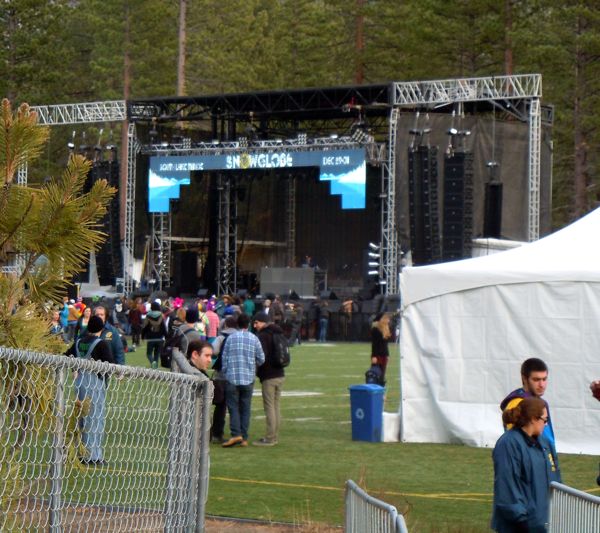
What did you think of SnowGlobe?

South Lake Tahoe officials want to know what people thought of the SnowGlobe Music Festival.

The survey is online at the city’s website.

The Dec. 29-31 SnowGlobe music event was definitely controversial. Photo/LTN

Other opportunities to voice your opinion are in person at the South Lake Tahoe City Council meeting Jan. 3 at 9am. Public comments on non-agenda items — which includes SnowGlobe — are taken at the beginning of the meeting.

City officials are also reading Lake Tahoe News, so comments may be left on the various LTN stories; or write and/or call the council or city official of choice.