NHP beefing up patrol in crosswalk zones

In light of the recent accidents involving pedestrians who have been struck and killed, and the fact that pedestrian-related crashes in Douglas, Lyon and Washoe counties were higher in 2011 compared to the previous year, troopers from the Nevada Highway Patrol will be concentrating their enforcement efforts on pedestrian and crosswalk violations over the next several weeks.

Troopers will be at various intersections in Northern Nevada specifically looking for drivers who do not yield for pedestrians at crosswalks as well as identifying pedestrians who choose to cross a street unsafely or by jaywalking.

In an effort to illustrate awareness, the NHP is issuing these safety reminders to motorists and pedestrians:

For pedestrians:

• Be certain to only cross a street or highway in a marked crosswalk

• Make sure that each driver approaching the intersection is yielding or has stopped for you before entering the street or crossing the entire roadway — especially on multiple-lane roadways

• Even when you have the signal to cross safely, scan both directions of travel and look for moving or approaching vehicles

• Don’t assume that every driver will see you in a crosswalk and be aware of all approaching traffic

• Be extra careful when crossing the road at nighttime and especially when there is little or no lighting.

For motorists:

• Pay attention at all times when operating a motor vehicle with special emphasis near intersections and marked crosswalks for pedestrians who may be crossing the roadway

• If you notice a vehicle in the adjacent or opposing lane slow down or stop, ask yourself why? There may be a pedestrian crossing the street that you don’t see or another type of roadway hazard not immediately visible

• When making a left or right turn at an intersection, always check to be certain that no one is attempting to cross the road adjacent to you

• Do not change lanes near an intersection where a motorist immediately in front of you is slowing down or stopped.

This list of 2011 crashes is provided by the NHP.


Lawsuit prevents Homewood from starting development

By Kathryn Reed

Homewood Mountain Resort’s desire to reinvent the West Shore ski resort is an “ill-conceived, inadequately studied, and environmentally-disruptive development project … threatening one of our nation’s iconic landscapes.”

At least that is what documents filed Jan. 5 in U.S. District Court in Sacramento say.

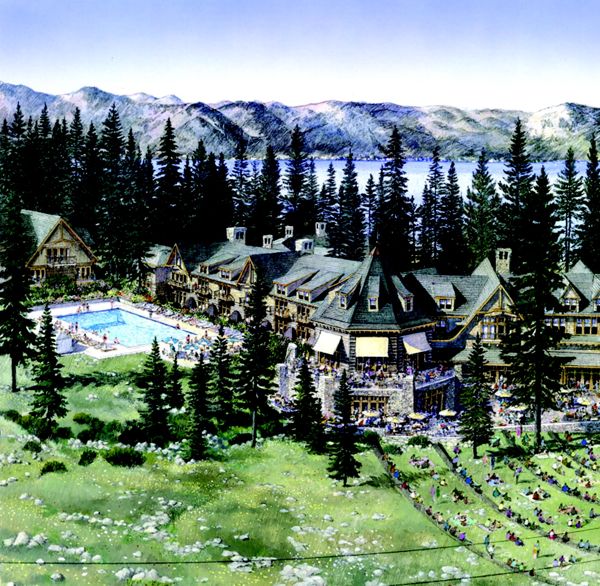
An artist's rendering of what Homewood's owners would like it to become.

Earthjustice on behalf of Friends of the West Shore and Tahoe Sierra Club is suing to stop the project that was approved Dec. 14 by the Tahoe Regional Planning Agency Governing Board.

Defendants in the suit are TRPA, Placer County, Placer County Board of Supervisors, Homewood Village Resorts and JMA Ventures. The latter is the San Francisco-based company that owns the ski area.

While approval of the project has been unanimous in every vote taken by everybody that had a say in the development and master plan for the ski resort, it has always been controversial.

Today the area is a throwback to years gone by. The resort, when one drives by on Highway 89, looks like something a Warren Miller movie would show to reflect skiing of yesteryear. What Art Chapman, JMA’s CEO, envisions is a five-star resort.

There is no doubt the look, feel and type of visitor would dramatically change. That’s what Chapman wants to happen. It’s not what the Friends of the West Shore want.

“We welcome a revitalized Homewood Ski Area, but the current project is simply too large,” Mason Overstreet, conservation director of Friends of the West Shore, said in a statement. “A smaller resort in scale with the surrounding community would still bring in hundreds of jobs for residents and millions of dollars in revenue. We must be careful not to destroy the beauty that attracts visitors to Lake Tahoe in the first place.”

The plaintiffs want the environmental documents to be declared invalid.

The lawsuit says, “… the Environmental Impact Report and Environmental Impact Study (EIR-EIS) prepared jointly by TRPA and the county failed to properly study and mitigate the project’s effects on traffic, air quality, water quality, noise, scenic resources, groundwater, and soil conservation, in violation of the California Environmental Quality Act (CEQA) and the Compact. Thus, the Homewood amendments and project stand to make matters worse.”

Joanne Marchetta, TRPA executive director, said in a statement, “It’s unfortunate that this lawsuit could divide the community at a time when we need to work together more than ever. TRPA continues to believe that lawsuits are not the best path to sustainability in the Tahoe basin.”

A major issue for challengers is TRPA’s allowing amendments to its codes – essentially disregarding the current Regional Plan, which in effect is the bible by which TRPA is supposed to live by – and by de facto, everyone in the basin’s law book.

The 1987 Regional Plan was supposed to be updated in 2007. The current date for expected approval is December this year, with draft environmental documents associated with it released in March.

Some of the changes expected in the Regional Plan Update – like to the height and density rules – are being incorporated into projects through amendments. Such amendments were part of the Boulder Bay project that passed TRPA muster last April and does not face a legal challenge.

The Governing Board and TRPA staff believe the project would be a boon for the environment. That was the overriding reason for approving the development.


USFS control burn project in Meyers

U.S. Forest Service fuels management crews are scheduled to resume prescribed fire operations on the South Shore Jan. 6.

Operations will take place in the Pioneer Trail-Highway 50 area near Meyers.

Fuels Management crews expect to complete 1 acre, which will be extinguished at the end of the crew shift.

Residents and visitors can expect to see smoke from this prescribed fire project area. Smoke may be visible near the intersection of Highway 50 and Pioneer Trail. The Forest Service strives to minimize the impacts of smoke on local communities.

Smoke-sensitive residents should consider staying indoors and keeping doors, windows and outside vents closed. To directly receive prescribed fire updates, send an email to pa_ltbmu@fs.fed.us.

Forest Service staff will post road signs around areas affected by prescribed fire, and update the local fire information line at (530) 543.2600, No. 6.


Ski resorts, USFS battling over water rights

By Jason Blevins, ESPN.com

Ski resorts are feuding with their Forest Service landlord over a water rights clause in updated ski area permitting regulations that keeps water rights tied to the land, not the resort operator.

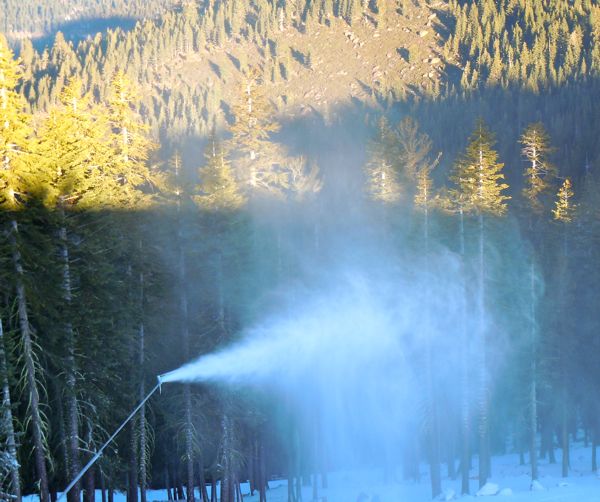
Snowmaking is what's allowing resorts in the Lake Tahoe area to be open this season. Photo/LTN

After intense lobbying — which included stern letters from a host of congressman and senators — last week the Forest Service rebuffed the calls for a moratorium and issued the new rule as an 18-month moratorium. The resort industry, led by the 121-resort National Ski Areas Association, answered with a promise to sue the agency, which hosts nearly 90 percent of all U.S. ski areas.

“This has to do with water rights in general and how water rights are treated,” said Michael Berry, president of the NSAA. “We believe they have crossed the rubicon and this has the potential to be very, very impactful. We have no guarantee that they will continue to use the water for purposes of ski area business.”

Since 2004, the Forest Service has co-owned water rights secured by ski areas operating on federal land. Before that, under the 1986 National Forest Ski Area Permit Act, ski area water rights on public land were owned by the federal government. So really, said Jim Pena, acting chief of the Forest Service, “this isn’t new.”

Read the whole story


Lack of snow not stopping Olympic Heritage week on West Shore

By Barbara Barte Osborn, Sacramento Bee

In 1960, with the sports world poised to show up on their doorstep, organizers of the Winter Olympics in Squaw Valley grew increasingly nervous through an unusually dry January.

“There was virtually no snow at Squaw Valley, and they brought in tribal snow-dancers and cloud-seeders,” said Mark McLaughlin, a noted Tahoe historian.

But the weather changed in early February, bathing the area in snow, and then brilliant sunshine, to reveal a stunningly beautiful winter landscape. Organizers of Olympic Heritage Week – a series of skiing events that commemorate the games 52 years ago – aren’t likely to be so lucky.

With events beginning Saturday and running through Jan. 15, there is no snow on the ground and none is forecast.

Read the whole story


Brown proposes $4.2 billion in cuts to California budget

By Kevin Yamamura, Sacramento Bee

Gov. Jerry Brown proposed Thursday slashing nearly $1.4 billion in welfare and child care aid for the poor while holding voters liable for $5 billion in education funding with a November tax measure.

The Democratic governor announced his January budget plan this afternoon after his proposal was inadvertently leaked on his Department of Finance website. He estimates the state faces a $9.2 billion general fund deficit through June 2013, which he proposes to bridge with mostly cuts and taxes.

Brown will ask voters to pass a $6.9 billion ballot measure in November that raises taxes on sales and income starting with single filers earning $250,000 a year.

“With the tax program, we will eliminate the budget deficit finally, after years of kicking the can down the road,” Brown said.

With or without the taxes, Brown is calling for a base level of $4.2 billion in cuts, including the $946 million to welfare-to-work and $446 million to subsidized child care. He also would save $842 million in Medi-Cal by moving recipients into managed care plans.

Read the whole story


Tahoe authors to speak at LTCC

Lake Tahoe authors Jeremy Evans and Scott Lankford are next up in Lake Tahoe Community College’s Writers Series.

The two will talk about their recent books on Jan. 25 at 8pm in the LTCC library. This event is free and open to the public. Books will be available for purchase.

Evans will talk about “In Search of Powder”, while Lankford will speak about his book “Tahoe Beneath the Surface”.


30th anniversary party for Tahoe publication

The Weekly magazine is celebrating its 30th anniversary in 2012 with an exhibit of 30 years of Weekly covers at North Tahoe Arts Center in Tahoe City through Feb. 27.

An Opening Reception is Jan. 13 from 5 to 7pm at the Arts Center, and everyone is invited to attend.

The exhibit will feature 30 years of covers, with one cover picked from every year of publication from its inception in 1982. Covers feature winter and summer recreation, local faces, local events and a great look at Tahoe and Truckee for the past 30 years.

The highlight of the exhibit is the first edition, which published on Feb. 18, 1982, as North Tahoe Week. The first edition was 12 pages and featured a photograph by Vance Fox of a skier cliff jumping near the horse trails in Squaw Valley.

The Weekly is celebrating its 30th year with a redesign of the magazine, debuting on Jan. 12, along with a special 30th anniversary edition on Feb. 9. There will be a 30th anniversary party on Feb. 11, location TBD, in which everyone will be invited to help celebrate the 30th anniversary.

For details, email editor@tahoethisweek.com.


Avalanche awareness

Alpenglow Sports in Tahoe City has partnered with outdoor industry leader Backcountry Access to provide a free community avalanche awareness event on Jan. 25 at 6:30pm.

The event will help attendees better understand avalanche beacon function and the advancements of these vital backcountry tools over the past few years. The evening will last two-plus hours and will consist of an indoor and outdoor component. The majority of the evening will be educational and field-testing.

Indoor topics will include Tracker beacons, concentric probing, strategic shoveling, and Float Airbag technology. The outdoor component will cover multiple burial scenarios using the Tracker “Special” mode, Micro-Search Strip, and Three Circle searching theories.

Bring your favorite beacon, a headlamp and appropriate clothing for cold weather.

Food and drink provided. Discounts will be available on Backcountry Access beacons.

Call Alpenglow Sports at (530) 583.6917 with questions.


California nonprofit looking to turn plastic pollution into fuel

By Amy E. West, Santa Cruz Sentinel

Plying through the infamous “Garbage Patch” in the North Pacific, a solar-powered catamaran gobbles up fishing nets, plastic bags and Styrofoam blocks, and then shoves them into a high-temperature cooker to convert the litter to fuel. This fuel propels the boat farther to devour more plastic – until every large piece has been scooped up.

It sounds like an environmentalist’s dream. But it’s the ambitious mission of the Santa Cruz nonprofit Clean Oceans Project, which six months ago teamed up with a Japanese manufacturer and a San Jose distributor, E-N-ergy, to bring plastic-to-fuel technology to the Monterey Bay.

The project was founded three years ago by ocean conservationists Nick Drobac and Jim “Homer” Holm, who hope to convince investors and donors of the feasibility of cleaning up plastic pollution and creating fuel at the same time. The proposed solution addresses one of the world’s biggest environmental problems: A non-biodegradable material that clogs landfills and waterways, strangles wildlife and contaminates food sources.

“This problem is enormous,” Drobac said, “and it grows every single day.”

Drobac and Holm say they are sold on technology from Blest Co. Ltd. that uses a process called pyrolysis. Using a 110-pound Blest demonstration model, the oceans project recently illustrated how a few pounds of roadside plastic litter can be fed into the pressurized oxygen-free oven and heated to 800 degrees Fahrenheit. This liquefies the plastic, converts it to a gas, which then condenses to form a crude oil mixture of gasoline, diesel, kerosene and heavy oil.

The components can be further refined to road fuels or used directly in boilers as heating oil, in generators, or some diesel vehicles that already use biodiesel, said E-N-ergy’s Jackie Ayzenberg. The end products consist of water vapor, inert char – which can be reused as fuel – and negligible amounts of carbon dioxide. On the smaller models, “the amount of carbon dioxide is less than one adult breathing,” said Kiyoshi Nakajima, creator of the Blest machine.

Various plastic resin types produce differing amounts of fuel. For instance, a plastic water bottle is not a good fuel source, but Styrofoam packaging is. Plastic weighing as much as a gallon of milk – roughly seven to 10 pounds – generates a gallon of fuel.

Read the whole story