Nevada in jeopardy of losing federal highway money

By Sean Whaley, Nevada News Bureau

CARSON CITY — Nevada is one of several states that will not make a Jan. 30 federal deadline to implement a newly mandated safety rule to ensure truck drivers have proof they are medically safe to drive, potentially putting federal highway dollars at risk.

The new rule from the Federal Motor Carrier Safety Administration (FMCS) requires state motor vehicle departments across the country to create a new database that will be linked nationally to keep track of the proof truck drivers need to show they are safe to drive.

Failure to meet the deadline could potentially put 5 percent of a state’s federal highway funding at risk in the first year, and 10 percent thereafter. But states that move forward with a plan for implementation are expected to avoid any penalties if they complete the project by 2014.

Nevada Department of Transportation spokesman Scott Magruder said the state would be at risk for about $10 million in lost federal road funds if a 5 percent penalty was imposed.

Tom Jacobs, a spokesman for the Nevada Department of Motor Vehicles, said the agency is working to meet the new mandate but is not expected to do so until the end of 2013.

“We estimate this massive project will take an additional 2,500 computer programming hours to complete,” he said.

A spokeswoman for FMCS who spoke on background said penalties are not expected to be imposed right away. States not in compliance by Jan. 30 will get a letter informing them of their status, after which they will have through Sept. 30, 2013, to get their databases operational, she said.

After that point, penalties could be imposed, the spokeswoman said.

The FMCS plans to continue a current card-carrying requirement for truck drivers through Jan. 30, 2014.

The new rule was finalized on Jan. 30, 2009. Three states currently have their databases operational.

Nevada truck drivers are now required to carry medical cards on their persons to show proof of medical health to drive. The new database rule imposed by the federal government will replace the need for truck drivers to carry the cards.

While it may be a challenge for the Nevada DMV to implement, Paul Enos, chief executive officer of the Nevada Motor Transport Association, said the requirement is not viewed by the industry as an example of excessive regulation.

“Our guys are already required to carry medical cards,” he said. “They are required to have them with them all the time. Really I think where the hardship would be would be more with DMV and their programming and implementing it.

“They want to make sure that when you are driving an 80,000-pound vehicle that you are physically fit and able to do so,” Enos said. “So the thought would be, if they have this in a database, then everybody’s getting checked, it’s not just a spot check on the road or during a compliance review. And that would then eliminate the need for a driver to carry that card with them when they are on the road.”

Jacobs said the agency plans to use a federal grant worth a little more than $400,000 to hire contract programmers to re-customize its database to comply with the new requirement. The grant is expected to cover the cost of the project but that remains undetermined at this point, he said.

Jacobs said the agency has every intention of making the extended deadline: “We can’t take the risk of losing federal dollars. Not at this point.”
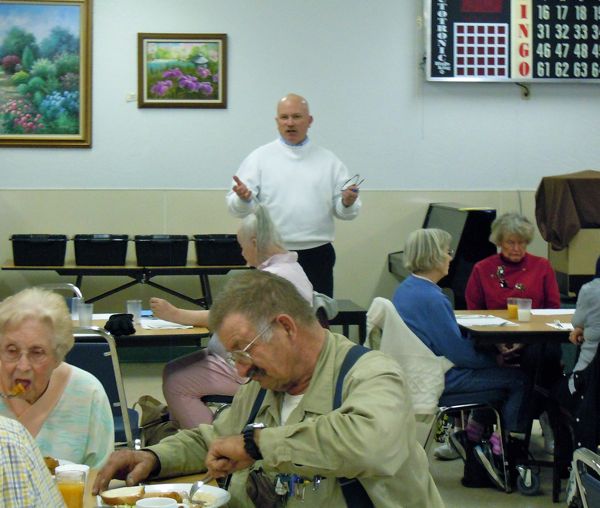


Seniors, mental health clients to share building in S. Tahoe

By Kathryn Reed

Seniors and some mental health patients are likely going to share the same building this spring in South Lake Tahoe. This co-mingling of usually different populations has some people concerned.

Erik Olsen, one of the seniors who spoke against the proposal on Thursday, told Lake Tahoe News seniors should have their own place to socialize and that’s it is not up to him to find a solution, it’s government’s problem.

Community Development Director Stan Sherer explains to seniors Jan. 5 how the city and county need to save money, pointing to how a year ago the city’s rec staff had seven employees and now it has one. Photo/Kathryn Reed

The problem governments have – specifically the city of South Lake Tahoe and El Dorado County – is the lack of money to keep operating as they have been. That is why they are consolidating resources. In this case the main resource is a building.

The county owns the senior center building, while the city runs the programs for the seniors. With the county no longer able to pay to lease some of the buildings it has been within the city limits that it uses to serve Lake Tahoe Basin residents, it is moving some operations to the county-owned senior building to lessen its financial burden.

Closing the county office at 1900 Lake Tahoe Blvd. and other changes is a savings of about $190,000 a year for the county.

The county operating out of the senior center means the city has help with utility and maintenance costs. It also will allow an “official” to be on site at all hours when the building is open.

The Board of Supervisors is scheduled to discuss and vote on the changes at the Jan. 24 meeting. The City Council is likely to take up the issue Feb. 7.

Olsen, who is a former national president of AARP, questions how the center can change what it is used for when some of the funding to upgrade the facility was from the Older Americans Act and other grants.

George Regan thinks mental health should look at using the library’s reading room.

City and county officials have been meeting with seniors for months. The latest gathering was Jan. 5 with Community Development Director Stan Sherer explaining the city’s point-of-view and answering questions. The week before it was Supervisor Norma Santiago addressing the lunch crowd.

“This is purely a fiscal crisis we are trying to address in our community,” Sherer said Thursday. “Change is difficult. We didn’t do this on a whim.”

The main change is the county will take over the room being used for senior exercise classes for one-on-one sessions with mental health clients. The room has a separate entrance so the newcomers don’t have to access the main senior center.

Sherer reiterated services for seniors are not being cut. Figuring out a solution to keep the exercise classes going is still being worked out.

The proposal is mental health workers will be in that room Monday-Thursday, 1-4pm.

Ann Snyder, a senior, has been acting as a liaison to get information to seniors. She addressed her peers first.

“The clientele is characterized as functional,” Snyder said of the mental health patients who will have sessions at the senior center. “The clients will mostly be bused to the center so it will not impact parking.”

Sherer also said employees will be parking at the recreation center and more disabled parking will be marked at the senior center to help with congestion.

Also sharing the site will be the county Veterans Administration. These people will use the Annex Meeting Room, which is to the left of the dining area. This should mean expanded services for veterans on the South Shore.

Changes could happen in February, but March is a more likely scenario.


Fewer schools keeping librarians on staff

By Eleanor Yang Yu, California Watch

Fewer than 1 out of 4 schools in California is staffed with a credentialed librarian, according to the state Department of Education.

Recent figures compiled by the department show there are about 900 school librarians in the state – that’s down from more than 1,100 two years ago.

From Los Angeles to San Mateo and Fullerton, school districts have cut librarian positions this year to cope with state budget cuts. Increasing numbers of schools are splitting one librarian between multiple campuses or relying on clerical aids or parent volunteers to keep the doors open.

Library advocates say students are the ones harmed when they don’t have trained librarians who can teach research techniques and turn them on to a love of reading. Others question whether technological advances and the ease of conducting research online have made librarians less essential.

Diane Alexander took early retirement last year because she thought she would have been spread too thin as the sole librarian for three high schools.

“If you have that many students to serve, you’re not really serving them,” said Alexander, who also is president of the California School Library Association. Her district, the Liberty Union High School District in Contra Costa County, cut positions to one librarian and three clerks to manage three high school libraries. “They expected me to be that person, but I didn’t feel like I could do an adequate job. It was so disturbing.”

But in this austere period, some wonder whether schools can afford to retain librarians as teachers and nurses are laid off.

“You have to make choices sometimes, and the importance of librarians is a bit less than it used to be,” said Ze’ev Wurman, a Silicon Valley executive who participated in the development of California education standards and served as a policy adviser for the U.S. Department of Education. “In the elementary grades especially, librarians are essentially teachers’ aides, doing a variety of things that have little to do with books or literacy, per se.”

Teachers, not librarians, are the ones who have to respond to research questions that arise in class, Wurman argued in a recent New York Times opinion piece. He believes that access to books is not a problem, citing a 2009 report [PDF] by the U.S. Department of Education that showed schools that received grants for their libraries showed almost no increase in the amount of materials checked out.

In California, school librarians are called teacher-librarians because they must earn both credentials. Alexander said she helped develop lessons with teachers and hosted classes in the library virtually every class period. Sometimes, she’d host two classes at once.

When teaching an English class about research projects, she’d often pull contemporary books with common themes, show students how to use databases, and explain copyright issues and source citing. When she had a spare minute, she would suggest good books to challenge a voracious reader or reach out to a struggling student.

“We’re the ones who know the current books,” Alexander said. “It can make a huge difference if you can hook a kid onto reading.”

The benefits of a trained librarian go beyond helping with reading and research, said Barbara Jeffus, the state Department of Education’s school librarian consultant.

“There is a body of research growing every day that if you have a teacher-librarian working with classroom teachers, student achievement is higher,” she said.

Jeffus pointed to a paper published in 2008 by a University of North Texas researcher who found a correlation between California schools with devoted librarians and students with higher test scores. The study controlled for some income-related factors, including the level of education of the students’ parents and the proportion of students receiving free and reduced-price lunch. The strongest pattern was found in high school students, where higher test scores correlated with the extent of the library services offered.

Some districts have been able to maintain funding for libraries, typically by passing flat-rate parcel taxes. But as a whole, California ranks last in the country for its student-to-librarian ratio, according to the state Department of Education.

So will it get to the point that California school libraries will shut their doors? Jeffus doesn’t think so.

“If they evolve, they’ll survive,” she said. “Some librarians are using every possible technological device with students. … These are pretty exciting times in school libraries and public libraries.”


Federal money to help counties administer health care to low-income residents

By Darrell Smith, Sacramento Bee

Thousands of the north state’s rural poor, including residents of the greater Sacramento area, will be able to access medical care in 2012 after more than 30 counties received federal approval and funding to expand their indigent health coverage.

The County Medical Services Program, or CMSP, a group of 34 mostly north state counties, received the green light to cover an additional 30,000 uninsured, low-income adults through Path2Health, a new indigent care program that launched Jan. 1.

Created as a prelude to federal health reform, Path2Health provides free health coverage for medically necessary services to uninsured adults in the 34-county network who are at or below 100 percent of the poverty line – about $10,890 for a single person – and who do not qualify for Medi-Cal. It is one of a number of low-income health programs, or LIHPs, across the state that will “build a foundation for when health reform takes over” in 2014, said Lee Kemper, executive director of CMSP’s governing board.

“We’re starting to make it possible to make people eligible now,” Kemper said. “This is basically a network that will be a bridge leading to new coverage. This will make it possible for counties to implement health reform early.”

The federal government will match each dollar the 34 counties spend on Path2Health, but officials did not know how much that would be. CMSP will serve 90,000 low-income adults by the end of 2013, Kemper said.

Under the Affordable Care Act, low-income adults covered by LIHPs such as Path2Health will transition to either Medi-Cal or the state’s Health Benefit Exchange in 2014.

The LIHPs go further than the indigent care programs that counties have long run under Medi-Cal. The LIHPs are managed-care plans with established health benefits and guidelines on coverage and access to basic and specialty care.

Rural administrators in CMSP say the federal matching dollars will help their counties – El Dorado, Nevada, Sutter and Yuba among them – to extend care to more of their neediest residents.

Read the whole story


Avalanche awareness training in Tahoe City

Alpenglow Sports in Tahoe City has partnered with outdoor industry leader Backcountry Access to provide a free community avalanche awareness event on Jan. 25 at 6:30pm.

The event will help attendees better understand avalanche beacon function and the advancements of these vital backcountry tools over the past few years. The evening will last two-plus hours and will consist of an indoor and outdoor component. The majority of the evening will be educational and field-testing.

Indoor topics will include Tracker beacons, concentric probing, strategic shoveling, and Float Airbag technology. The outdoor component will cover multiple burial scenarios using the Tracker “Special” mode, Micro-Search Strip, and Three Circle searching theories.

Bring your favorite beacon, a headlamp and appropriate clothing for cold weather.

Food and drink provided. Discounts will be available on Backcountry Access beacons.

Call Alpenglow Sports at (530) 583.6917 with questions.


Kinder Cup enters its 12th season

The Heavenly Ski and Snowboard Foundation will kick-off the 12th annual Kinder Kup Race Series at Heavenly Mountain Resort on Jan. 22.

The 8am to 2pm event is open to all skiers and snowboarders age 6 and younger. The Kinder Kup series is designed to introduce young athletes to competition in a friendly environment. No previous race experience necessary and all abilities are welcome.

Entry is $20 and includes a World Cup only competitor lift ticket if needed.

The Kinder Kup is a three event series with races Jan. 22, Feb. 26 and March 25. All races take place at Heavenly Mountain Resort on the World Cup chairlift located at the California base across from the Heavenly Tram.

Registration forms are online. Advance registration is recommended.

On-site registration is available the morning of the event at the Heavenly Foundation building from 8am to 9am. Practice begins at 9am, each competitor is allowed two practice runs; the race starts at 10am.


Plein air workshop: Painting Winter’s Whites

Watercolorists will explore with artist Joan Hoffman the use of white — when to leave the white paper to make a statement and when to tone the paper an off-white to make the snow glow like Monet’s snow scenes.

The workshop is at Sorensen’s Resort in Hope Valley.

To sign up, call 800.423.9949.

The introduction is Jan. 23, 3-4pm; with classes on Jan. 24. and Jan. 25 from 9am-noon and 1-4pm.


Workshops to be taught by organic farming expert

Organic farming expert Eliot Coleman is coming to Northern Nevada.

Coleman, a bestselling author, researcher and farmer, is putting on a two-day workshop through Western Nevada College Specialty Crop Institute Feb. 11-12.

“Four Season Farming with Eliot Coleman” meets Feb. 11 from 9am-3:30pm at the Reno High School theater, 395 Booth St. The workshop will focus on season extension practices for small farms. Cost is $75 before Jan. 27, and $85 afterward. Lunch is included.

Two additional 90-minute workshops will be offered Feb. 12 at Rail City Garden Center, 1720 Brierley Way, Sparks. Session 1 is 10:30am-noon, and Session 2 is 1:30-3pm.

Cost per session is $45 before Jan. 27 and $50 afterward. They will focus on season extension practices for the home gardener, including how to use portable tunnels for the home garden. Each workshop will cover different topics, and participants can choose one or both.

Registration is required for all workshops as enrollment is limited.

Coleman has written several bestselling books, including “The New Organic Grower”, “Four Season Harvest and the Winter Harvest Handbook”. Coleman has been farming for more than 40 years. He and his wife own and operate Four Season Farm, an experimental market garden in Harborside, Maine.

For more information or to register, contact Ann Louhela at (775) 351.2551 or louhelaa@wnc.edu.


S. Tahoe sign, snow ordinances presentation

A presentation on South Lake Tahoe’s sign and snow ordinances at City Council chambers at Lake Tahoe Airport on Jan. 12 at 6:30pm.

This is a South Tahoe Chamber of Commerce event.


Synthetic drug presentation

South Tahoe Chamber of Commerce lunch at Pizza Hut from noon-1pm features an educational presentation by police Officer Rebecca Inman on Bath Salts and Spice, a dangerous new threat to community and young people.

Lunch is self-pay, public welcome.