3 El Dorado County residents survive cruise ship accident

By Denny Walsh, Sacramento Bee

The final leg of a European vacation ended abruptly early Saturday morning for three El Dorado County residents when the Costa Concordia cruise ship ran aground and tipped on its side off the Tuscany coast.

Adam and Joanne Lynch of Pollock Pines and Phyllis Egan of Placerville were unhurt during what they described to Joanne Lynch’s sister, Melody Rainwater, as a chaotic and somewhat unnerving experience.

Rainwater called the Bee to share news of her family’s narrow escape.

Egan and the Lynches did not return messages left by the Bee at their hotel in Rome.

“Their cabin was on the dry side, and they were able to get out pretty easily,” Rainwater said Joanne Lynch told her. Her sister telephoned from the U.S. Embassy in Rome to assure Rainwater they were safe. In a news release, embassy staff estimated that as many as 130 Americans were on board the Costa Concordia.

Like many of the other 4,231 passengers and crew, the El Dorado County trio spent the night on the tiny island of Giglio, where they took shelter in a church.

Read the whole story


Mardi Gras event benefits Austin’s House

The fourth annual Mardi Gras Magic Dinner & Dance to benefit Austin’s House is Feb. 17 at the Carson Valley Inn. This fundraiser recreates the party atmosphere of Bourbon Street in New Orleans on Fat Tuesday with food, music, dancing, raffle prizes and a grand prize drawing for a trip to The Big Easy.

The evening starts at 6pm with a cocktail hour. Then feast on a Cajun buffet dinner.

Dancing music is provided by Fabrizio.

Tickets are $50. Only 200 tickets will be sold. Call Austin’s House at (775) 267.6711 for tickets.

Austin’s House is the only emergency children’s shelter in rural Northern Nevada. Austin’s House provides services and care for up to 10 children from infants to age 18.


Lava Cap Winery redesigns logo, label

Lava Cap Winery of El Dorado County has a new logo and label design, with an updated website coming soon.

“The classic, timeless look and feel of the new brand image not only evokes the winery’s heritage, but also indicates the quality of the wine handcrafted by the Jones family,” Shelley Mitchell, spokeswoman for the winery, said.

The new label for Lava Cap’s premium varietal wines feature an illustration of the winery and highlights the mountainous El Dorado appellation. To create a clear distinction for Lava Cap’s blended wines, another new label design features a colorful, modern illustration of the unique mountain vineyards near the historic American River.

Explaining the thinking behind their new brand image, Tom Jones, Lava Cap’s winemaker since the winery’s inception, in a press release said: “Our wines are a union between classic and modern, casual and elegant. We feel our new brand image showcases our style and passion. The new labels also underscore our winemaking heritage.”

Consumers will begin to see the new labels on shelves and in restaurants this month.


RAOK: A grateful sister

Carole Taylor is Lake Tahoe News’ Random Acts of Kindness winner for today. She was nominated by her sister, Ruth, for everything she has helped her with.

Alpen Sierra Coffee will be making her mornings better by rewarding her with 1 pound of coffee.

Random Acts of Kindness is Lake Tahoe News’ way of getting people to pause, to pay attention to all the good there is out there. We want to hear about the kindness you have received, witnessed or given. All you have to do is jot a comment at the end of story. Then you will be in the running for a prize donate by one of the many kind businesses in Lake Tahoe.

People may write in multiple days. The promotion is going on throughout January. To read previous RAOK stories go to the Random Acts of Kindness tab at the top of the page.

There are a few rules associated with Random Acts of Kindness. If you want to read them, check out this story.

Be kind!


Nevada trying to protect its tobacco payments

By Sean Whaley, Nevada News Bureau

CARSON CITY – A state panel this week supported a request from the Department of Taxation for $260,000 to hire a team of auditors to track cigarette sales to protect a $40 million a year payment to Nevada from the nation’s major tobacco companies.

As much as $360 million paid to the state beginning in 2003 is at risk as Nevada engages in arbitration over the annual payments made by the nation’s major tobacco companies as part of the 1998 Master Settlement Agreement (MSA), said William Chisel, director of the Tax Department.

“The stakes for the arbitration are high,” he said. “The risk of losing substantial amounts of money increases over the years if we do not institute this team.”

The tobacco payments help fund the Gov. Kenny Guinn Millennium Scholarship for eligible Nevada high school graduates, among other programs.

The Board of Examiners, made up of Gov. Brian Sandoval, Attorney General Catherine Cortez Masto and Secretary of State Ross Miller, approved the request for the funding from the Legislature’s contingency fund to establish the three-person enforcement unit.

Lawmakers who serve on the Senate and Assembly money committees will meet as the Interim Finance Committee Feb. 9 to consider the request.

Sandoval asked Chisel if the request should have been submitted to the 2011 Legislature so tobacco funding could have been used to fund the unit. The Attorney General’s Office said the funding from the master settlement agreement has historically funded its oversight of the tobacco agreement, but that the Tax Department has not been funded in this way.

Sandoval said the enforcement unit costs should be built into the next budget with tobacco funds identified as the funding source.

Chisel said it is important for the state to monitor the sales of cigarettes by the smaller tobacco companies that are not part of a master settlement agreement.

As part of the MSA, there is a requirement that these smaller companies set aside a portion of their tobacco sales in an escrow account in an amount proportionate to the payments made to the state by the major tobacco companies. The MSA provides for a reduction of the required annual payments by the major tobacco companies to any state which fails to adequately enforce these laws in a particular calendar year.

Chisel said the team will work to protect the payments that have already been made to the state.

“Well, we’re in arbitration right now with the big tobacco companies and our concern is that we want to track these nonparticipating manufacturers, the ones that did not get involved with the MSA,” he said. “We’re responsible to make sure that they pay into an escrow account of two cents per cigarette. At stake is the $40 million we get each year for the MSA payment.”

Nevada has not tracked these sales and payments before, and doing so would lessen the risk of losing any portion of the MSA payments in the arbitration process, Chisel said.


Opinion: Lack of trust poisons Sacramento politics

By Jon Coupal

The biggest challenge for California Republicans this year will be trusting Democrats.

There’s a lot of loose talk making its way around the halls of the state Capitol these days about Republican irrelevance. Gov. Jerry Brown has made it clear that he is going to bypass the Legislature, where some Republican votes would be needed to increase taxes, and instead push for more taxes via ballot measure.

This strategy follows on the heels of Senate President Pro Tem Darrel Steinberg’s declaration last summer that Democrats will be working without Republicans to increase job growth in California. This is a particularly risky course for Democrats. California’s Democrats have three vulnerabilities:

— Erosion of the quality of public schools;

— Mismanagement of government finances; and

— Inability to foster private sector job creation.

By declaring Republican legislators to be irrelevant, they are assuming full responsibility for fixing the state government’s fiscal health and California’s high unemployment rate, itself the result of the accumulation of decades of Democratic-dominated regulatory and fiscal policies. We will all have to see how well that works out. There’s an old adage that says be careful what you wish for. Cooler heads among Democratic leaders might question whether it’s such a good idea to take on full accountability for California’s economic future.

Jon Coupal is the president of the Howard Jarvis Taxpayers Association.

Read the whole story


Seismic deficiencies require changes to Fanny Bridge

By Kathryn Reed

STATELINE – News that a main sewer line may possibly run under where the intersection of highways 28 and 89 in Tahoe City could be relocated came as a surprise to transportation officials.

Marcia Beals, general manager for the Tahoe-Truckee Sanitation Agency, dropped this piece of information on the Advisory Planning Commission of the Tahoe Regional Planning Agency at the Jan. 11 meeting.

She was one of nine people to share her views and concerns about altering the highway configuration to accommodate Fanny Bridge. Fanny Bridge has been deemed seismically unsafe for a state highway.
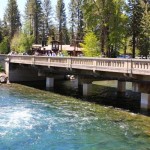
Fanny Bridge in Tahoe City does not meet seismic standards.

“We’ve looked at relocation concepts and have difficulties in how that could be done,” Beals told the board.

Jeff Smith, a consulting engineer for the sewer district, pointed out there could be problems with manhole covers, the weight from the road placed on the lines, and if a rupture occurred during construction what that would mean to contaminating the Truckee River.

After the meeting Tahoe Transportation District officials spoke briefly with Beals and Smith, with the plan to have more in depth discussions soon.

At this stage, all lines on a map are rough and no decisions about a route have been made.

Originally five alternatives were proposed by the Tahoe Transportation District to reroute highway traffic from this busy intersection and off the bridge that crosses the Truckee River.

Two other alternatives were introduced at the APC meeting from comments brought forward at the two scoping meetings in December.

“There’s a lot of conflict in that area,” Alfred Knotts, TTD planner, told the APC board.

One alternative is the standard do nothing. That alternative could bring load restrictions for trucks crossing it – which in turn could affect commerce along the West Shore.

Some alternatives have a section of Highway 89 running along the lake becoming a road Placer County would own, with a bypass going through 64 acres owned by the U.S. Forest Service to the west to connect with Highway 89 farther west of the current Y in Tahoe City.

One idea is to not allow any traffic crossing Highway 89. This would create a more pedestrian, bike friendly area.

Another is to build a bigger, more stable bridge.

“A new or improved bridge would reflect that cultural value,” Knotts said.

Roger Kahn, who owns two parcels at the Tahoe City Y, would have preferred TTD staff met with him and others whose property are likely to be affected.

He said closing the road would have a huge economic impact at that end of Tahoe City. The Bank of the West branch manager echoed that concern.

Leigh Cullen said she’s concerned if Placer County is responsible for Fanny Bridge that necessary repairs won’t be made.

Richard Courcier took issue with studies that say part of the project is designed to relieve congestion, when in fact he said it’s only busy in July and August at the Y. He also said having two roads – not closing off the bridge – would be better to help on high traffic days.

He owns the rafting company that operates on the Truckee River. Courcier said shutting Fanny Bridge off to vehicle traffic would create more vehicle miles traveled by anyone coming up the West Shore wanting to go into the heart of Tahoe City.

The APC board took no action last week.

Comments on the Fanny Bridge project are being taken until Jan. 30. Documents are on TTD’s website.

All of the alternatives will be studied in the environmental impact statement, environmental impact report, and environmental assessment. It’s expected a draft of the three environmental documents will be released in the fall for a 60-day comment period. The final EIS/EIS/EA could come out in the first quarter of 2013. Project approval would be on target by summer 2013, with construction possible in 2015.




Jazz pianist finds many paths for musical harmony

By Geralda Miller, Reno Gazette-Journal

Bill Hecht is an architect of sound.

He’s a jazz pianist who entertained audiences for years with the Harrah’s Reno house band and now plays with the Reno Jazz Orchestra.

He’s the composer of slot machine music.

For 10 years, he sang baritone with the Reno Philharmonic Chorus. Now, he plays piano and sings with his church choir. During the Christmas holidays, he strolled with the Great Basin Carolers at Squaw Valley USA and Northstar California.

“It’s been about music for a long time now,” the 58-year-old said.

Hecht has improvised in life as easily as he manipulates the chords in a Duke Ellington or Count Basie piece.

“After the melody is stated, you do an improvisation that respects the chords that fit with the melody,” he said. “That’s the only real boundary.”

Hecht’s mother sat him down at the piano at age 6, and he was on his way to mastery.

“She got me the greatest teachers in the Bay Area,” he said. “My classical teacher was trained at Julliard. He had a great feel for working with kids.”

At 14, he switched from classical to jazz. Although formal instruction was important, he got the real taste of jazz when his mother took him to the hot clubs to see many of the greats. He remembers seeing Dave Brubeck, Errol Garner, Miles Davis and Herbie Hancock.

“I think it was the Both/And club where she took me to see Miles Davis, not realizing I wouldn’t be able to get into that club being a minor,” he said. “But Tony Williams, the drummer, was also a minor, so she got me in. I’m a big Herbie fan. When I saw him with Miles, I was hooked.”

With a father who was a physicist and a mother who was a psychologist, Hecht said he attempted classes at the University of California, Berkley but eventually dropped out to tour the country with a band.

In the mid-1970s, the band had a gig on the north shore of Lake Tahoe, and Hecht said he fell in love with the area’s beauty.

“I ended up in Lake Tahoe because, of all the places that we went, that was the most beautiful,” he said. “At the time I thought, ‘Well, I’ll never live in Reno.'”

Read the whole story


Kirkwood gearing up for Freeride Flow Fest

Kirkwood Mountain Resort is hosting the inaugural Freeride Flow Fest on March 16-18.

The three-day event brings together novice and recreational winter athletes with professional athletes, backcountry experts and top industry vendors for clinics, demonstrations, electronic disc jockeys, performances and a whole lot of après ski.

Tickets are on sale online.

Confirmed athletes include: Sage Cattabriga-Alosa, professional big mountain skier; Alison Gannett, leading the KEEN Rippin’ Chix Backcountry Camp and Steeps Clinics; legendary ski pioneer Kent Krietler, as backcountry guide and yoga instructor; Lorenzo Worster, world renowned telemark skier; Hanna Hardaway, two-time Olympian; Brooke Edwards, freeride instructor and Tough Guy Productions event coordinator; Maeve Nevins, backcountry instructor; and Wendy Lautner, published author and backcountry enthusiast.

Clinics focus on backcountry skiing including avalanche and beacon search, alpine, telemark and snowboard freeriding, women’s only clinics, park riding, big air bag jumping and yoga. As well as being a leave no trace earth conscious event, a portion of the proceeds from the festival will go to Protect Our Winters, an environmental center point of the global winter sports community, united towards a common goal of reducing climate change effects on sports and local economies.


Cross country ski event benefits search and rescue team

On March 4 at 9am, cross country ski racers will gather to embark on the 36th annual Great Ski Race.

The Great Ski Race covers 30 kilometers beginning at the Tahoe Cross Country Center in Tahoe City to the Cottonwood Restaurant in Truckee.

Race registration is available online. Prices go up Feb. 16.

The Great Ski Race is the main fundraising event for the Tahoe Nordic Search and Rescue Team, a nonprofit all volunteer organization. Team members, along with community supporters, organize the Great Ski Race, which continues to be one of the largest Nordic ski races west of the Mississippi. Race proceeds are used primarily to purchase equipment for the team and to support winter survival and avalanche education programs sponsored and conducted by the team.

The Great Ski Race has gone from 60 racers being manually timed in 1977, to more than 600 racers with electronic timing in 1985, to more than 800 racers in 2001. In 2005 all records were broken, with 1,109 registered racers, 1029 finishers, and the fastest men’s and women’s times to date. Registration fees: $55 before Feb. 15; $65 Feb. 16-March 3; $100 if registering on race day; and juniors 18 and under are $25. The entry fee buys a pre-race package, T-shirt, refreshments and a hot lunch at the finish, a chance to win numerous prizes, live music and dancing at the finish.