Opinion: Women’s center grateful for toy donations

To the community,

The South Lake Tahoe Women’s Center would like to take a moment to thank Tyler and Cheryl Cannon for their incredible outpouring of generosity this holiday season.

Tyler and Cheryl, along with their friends, donated over 100 new toys to the women’s center. The toys helped bring a brighter holiday to many local children with families affected by violence. The Women’s Center is tremendously grateful for individuals like Tyler and Cheryl, who help to make this community so special.

Emily Peart, South Lake Tahoe Women’s Center development coordinator


League appoints board member as executive director

The League to Save Lake Tahoe board has picked one of its own to take over the organization.

Darcie Goodman-Collins, who has been on the board since 2009, is now the executive director. She has been affiliated with League since 1996 when she was an intern.

Goodman-Collins takes over for Rochelle Nason who abruptly left last fall. The League under Nason’s guidance paved a path to multiple courtrooms in an effort to keep the conservation group’s philosophies at the forefront of all matters concerning development or redevelopment in the Lake Tahoe Basin.

A criticism heard over and over again is the League doesn’t play well with others.

In a prepared statement, the incoming executive director is taking a more tempered approach.

“There are two lessons that I’ll bring with me into this position. The first I learned at Save the Bay. It is that collaboration, both outside and inside the organization, is critical for success. The second I learned as a board member at the League. It is that sound science must play a crucial role in decision-making if we are to make wise choices on how we engage with and preserve our outdoor treasures for all of us,” Goodman-Collins, 32, said.

Goodman-Collins grew up in South Lake Tahoe. She was the community’s youth representative at the first environmental summit when President Bill Clinton was here.

Since then, Goodman-Collins has earned bachelor’s degrees from UC Santa Barbara in biology and political science, and earned her doctorate at UCSB in environmental science and management. Her dissertation was how environmental restoration and science can integrate with community engagement and public policy.

She has worked with the UC Davis Tahoe Environmental Research Center and the Tahoe-Baikal Institute. Most recently she was habitat restoration director at Save the Bay.

Besides being passionate about science, Goodman-Collins likes to water and snow ski, snowshoe, and hike.

She and her husband plan to move to South Lake Tahoe.

— Lake Tahoe News staff report


Smoke on South Shore from control burn outside basin

Smoke visible in the Meyers area that is drifting into the Lake Tahoe Basin is a prescribed burn in the Eldorado National Forest near Iron Mountain Road.

Lake Valley fire officials say there is no reason to be alarmed.


Truckee meeting focuses on aquatic center

The Truckee Donner Recreation and Park District is hosting a public information meeting to present the preliminary plans for the proposed Truckee Aquatic Center.

The architect will be on hand to answer questions and receive input from the public.

The meeting is Jan. 19 at 6:30pm at the Community Recreation Center.

Contact Amanda Oberacker for more information at amanda@tdrpd.com or (530) 582.2361.


Davis, Hight, Teter test out White’s superpipe at Northstar

By Seth Lightcap, ESPN Action Sports

The largest amount snow in Lake Tahoe right now is without a doubt all packed into the walls of the new Shaun White Signature Superpipe at Northstar. After nearly 700 hours of work done by Snow Park Technologies and Northstar, the 22-foot superpipe opened to the public on Dec. 31.

The 500-foot long pipe is notable for several reasons. Not only was it the first halfpipe to open in Tahoe this winter, it is the first-ever 22-foot Tahoe superpipe that will remain open to the public. The massive terrain feature marks the landmark deal Shaun White signed with Vail Resorts last August that made Northstar his home mountain and primary training ground.

White has shown no interest in riding his namesake superpipe yet, however. Rumors flew that he would be at Northstar during the first week of January for a private training session, but for reasons yet to be uncovered, he never showed. Instead it was Burton teammate Danny Davis, who lives less than ten minutes from Northstar, who became the first to score a private session on the new pipe when he took over the two-day training window that White passed up.

“I guess I kinda bit on his session,” laughed Davis, when asked about the opportunity he was given to break in the new pipe. “I called SPT and asked if Shaun was coming and they said ‘No, you want it?’ I was like, ‘Hell yeah!’ We always seem to be poaching his sessions. Thanks for this one Shaun!”

Davis landed tricks during the session that he hadn’t put down since his Olympic-dream-killing back injury two years ago.

Read the whole story


Tahoe Tails — Adoptable Pets in South Lake Tahoe

Jenna is a gentle, affectionate 18-month-old pit bull mix.

She is house trained and has good manners. She likes to play with other dogs, but she would probably be best as the only dog in her new household as she likes to have her people all to herself.

She walks very nicely on her leash, and would learn more good behavior in training classes.

Jenna is spayed, microchipped, and vaccinated. She is at the El Dorado County Animal Services shelter in Meyers, along with many other dogs and cats who are waiting for their new homes.

Call (530) 573.7925 for directions, hours, and other information on adopting a pet.

For spay-neuter assistance for South Tahoe residents, go online.

— Karen Kuentz


Magnet school looking for kindergartners for fall ’12

Lake Tahoe Environmental Science Magnet School in Meyers is taking names for the fall 2012 kindergartners.

Children’s names need to be submitted to the school by March 29 at 3pm to be considered for the April lottery.

Youngsters must be 5 by Nov. 1, 2012, to be entered into this lottery.

The school is located at 1095 East San Bernardino Ave., at the end of Apache, off Highway 50 in Meyers.

For questions, email mtruszewski@ltusd.org.


Opinion: Proper disposal of hot ashes can prevent unwanted fire

By John Poell

Improperly stored fireplace ashes are being blamed for a Christmas Day blaze in Connecticut which killed five people. Locally, several recent fires were started by the same thing.

Fortunately, the Lake Valley Fire Protection District, with the assistance of South Lake Tahoe Fire Department, has been able to control and contain the fires. Discarded fireplace and wood stove ashes are a major cause of house fires every year.

Locally, the Lake Valley Fire Protection District has kicked off a Can Your Ashes campaign.

The campaign is designed to educate residents about the inherent dangers associated with disposing of fireplace, wood stove or barbecue ashes in an improper container or location. Embers, often concealed in what appears to be cold ashes, can remain hot enough to kindle a fire for several days.

In one of the recent blazes, a resident placed hot ashes into a plastic trash container, and then placed the trash can on the back deck. The trash later caught fire, burned through the container, and set the outside wall of the home on fire. The fire finally breached the wall, which ultimately caused major damage throughout the entire structure.

In a second Meyers-area fire, Lake Valley FPD officials found hot ashes from a wood stove were placed into a non-metal container (a 5-gallon plastic construction bucket) and placed in the laundry room. The next morning the residents discovered that the bucket burned a hole through the floor and was still smoldering underneath the subfloor.

According to the most recent National Fire Protection Agency statistics, between 1994 and 1998 improperly discarded ashes caused 9,870 residential structure fires, 32 civilian deaths and 171 civilian injuries. Two residents recently died in their home within the Tahoe basin due to a similar incident with hot ashes.

To safely dispose of ashes, we offer these tips:

• Never store ashes in bags or boxes.

• Place discarded ashes in a heavy metal container, douse with water, and cover with fitted metal lid.

• Store the container outside, away from structures, decks, fences, wood piles or other combustible materials.

• Never use a vacuum cleaner to pick up ashes.

• Contact your local trash collection agency for their disposal recommendations after ashes have cooled and embers are out.

Manufacturers advise that wood stoves should never be completely cleaned of ashes during the burning season. They burn more safely and efficiently with a layer of ash in the bed.

General fire safety tips:

• Make sure you have working smoke alarms on every level of your home, outside each sleeping area, and inside each bedroom. Test them at least once a month.

• Keep anything that can burn at least three feet from space heaters and other heat sources.

• Never leave the kitchen when something is cooking.

• Keep candles and matches out of the reach of children.

• Extinguish all fires, even candles, when you leave the room or go to sleep.

• Remember to call 911 for all fires, no matter how small.

This public safety campaign to Can Your Ashes can save lives and property.

Please contact us at (530) 577.3737 for further information.

John Poell is battalion chief-fire marshal for Lake Valley Fire Protection District.


RAOK: Friendship is about giving back

Carla Zezula knows how to make a friend’s day — just ask Mike Patterson. He nominated Carla for the good deeds she has done while he’s laid up with a broken ankle.

As Lake Tahoe News’ latest Random Acts of Kindness winner, Carla is receiving an hour of digital ad creation through KizmeTech.

What kindness have you witnessed, received or done? Tell us about it and you will be in the running for a prize from one of the many Lake Tahoe businesses that are part of Random Acts of Kindness.

Although the prizes are great, the whole point of RAOK is to promote kindness, recognize it, spread it, say thank you, slow down, maybe even be a little less caustic and critical.

Write as many times as you like. The promotion is going on throughout January. Previous RAOK stories may be accessed via the Random Acts of Kindness tab at the top of the page.

There are a few rules associated with Random Acts of Kindness. If you want to read them, check out this story.


With 38 pipes draining into Lake Tahoe, are lake clarity efforts worth a billion bucks?

By Anne Knowles

Current efforts to improve the clarity of Lake Tahoe are not only a waste of time and money, they are a fraud.

That’s the claim made in the inaugural newsletter of the Tahoe Pipe Club, a secretive coalition of “citizen, business owners, scientists and engineers,” according to its website, who are fed up with what it says is more than a billion dollars squandered on misguided scientific techniques which have failed to reduce lake turbidity.

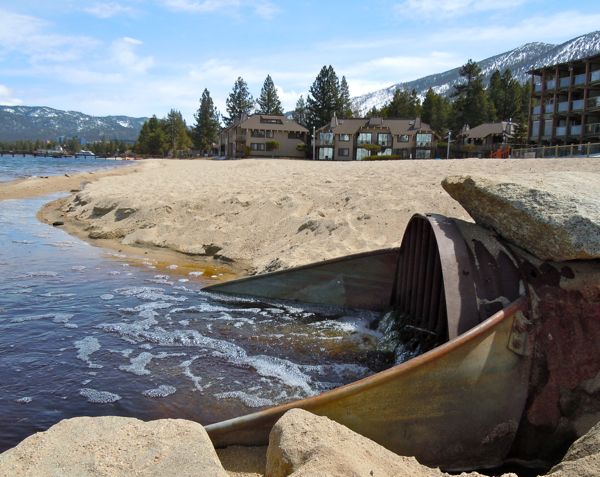
One of 13 drains in South Lake Tahoe that reach Lake Tahoe. Photo/LTN file

In its newsletter and on its website, the group points to “ineffective watershed management practices,” consisting of mechanisms such as road gutters and storm drain systems, often installed in flood-prone areas that do not impact the lake.

“As justification to use lake clarity funds, the public was told that these erosion control and BMP (best management practices) retrofit projects would clean the water which they do not, and these public relations campaigns were the genesis of the hoax which persists still today,” reads the newsletter entitled “Turning Tahoe Black?”

The club advocates using infiltration methods in which stormwater is absorbed into the ground via swales and basins rather than filtered and conveyed back into the lake, and to focus on only those watersheds that have a direct link to the lake in order to best utilize dwindling lake clarity funds.

The newsletter also grades eight clarity projects based on six categories. Only the Montgomery Estates project in South Lake Tahoe received a passing grade and was judged to provide a benefit. The Luther Pass to Meyers project, for example, got an A for urban restoration, a C for hydrologic connectivity, and an F for the remaining criteria.

“The declining water quality and clarity of Lake Tahoe after spending a billion dollars and having ignored what matters most, the urban runoff from highways, streets, roads, and drainage and its discharge directly into Lake Tahoe through culverts and pipes, which account for an estimated 75 percent of the TMDL (total daily maximum load)” spurred members to form the club in 2010, John Runnels, a club member, said in an email to Lake Tahoe News.

The club won’t release member names or numbers. One member using the pseudonym Tyler Durden, from the book and film “Fight Club,” posts to the website and sends out the group’s newsletter. In an email to Lake Tahoe News, he says the focus should be on the club’s ideas, not its adherents.

“Pipe club is about the idea of sustainable effective urban actions to get to predevelopment clarity,” Durden said in an email to Lake Tahoe News. “Nothing will please us more than disbanding. We agree to dissolve when our goals are met.”

Those goals, as outlined at the website, include replacing conveyance-based approaches to water quality with infiltration methods, stopping unnecessary river realignment, no more land coverage tracking for water quality purposes, and an end to road sweeping and the paving of the Lake Tahoe Basin.

The club gets its name from the hundreds of drain pipes that feed into the lake, which the group is documenting in photos and videos at its website and in annual calendars.

“This 2012 Lake Tahoe Storm Drain Calendar is dedicated to the hundreds of urban outfall pipes which chronically discharge toxic storm water directly into the perennial streams of Lake Tahoe and Lake Tahoe itself every time it rains or snows,” reads the website.

The group has identified 38 pipes it says are a priority: 13 in South Lake Tahoe, including the three El Dorado pipes; 10 in McKinney Bay; four in Tahoe Pines; three in Kings Beach; two in Incline Village; and one each in Carnelian Bay, Marla Bay, Meeks Bay, Sunnyside, Tahoe Vista and Tahoma.

“The pipe club is compiling all this evidence of pipes putting dirty water into the lake,” said Dylan Eichenberg, a senior at UC Berkeley who is studying conservation and resource management, grew up in Tahoma and supports the pipe club’s goals. “The pipes are by far one of the most significant impacts on the lake.”

Eichenberg is not a member of the club, but knows some of its members, has followed its work and supports it, and studied the same issues for his term paper entitled “Urban Impacts on Lake Tahoe”. He would like to see what he calls “rain gardens” installed at the lake, which stormwater would flow into instead of storm drains.

“There could be trenches or basins every couple blocks as needed,” Eichenberg said.

Tahoe Pipe Club is also routinely taking Secchi depth measurements and posting the results to Twitter and Facebook. Secchi depth measurements gauge water clarity using a dinner-dish sized-disk lowered into the water. Clarity is measured at the depth at which the disk is last visible to the naked eye.

The club hopes by posting the data and other related science it can raise public consciousness on the issue and influence lake clarity work and the resources supporting it. The group has no plans to raise money or initiate projects, and it does not attend public meetings such as the Tahoe Regional Planning Agency, although it keeps the TRPA informed of its work.

For its part, the TRPA says it is aware of the group but defends its focus on water quality treatment based on the existing conveyance approach.

“TRPA appreciates Tahoe Pipe Club’s dedication to the water quality of Lake Tahoe,” the TRPA said in a statement provided to Lake Tahoe News. “The problem is not what comes out of the pipes, but what goes in. That is why TRPA is committed to supporting environmental redevelopment projects that include erosion control efforts for treating stormwater runoff in our built environment, from which science tells us is where 72 percent of the pollution entering Lake Tahoe comes. As water quality science evolves, TRPA will continue to support the most effective techniques for treating storm water on both public and private property.”