State Parks struggling to deal with money woes

By Kathryn Reed

BRENTWOOD – When Jerry Brown was governor the first time, 90 percent of the State Parks’ budget was from the general fund. As of July 1, Brown proposes the general fund will be responsible for 28 percent of that department’s budget.

“Now we have to fund our mission,” is how Ruth Coleman, director of the Department of Parks and Recreation, put it at a meeting last week. Parks will be cut by $22 million in fiscal year 2012-13 as the proposals are written today.

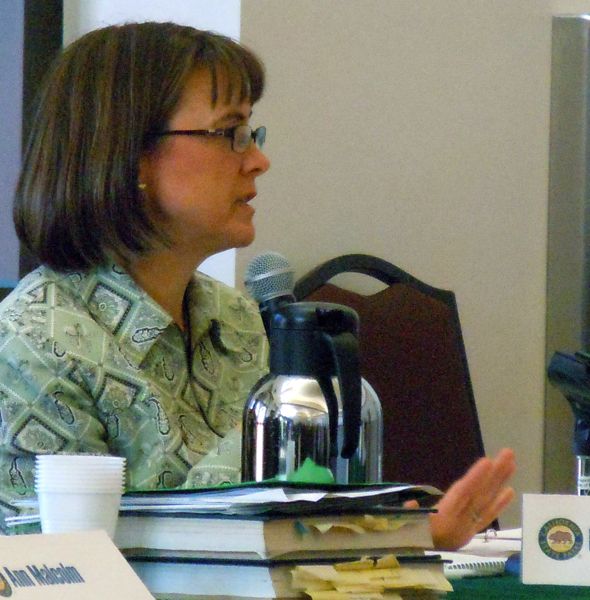
Parks Director Ruth Coleman addresses the commission Jan. 27. Photo/Kathryn Reed

She said while the mission of the department has not changed, how it is funded has. Still on the table is the closure of 70 of the 278 state parks beginning July1 – the start of the next fiscal year.

“We don’t know if the 70 closures are permanent,” Coleman told the California State Park and Recreation commissioners.

Coleman told the seven-member board she is creating a business plan for every park, which is more like a strategic plan, for how to manage the parks. This includes developing public-private partnerships, having staff develop a more entrepreneurial mindset, being flexible, and possibly combining state parks.

Workshops will be conducted at five locations on Feb. 22 to gather input from the public and possible partners about how they want the parks to function going forward. The nearest meeting location to Lake Tahoe will be in West Sacramento. Time and exact locations are on the department’s website.

Coleman said she is working on ways to allow parks to keep more of the money they generate. However, this could be subject to approval by higher ups.

Lake Tahoe comes under the High Sierra region, which has 11 units in it.


Rail jam in South Lake Tahoe

There will be a rail jam Feb. 3 at the Hot Gossip parking lot (3447 Lake Tahoe Blvd., South Lake Tahoe).

Registration is from 4-5pm, practice 5-6pm and competition from 6-8pm. Registration fee is $25.

All competitors must wear helmets and be members of the USASA. Memberships available on site.


Where are you going to be spending the Super Bowl?


Origins of Black History Month

To commemorate and celebrate the contributions to the United States made by people of African descent, American historian Carter G. Woodson established Black History Week. The first celebration occurred on Feb. 12, 1926.

For many years, the second week of February was set aside for this celebration to coincide with the birthdays of abolitionist/editor Frederick Douglass and Abraham Lincoln. In 1976, as part of the nation’s bicentennial, the week was expanded into Black History Month. Each year, U.S. presidents proclaim February as National African-American History Month.

The number of people who identified as black, either alone or in combination with one or more other races, in the 2010 Census was 42 million. They made up 13.6 percent of the total U.S. population. The black population grew by 15.4 percent from 2000 to 2010.

The projected black population of the United States (including those of more than one race) for July 1, 2050, is 65.7 million. On that date, according to the projection, blacks would constitute 15 percent of the nation’s total population.

The black population in New York, which led all states in 2010, is 3.3 million. The other nine states in the top 10 were Florida, Texas, Georgia, California, North Carolina, Illinois, Maryland, Virginia and Ohio.


RAOK: Being kind when others are upset

Nancy Kerry is Lake Tahoe News’ final Random Acts of Kindness winner. She was nominated by an anonymous commenter for her supreme kindness in dealing with the complaints during SnowGlobe.

Nancy has told us as a public employee she is not allowed to accept the gift donated by Barton Health. The gift is a backpack full of all sorts of things people might need during an emergency. She can’t even accept it and re-gift it. Lake Tahoe News per Barton Health’s suggestion is giving the backpack to the senior center for staff to decide which senior should receive it.

Under the Voices section is a wrap-up of Random Act of Kindness.


Grand jury out of money, takes county to court for more

By Kathryn Reed

El Dorado County’s civil grand jury has spent all of the money allocated to it – $40,442 – and now wants a judge to tell the Board of Supervisors to keep paying any bill that comes in through June 30 – the end of the fiscal year.

The county doesn’t want to give any entity a blank check.

The money issue is now tied up in court. Interpretation of the Penal Code is one of the controversies.

Penal Code Section 890.1 states: The per diem and mileage of grand jurors where allowed by law shall be paid by the treasurer of the county out of the general fund of the county upon warrants drawn by the county auditor upon the written order of the judge of the superior court of the county.

Penal Code Section 914.5 states: The grand jury shall not spend money or incur obligations in excess of the amount budgeted for its investigative activities pursuant to this chapter by the county board of supervisors unless the proposed expenditure is approved in advance by the presiding judge of the superior court after the board of supervisors has been advised of the request.

El Dorado County Superior Court Judge Steve Bailey is expected to make a ruling Feb. 15 based on the testimony that was given in January.

But Bailey in a July 2011 court order outlined how payments should be structured for this grand jury. It’s possible the ruling later this month will change that protocol.

Foreman Ted Long is allowed to sign all paperwork for members to get paid without anyone double checking his numbers or validating the work was done. Long is a former South Lake Tahoe city councilman who ran into controversy regarding finances while he served as president of the Clean Tahoe board. A nearly year-long police investigation that started in 2006 resulted in no criminal charges being filed against anyone. (Clean Tahoe was part of the 2007-08 grand jury report.)

The 19-member grand jury is entitled to $15 per day worked and the IRS mileage rate, which is currently 55.5 cents per mile, according to the Penal Code. But the county also gives it a fixed budget – like any body whose budget it oversees.

With six members residing in the Lake Tahoe Basin, it means more miles driven than most years because weekly meetings are in Placerville, as are other points of business for this oversight body. In previous years there have been one or two Tahoe residents on the grand jury, so mileage was less of an issue.

“The El Dorado civil grand jury is an investigatory body created for the protection of society and the enforcement of the law. It is an arm of the court and a representative of the public. Although it is an arm of the court, it operates independently of direct court supervision. It is a check against governmental authority. It is not a branch of the county, nor is it answerable to the district attorney,” the county’s website says in explaining what the grand jury is.

Still, it is the county that pays the grand jury’s bills, it is the District Attorney’s Office representing it in court, and it is Judge Bailey who is overseeing everything.

“The question is what to do when the grand jury thinks it needs more money,” Ed Knapp, county counsel, told Lake Tahoe News. “The board can augment the budget or it can express to the court why it doesn’t want to do it.”

All county department budgets keep being slashed. The grand jury’s was cut in half for this fiscal year.

Knapp said with the county looking at an $8.5 million gap to close by July 1, all entities in the county would keep being pinched.

But Long, who is on his third stint on the grand jury – having served last year and eight years ago, says the grand jury should not sustain across-the -board cuts like other departments because members need the latitude to do their job and shouldn’t have to ask the people they may be investigating to fund the operation.

Last week he sent a settlement proposal to Knapp and others about how to resolve the situation.

He told Lake Tahoe News fixed costs like the copy machine and phone are a known quantity, but sometimes there are outside expenses like eight years ago when an auditor was hired by the grand jury to look at South Lake Tahoe’s Redevelopment Agency. Long would like a reserve of $10,000 set aside each year for those surprise expenses. He’d also like an average of the last few years’ worth of budgets to help determine what should be allocated going forward for mileage.

The meeting room in Placerville is not set up for teleconferencing, but that could change.

Supervisor Norma Santiago said, “This would save the grand jury on their traveling expenses, which is one of the primary causes for the increase in expenses.”

She said other departments could also use the technology.

What’s being investigated?

While the grand jury investigations are somewhat secretive in that the members may not talk about what they are working on, but those being investigated may.

In fact, the Feb. 2 South Tahoe Public Utility District meeting has an agenda item that is for the board to be brought up to speed about what staff has been telling the grand jury.

Water meters are a big part of what the grand jury is asking about, according Dennis Cocking, spokesman for the district.

South Lake Tahoe is also under scrutiny. City Manager Tony O’Rourke said he has been questioned about refinancing the city-owned ice rink and “whether the city should be swallowed by the county.”

While O’Rourke believes in the function of the grand jury, he told Lake Tahoe News he would hope it would investigate corruption and more valid complaints.

Long said this year about one-third of the 12 active investigations are centered in the basin.

The report will come out in late June or early July.


Opinion: State Parks’ rehearing of Washoe Meadows was a farce

By Nancy Graalman

After a misplaced display of pique – directed at citizens exercising their public meeting rights instead of at California State Parks staff responsible for an awkward do-over of actions taken last fall – State Park

Commissioners approved last Friday a re-packaged resolution that downgrades portions of Washoe Meadows State Park to clear the way for golf course development as part of the Upper Truckee River Restoration and Golf Course Configuration Project in South Lake Tahoe.

The mulligan was prompted by State Parks’ seeking to “correct” the procedures that were the foundation of the Commission’s vote last October to reclassify Washoe Meadows and approve the river repair project.

It quickly became obvious at the Jan. 27 meeting in Brentwood that the “reconsideration” directive was merely for technical and pre-emptive purposes. The revised reviews, draft resolutions, and findings of fact handed out at the meeting, bolstered by statements by State Parks’ legal representation, seemed to be a response to the lawsuit filed in November by the Washoe Meadows Community against the Commission and Parks Department for environmental studies inadequacies as well as violations of statutory obligations related to the reclassification of Washoe Meadows.

It was clear from the start that the the re-vote was a mere formality.

However, because the issue was part of the commission’s agenda open for public input, citizens introduced substantive material that adds to mounting evidence that the Parks Department’s chosen alternative — which relies on extending nine holes of the Lake Tahoe Golf Course into current Washoe Meadows parkland — remains problematic for issues ranging from geomorphologic claims to economic analyses about golfing trends and the reality of potential burdens on California taxpayers.

Among last Friday’s speakers who urged the commission to reject the reconsidered project — or at least delay the vote — was Norma Santiago, El Dorado County supervisor and current chair of the Governing Board of the Tahoe Regional Planning Agency. Ms. Santiago not only cited the significant economic and environmental concerns over the state’s proposals, she also offered fresh, creative and positive ways to look at river restoration, golf continuation, and South Lake Tahoe recreational opportunities.

Defense of Place, while firmly denied permission to speak the usual five minutes given to organizations, urged the commission not to leave a legacy as the board that opened the door to the downgrading of legislatively protected state parks, leaving natural resources vulnerable to unintended consequences. (California’s only previously publicized attempt to reclassify a protected state park area occurred in September 2010 when the Parks Department yielded to public alarms about legal and ecologic risks and withdrew its proposal to reclassify a portion of Tolowa Dunes StatePark as a state recreation area.)

Nancy Graalman is a member of Defense of Place.


Tough Mudder

Northstar will host the Tough Mudder event series Sept. 22-23 at the Truckee resort.

Tough Mudder events are 10- to 12-mile obstacle courses designed by British Special Forces to test all around strength, stamina, mental grit, and camaraderie. With the most innovative courses, half a million participants, and more than $2.5 million raised for the Wounded Warrior Project, Tough Mudder is the premier adventure challenge series in the world.

Registration is open.

For more information about the Tough Mudder event at Northstar or to register, go online.


Forum for businesses

Businesses in South Lake Tahoe and El Dorado County are invited to a forum to learn about what low-cost, no-cost services and loans are available.

The Feb. 29 3:30-5:30pm forum is being put on by the Lake Tahoe South Shore Chamber of Commerce and Lake Tahoe Community College.

The meeting is at Lake Tahoe Community College’s board room in South Lake Tahoe.

To reserve a seat or for more information, call (775) 588.1728, ext. 303 or email emily@tahoechamber.org.


Rail jam

There will be a rail jam Feb. 3 at the Hot Gossip parking lot (3447 Lake Tahoe Blvd., South Lake Tahoe).

Registration is from 4-5pm, practice 5-6pm and competition from 6-8pm. Registration fee is $25.

All competitors must wear helmets and be members of the USASA. Memberships available on site.