Lake Valley Firefighters’ Ball
The 50th annual Lake Valley Firefighters’ Ball is March 2 at 8pm at MontBleu in Stateline.
Click on the flyer for more info.
The 50th annual Lake Valley Firefighters’ Ball is March 2 at 8pm at MontBleu in Stateline.
Click on the flyer for more info.
The Tahoe Mountain Milers Running Club is hosting the Fresh Tracks 5K Snowshoe Walk and Race on Feb. 26 at 10am at Camp Richardson Resort.
The beneficiary is the Eric Nageotte-Lowe Scholarship Fund for the Heavenly Freestyle Team.
Check out the website for complete information and a mail-in registration form.
Register by Feb. 15 and the fee is $30, which includes a sweat shirt, snowshoe rental, post-race refreshments, and continued day use of groomed Camp Richardson trails.
Sweat shirts are for the first 50 registrants.
Online registration is available.
Entry forms are available at Kahle Community Center, South Lake Tahoe Recreation Center, Lake Tahoe Community College, Eclipse Running in Reno, CV Sports in Carson City, and the Douglas County Public Libraries in Minden and Lake Tahoe.
Day of race registration is $40.
For those who like to compete, unique handmade age-group awards are three deep.
There will be barbecued sausages and hot dogs along with other post-race refreshments.
For more information, call (775) 588.2864 or email tahoecarol@charter.net.
Sierra Nevada College presents Geographical Divides: Finding Common Ground featuring 16 artists who were asked to explore the geographical and cultural differences in Nevada, if such differences truly exist.
The assembly of printmakers — eight from the north, eight from the south — produced two prints from each collaboration. Visually exploring connections and disconnections between Southern Nevada and Northern Nevada cultural attitudes, aesthetics and geographical distinctions—these sixteen artists communicated and visually responded to each others unique economic, environmental, political and social settings—further dissecting this notion of a splitting geography and/or communion of Nevada’s polarities.
Geographical Divides: Finding Common Ground examines Nevada unique visual culture.
Collaborating artists include: Maria Arango, Las Vegas/Lynn Schmidt, Reno; Erik Beehn, Las Vegas/Nolan Preece, Reno; Bobbie Ann Howell, Las Vegas/Galen Brown, Carson City; Daryl DePry, Las Vegas/Sharon Tetly, Carson City; Keith Conley, LasVegas/Sidne Teske, Tuscarora; Anne M. Hoff, Las Vegas/Vicki LoSasso, Reno; Jeanne Voltura, Las Vegas/Candace Nicol, Reno; and Juan D.Varela, Las Vegas/Ashlea Clark, Reno.
This exhibit was organized by the Nevada Arts Council, is part of the Nevada Touring Initiative – Traveling Exhibition Program and is funded by the National Endowment for the Arts and the Nevada Legislature.
Geographical Divides: Finding Common Ground is on display from Feb. 16 through April 6 in the Lake Gallery of Prim Library on the Sierra Nevada College campus in Incline Village.
For group tours,contact Library Director Betts Markle at emarkle@sierranevada.edu or (775) 881.7511.
By Kevin Yamamura, Sacramento Bee
When teachers unions and education groups backed Proposition 98 nearly a quarter-century ago, they told voters it was “a well-thought-out plan for California’s schools to once again be among the very best in the nation.”
But as public schools pack more than 30 students into kindergarten classrooms, cut a week of instruction and shutter campus libraries, education advocates wonder to what extent Proposition 98 has served its purpose.
The state ranks among the worst in students per teacher and spent 12 percent below the national average per pupil even before the recession. Compared to their high-water mark in 2007-08, K-12 schools and community colleges will receive 12 percent less in state and local funding this year.
“It certainly doesn’t appear as if education has been treated as a favorite child over the last few years when you look at all the cuts,” said veteran schools lobbyist Bob Blattner.
The law, approved in 1988, is complex enough that watching a video tutorial by the Legislative Analyst’s Office feels like upper-level college work. The measure is designed to ensure that K-12 schools and community colleges receive about 40 percent of state revenues, as well as increases for growth in taxes and student enrollment.
Proposition 98, and a revision in 1990, allow for a safety valve in bad fiscal years. California can cut schools as long as it vows to send enough money to districts in the future. Though it may be of little comfort to families with children in schools now, the state eventually owes about $10.4 billion more to education.
“I think schools would be worse off without it,” said John Mockler, the education consultant widely credited as author of the initiative. “I can’t imagine how much worse, but they would be worse.”
Many say Proposition 13’s limit on property taxes led to Proposition 98 as schools had to compete more with other public programs for resources. Mockler contends the real tipping point came when Gov. George Deukmejian and lawmakers used a $1.1 billion surplus for tax rebates in 1987 rather than education.
The initiative itself has become a battle cry in state politics. Politicians now claim they “fully funded schools” if they follow Proposition 98 formulas, regardless of the condition of classrooms.
“I think that has hurt us over the years because nobody really understands what Proposition 98 is,” said Robert Miyashiro, vice president of School Services of California and an expert in K-12 finance. “People understand high class size, shortest school year, fewest textbooks.”
Are you or someone you know struggling to maintain the exterior of your home? Habitat for Humanity is working in South Lake Tahoe with a nationwide program called A Brush With Kindness.
Volunteers are the heart of the program that has already helped four homeowners in South Tahoe and plans to help more.
Applicants must own and occupy their home, and show need of help. The application process takes one to three months, so we are looking toward spring and summer to begin new projects.
For more information call Carolyn at (530) 541.4654 or email sltahoehabitat@gmail.com.
By John Packham
It comes as no great surprise that Food Stamps and other means-tested public programs for the poor have emerged as campaign issues during the current election cycle. Expect more of the same as the Republican presidential primary race tightens and the candidates attempt to outduel each other on matters of reducing federal spending and eliminating dependency on “big government.”
Newt Gingrich’s recent labeling of President Obama as “the best food stamp president in American history” follows a time-honored Republican tradition of demonizing programs for the poor and vilifying their recipients — campaign tactics that hearken back to Ronald Reagan’s bromides on “welfare queens” and other stereotypes of aid recipients.
After unemployment insurance, the Supplemental Nutrition Assistance Program (SNAP — formerly the Food Stamp Program) has historically been the most responsive federal program in assisting families during economic downturns. SNAP is a cornerstone of the nation’s public health safety net and, simply put, our most important anti-hunger program.
The full cost of SNAP benefits is paid by the federal government, with the costs of administrating the program shared between Washington and the states, which operate the program. In Nevada, the average monthly benefit per person is $123.
Unlike most means-tested benefit programs, SNAP is only available to households with low-income individuals and limited financial assets. Currently, SNAP eligibility is limited to households whose net income is less than or equal to the federal poverty line (about $18,500 a year or $1,545 per month for a family of three) and who possess assets of $2,000 or less (or $3,000 for households with an elderly or disabled family member).
John Packham is director of health policy research at the University of Nevada School of Medicine and president of the Nevada Public Health Association.
By Kathryn Reed
Using a spork, Odette Sosa eagerly scoops out the fruit of the kiwi that has been cut in half. She got it off a friend’s tray. She had already eaten her orange – what she said at the time was the best part of the meal. But she wanted more fruit.
This Bijou Community School first-grader said she’s used to eating lots of fruit at home.
Natalie Bedlre, her friend sitting next to her, says one of her favorite school lunches is the chicken with gravy over brown rice. Good thing – because that was on the menu Monday.
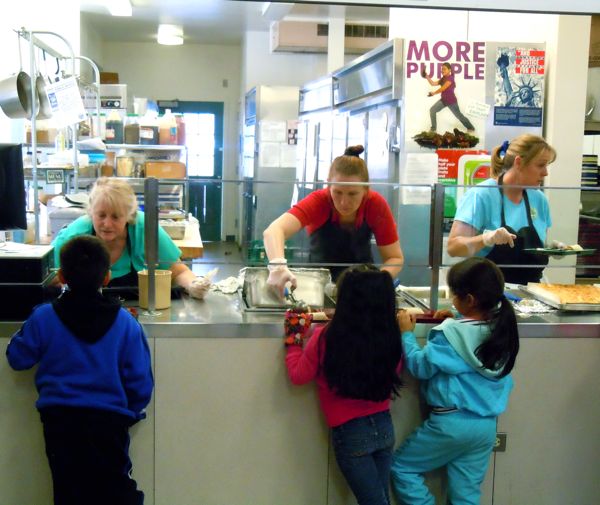
The cafeteria staff at Bijou serve about 400 lunches a day. Photos/Kathryn Reed
But pizza is still an all-time favorite at all grade levels. Only these slices are healthier than what their parents were likely served when they were in school. Crusts are at least half whole wheat, cheese is reduced in fat and sugar content of sauces is noted.
While the elementary kids probably don’t know it or even care, the tray of food before them is designed to ensure they have a well-balanced meal.
Because Lake Tahoe Unified School District is part of the National School Lunch Program it must follow all of the federal guidelines. This includes having five components with each lunch – meat or meat alternative, fruit, vegetable, grain, and milk.
The offer vs. serve aspect allows a youngster to choose three of the five choices and still meet the federal guidelines. This recognizes not everyone is going to eat everything – whether because of taste or dietary restrictions.
Plus, food waste is something to consider. No reason to pile something on that won’t be consumed.
On Monday, most of the trays are empty. But Patty Lefteroff, who runs the Bijou kitchen, knows to cut the whole grain bean and cheese burritos in half for the younger students. If any of them were still hungry, they just had to ask for more.
With about 60 percent of LTUSD students qualifying for a free or reduced lunch, it means the feds are paying for the bulk of the food program. It also means having to follow their rules and most of their recipes.
Even though the feds released regulations Jan. 25 about what districts must serve, California’s rules are stricter and therefore LTUSD is already doing what much of the country will have to do to meet the federal rules.
Deep fat fryers left LTUSD school kitchens in 2001, trans fats were eliminated in 2008, sodas have not been allowed at the high school for years and never were at the elementary level, whole grain regs are the norm now and flavored milk is already nonfat.
Shelley Giannotta, director of LTUSD food services, said the one item she will struggle with is sodium content. Salt is in everything. The just released federal rules say by 2014-15 current sodium levels must be cut by 5 percent to 10 percent; going up to a 25 to 50 percent reduction from today’s baseline in 2022-23.
But LTUSD does not have to offer a food program. California law leaves that choice up to the districts.
“If we did away with it, we would have a lot of kids going hungry,” Giannotta said while in the Bijou cafeteria Feb. 6. “We are here for the kids.”
Giannotta knows if they didn’t eat at school, some may not eat anything – and if they are given food at home, it may not be a hot, balanced meal.
Most of the kids in the room are eating the school lunch. Very few lunch boxes are visible.
But it’s impossible to know who has paid or who is getting a subsidy. This is because kids give their student number to one of the lunchroom workers and it’s calculated via the cash register.
About 1,800 lunches are served a day and 700 breakfasts throughout the district.
The magnet school has a different menu than the other three elementary students because fewer students eat the hot lunch. This means they are given one choice of entrée instead of two like the other students.
The middle and high school students have another menu. But that is likely to change next year when the student union opens at South Tahoe High School.
With that addition comes the opportunity to offer more items in a food court setting. South Tahoe High School’s food area will be set up to have eight points of service, though it may start with fewer offerings. One area may be soup and salad, another for burgers (not just beef), another for rotating world themes – it’s all still being worked out.
New dishes will be incorporated to balance out the favorites.
Entrée salads are offered to elementary kids in the fall and spring, to the older kids year-round.
When meat is on the menu food preparers are always able to accommodate the vegetarians in the crowd.
Lefteroff said a handful of kids at Bijou don’t eat meat. Grilled cheese, a cold cheese sandwich or PB&J are back ups.
To avoid the expense of tahini and possible peanut allergies, the hummus is made with sunflower seed butter.
Giannotta wants to provide locally grown food, but being in the mountains makes it difficult. Mt. Moriah Farms in Davis supplies pesticide-wax free apples. She works with Bonanza Produce as well. Money is an issue, but there isn’t an idea she isn’t willing to pursue.
Being part of the federal program means getting the commodity discounts that are offered.
Lunches at the six Lake Tahoe Unified schools are probably the cheapest place in town to eat – especially considering the nutrients involved. Elementary lunches are $2.25, while it costs $2.75 to eat at the middle or high school.
While some districts subsidize their food programs, the opposite happens in LTUSD. In the 12 years Giannotta has been at the helm, she keeps making changes. Besides food content and nutritional upgrades, she returns more than $50,000 a year to the general fund that can then be used for textbooks, class size reduction or whatever the school board deems necessary.
ngg_shortcode_0_placeholder (Click on photos to enlarge.)
By Eric Guevin
Scald injuries are painful and require prolonged treatment. They may result in lifelong scarring and even death. Prevention of scalds is always preferable to treatment and can be accomplished through simple changes in behavior and the home environment.
In conjunction with Burn Awareness Week, Feb. 5-11, the American Burn Association and Tahoe Douglas Fire Protection District are providing information relating to scald burns.
Although anyone can sustain a scald burn, certain people are more likely to be scalded — infants, young children, older adults and people with disabilities. These high-risk groups are also more likely to require hospitalization, suffer complications and experience a difficult recovery. Most burn injuries occur in the person’s home and the vast majority of these injuries could have easily been prevented.
Eric Guevin
Tap water scalds are often more severe than cooking related scalds.
The American Burn Association recommends the following simple safety tips to decrease the risk to yourself and those you love from tap water scalds:
• Set home water heater thermostats to deliver water at a temperature no higher than 120 degrees. An easy method to test this is to allow hot water to run for three to five minutes, then test with a candy, meat or water thermometer. Adjust the water heater and wait a day to let the temperature drop. Re-test and re-adjust as necessary.
• Provide constant adult supervision of young children or anyone who may experience difficulty removing themselves from hot water on their own.
• Gather all necessary supplies before placing a child in the tub, and keep them within easy reach.
• Fill tub to desired level before getting in. Run cold water first, then add hot. Turn off the hot water first. This can prevent scalding in case someone should fall in while the tub is filling. Mix the water thoroughly and check the temperature by moving your elbow, wrist or hand with spread fingers through the water before allowing someone to get in.
• Install grab bars, shower seats or non-slip flooring in tubs or showers if the person is unsteady or weak.
• Avoid flushing toilets, running water or using the dish or clothes washer while anyone is showering.
• Install anti-scald or tempering devices. These heat sensitive instruments stop or interrupt the flow of water when the temperature reaches a predetermined level and prevent hot water that is too hot from coming out of the tap.
Cooking-related scalds are also easy to prevent.
Some things you can do to make your home safer from cooking-related burns include:
• Establish a “kid zone” out of the traffic path between the stove and sink where children can safely play and still be supervised. Keep young children in high chairs or play yards, a safe distance from counter- or stovetops, hot liquids, hot surfaces or other cooking hazards.
• Cook on back burners when young children are present. Keep all pot handles turned back, away from the stove edge. All appliance cords should be coiled and away from the counter edge. During mealtime, place hot items in the center of the table, at least 10 inches from the table edge. Use non-slip placemats instead of tablecloths if toddlers are present.
• Never drink or carry hot liquids while carrying or holding a child. Quick motions may cause spilling of the liquid onto the child.
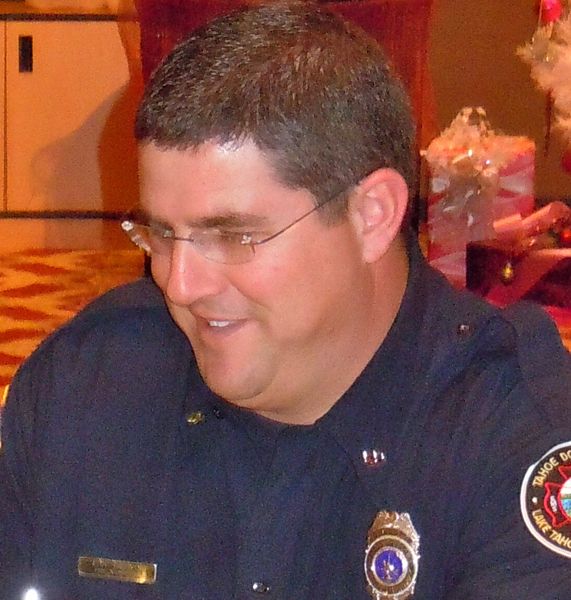
Eric Guevin is acting fire marshal for Tahoe Douglas Fire Protection District.
Douglas County Board of Commissioners on Feb. 10 will get an update on progress made in the implementation of the county’s Economic Vitality Strategy and Action Plan.
Seventeen months has passed since the county put the plan into action to implement 12 projects focused on revitalizing historic downtowns, capitalizing on outdoor recreation amenities, and strengthening education and workforce.
The public is invited to the 3pm meeting in the Valley Ballroom at the Carson Valley Inn, 1627 Highway 395 North, Minden.
The current status of the proposed North Tahoe courthouse, currently in site acquisition, will be discussed at the North Tahoe Regional Advisory Council meeting Feb. 9 at 6pm.
The Administrative Office of the Courts, in partnership with the Superior Court of Placer County, will present project information, including the proposed site and status of environmental reviews.
The meeting is at the Tahoe City Public Utility District Board Room, 221 Fairway Drive, Tahoe City.
The proposed project would replace the current Tahoe City courthouse, which is severely undersized and overcrowded and has numerous deficiencies in security, access, efficiency, and accessibility under the Americans with Disabilities Act. The proposed new single-courtroom building would provide adequate space for criminal, civil, traffic, and family law proceedings for Tahoe area residents, as well as self-help services and improvements in court security and court operations.
The project is ranked as an “immediate need” in the judicial branch’s capital-outlay plan, making it among the branch’s highest-priority infrastructure projects. It is among 39 projects funded by Senate Bill 1407 that was passed in 2008, which finances critically needed courthouse construction, renovation, and repair through a portion of judicial branch fees, penalties, and assessments, without impact on the state’s general fund.