Simple device makes walking on ice less precarious

By Kathryn Reed

Ice under tennis shoes and a dog at the end of a leash. And I didn’t fall. I didn’t even slip. Not once.

This is because I had a pair of Yaktrax on. I’ve owned a pair of the Walkers for a while, but seem to forget I have them until I’m sliding. Last week a pair of the Pro model arrived in the mail.

I’m keeping these in my car so I have them with me in case I’m in an icy parking lot or I’m off to walk my friend’s dog, AJ.

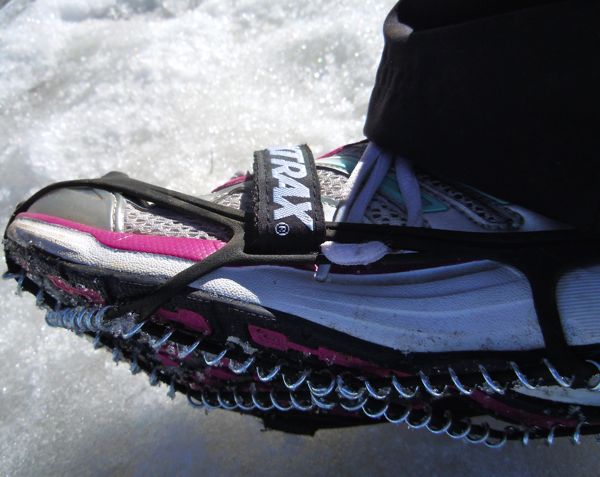
Yaktrax make walking on ice less scary. Photo/Kathryn Reed

These simple-to-use devices allowed me to walk my normal pace and normal gait. I walked on ice, hard pack and a mix of white stuff. The surface was level. I didn’t run, but the manufacturer says these are good for runners.

Abrasion-resistant steel coils are wrapped around heavy-duty natural rubber that slips over the bottom of shoes. One obvious difference between the Pro model and my old ones is the nylon hook and loop strap that fits around the top of the shoe for a more secure feeling.

The Yaktrax website says, “The easiest way for most people to install Yaktrax on their shoes is to sit down, cross your legs, pull your foot up near your other knee and slip them over your shoe.”

They also say not to wear them inside — which in my mind is the easiest place to sit.

I was outside putting them on because I didn’t need them on the street. I needed them to walk along the path in the Upper Truckee Marsh. Sitting was not an option if I wanted to stay dry.

Had it been colder, it would have annoyed me that I needed to take my gloves off to get them on and off. Part of that has to do with the strap, and part is these are tighter than my other pair.

But that was the only issue I had with these winter walking aids that are named after the Tibetan yaks that roam the Himalayas.

After my one test walk of the Yaktrax Pro, I know in the future I will not hesitate to wander into icy areas that normally I would avoid.


Sandoval’s economic plan calls for 50,000 jobs in 3 years

By Sean Whaley, Nevada News Bureau

RENO – Gov. Brian Sandoval used UNR on Tuesday as a backdrop to unveil his economic development plan, and he challenged the business community and all partners to work to create 50,000 new jobs by the end of 2014.

The 63-page report, “Moving Nevada Forward: A Plan for Excellence in Economic Development 2012 – 2014” calls for creating a cohesive system to move forward with economic development, expand “global engagement” and increase opportunity thorough education and workforce development, among other objectives.

“This (report) is a blueprint for building a vibrant, sustainable economy for all Nevadans,” Sandoval said. “It puts us in a better position to succeed in the hyper-competitive push to champion a strong economy that creates good jobs.

“State government will play a role by advocating for business, providing the infrastructure that helps business thrive, and helping to educate our future workforce,” he said. “The plan spells out our efforts.”

A key component of achieving job growth is a $10 million Catalyst Fund created in cooperation with the Legislature to help existing Nevada businesses expand and to encourage other businesses to relocate to the state.

“So I’m issuing a challenge today, to all of our partners in building this economy,” Sandoval said. “We must create 50,000 jobs by the end of 2014, the 150th anniversary of Nevada becoming a state.”

The plan was developed by Steve Hill, executive director of the governor’s Office of Economic Development, after consultation with business leaders and policy-makers from around the state. The report piggybacked on a report prepared by the Brookings Institution and SRI International that was delivered to the state Board of Economic Development in November outlining how Nevada could move forward with economic diversification and job growth.

The Brookings report identified seven economic sectors, some already in existence such as gaming and tourism, and some emerging, such as clean energy, where Nevada should focus its efforts.

That report received some criticism for lacking specifics of how to achieve job growth in Nevada, which has the highest unemployment rate in the country.

Hill was directed to prepare a plan that would be a working document that the public can easily understand.

The report says that Nevada’s assets for economic development include more than 40 million visitors annually, the largest gold producer in the country, and its national defense opportunities at Nellis Air Force Base and the other military installations around the state.

The state has serious liabilities as well, however, including a disjointed economic strategy, an under-performing education system and a workforce that is not trained for new job opportunities.

Hill said an economic development plan is critical given the current state of the economy.

“We don’t have to worry going forward whether Nevada will be connected to the globe, it will be,” he said. “And we need to learn how to capitalize on that better. So, globalizing, both in terms of exporting, in terms of foreign investment in Nevada, bring good jobs, it brings additional financing and investment in the state and is an area that we need to focus on.”

The plan also focuses on the need for education reform, Hill said.

“We all know that we need a higher level of education achievement in order to drive this economy forward,” he said.

The plan also has benchmarks to assess whether Nevada is achieving its ambitious job-creation goals, Hill said.

Following the release of the plan, Sandoval and Hill toured a Reno business, the Pacific Cheese Company, where president Steve Gaddis said he expects continued expansion of the company with more jobs added in the coming months. The company has a plant in California as well.

The company had 33 employees early last year and has 99 employees now. Gaddis said he expects to expand to 120 to 130 workers by February 2013. Almost all of the workers have been hired locally, Gaddis said.

Gaddis said the first plus for Nevada as a place to do business is the fact that it is not California.

“For us it’s the combination of regional supply logistics, a good labor force, the tax factor attracts us a lot because most of what we will save in Nevada will clearly go back in this business to create jobs and growth,” he said.

The plan generated some immediate criticism from the Nevada Policy Research Institute, a conservative think tank.

Geoffrey Lawrence, deputy policy director at NPRI, said the intent of the plan is to substitute the government for private businesses and politically connected bureaucrats for entrepreneurs. He questioned whether it is constitutional.

“It is a roadmap for crony capitalism and would lead to less productivity and less growth,” he said. “It is clearly unconstitutional. In short, this plan would take Nevada 180 degrees in the wrong direction.”

Lawrence said the state constitution declares that the state shall not donate or loan money, or its credit, subscribe to or be, interested in the stock of any company, association, or corporation, except corporations formed for educational or charitable purposes.

Giving subsidies to private businesses, as this plan calls for, is unconstitutional, he said.


What are you going to do for your Valentine?


Opinion: Water bond will fail if it remains bloated

Publisher’s note: This editorial is from the Feb. 5, 2012, Sacramento Bee.

If we had our druthers, we’d let voters decide this November on the once-delayed $11.1 billion water bond, passed by lawmakers in 2009. The sooner voters dispatch this albatross, putting it out of its misery, the sooner California can get serious about smarter and more equitable alternatives for financing needed water infrastructure.

But the very thing that makes this bond so unappealing – its excess flab, the debt payments it will foist on a cash-poor state – are the things prompting Gov. Jerry Brown to get it off the ballot. Brown is pushing a tax increase initiative in November that he doesn’t want tethered to this Hindenburg of a water bond. So he’s asking lawmakers to push the water bond off to 2014, in the vague hope that an improving economy will make the measure more attractive to voters.

It’s wishful thinking. The economy may improve in two years, but there is no telling if it will bring more water-generous voters to the polls than may show up this year.

Intriguingly, a recent Field Poll shows that voters are generally in favor of investing in water projects. But polls also show that few Southern Californians even know that their water comes out of this place known as the Sacramento-San Joaquin Delta. Perhaps by waiting two years, the water community could help educate Californians that the Delta is not just an outlet of the Mississippi.

If they put off the vote, lawmakers should rethink the assumptions and process that produced this water bond. As is too often the case, this infrastructure package was the product of a group shakedown. If San Joaquin farmers were to get their reservoir, then San Diego insisted it get $100 million to raise a dam and Lake Tahoe supporters wanted their $100 million. Projects were added merely to win votes, with far too few requirements that beneficiaries of water projects put up their own money to share in the costs.

Read the whole story


South Tahoe grappling with $44.9 million health care bill

By Kathryn Reed

It would cost South Lake Tahoe close to an additional $2 million a year for the next 20 years to fully fund its retiree health care plan. That’s because as of Sept. 30, 2011, that account had an unfunded liability of $44.9 million.

The city currently pays its share plus $400,000 a year. It’s still not enough because for years the full amount was not paid. The more that is paid each year means the projected 6.5 percent return on investment will help defray the deficit.

“We have a moral and legal obligation to make sure the retiree health plan is solvent. This is a time bomb that will go off,” City Manager Tony O’Rourke said.

But the city doesn’t know what it is going to do to fix the problem.

On Feb. 7 the City Council heard the dire news from John Bartel, president of Bartel Associates out of San Mateo.

He called the retiree health benefits “generous”. An expensive component, Bartel said, is also the average age of city retirees. For those in public safety, the average age at retirement is 53.9 years, while for everyone else it is 56.3 years.

“That exacerbates the problem,” Bartel told the council.

With Medicare not being available until one turns 65, it means the city – via the taxpayers – are footing the entire bill. For city employees hired before Jan. 1, 2008, many receive all of their medical care for the rest of their lives, plus for their spouse and dependents.

Fifty-eight percent of the retirees pay nothing for health benefits.

Councilman Hal Cole asked why the premiums don’t significantly drop when retirees start on Medicare.

Bartel said the city’s insurance broker needs to answer that question. But he also said the city needs to make sure retirees are signing up for Medicare so the city’s plan then becomes the secondary policy.

“If you continue this policy, you will pay more in retiree health care than you do in employee payroll for these employees,” Bartel said of the overall retiree health plan.

The staff report written by O’Rourke says, “The city’s retiree health plan liability has grown due to higher than expected claims ($4.3 million), more retirees than expected ($2.4 million), insufficient invest principal and earnings ($3.7 million) projected higher health care costs trends ($8.4 million) and updated CalPERS demographic assumptions ($2.4 million).”

The city pays $1,700 month for active employees and $1,100 for retirees.

The health plan was changed four years ago to be less generous. But it didn’t solve the burden of paying for those in the system before that date. And with stats from the consultant saying the last 90 days of a person’s life are the most expensive in terms of health care, the bills are going to keep accruing.

A higher deductible was put into place for this fiscal year that has an immediate savings of $4.7 million and an ongoing operational savings of $500,000 per year.

While it’s the 134 retirees who are at issue, they receive the same health benefits as the current 139 employees. So, any changes to employee health benefits affects retirees.

This problem did not pop up overnight. It has, though, essentially been ignored by previous councils and administrations. This council on Tuesday agreed something needs to be done. (Councilwoman Angela Swanson was absent.)

“We need to increase the cost-efficiency of the plan,” O’Rourke said.

That will take the six employee groups to come to the table.

Jerry Copeland, who represents the admin-confidential group, said one problem is the isolated location of South Lake Tahoe limiting health care options. But he also said, “It does need to be discussed as an entire budget issue. It needs to be transparent and open.”

In recent years, the whole unfunded liability of retiree health care has not been discussed in the open.

Retirees have not been asked to the table. Nor is the city contractually obligated to invite them. But it is possible some of them might opt for a cash payment instead of being on the health plan.

Mayor Claire Fortier asked what paying down the debt would equate to in layoffs. O’Rourke said the loss of 17 to 20 people. But he also said with departments so thin and employees being tasked with doing the jobs of multiple people, he doesn’t see how cutting jobs is a possibility. Plus, it would mean the reduction in services to the public.

Tuesday’s meeting was a workshop, with no action plan. More definitive ideas are expected to be brought to the council at the March 6 meeting, with the five likely to be asked to take action. However, they will be limited in what they can do based on contractual agreements. But they can direct staff to negotiate for certain things.

Employees can accrue 500 hours of sick time and be paid out when they leave. That could be negotiated.

Councilman Tom Davis would like to work on increasing revenues via special events that would put heads in beds and therefore up the city’s hotel and sales tax collections.

“Revenue is not a real solution. We need to look at the expense side,” O’Rourke said. “The burden doesn’t rest with the retirees; it’s with the current employees.”


The Manager as Coach

The North Lake Tahoe Chamber of Commerce and the Truckee Donner Chamber of Commerce in partnership with the Sierra Human Resources Association are offering “The Manager as Coach” Feb. 14 from 8:30am to noon at Cedar House Sport Hotel, 10918 Brockway Road, Truckee.

This workshop is designed to bolster leadership effectiveness, including how to juggle your priorities, deliver feedback, and handle concerns and difficult situations, as well as correct behavior and conduct an effective performance review.

Registration is $59/person for chamber and SHRA members and $69/person for non-members. To register and for more information about the workshop, call Laura Moriarty of SHRA at (530) 573. 0224 or North Lake Tahoe Chamber of Commerce Manager Kym Fabel at (530) 581.8764.


Fantasy writers social

Bona Fide Books is hosting Lake Tahoe’s first local fantasy writers social Feb. 16 at 6:30pm at Bona Fide HQ, 1069 Magua St., No. 4 in Meyers.

Writers of all ages and levels of experience are welcome. Discuss your latest work or ideas for new projects with others who work in this genre.

For more information, call (530) 573.1513 or go online.


Environmental writer to speak at LTCC

Lake Tahoe Community College is hosting a reading, conversation, and book signing with environmental novelist Li Miao Lovett at 7pm Feb. 9 in the college’s Aspen Room.

Lovett is a San Francisco-based author of “In the Lap of the Gods”, a novel about the displacement of millions along China’s Yangtze River.

The event is free and open to the public. Books will be available for purchase.

This event was made possible by Poets and Writers Inc. through a grant it has received from The James Irvine Foundation.


Humane Society fundraiser

Dressed to the nines, with leash in hand. That is what Feb. 18 is all about at the Ritz Carlton in Lake Tahoe.

A Champagne celebration to people’s best friends wouldn’t be the same without them present, which is why the Humane Society of Truckee-Tahoe invites pooches and their people to the fourth annual gala.

Support the Humane Society of Truckee-Tahoe while enjoying a black-tie evening of dinner and dancing. Tickets are $150 for one person and one dog. Call (530) 587.5948 to purchase tickets. The event starts at 5:30pm.


Li Miao Lovett at LTCC

Lake Tahoe Community College is hosting a reading, conversation, and book signing with environmental novelist Li Miao Lovett at 7pm Feb. 9 in the college’s Aspen Room.

Lovett is a San Francisco-based author of “In the Lap of the Gods”, a novel about the displacement of millions along China’s Yangtze River.

The event is free and open to the public. Books will be available for purchase.

This event was made possible by Poets and Writers Inc. through a grant it has received from The James Irvine Foundation.