LTUSD, TTUSD closed; several more inches of snow coming

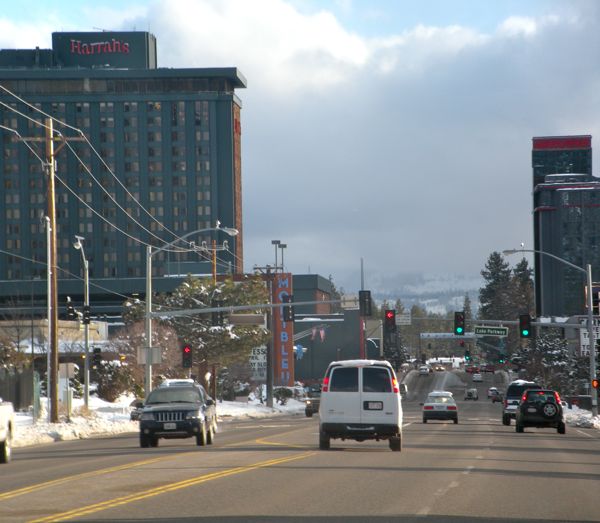
With a forecast of more snow for most of Thursday, officials from Lake Tahoe Unified and Tahoe Truckee Unified school districts have canceled classes for today.

Lake Tahoe Community College is open.

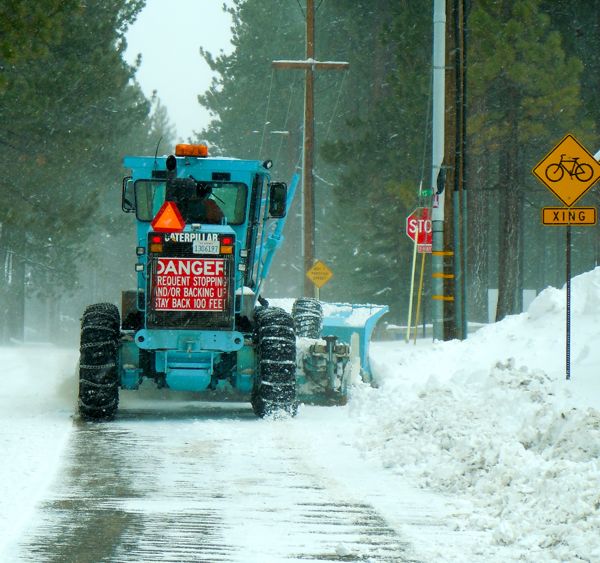
Snowplows are finally being put to work in Tahoe. Photo/Kathryn Reed

A winter storm advisory is in effect for the Lake Tahoe Basin through noon March 1. The heaviest snow is expected to taper off by 10am.

While not much fell over night on the South Shore, snow totals are likely to climb today with 4 to 8 inches forecast below 7,000 feet and 5 to 10 inches above that point.

Winds continue to rage, with sustained blowing at 20 to 30 mph and gusts of 50 mph. The top of the mountains will have wind speeds of 100 mph.

Driving is likely to be dangerous at times with whiteout conditions and snow piling up. For specific road information, click on the state icons on the home page of Lake Tahoe News.

Wind is also going to affect operations at ski resorts, so call ahead to know what is open or check the ski report on Lake Tahoe News that is up by 8 each morning. Mount Rose will be closed today.

The sun is expected to return Friday and be around through the weekend.

— Lake Tahoe News staff report


K’s Kitchen: A cocktail with a seasonal super fruit

By Kathryn Reed

Drinking iced cocktails in winter is not my normal routine. But sometimes it’s necessary when the fruit in the drink is ripe this time of year.

That’s why kiwi mojitos were being concocted in our kitchen last weekend. Plus, I know my sister likes mojitos and has experience making them. And they are also one of Sue’s favorite cocktails.

I’m really not good with mixed drinks because I don’t get the portions of alcohol right even when I follow directions. I’ve ruined plenty of mixed drinks. That’s why Pam was there to pour in the rum.

The recipe comes from the March issue of Rachael Ray magazine. (The publication just started arriving, and this is the only recipe I’ve tried so far.)

What I didn’t know until reading the magazine is how good kiwis are nutritionally.

According to the magazine, two kiwis provide 230 percent of the vitamin C you need each day – which means they are good for flu prevention.

I really wish I had known they help prevent cataracts considering I had surgery on both eyes in 2010.

Kiwis help lower cholesterol and keep skin clear.

According to kiwi-fruit.info, kiwis are native to China, where they are the country’s national fruit. There they are called yang tao (sunny peach) or mihou tao (macaque peach). They were imported to New Zealand in the early 20th century. The first crop in California was harvested in 1970.

We did things a little differently than what the magazine called for, so below is our adaptation. While I write about using a shaker, we don’t own one – so don’t let that direction stop you.

Kiwi Mojitos (makes 3)

1 C peeled kiwis, from 4-5 kiwis

4 tsp honey

8 mint leaves, or more

Ice

Club soda or tonic water

Rum, about a shot per glass

Puree kiwis and honey in food processor or blender. In cocktail shaker, muddle mint leaves. Fill shaker with ice, then add rum and kiwi puree. Shake vigorously and strain into ice-filled glasses. Fill remainder of glass with soda or tonic water.


Roots of Women’s History Month dates back to 1800s

National Women’s History Month’s roots go back to March 8, 1857, when women from New York City factories staged a protest over working conditions. International Women’s Day was first observed in 1909, but it wasn’t until 1981 that Congress established National Women’s History Week to be commemorated the second week of March.

In 1987, Congress expanded the week to a month. Every year since, Congress has passed a resolution for Women’s History Month, and the president has issued a proclamation.

The number of females in the United States according to the 2010 Census is 157 million. The number of males was 151.8 million. At 85 and older, there were more than twice as many women as men.

The estimated number of mothers in the United States in 2009 was 85.4 million.

The median annual earnings of women 15 or older who worked year-round, full time, in 2010, was $36,931 – the same as it was in 2009.

The umber of women 25 and older with a bachelor’s degree or higher in 2010 was 30.7 million. This compares to 29.2 million men.

Women had a larger share of high school diplomas (including equivalents), as well as associate, bachelor’s and master’s degrees. More men than women had a professional or doctoral degree.

Revenue for women-owned businesses in 2007 was $1.2 trillion. In that year, there were 7.8 million women-owned businesses.


Winter activities need to be approached with caution

Before venturing out onto the ice this winter, stop to consider whether or not it will support your weight. If there’s any doubt, you should keep your pets, children, and yourself away from the ice.

We would also advise everyone involved in heavy snow shoveling activities to take regular breaks and drink plenty of fluids. Watch out for signs of frostbite and hypothermia and avoid any alcohol consumption when engaging in outdoor activities.

We at the city of South Lake Tahoe Fire Department want you to have a fun and safe winter season.

— Sallie Ross-Filgo, South Lake Tahoe Fire Department


Tahoe’s clarity — a billion dollar scientific experiment

By Kathryn Reed

Stabilized is the word being used to describe what is going on with the clarity of Lake Tahoe. It took $1.5 billion to get to that point.

That is the amount of money spent, according to the Tahoe Regional Planning Agency, on environmental improvement projects between the inception of the program in 1997 and 2010. In 1997, the depth the Secchi dish, which looks like a white dinner plate, could be seen was 64.1 feet. In 2010 the depth was 64.4 feet.

On Feb. 29 the 2011 clarity data was released, showing a clarity depth of 68.9 feet – or an improvement of 4.5 feet in one year. 2010, though, was the second worst reading since records began to be kept in the late 1960s, having decreased by 3.7 feet from 2009.
It has taken $1.5 billion to stabilize Lake Tahoe's clarity. Photo/LTN file

The back-and-forth nature of the readings amounts to little change in the last decade. In 2000, the disk could be seen at a depth of 67.3 inches.

“We feel it’s positive news because we’re at the point of stabilizing,” Kristi Boosman, TRPA spokeswoman, told Lake Tahoe News. “It would have been a whole lot worse had we not made the investment we did.”

But there is no proof that statement is true.

That money – mostly from the feds through the Southern Nevada Public Lands Management Act – is about to run out. That means another funding source needs to be found. Public-private partnerships are touted as the answer, but what exactly that looks like and who will be in either category remains to be seen.

Lake Tahoe clarity readings: 2011: 68.9 feet (21 meters) 2010: 64.4 feet (19.6 meters) 2009: 68.1 feet (20.8 meters) 2008: 69.6 feet (21.2 meters) 2007: 70.1 feet (21.4 meters) 2006: 67.7 feet (20.6 meters) 2005: 72.4 feet (22.1 meters) 2004: 73.6 feet (22.4 meters) 2003: 71 feet (21.6 meters) 2002: 78 feet (23.8 meters) 2001: 73.6 meters (22.4 meters) 2000: 67.3 feet (20.5 meters) Source: TRPA

“We always have to ask ourselves if we are getting results from the dollars because they are public dollars,” Harold Singer, executive director of Lahontan Regional Water Quality Control Board said. His agency is tasked with managing water issues on the California side of the basin, though Lahontan’s jurisdiction is much greater than Tahoe.

“You can’t tie year-to-year clarity readings to the landscape. You have to look at long-term trends,” Singer told Lake Tahoe News. Otherwise it’s just looking at what was going on that one year instead of at the big picture, he said.

The surprise with the year-over-year improvement was 2011 was a heavy snow year, which in turn created a ton of runoff. This usually means more sediment reaches the lake to cloud the water, with an expected outcome of diminished clarity.

Geoffrey Schladow, director of the UC Davis Tahoe Environmental Research Center, in a statement said, “The factors that contribute to lake clarity are complex, and are not necessarily linked to factors occurring in the current year. Understanding what controls the long-term trends is at the heart of what we are attempting to do.”

TERC along with TRPA released the report.

But one of the problems is no one is sure what is working and what isn’t. For years nutrients like nitrogen and phosphorous were seen as the big bugaboos. Now it’s fine sediment.

While TRPA has come up with a top 10 list of what individuals can do to help with lake clarity, there is no overall top 10 list of projects that could or should be implemented.

No one has identified the top areas contributing to the degradation of lake clarity. The mantra is “urban upland” – or the old developed areas in the basin.

This means that instead of taking a concerted approach to fixing the biggest polluters, the powers that be have cast a broad net to fix the problem. So, the next billion dollars that is spent on lake clarity may not be spent in the most efficient manner because after all of these years no one has prioritized what needs to be fixed to get the best return on investment.

Goals from 2008-18 are outlined on Page 14 of this document. But they are neither specific nor detailed.

TRPA also supplied this information with accomplishments through 2006. It says how the money was spent, not whether it did any good in terms of lake clarity.

Even though the goal of TRPA and the states is to have Lake Tahoe’s clarity be 97 feet by 2076, no detailed plan to reach that goal has been put in place by now. TRPA was created more than 40 years ago with the main emphasis to protect the waters of Lake Tahoe.



In search of disappearing vernal pools

By Stephanie Taylor, Sacramento Bee

A vanishing and mysterious phenomenon, concentrated on the western alluvial slopes of the Sierra, spans much of California’s Great Valley. Vernal pools. We most often hear about vernal pools in relation to the “endangered” fairy shrimp, and I was always slightly annoyed that such a big deal is made over something we can barely see.

In winter, rain collects in shallow depressions of hardpan earth so dense that water can’t drain. Every freshwater pool is as unique as a fingerprint, with hundreds of species adapting to precise conditions of its specific environment. An integral element in California’s freshwater system, each vernal habitat is like an island, a microcosm that represents our wider ecosystem of interdependence, including specialists and generalists, each with a talent or trick for survival.

Fleeting vernal habitats are easiest to see in the spring. Flowering plants proliferate in concentric rings in a seemingly impossible array of color and pattern. When John Muir walked this valley, he wrote, “Sauntering in any direction my feet would brush about a hundred flowers with every step, as if I were wading in liquid gold.”

With summer, the bounty fades in the desiccating heat, and in fall the magic is covered with a sheltering layer of dying matter.

Winter hides what I think are the most fascinating secrets of vernal pools. The land looks barren but softly golden as we drive by. Stop, and an undulating countryside transforms into a surreal fantasy-scape.

At the top of a gentle hill at Rancho Seco Recreation Area, hundreds of fuzzy mounds descend in all directions. These are mima mounds, covered with dead grasses highlighted white in the late afternoon sun. Each casts a shadow over slightly greener, flatter areas that should be filled with water reflecting a huge sky. But most pools are dry now. There’s been so little rain.

Read the whole story


S. Tahoe convention center project out of bankruptcy

By Kathryn Reed

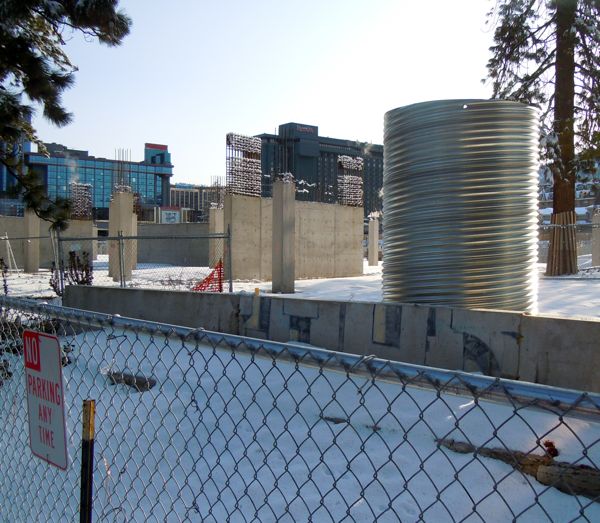
The hole – as the 11-plus acre site on the state line in South Lake Tahoe is known – is out of bankruptcy.

After a 4½-hour hearing Wednesday in Sacramento, the judge dismissed the case.

“We are definitely in a better place because we don’t have to get approval from the bankruptcy court (about a project). We hope in the next month or two we would get together (with the property owners) and see where we go,” City Attorney Patrick Enright told Lake Tahoe News.

The convention center property is out of bankruptcy as of Feb. 29. Photo/LTN file

Randy Lane, the principal of Lake Tahoe Development Company of Zephyr Cove, was not available for comment Feb. 29.

It is his company that in October 2009 filed for bankruptcy. But it was the City Council two years before that allowed him to break ground without having a final parcel map filed or secured financing in place.

No final map means there are 29 parcels to deal with – most of which are covered with rebar and concrete.

Now four entities own the 29 parcels. Sixteen have been foreclosed on, four are in the process and the remaining nine are owned by Lake Tahoe Development Company, with Owens Financial having the first deed of trust on those nine. This means Owens could foreclose on the properties at any time.

It is now up to the four property owners to figure out what to do with the land. It’s possible one could buy out the others or all could sell to another entity.

While many have said the convention center, two boutique hotels, retail and open space planned for the property across from Heavenly Village on the Harveys side of Highway 50 should be scrapped, that is the project that was approved. Permits would allow for alterations, but not a change to the footprint. It was supposed to be the largest project in the city limits at more than $400 million.

TRPA said the permit expires in nine months. If the next developer has to start from scratch with permitting, it will cost time and dollars.


S. Tahoe youth group helps Bay Area animal program

Members of the Lake Tahoe Boys & Girls Club Builder’s Club raised $100 to donate to the organization BADRAP.

Builder’s Club is a leadership program for middle school students which meets at the Boys & Girls Club main site every Monday at 3:30pm. The program is a collaborative partnership with the Kiwanis Club of the Sierra, Kiwanis International, and the Boys & Girls Club of America, and provides youth with leadership skills through service. Participants elect officers, learn how to conduct meetings, and identify needs for community service.

Club members identified an issue several months ago that they were passionate about through BADRAP. BADRAP began as a resource for pit bulls and their people in the Bay Area in 1999 and has grown to a national sensation providing information, training, disaster relief and animal welfare program models to help dogs everywhere.

This project is one of the many ways the Boys & Girls Club is having a lasting impact on its 870 members.

The Builder’s Club will host an open house March 12 from 6-8pm at the club’s main site, 1100 Lyons Ave., South Lake Tahoe The public is welcome and a free dinner will be provided.


Annual Kiwanis crab feed coming in March

Kiwanis Sunrisers’ annual crab feed is March 9 at 6pm at Harrah’s Lake Tahoe.

There are limited number of the $38 tickets.

For more information, click on the flyer or call (530) 541.5900.


Caesars’ revenue up, but loss widens on interest costs

By Steve Green, Las Vegas Sun

Hotel-casino operator Caesars Entertainment Corp. of Las Vegas said Wednesday that revenue increased in the fourth quarter, though the company posted a higher net loss from a year earlier.

Overall revenue of $2.172 billion was up 2.4 percent from the year-ago quarter.

Revenue is up for the parent company of Harrah's and Harveys at Stateline. Photo/LTN file

But Caesars posted a net loss of $220.6 million, or $1.76 per share, compared with a loss in the year-ago quarter of $196.7 million, or $1.71.

The higher loss in the 2011 quarter was caused partly by higher interest expenses, which increased from $509.7 million to $673.9 million on a year-over-year basis.

Caesars, which has properties around the country including Harrah’s Lake Tahoe and Harveys, said its Las Vegas resorts were hurt by “relatively flat trips (number of visits) and a decrease in spend per trip.”

Read the whole story