Little Feat
Little Feat will be at Harrah’s Lake Tahoe on April 14 at 7:30pm.
Guests must be 21 to attend.
Cost is $35.
For more information, call 800.786.8208.
Little Feat will be at Harrah’s Lake Tahoe on April 14 at 7:30pm.
Guests must be 21 to attend.
Cost is $35.
For more information, call 800.786.8208.
UC Davis’s Tahoe Environmental Research Center in partnership with Lake Tahoe School and Tahoe Expedition Academy will host the seventh annual Science Expo this month.
The Science Expo features interactive experiments and demonstrations for children ages 6 to 12 and their families.
The Science Expo is open to the general public on March 14 from 4–6pm at the Tahoe Center for Environmental Sciences in Incline Village. Ice cream will be provided by Susie Scoops of Incline Village. Admission is free.
The 2012 Science Expo will showcase 20 hands-on exhibits, activities and demonstrations emphasizing Life Science concepts including:
Different forms of life
Microorganisms
Nano-, micro- and macro-scales of life
DNA
Plankton
Fish of Lake Tahoe
Metamorphosis
Photosynthesis
Pollen, seeds and plants
And much more.
Last year, nearly 700 people, students and parents, came through the Science Expo event. The event is hosted annually on a three-year cycle with emphasis on Life Science (2012), Physical Science (2013) and Earth Science (2014).
This year, students from Kings Beach, Incline Village, Tahoe City, Truckee and South Lake Tahoe will be attending during the school days of March 12-15.
The Tahoe Center for Environmental Sciences is located at 291 Country Club Drive in Incline Village.
For more information, call (775) 881.7566.
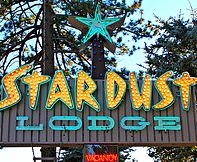 • Stardust Lodge will be before the South Lake Tahoe Planning Commission on March 8 at 3pm at Lake Tahoe Airport requesting its sign be grandfathered in under the “unique sign” designation.
• Tracy Rhine, 39, of El Dorado has been appointed by Gov. Jerry Brown as deputy director of Legislative and Policy Review for the California Department of Consumer Affairs. This position does not require Senate confirmation and the compensation is $103,008.
• Preschool Storytime at the South Lake Tahoe library is every Friday through April 27 at 11am. This is 30 minutes of stories, games and crafts suitable for ages 3-5.
• Zildjian S. Borromeo, a 2010 graduate of South Tahoe High School, was recently promoted to Navy seaman apprentice.
• A Massage at Tahoe has a new website.
• Organizers of the almost 30-year-old Lake Tahoe Music Festival are no longer going to put on the event because of competition from other events and financial concerns.
By Kathryn Reed
STATELINE – Ten ideas to provide year-round transportation linking the North and South shores have been whittled to three, with two involving ferry service and one a bus route.
Advocates believe a ferry on Lake Tahoe could provide 3,500 daily boardings, operate eight hours a day during the height of summer, take about 45 minutes with a layover of 15 minutes, and make 12 roundtrips a day.
Today, no consistent year-round public transit service exists between the North and South shores.
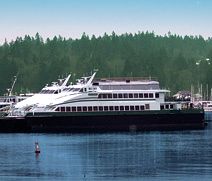
This ferry is what the Tahoe Transporation District shows on its website as a possible boat to ply the waters of Lake Tahoe.
Five community members showed up at a meeting Tuesday night on the South Shore to hear what is going on with water transit on Tahoe. Another meeting is slated for tonight on the North Shore.
Lake Tahoe News asked officials if year-round public transit between the North and South shores is something they want or something the public is demanding.
Alfred Knotts, who is leading the project for the Tahoe Transportation District, said, “We have to show the feds there is public demand.” That is because the feds are funding part of the study and are hoped to be a source of money for whatever alternative is picked.
The Federal Transit Administration has given TTD a $500,000 grant that is paying for this study and the public relations associated with it.
A travel mode survey was conducted in October 2010 that is being used to gauge how locals and tourists move around the Lake Tahoe Basin. That survey revealed 17 percent of the 123,000 daily trips are made between the North and South shores.
The survey also says 81 percent of the daily trips are from full-time residents, while the remaining 19 percent are made by visitors.
It’s mostly tourists who transportation officials believe would use the ferry service.
While buses are one component that will be studied, that aspect of the equation was not discussed at the Tuesday meeting.
Still to be studied is whether a ferry would produce more emissions than these people would spew in a land vehicle. After all, lake clarity is supposed to be the mantra of all entities in the basin.
What’s proposed
Alternatives 1, 2 and 6 are what will be studied. Alternative 1 is direct ferry service between South Lake Tahoe and Tahoe City. Alternative 2 is ferry service between South Lake Tahoe, Tahoe City and Kings Beach. Alternative 6 is bus service between South Lake Tahoe and Kings Beach via the East Shore.
Matthew Taunton with HDR consultants in Phoenix, who is working with TTD on the proposals, said alternative No. 1 would be the cheapest ferry proposal because it only has two terminals.
But he also said at other meetings there is community support for Alternative 2 because it goes more places.
Boats being looked at cost about $11 million, with an operating cost of at least $1.2 million a year.
More analysis will be done on the three ideas to come up with a preferred alternative. After that, the environmental analysis begins on the preferred alternative.
Knotts said whatever idea is pursued will connect with land-based transportation. That includes TART on the North Shore and BlueGo on the South Shore, even though the latter has never had consistent routes and is not used by tourists.
How parking will work, or getting people to ferries remains to be figured out.
It’s expected whatever system is proposed will need to be subsidized – possibly as a public-private venture.
“This would diversify and connect our markets in ways that do not exist,” Knotts said.
Not a new idea
Water transit on Lake Tahoe is not new. It has been talked about at least since 1987. And it has been tried several times. Nothing has stayed afloat for long.
In the early 1990s, Hornblower Cruises ran the Meteor. A Plexiglas cover made winter travel chilly between South Lake Tahoe and Tahoe City. The first trip with skiers was in January 2002.
Ironically, it was named after the historic logging steamer that sank in Lake Tahoe in 1940 after 65 years of service.
A 46-foot double-decker cabin was expected to be the solution in 2003 to transport people between the five marinas operated by Bob Hassett. Now he uses not much more than a dinghy to move people between the South Shore marinas he operates – Timber Cove, Camp Richardson and Lakeside. Hassett started that shuttle in 2002.
Last summer Hassett started a larger boat shuttle between Camp Rich and Meeks Bay.
A 2003 proposal by Caltrans that was adopted by the Tahoe Regional Planning Agency says, “Discussions of a water ferry option generally led to the conclusion that a bicycle water ferry is a unique and potentially viable option for bicycle recreation and transit, but that there are two distinct paths to its development: 1) in terms of bicycle transit, increased bicycle access on ferries and improved ferry stops/service should be part of the broader scope of improving waterborne transit throughout the Tahoe Basin and 2) in terms of a unique recreational activity, a bicycle-only ferry pilot project could be implemented and run by a local nonprofit or bicycle advocacy group.”
In 2005, $8 million was approved by the feds for water transit on Lake Tahoe.
“That was an authorization and not an appropriation, meaning if we meet FTA’s criteria, we could be eligible for an appropriation to fulfill what was authorized,” Carl Hasty, TTD executive director, told Lake Tahoe News on March 6.
South Lake Tahoe’s 2008 draft Sustainability Vision has a goal to “create regular/dependable waterborne transit for residents and visitors.” That hasn’t happened.
The Blue Warrior shuttle on the North Shore in summer 2010 didn’t last long.
A consultant in November 2010 recommended water transit begin the following summer – but that didn’t happen.
Tahoe Transportation District in December 2010 thought it could have some water service functioning this summer.
Fifteen months later, Knotts would not give a date when a ferry might ply the waters of Lake Tahoe.
Funding of this project is nowhere to be found at this time. The California water bond that keeps being taken off the table once was going to help fund waterborne transit at Lake Tahoe. It still could. But some people in this Los Angeles Times article, called that idea “pork”.
——-
Info:
• Meeting – March 7 at 6pm at 221 Fairway, Tahoe City (the Tahoe City PUD office).
• Alternatives and the PowerPoint from the meetings iare expected to be posted on TTD’s website.
By Jim Sanders, Sacramento Bee
Finally some good news for California lawmakers who have seen their pay and approval rating fall in recent years: Special-interest perks are up.
Lawmakers and constitutional officers accepted more than $750,000 in food, travel or other gifts last year, shattering the roughly $520,000 received the prior year, according to financial disclosures Friday to the Fair Political Practices Commission.
Gifts ranged from overseas trips and golf rounds to tickets to Disneyland or Sacramento Kings games, with givers consisting of Indian tribes, energy firms, law enforcement groups and many other powerful Capitol players.
The rise in handouts follows several years of belt-tightening imposed by California’s independent salary-setting commission, which has cut lawmakers’ pay from $116,208 to $95,291, eliminated their cars and reduced per diem payments.
Phillip Ung of California Common Cause said the rise in gifts suggests that lawmakers feel no stigma about taking from interests that often seek their votes on legislation.
“It’s disappointing,” Ung said. “Voters send public officials to Sacramento to solve the issues in front of the state, not to cash in perks that special interests hand them. And they seem to be cashing in quite a bit.”
Truckee Elementary is going green. Designated as the flagship school to lead the greening of the Tahoe Truckee Unified School District, the students and staff of Truckee Elementary will be pioneering a path toward an environmentally sustainable future for the entire district.
 During the next few years, Truckee Elementary will undergo a green transformation: in the building, in the classrooms, and ultimately, in the minds and hearts of its students. School operations will employ sensible, sustainable practices to reduce carbon footprint and waste. The teaching staff will inject environmental science and responsibility into educational programs.
In 2011, key pieces started falling into place. The PTO and TTUSD began tossing around ideas to improve the school’s sustainability and reduce consumption. What was missing was the means. Enter the Shane McConkey Foundation.
In September, the McConkey Foundation granted $20,000 to the TTUSD for the purpose of putting its schools on a path toward sustainability and environmental responsibility.
Inspired by the McConkey Foundation’s mission and grant, the Truckee Elementary PTO stepped up, offering to match the Foundation’s grant to the school, dollar for dollar.
The linchpin in bringing green practices and environmental education to the school’s students is SWEP, the Sierra Watershed Education Partnerships, a nonprofit dedicated to promoting environmental stewardship in the region’s students.
SWEP established the school’s Green Team, currently comprised of 27 eager Truckee Elementary fifth-graders, supported and mentored by motivated, environmentally-conscious Truckee High School Envirolution Club student volunteers.
With help from SWEP, the TTUSD and the PTO, Truckee Elementary teachers will be latching on to a wide range of pilot programs designed to integrate environmental awareness and build on the base curriculum. Students will take math and science principles learned in the classroom and apply them in the cafeteria, in the school’s gardens and in nearby forests and watersheds. They’ll be applying book and chalkboard learning to environmental reality when attending the school’s existing Sagehen Creek field-study program (run in conjunction with UC Berkeley).
By Dan Walters, Sacramento Bee
The thousands of college students who marched on the Capitol on Monday to protest rising fees and decreasing state support had a point: Higher education has taken a disproportionately heavy drubbing in recent years as politicians attempted – and largely failed – to balance the state budget.
The Legislature’s budget analyst has calculated that under Gov. Jerry Brown’s 2012-13 budget, state general fund spending on the University of California, the state university system and community colleges will have dropped 21 percent in five years, while fee and tuition revenue will have increased by 64 percent.
Several of those politicians uttered sympathetic words as they addressed protesters. But they sidestepped the political trade-offs that cut college funds and avoided any mention of the Brown tax plan they have endorsed.
“We can’t do it alone. We need your help,” Assembly Speaker John A. Pérez told the students. “You have the right to be mad,” Senate President Pro Tem Darrell Steinberg declared, adding that state needs “a revenue measure to put more money into higher education.”
But as Steinberg decried “Republican obstructionism,” he didn’t mention that he opposes the so-called “millionaires’ tax” measure for education that most of the protesters prefer, and has endorsed Brown’s alternative income and sales tax measure that would not increase college support.
Tahoe Production House is having a casting call for a five episode web series to be aired in Lake Tahoe, Carson City, Reno, Sacramento, San Francisco, and Los Angeles.
This is a comedic love story. The webisode has been sold to major distributors. It will shot HD and distributed worldwide.
The plot: a city couple comes to Tahoe for a vacation, get engaged, then the episodes follow the comedy that goes along with planning the big event. Photography will be begin this spring.
Non-union actors with theater background and other experience are encouraged to submit a headshot and resume to info@tahoeproductionhouse.com as soon as possible.
The male and female characters are between the ages of 25 and 35.
Placer County has proposed developing a biomass power generation facility near the Eastern Regional Material Recovery Facility at Cabin Creek. The proposed biomass power generation facility would be located on county-owned land off Highway 89 between Squaw Valley and Truckee.
A meeting to discuss the project is set for March 13 from 9am-1pm at 305 Squaw Valley Road, Olympic Valley, First Floor Community Room.
For more information, call (530) 745.3011 or email bstorey@placer.ca.gov.