El Dorado County Grand Jury budget more than doubles

The El Dorado County Grand Jury’s budget has more than doubled from what supervisors originally approved.

The 2011-12 budget was for $40,422. But halfway through the fiscal year the jury spent the allocation that was supposed to last through June 30.

In January per court orders the Board of Supervisors added $12,000 to the grand jury budget.

Since then another $41,398 has been allocated for the grand jury to complete its job.

“The money comes out of our contingency, our set aside for economic uncertainties,” Mike Applegarth, the county’s principal administrative analyst, said.

Applegarth told Lake Tahoe News a budget of about $90,000 for the grand jury is likely to be put into the 2012-13 budget.

— Lake Tahoe News staff report


Opinion: Attorneys don’t appear to be telling the truth about pot laws

By Steve Kubby

Are California’s four U.S. attorneys telling us the truth about federal marijuana laws? Here are quotes from the feds, as well as evidence to refute their allegations. Judge for yourself if these federal prosecutors are acting in a lawful manner:

“All marijuana cultivation and sales are illegal under Federal law.”

Congress has recently allowed Washington, D.C., to legalize, not just decriminalize, medical marijuana, while denying California the same rights. As a result, the feds are engaging in raids, prosecutions and asset forfeiture against California dispensaries, despite being in compliance with state law, while allowing dispensaries in D.C. to operate legally and without any Federal threats or raids whatsoever. This directly violates our First Amendment right for our vote to be counted just as much as the vote in D.C. Furthermore this violates the equal protection clause of the Fourteenth Amendment.

Steve Kubby

“Congress has determined that marijuana has no medical use within the United States.”

Any claim by Congress that marijuana does not have legal medical use ended when Congress chose to allow Washington, D.C., to legalize the medical use of marijuana.

“Federal law trumps state law when it comes to the Controlled Substance Act.”

The U.S. Supreme Court has ruled in Gonzales v. Oregon, that the United States attorney general could not enforce the federal Controlled Substances Act against physicians who prescribed drugs, in compliance with Oregon state law, for the assisted suicide of the terminally ill. Furthermore, the U.S. Supreme Court has had three opportunities to declare the Compassionate Use Act unconstitutional yet they have refused to do so. Their legal decisions have clearly upheld that the People of California have every right to legalize the possession and cultivation of marijuana for medical purposes.

“The Constitution does not provide any right to use marijuana.”

The Ninth Amendment of the United States proclaims: “The enumeration in the Constitution of certain rights shall not be construed to deny or disparage others retained by the people.” In other words, the power and authority of the federal government cannot be used to prohibit our right to use or grow a natural healing herb.

“The U.S. attorneys have the right to ignore state law.”

Barring a decision by a court of competent jurisdiction, the U.S. attorneys are in direct violation of the California Constitution, which requires that any changes to a voter initiative must be submitted to the voters of the state and approved by them. Thus, no city attorney, nor city council, nor board of supervisors, nor sheriff, nor district attorney, nor legislature, nor attorney general, nor governor, nor U.S. attorney has the legal right to change the state’s medical marijuana law. Only the voters can change or modify this law. Thus, almost all of the U.S. attorney’s limits on medical marijuana are a direct violation of the state constitution.

“California is obligated by the supremacy clause to enforce federal law over state law.”

Any such action by California police or agencies is a direct violation of the California Constitution. According to Article 3, Section 3.5 such actions are strictly forbidden:

An administrative agency, including an administrative agency created by the Constitution or an initiative statute, has no power:

(a) To declare a statute unenforceable, or refuse to enforce a statute, on the basis of it being unconstitutional unless an appellate court has made a determination that such statute is unconstitutional; (b) To declare a statute unconstitutional; (c) To declare a statute unenforceable, or to refuse to enforce a statute on the basis that federal law or federal regulations prohibit the enforcement of such statute unless an appellate court has made a determination that the enforcement of such statute is prohibited by federal law or federal regulations.

“This is not what the people of California voted for when they passed Proposition 215.”

Actually, voters were admonished by police and prosecutors that passing Prop. 215 would result in full marijuana legalization. James P. Fox, president of the California District Attorneys Association solemnly warned voters, in the 1996 official ballot arguments opposing Prop. 215, “This initiative allows unlimited quantities of marijuana to be grown anywhere … in backyards or near schoolyards without any regulation or restrictions.” Because this was the president of all the district attorneys in California and a publicly recognized authority on the law. Voters trusted his opinion and that this is how all the state district attorneys would interpret the new law, if approved by voters.

“The ‘unregulated free for all’ that has allowed marijuana growers and merchants to make fortunes must come to an end.”

The notion that California must crack down on medical marijuana and pass restrictive laws to reign in an out of control ‘green rush’ is pure government propaganda, intended to scare Californians into taking drastic measures that will only harm patients and further damage our economy.

Any further efforts to restrict medical marijuana must be viewed as the product of fear and intimidation, which will only result in more arrests and incarcerations of sick, disabled and dying patients. Appeasing bullies doesn’t work in the schoolyard and it certainly won’t work with the feds.

Steve Kubby is CEO of Strategic Campaigns LLC.


Retired journalist turns to Basque roots, sheep farming and cheese making

By Ella Lawrence, KQED

On a steep hill above Marshall, a gorgeous rolling sheep ranch sits on 800 acres of land. Its owner Marcia Barinaga, a third-generation American Basque, bought it with her husband when she decided to “take a break” from her career as a science journalist and retire on the land they had grown to love since purchasing a shore house in Marshall in 1993.

While Barinaga’s original intention was to retire, she is not a woman who sits still easily. The compact, well-spoken cheesemaker with a doctorate in molecular biology was not sure what she wanted to do with the land. But her Basque roots run deep and slowly the idea of making sheep’s milk cheese took hold of her. “When we bought the ranch I had never even touched a sheep and there were no buildings here,” she laughs. But Barinaga is a quick learner and within a few years she had traveled to Basque country to learn shepherding and cheesemaking from her distant relatives; built a milking parlor and a small creamery; and by 2008 began producing two types of distinctly Basque cheeses.

On a recent tour of Barinaga Ranch and creamery, Marcia was asked by a visitor, “What kind of cheese did they have in your father’s Idaho sheep camp?”

She laughed and responded, “Big blocks of orange American cheese. They never thought to make cheese with their sheep’s milk!”


Lego party at South Lake Tahoe library

The South Lake Tahoe branch library is putting on a Lego Block Party he last Saturday of each month (adjusted for holidays). Those dates are: March 31, April 28, June 30, July 28, Aug. 25, Sept. 29, and Oct. 27.

Design, build, and invent with Legos. The whole family is welcome. Lego creations will be displayed in the library until the next month’s party.

The library is at 1000 Rufus Allen Blvd.

For more information, call (530) 573.3185.


Recruiting the next generation of park rangers

By Kurt Repanshek, National Parks Traveler

Who will be the next stewards and advocates of the national parks? In a society where Baby Boomers are graying steadily if not quickly, and where the “face” of the National Park Service is decidedly male and Caucasian, it’s not an unreasonable question to ask.

The question was raised at America’s Summit on the National Parks, a conference that drew nearly 400 to Washington, D.C., in mid-January to explore the future of the National Park System as the National Park Service heads towards its centennial in 2016. Concern over that question stems from the relative lack of diversity in the faces of the nearly 279 million visitors to the parks last year, a similar lack of diversity in the workforce of the Park Service, and a nagging concern that today’s youth are not drawn to the parks.

But the concern is not newfound, and there are groups across the country that are working to answer that question by enticing youth of all races into not just the national parks specifically, but the outdoors in general.

For more than 50 years the Student Conservation Association, an idea a college student at Vassar College outlined in her senior thesis, has been connecting youth with the outdoors. It was launched in the mid-1950s when Elizabeth Cushman, shocked by a magazine article suggesting national parks should be shuttered because they were being overwhelmed by visitors, was searching for a way that students could help the National Park Service with trail work and other conservation projects.

Her proposal: a student organization fashioned after the Civilian Conservation Corps of the 1930s.

Read the whole story


Students to get hands-on education in Tahoe forest

By Kathryn Reed

Joy Barney is doing her part to make sure students on the South Shore are getting outdoors.

The conservation education coordinator for the Lake Tahoe Basin Management Unit of the U.S. Forest Service was shocked when she moved here five years ago and some high school students looked at her funny when she asked if they had ever hiked in the surrounding forest. She presumably had a look of disbelief when they said no.

“A lot of students who grow up here don’t have the same access as tourists who come play here,” Barney said.

Students will be learning about life in the outdoors of Lake Tahoe through Children's Forest. Photo/LTN

Through the Children’s Forest program third- through fifth-grade students will explore the area from the Tallac Site to Taylor Creek Visitors Center along Highway 89 on the South Shore. It’s officially known as the Pope-Baldwin Recreation Area.

Barney said the goal is to link the two areas historically, culturally and environmentally, and then explore how to improve what’s there. Youngsters will be given opportunities to have a voice and be leaders in forest management.

Children’s Forest is an expansion of the Forest Service’s More Kids in the Woods program that started in 2007. The new program is site specific, whereas the older initiative is more programs driven.

This is the second year the USFS has handed out Children’s Forest grants, with it the first time for LTBMU to receive a grant. The amount allocated is $40,000. Another $50,000 in in-kind contributions has come from LTBMU, South Tahoe Environmental Education Coalition and Tahoe Heritage Fund. The Washoe Tribe is also an integral partner.

The bulk of the costs are to start the program, with the goal being it will be in existence for years. The funding provides age-appropriate curriculum.

The big launch will be June 2-3 during the Wild Tahoe Weekend, which is now in its second year. Fourth- and fifth-graders will initiate the Children’s Forest, with third-graders becoming part of the program in the fall during their annual kokanee salmon field trips.

Besides Lake Tahoe Unified students, Incline Elementary, Lake Tahoe School and Tahoe Expedition Academy students will be part of the outdoor program. About 1,700 students are expected to go through Children’s Forest this summer and fall.

The Native Species Festival on June 3 is when the Children’s Forest will be in the forefront. While it is geared toward adults and kids, it will be students who lead most of the programs that day, including a play put on by fifth-graders. Everyone may dress as a native species for the parade.

The Forest Service is talking with Washoe Tribe members to see if they would do seed collection earlier than normal so plantings could occur during the festival at the Washoe Tending and Gathering Garden at the Tallac Site.

The plan is once the garden is finished, it will provide students an opportunity to learn about native plant species and develop a relationship with the Washoe Tribe.

From June 4-13 field trips to the site for fourth- and fifth-graders are slated. This is when the pilot curriculum for Children’s Forest will be introduced to the students.

Learning materials include fourth-graders tackling forest ecology and land management, and fifth-graders watershed restoration, hazardous fuels reduction, and human impacts on the environment.

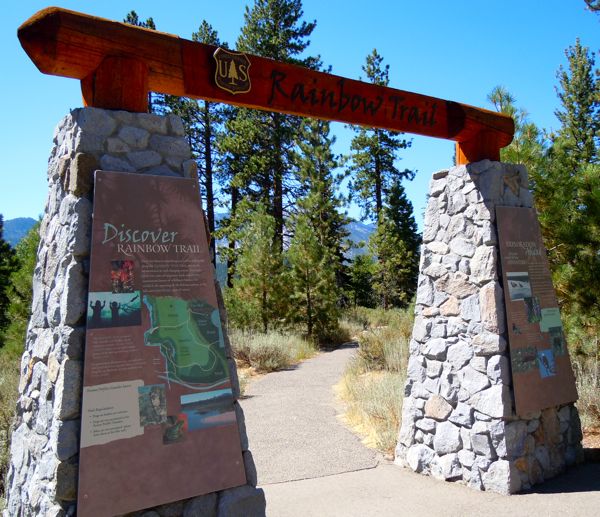
During the summer, expect to see high school students who are part of the 4-year-old Generation Green program leading tours from the Rainbow Trail to the Tallac Site, talking about trees, forest ecology, history and cultures of the area.

In a separate program, K-2 students get outside each year in what’s called Outdoor Explore where they follow the Lam Watah trail in Stateline to Nevada Beach. This group may eventually be incorporated into Children’s Forest.


Study: Nevada one of the most corruptable states

By Anjeanette Damon, Las Vegas Sun

Evil doers looking for public officials to corrupt should put Nevada on their list of hunting grounds.

The Silver State emerged as the ninth most corruptible state in the nation, according to an exhaustive $1.5 million yearlong investigation by a partnership of public integrity organizations.

Investigators rated states on 15 indicators of public accountability and transparency in an effort to gauge the risk of corruption in the three branches of state government.

Nevada failed on nearly every indicator, including ethics enforcement, lobbying transparency, internal auditing and pension fund management.

Nevada’s overall grade: a dismal D-minus.

Read the whole story


Opinion: Importance of leading a child to healthy eating

By Sadie Barr

Something curious happens when we reduce fat, sugar and salt from school food and replace it with less processed options – kids won’t eat it.

Their over-salted, hyper-sweetened and fat-laden palates have been primed by years of beige and orange food in the lunchroom to shun anything that tastes like real food. They are rebelling against the absence of chicken fingers, French fries and tater tots. Unfortunately, some schools listen.

As someone who works in school lunchrooms in Washington, D.C., where the school-food requirements are much stricter than the national standards thanks to the Healthy Schools Act, I see this every day. Just last week, I was at an elementary school when butternut squash was served. Hardly a child would touch it. When I asked students why they weren’t eating it, they claimed that they didn’t like it. When prodded, most would admit that they had never tried it. Once I explained to them what it was, how the beta carotene can help them see in the dark (white lies never hurt), and bribed them with stickers, they tasted it, and many exclaimed: “It’s good!”

It is hoped that they’ll eat it the next time with minimal prodding.

Sadie Barr manages school meal programs for 15 public and charter schools in the Washington, D.C., area.

Read the whole story


Help for first time homebuyers in El Dorado County

With mortgage interest rates below 5 percent and housing prices at record lows, local first time house hunters with modest incomes may benefit from El Dorado County’s First Time Homebuyer Loan Program.

The El Dorado County Health and Human Services Agency’s Housing Program has received $800,000 from the state’s Home Investment Partnerships Program fund to provide low-interest rate deferred payment loans to eligible homebuyers to help with the purchase of a home in the unincorporated areas of El Dorado County. Funding for this program is provided through the California Department of Housing and Community Development HOME Program and the County’s revolving housing loan fund.

Eligible applicants must provide a down payment, the greater of $2,500 or 2 percent based on the purchase price of a home. Individuals must also qualify for a fixed-rate 30-year first mortgage through a commercial lender and have a total household income at or below 80 percent of the area median income based on household size. With a few exceptions, eligible applicants cannot have owned a home or been on title to real property within the last three years. Current annual maximum household income limits are: one person, $42,650; two persons, $48,750; three persons, $54,850; four persons, $60,900; five persons, $65,800; six persons, $70,650; seven persons, $75,550; eight persons, $80,400.

The loan program includes loan amounts up to $80,000 at 3 percent interest with payments deferred for 30 years. Loans are available while funding lasts to eligible buyers on a first-come, first-served basis after completing an application process.

For more information about this program, go online or call (530) 642.4864.


Snowboarder dies at Sugar Bowl

A snowboarder died at Sugar Bowl Resort on Monday.

No personal information about the victim has been released.

The boarder was in the Crow’s Peak area of the Lake Tahoe area resort.

“Ski Patrol performed first aid and transported the individual to the base area, where a helicopter and paramedics were standing by to provide emergency transport to the hospital. The snowboarder was pronounced dead before transport,” a resort spokesman said in a statement.

Placer County sheriff’s deputies are investigating the cause of the March 19 fatality.

— Lake Tahoe News staff reporter