Sand Harbor parking, kayak access concern beach-goers

By Anne Knowles

CARSON CITY – Capacity and kayakers top the list of issues to be addressed in the Lake Tahoe Nevada State Park general management plan update.

The Nevada Division of State Parks had meetings this week with interested agencies and the public to get input on the blueprint for managing the park that runs along the East Shore of Lake Tahoe, from Incline Village to Spooner Lake, and contains the popular Sand Harbor beach and miles of hiking trails.
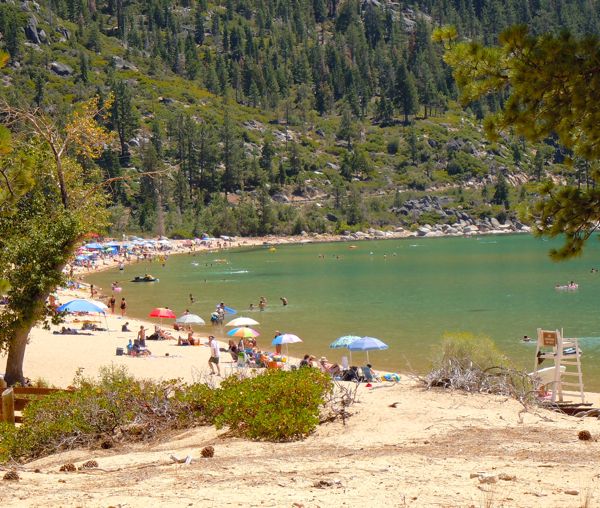
Bus access to Sand Harbor may ease parking issues. Photo/LTN file

The update, which will revise the current plan done in 1990, will cover everything from natural resources to recreation as well as fiscal management of the park. The division plans to produce a draft by the end of this summer, followed by a 30-day review period with another public meeting, and a final version by the end of the year.

First on the list of challenges is Sand Harbor beach, which on summer days quickly fills up, causing cars to back up on Highway 28 and creating a public safety hazard.

“Capacity at Sand Harbor is a huge issue for us,” Jay Howard, park supervisor III at Lake Tahoe Nevada State Park, told about 100 people during the public meeting. “We close the gates as soon as it is full and may reopen them at 3(pm), but we don’t have the staff to open, close, open, and close the gates.”

Inadequate staffing is a problem that may not be resolved any time soon due to budget constraints. In the last two years, the Nevada parks division has cut staff in department offices and the state’s 25 parks by 60 percent.

“It’s a challenge, but we have found some opportunities,” said Dana Dapolito, environmental planner with California Tahoe Conservancy, who attended the meeting the Nevada parks division hosted for agencies. “What it has done is made us more creative in pursuing public-private partnerships.”

CTC, while it operates in California, is interested in what Nevada State Parks does because the two agencies jointly run Van Sickle Bi-State Park on the South Shore. A general management plan for it was created in 2005.

To address the capacity problem on the East Shore, the Tahoe Transportation District is launching a shuttle bus service between Incline Village and Sand Harbor. Scheduled to start in mid-June, the service will run two to three 40-foot buses with room for people and gear back and forth between the sites. Tickets are expected to cost $3.

Howard said the location of the Incline Village bus stop is still being worked out because it will need adequate parking.

If successful, the East Shore Express will be extended to Spooner Lake, taking in Chimney Beach where parking is also is short supply, said Howard.

Meanwhile, a 1.5-mile zone around the entrance to Sand Harbor is being marked to deter people from parking on Highway 28, said Howard. Signs going up before the summer season will clearly delineate the area and warn drivers of a $115 fine for parking there.

Howard said the division will monitor for overcrowding at Sand Harbor, but he expects attendance to remain about the same as people deterred by fines along the highway will be replaced in equal numbers by beachgoers who take the shuttle bus to the beach.

Sand Harbor has another capacity conundrum: kayakers. Kayakers must use the boat launch, where parking is limited, because kayaks are a hard-bottomed boat which cannot be launched from swimming beaches.

“There are only 14 places to park,” said Lola Mitchell, an Incline Village resident and kayaker who attended the meeting. “So we need new access. They are talking about letting them access the beach.”

Howard said a designated launch for kayaks and paddleboards – another hard-bottomed vessel — on the beach is being considered but nothing has been decided yet.

Paddleboards are competing with kayaks in popularity and visitors are requesting the park add a concession for renting the boards, said Curtis Appling, principal with Ascent Environmental, a Sacramento-based environmental planning firm hired by the parks division to develop the general management plan.

During the public meeting, at a series of information stations for different parts of the park, the division was writing down concerns and suggestions from the public. At the Sand Harbor station, for example, one attendee suggested requiring reservations to reduce traffic jams. At the station for the Spooner Lake backcountry, mountain bikers said visibility is poor on the path dedicated to bikes.

Another issue of concern to the division and public alike is fuels management and indentifying priority areas, such as Tunnel Creek, where ladder fuels in dense forested areas can develop. The division’s plan is to control it through hand thinning and controlled burns.

Howard said the agencies that met with the division at a separate meeting voiced concerns about fuels management as well, and about protection of certain species including bald eagles, mountain beaver and Northern Goshawk.

Officials said information on the developing general management plan would be posted at the parks division website.



Opinion: Caltrans listens to residents regarding speed limits

To the community,

I just finished my meeting with Jody Jones and Andrew Brandt from Caltrans. Apparently our concerns were heard because Caltrans is modifying its recommendation regarding speed limits.

In Meyers, from Hopi to right above Arapahoe the speed limit will remain the same 40 miles per hour. The entrance to Meyers to Hopi is being classified as a transition zone from the 55 miles per hour as you come down from the summit to the 40 miles per hour beginning at Hopi. For this four-tenths of a mile, the speed will increase from 40 to 45 then it goes back down to the 40.

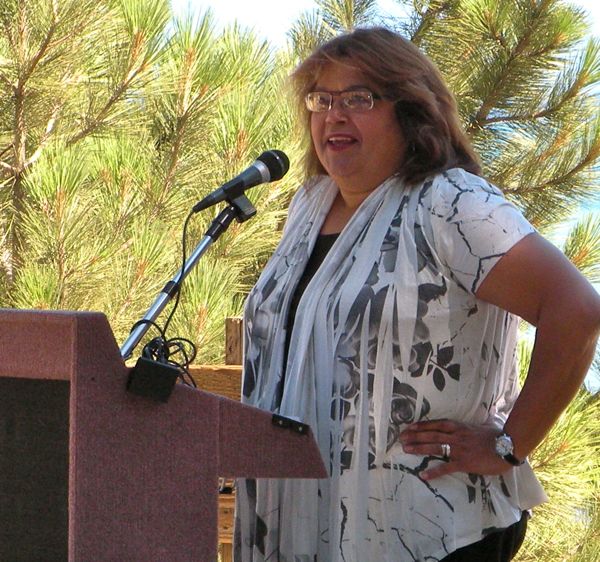
Norma Santiago

A little beyond Arapahoe where the speed limit is currently 50 it will increase to 55 until you get into the city where it will transition to 45 then to 40 until before you get to Stateline where it will remain 35.

In its evaluation, Caltrans does take into account those optional considerations noted in the federal law; however, combined with the other considerations the most they can reduce the speed limit is 5 miles per hour. So unless something dramatically changes in driver behavior or geometrically along the highway, these are the speed limits.

However, understand that by 2014, given the road projects that Caltrans has planned, the study will be repeated and the speed limit will be adjusted accordingly. Included in those plans are a class 2 bike trail on Highway 50 through Meyers; a pedestrian crosswalk across Highway 50 that is going to be sited between Apache and the bug station; a pedestrian button at Pioneer Trail and Highway 50.

While I know this isn’t all we wanted, however, most important, we were successful in convincing Caltrans to keep the Meyers commercial core at 40. As we move through the implementation of the Meyers Community Plan, we will continue to arm ourselves with the community design that further merits additional decreases in speed.

I want to thank all of you for your ongoing support throughout this process. I will continue to pursue changes in legislation that reflect further considerations, for example when the law refers to environmental considerations, it speaks to what is actually on the road in terms of buildings, storefronts, etc. There is no consideration given to how higher speeds effect air quality.

Additionally, I would like to see Caltrans adopt the USLIMITS methodology for setting speed limits which affords greater flexibility. Unfortunately, all this has to go through the legislative process which takes time, but I am hopeful for the change.

The new signs should be up in mid-April.

Again, thank you everyone for your support.

Norma Santiago, El Dorado County supervisor


Calif. Indian casinos taking financial toll on Reno resorts

By Dale Kasler, Sacramento Bee

One of Reno’s splashiest resorts is fighting to stave off financial disaster as Northern California Indian casinos continue to grab market share.

The Silver Legacy Resort was supposed to reinvigorate Reno’s gambling industry when it opened 17 years ago. Its $300,000 laser-light show, illuminating a 120-foot-high silver-mining rig looming over the casino floor, was hailed as a tourism draw for the whole city.

Instead, the resort is in danger of becoming the latest casualty of Northern California’s tribal gambling boom. The Silver Legacy has scrambled in recent weeks to avoid default on a $142.8 million bond.

The debt came due March 1, but repayment was extended for two weeks, to last Thursday. As the latest deadline passed, the downtown casino’s owners said they were making headway on negotiating with bondholders to restructure the IOU.

While it appears the resort could stay open, it’s a painful reminder for Reno of how its casinos have fallen victim to the explosion of Indian gambling. Ken Adams, an industry consultant in Reno, said Thunder Valley Casino in Lincoln is the main reason the Silver Legacy is in trouble.

While the weak economy has hurt, “the real story is Thunder Valley – it’s that simple,” Adams said Monday. “Thunder Valley and its peers took away a significant portion of the revenue from Reno.”

Read the whole story


Bowman to give clinic to young snowboarders at Sierra

Dew Tour champion, X-Games silver medalist, South Lake Tahoe local, and professional skier Maddie Bowman will be hosting an introduction to freestyle skiing class this weekend at Sierra-at-Tahoe — her home resort.

Bowman will educate Sierra Resort Rippers, children ages 5-12, on everything from terrain park safety to freestyle skiing.

Maddie Bowman

She will also talk to the Rippers about her journey from Sierra to the X-Games podium.

Bowman will ski with the kids on March 24 and March 25 from 1-3pm in the Burton Progression Park located on Broadway trail.


3-day academy for skiers, riders at Heavenly

For three days, the best of the best in snowsport education will share their knowledge in an exclusive clinic at Heavenly Mountain Resort.

Michael Rogan, Robin Barnes and Josh Spoelstra, all Professional Ski Instructors of America or American Association of Snowboard Instructors National Demo Team members, will work with skiers and snowboarders at the Peak Performance Academy from March 26-28.

The Peak Performance Academy will pair participants with elite ski and snowboard instructors for an all-mountain clinic that focuses on steep and mogul techniques, video analysis, high-end riding and off-piste tactics, as well as addressing personal goals.

Registration is $1,550 and includes three nights lodging at the Marriott Grand Residence Club in the Heavenly Village, a three-day lift ticket, daily on-mountain lunch, hosted après party, and a dinner on March 27. Book online.


Don’t depend on a doctor being at sporting events

By Erin Beresini, Outside

Peter Hass had been running for about two hours when he collapsed at the finish line of San Francisco’s Kaiser Permanente Half Marathon last February. The race’s only medical team, which included chiropractors but no M.D.’s, had been called away to deal with another emergency, so a doctor who happened to be running the race performed CPR. Meanwhile, the race announcer issued calls for help over the loudspeaker. The nearest city paramedics arrived 22 minutes later. By the time they reached the 36-year-old Hass, it was too late.

Last year, 13 Americans died during running races, and another eight while competing in triathlons. While those numbers might seem troubling, the deaths are attributable mostly to the booming popularity of endurance sports—13 million Americans enter running races each year, and 2.3 million compete in triathlons. But the rising participation and the proportional death toll—especially in cases like Hass’s—highlight the need for quality medical care at these events. And usually that care comes from volunteer doctors.

At least it used to. More and more doctors are refusing to donate their services, and it’s for one frustrating reason: they can’t get medical-malpractice insurance. Most doctors’ insurers typically won’t issue one-day policy riders for sporting events, and race organizers haven’t stepped up to offer alternative coverage. After the 2008 Ironman World Championships, volunteer medical director Franklin Marcus famously resigned because race organizers had refused to offer coverage.

While some doctors are still willing to volunteer, many events have been dangerously understaffed. Kathy Matejka, event-services director for USA Triathlon (USAT), the official governing body of the sport in the U.S., acknowledged that doctors have been unable or unwilling to take on the risk of volunteer service absent the umbrella of malpractice coverage. The result “was compromised medical support in some instances.”

The truth is, individual physicians may not have much to fear. Outside was unable to find any American doctor who’d been named in an event-related lawsuit. This is because plaintiffs typically go after race organizers, who have deeper pockets.

But while the risk of lawsuits may be overblown, the threat of not having enough qualified doctors on hand is very real. One man attempting to fix the problem is George Chiampas, president of the World Road Race Medical Society and medical director for the Chicago Marathon since 2007. Chiampas, who notes that Good Samaritan laws cover doctors only if they’re bystanding fans and not official event volunteers, teamed with USA Track and Field and sports insurance company ESIX to create policies specifically for volunteer medical teams. Beginning in 2009, all five major U.S. marathons — Chicago, New York, Twin Cities, Boston, and Houston—bought the plan, at a cost of $50 to $60 per doctor. USAT began offering the program last year.

Read the whole story


OPEN fundraiser

OPEN’s annual burger night fundraiser at Ernie’s is April 11 from 5-7 pm.

The wait staff are volunteers, so tips are appreciated. For $10 people get a burger (regular, with cheese, or veggie), fries and a soft drink.

OPEN — Ordinary People meeting Extraordinary Needs – helps support the medical needs of people on the South Shore.

Ernie’s is on Emerald Bay Road in South Lake Tahoe.

Tickets cannot be purchased at the door. To purchase them, call David Kelley at (530) 577.8012 or email coke.thesubstitute@gmail.com.


Art reception, poetry slam and reading

Bona Fide Books is hosting an art reception, poetry slam and reading for Reno-based poet and artist Benjamin Arnold on April 7, 7-10pm at Bona Fide HQ.

This event is free and open to the public. Singer-songwriter Athena McIntyre of Rockin’ Minerva will provide music starting at 9pm.

This interactive National Poetry Month kick-off will feature an “imPROMPTu” poetry slam. Participants are given paper and a pen — no existing poems are allowed — then given 10 minutes to create a poem to slam. There will be three rounds of competition, and the judge-selected winner gets to choose one of Arnold’s prints as a prize.

The art reception will feature Arnold’s latest work, including digital art printed on aluminum, broadsides, “smallsides” and acrylic and oil paintings.

Benjamin Arnold is a teacher, poet, writer, and artist living in Reno. He is the author of “Synaptic Traffic: Intersections of Prose & Poetry”.

Bona Fide HQ is located at 1069 Magua St., No.4, behind the Getaway Café in Meyers.

For more information on this or other Bona Fide events, contact Kim Wyatt at editor@bonafidebooks.com.


Snippets about Lake Tahoe

• Judith Chow, a professor at the Desert Research Institute in Reno, received the Sanqin Friendship Award for her research on how pollution is affecting China’s famous terracotta soldiers.

• Live Violence Free’s fourth annual Bowl-A-Thon is April 25 from 6-8pm at Tahoe Bowl in South Lake Tahoe.

• All parents delivering at Marshall and Barton hospitals are eligible for a free home visit for their newborn. A registered nurse can talk to you about your baby’s health, your health, and ways to connect with your community. Call Marshall Medical Center at (530) 626.2770, ext. 2315 or Barton Memorial Hospital at (530) 543.5547.

• Volunteer drivers are needed to deliver meals for the El Dorado County Senior Nutrition Program weekdays between 10:30am and noon. For more information, call (530) 621.6160.

• Tahoe Truckee Earth Day will be celebrated April 21 at the Village at Squaw Valley from 11am-5pm. Truckee is co-sponsoring a free collections of electronics, tires and batteries from 9am-2pm in the parking lot at the Village at Squaw Valley.


Helmet technology advances worth new purchase

By Kelly Kaoudis, SKI magazine

Last season, 1.3 million snow sports helmets were sold in the U.S., up three percent from the year before and 25 percent from the 2008–’09 season. Even in one of the toughest snow and retail years in recent decades, helmet sales continue to rise.

The consistent upward trend can partially be attributed to innovations in comfort, fit, and protection, according to Kelly Davis, the director of research at Snowsports Industries America (SIA). While safety experts agree widespread helmet use has reduced the frequency of serious head injuries, today’s lids don’t eliminate all the risks. In fact, in some cases, relatively low-impact falls and collisions can be just as dangerous as plowing into a blue spruce or landing a cliff-drop on your cranium.

A typical helmet disperses about 75 percent of the force of a direct blow to the head, though the impact may still be fatal, according to Dr. Jasper Shealy, a professor specializing in human factors engineering at the Rochester Institute of Technology and a helmet expert.

“Research shows that a [traditional] helmet can reduce brain injury if an incident involves a direct impact with a fixed object like a wooden post [or a tree],” said Shealy.

Read the whole story