Lecture about musculoskeletal ultrasound in sports medicine

Jonathan Finnoff, medical director of Barton Health’s Rehabilitation and Sports Medicine, will give a lecture on musculoskeletal ultrasound in sports medicine April 4, 6-7pm at Lake Tahoe Community College.

Anyone who has an interest in musculoskeletal injuries (e.g., joint, tendon, ligament, bone, or muscle) is encouraged to attend. Topics include: how ultrasound works and the advantages and disadvantages of ultrasound in relation to other imaging studies such as X-ray, MRI and CT scanners. The presentation will use a “case-based” format to demonstrate the utility of ultrasound.

The event is free.


Robins struggle to survive in spastic Tahoe weather

By Tom and Cheryl Millham

Robins are a species that migrate to Lake Tahoe in the early spring to nest and raise their young. Then, they leave in the fall, back down to the lower elevations.

So, what is the problem?

Well, in February and early March, as you will remember, the Lake Tahoe Basin had spring-like weather and temperatures. Because of this unseasonably warm weather the male robins thought it was time to head to the higher elevations such as Lake Tahoe to begin setting up territories for the soon to follow females.

They were doing fine until it started to snow.

Robins are ground feeders. They run around the ground pulling up worms or other insects. They also eat fruit — never seed — and berries.

Lake Tahoe Wildlife Care started receiving calls after the first blizzard about robins which were standing around in the snow with no food and what could people feed them.

Here is the list if you would like to help them survive the snowstorms. On your back deck, throw out blueberries, cranberries, grapes and/or raisins. We have one robin that comes down to get raisins, even before we close the sliding glass door.

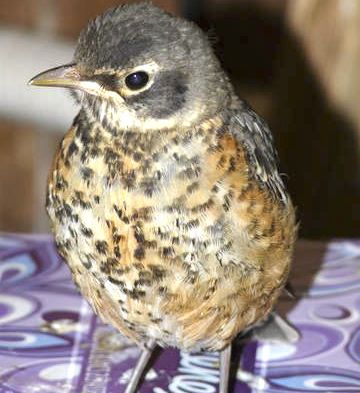
A baby American robin. Photo/LTWC

If you have a robin attacking a low window or sliding glass door (and I do mean attacking), you need to help in a hurry. We have seen robins that have attacked windows/glass so viciously that they have made their bill bleed. They have not gone “mad” or “crazy”.

Here is what is happening. The male robins come up to Lake Tahoe first to set up their territories. When the females arrive, they can entice a mate to come to their area. If the reflection is right, this male robin sees, what he thinks is another male robin. When, in actuality, he is just seeing himself and attacks the “new” male.

Birds do not understand glass or mirrors. So, all you have to do is tape up a single piece of paper on the outside of the glass so the robin cannot see himself. He then thinks that he chased away the other male robin and he is happy again. In a few days, you can take down the paper.

Tom and Cheryl Millham run Lake Tahoe Wildlife Care on the outskirts of South Lake Tahoe.


Snippets about Lake Tahoe

• While sports pages are filled with teams swapping quarterbacks, Vikings quarterback Christian Ponder is thinking about golf. He is one of the new players committed to the July 17-22 annual American Century Championship golf tournament in Stateline. Other “rookies” are New York Giants Super Bowl champion defensive-end Justin Tuck, Baltimore Ravens running back Ray Rice, Dallas Cowboys tight-end Jason Witten and former New York Yankees and Oakland A’s slugger David Justice.

• The March 12 issue of Newsweek magazine talks about 150 fearless women in the world, with Jennifer Siebel Newsom, who recently spoke in Squaw Valley, and Jaycee Lee Dugard making the list.

• Heavenly and Kirkwood have extend their seasons to be open the weekends of April 20–22 and April 27–29, 2012, weather and conditions permitting. They are open seven days a week through April 15.

• Some South Shore businesses are participating in a Good Neighbor Donation Day on March 31 from 10am to 3pm. More information is online.

• Day of the Young Child is June 9 from 10am-2pm at Lake Tahoe Community College. Click on the flyer for more information.


3-day photo workshop combines STHS facilities with Tahoe scenery

Lake Tahoe’s inaugural state-of-the-art Digital Photography Institute will take place June 29, 30 and July 1 on the South Shore.

After shooting the natural beauty of Emerald Bay, Taylor Creek, Hope Valley and Lake Tahoe, participants will have access to the newly constructed $65 million facilities at South Tahoe High School. The Tahoe Arts and Design Academy includes Mac labs, cutting edge software, experienced instructors and trained staffs.

Institute participants will begin their photography adventure June 29 with keynote speaker Tim Peare, a professional snowboarding photographer.

All proceeds from the $750 three-day workshop go to support student scholarships and grant funding through the nonprofit Lake Tahoe Educational Foundation. Registration ends May 31.

For more information or to register, go online.


Opinion: Dangers on slopes can be manmade

By Dick Penniman

Have you ever hit a tree while skiing? It doesn’t take much to imagine what it feels like. It hurts, but worse … it can kill you. That’s why most skiers and snowboarders stay on open, groomed trails.

What about hitting a lift tower, a signpost or a snowmaking gun? Is it the same as hitting a tree? The answer is “No!” These are “manmade” structures scattered along the groomed trails, and they are usually made of steel. Clearly, a 3-inch steel pipe can cause more serious injuries than a 3-inch sapling.

And what about those brightly colored mats used by most resorts. Do they offer adequate protection? Again, the answer is “No!” In California, there are no laws or regulations requiring resorts to pad or protect anything. The 3-inch to 4-inch mats most resorts use on lift towers are far too thin to offer any protection beyond collisions of just a few miles per hour. These mats look like pads but barely protect the obstacles, themselves, from getting scratched.

Why pad anything? Shouldn’t we just steer clear of obstacles? We’ve all seen the cartoons that show a character flattened upright against a tree with arms and legs wrapped around it. They always get up and walk away. But that’s in the cartoons and not the way collisions happen in real life. Nearly all collisions with fixed obstacles result from sliding into the object after a simple fall on icy snow. It’s not funny and, tragically, real people often can’t get up and walk away.

Kids are particularly at risk because:

• They go fast, fall more often and don’t have as much control over where and how they fall. Teach your child to ski or ride slower, particularly when it’s icy.

• They are not very aware of their surroundings. Teach your child to steer clear of every fixed object on the slopes, even if they look like they’re padded. I’ve seen kids intentionally run into padded lift towers thinking it would be funny because they would just bounce off. Sadly, they learned a “hard” lesson.

In addition, check if your favorite resorts are doing anything seriously to reduce collision injuries. Review the California Mountain Resort Safety Report online. The report includes an assessment of almost every California resort and gives you information that will help you compare them and decide which resort is best for you and your family.

Dick Penniman is the chief research officer of the SnowSport Safety Foundation.


Permanent location to rehab wildlife in LTWC’s sights

By Kathryn Reed

MEYERS – If it’s true getting a step in the door is the hardest part to realizing a dream, then that step may have literally been taken this month by the Lake Tahoe Wildlife Care board of directors based on where they conducted their meeting.

They met in a house at the bottom of the Old Meyers Grade in what is now a vacation rental. But that nearly 3,700-square-foot house on those 16-plus acres that back up to U.S. Forest Service property is on land zoned recreational/commercial and comes with 130,000-square-feet of coverage. That could make all the dreams of the Millhams come to fruition.
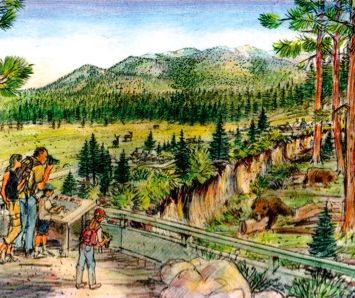
A conceptual drawing of what the bear facility at Lake Tahoe Wildlife Rehabilitation and Education Center could look like.

For 34 years, Tom and Cheryl Millham have been operating the animal rehabilitation center. The animals are in cages in their back yard. They function with a special use permit from El Dorado County.

They are tired. They want to enjoy their retirement by not being tied to the phone to rescue animals, care for them and then release them.

While in many ways they are a mom-and-pop operation, Cheryl Millham’s knowledge is coveted. She is often asked to be a guest lecturer. She knows how migration patterns have changed over the decades; she knows what animals were here 30 years ago are no longer here. She is a wealth of information.

The Millhams work closely with the state Department of Fish and Game, especially with bear releases. Another cub is slated to go back into the wild this week near San Luis Obispo.

But the Millhams have had their dreams dashed before. Parcels have come and gone as possible locations. Not only do they want to move their operation, but also expand it to include a larger education center, a place to have conferences, and a sanctuary to let the animals that cannot be released call home.

The board is hoping this was the first of many meetings in a permanent home.

“This is the closest now to having a done deal,” Tom Millham told Lake Tahoe News. And even now the deal is far from being done.

Before the nonprofit is on the deed, the money needs to be secured for the property that is listed at $1.99 million. This is less than the $5 million the owners wanted in 2007.

“They are open to being creative,” Rene Brejc, who is listing the property, said of the trust that owns the property.

Tom Davis, who is on the LTWC board, pointed out that how the center has operated for the past 34 years is not how will be able to operate in the next 34 years. He said veterinarian officials from UC Davis have expressed an interest in having a teaching component at the center about wildlife.

Talk that night was about how perhaps a foundation or investors need to be sought and a significant fundraising drive initiated.

Beyond the payment for the property, significant improvements need to be made – from parking, to building cages, to upgrading the water system.

The property now uses a well, but with the type of facility the Millhams envision, officials would require the center serviced by South Tahoe Public Utility District. This would help it better comply with fire regulations as well.

Jumping through county and Tahoe Regional Planning Agency hoops could be problematic. Preliminary discussions with both agencies have taken place.

There have been meetings where planning officials have said they worry about how much soil a 300-pound bear will compact at the wildlife center. This, despite the fact that bears and other wildlife roam the woods everyday without any apparent degradation to Lake Tahoe’s clarity. And plenty of hefty people compact soil, too, and they aren’t told to stop doing that.

El Dorado County Supervisor Norma Santiago, who was at the board meeting, said she would not let the county be a stumbling block. She is also on the TRPA Governing Board.

Julie Regan with TRPA, when contacted by Lake Tahoe News, said, “It’s important to find a solution that works. (LTWC) is an important community asset. When El Dorado County brings forward their local area plan, I’m sure they would want to look at what land use changes would come after the adoption of the Regional Plan.”

While other places have facilities like what the Millhams and the LTWC board envision, one does not exist in the Lake Tahoe Basin.

Mike Dill with Aspen Environmental Services along with the Millhams has met with TRPA and county officials. Issues like needing to fence the entire property could be a stumbling block. The fact that TRPA does not allow accessory uses for entities falling under “public health and safety” is another issue. The building permit expires this fall.

It has been agreed a bridge that would hold the weight of a golf cart could be built across Echo Creek.

Despite the hurdles, the Millhams, board members, the consultant, the county supervisor and the real estate agent agreed on two things – Lake Tahoe Wild Care would not close and a solution would be found.



Truckee to launch summer air fair

The Truckee Tahoe Airport is soaring to new heights with the inaugural Truckee Tahoe Air Fair & Family Festival in July.

The last air shows at the airport were from 1974-96.

On July 7, from 7am to 4pm there will be periodic fly-bys; large static aircraft displays; pilot docents; hot air balloons (weather permitting); free Experimental Aircraft Association (EAA) Chapter 1073 Young Eagle flights for youths ages 8 to 17; live music; kids activities; a food court, beer garden, souvenir and craft vendors and more family fun.

Scheduled to be on display are a large variety of aircraft from military, experimental and general aviation. Several of the original Tuskegee Airmen will attend as grand marshals.

The Truckee Tahoe Air Fair is looking for interesting aircraft to put on static display in addition to vendors. To participate, contact Tim LoDolce at flyingtiger17@gmail.com or phone (530) 386.3100.

This event is free, and all proceeds from sponsorships and vendor sales go toward local youth programs, activities and scholarships.

The event will take place at the Truckee Tahoe Airport located at 10356 Airport Road, Truckee.


Meyers Community Plan meeting

A community meeting hosted by El Dorado County Supervisor Norma Santiago will take place April 4 from 6-8pm at the Lake Tahoe Environmental Science Magnet School in Meyers.

This meeting will be a first step toward implementing an update of the Meyers Community Plan. The agenda includes a presentation by Santiago in which she will review major components and past processes along with identifying current community assets.

She will then ask for community input and unveil an implementation strategy which includes funding opportunities and next steps.


Opinion: Explaining what the ‘****’ talk is all about

By Kristin Luker

I was a first-year graduate student at Yale in the late 1960s and had been called into the room of a faceless bureaucrat. What I mostly remember about the man was how gray he was: gray eyes, gray hair, garbed in the traditional Ivy League charcoal-gray suit.

He told me that the fellowship I was on was being dropped, and I needed to switch to another one. The problem, it seemed, was that I was eligible for two fellowships; one roughly the equivalent of what I had, and one much more generous. After looking at me for a long moment, he summarily dismissed the very idea of awarding me the better fellowship. “Well,” he said, leaning over the table so he could explain the facts of graduate school life to me, “we absolutely can’t give you that fellowship. You might get pregnant and get married.” And yes, he did say it in that order.

Note what he didn’t say. He didn’t say that I might choose to become pregnant, or that such a question never arose when male graduate students were under consideration. (I know because I asked them.)

And that’s what all this slut talk is really about.

Kristin Luker, a professor of law and sociology, is the founder of the new Center on Reproductive Rights and Justice at UC Berkeley School of Law.

Read the whole story


Truckee Donner PUD has money for businesses

The Truckee Donner Public Utility District is continuing efforts to help local business owners save on energy bills by covering part of a lighting upgrade cost. This includes a “last chance” opportunity to receive a rebate to replace old, inefficient T12 fluorescent lamps and magnetic ballast lighting with new, cost-effective fixtures.

Fluorescent T12 lamps and magnetic ballast started being phased out by federal regulatory bodies as of July 2, 2010. The TDPUD’s commercial lighting rebate program covers one-third of the cost for businesses to upgrade to high-efficiency T8 lamps and electronic ballasts or better. By switching out the old T12 lights with more energy efficient lights, businesses can reportedly see as much as 33 percent in energy savings, which can translate to hundreds of dollars of savings per year.

This rebate program on T12s is being phased out this year. After Dec., 31, 2012, the TDPUD will no longer be able to provide rebates on T12s. The total commercial lighting rebate limit is $10,000 per customer. If a proposed project cost is greater than $30,000, businesses can contact the TDPUD conservation staff to discuss rebate opportunities.

The TDPUD has helped 75 local businesses and agencies invest in cost-effective lighting projects by providing more than $250,000 in rebates in the last three years. These 75 combined projects will continue to save more than $250,000 per year. That translates to 2 million kilowatt-hours of energy saved.

The TDPUD offers many commercial lighting programs which help businesses be energy smart and save money. Commercial TDPUD customers can draw upon any of these four programs to save precious cash each month:

· Commercial Lighting Rebate Program: Replacing old fluorescent tube lights and magnetic ballast lights is not only energy smart, but it saves money. This program allows businesses to upgrade to a wide variety of high-efficiency commercial lighting. Contact the TDPUD to learn more or to find out if your commercial lighting project qualifies.

· Business Green Partners: The TDPUD offers free screw-in CFL and LED lights for Truckee business owners to install themselves.

· LED EXIT Sign Retrofit Program: Available to any TDPUD electric business customer, this program offers a free exit sign light retrofit. This includes free installation by a TDPUD contractor to replace exit sign incandescent or fluorescent lights with high-efficiency LED Lights.

· LED Building Accent Lighting Program: The TDPUD will provide free LED light bulbs to Truckee businesses to replace accent lighting on store windows, roof eaves or trim. Businesses interested in this program should contact the TDPUD, which offers free LED replacement bulbs for these strands.

For more information on these and other money-saving conservation programs, contact the TDPUD Conservation Department at (530) 582.3931.