3 Truckee men accused of burglary

Three Truckee men were arrested March 28 on burglary charges.

A second homeowner four days earlier had reported his house ransacked, with skis, snowboards and distinctive-rare alcohol missing.

A Truckee officer patrolling the area noticed a pair of the reported stolen skis at a house near the victim’s.

A search warrant reportedly led to additional items located inside and outside the residence. The three occupants arrested were Benjamin Feathers, 22, John Schilder, 20, and Nicholas Carlozzi, 19.

 — Lake Tahoe News staff report


Stockton chiropractor dies snowmobiling near Truckee

By Keith Reid, Stockton Record

A Stockton chiropractor who dedicated decades of his life as a University of the Pacific booster, as a youth basketball coach and to local service clubs died Saturday in a snowmobile accident in Truckee.

James Darnall, 55, was with friends at a popular recreational area Saturday five miles off Highway 267 in Truckee. Emergency response teams were dispatched to the area just after 3pm to a call that Darnall had driven a 2011 Ski Doo snowmobile eastbound into a tree, California Highway Patrol Truckee office manager Terri Fisher said.

Darnall is remembered by his friends and family as a kind and caring man who was an Eagle Scout in high school, a dedicated husband to Carrie and father to daughters Colleen, 26, and Melanie, 24.

A 1978 Pacific graduate who played tight end on the university’s football team and catcher on the baseball team, James Darnall became active in the booster club after becoming a successful chiropractor.

“For 30 years, he’s been active as a booster and Rotary Club member,” Carrie Darnall said. “He was a caring doctor for his patients, a good family man and a good father.”

In the aftermath of the Sept. 11, 2001, attacks in New York, Darnall felt it was his duty to fly east to volunteer his services as a chiropractor. He spent several late-night shifts helping volunteers and public safety workers with their physical ailments.

Read the whole story


Wells Fargo in South Lake Tahoe robbed

South Lake Tahoe police officers are looking for a man who they believe robbed a bank Thursday morning.

The suspect demanded money from the teller working at the Wells Fargo Bank inside Raley’s at the Village Center. He did not use a gun during the 10:10am March 29 robbery. Officers are not disclosing how much money was stolen.

Officers are looking for this man in connection with a March 29 bank robbery in South Lake Tahoe.

The suspect is described as a white male, in his 20s, with a light mustache and goatee. The suspect wore a black hooded sweat shirt, dark sunglasses, dark pants and black shoes.

If anyone has information related to this event, call (530) 542.6100.

— Lake Tahoe News staff report


Efforts renewed to name Lake Tahoe cove after Samuel Clemens

By Cy Ryan, Las Vegas Sun

CARSON CITY — The state is considering taking another stab at naming a cove on the east shore at Lake Tahoe after Samuel L. Clemens, better known as Mark Twain. But an ill-fated campfire at Tahoe is slowing the efforts of the state Board on Geographic Names.

The state board initially submitted the proposal to name the cove. But the national geographic names board rejected it on a split vote.

Bob Stewart, a member of the geographic names board, said the board hopes to convince the U.S. Forest Service to withdraw its opposition to the name change.

As a young man, Clemens followed dreams of riches in timber and mining but won fame as the author of “The Adventures of Tom Sawyer” and “The Adventures of Huckleberry Finn.”

Clemens and friends hiked from Carson City to Lake Tahoe in September 1861 to stake a claim for cutting trees to sell the timber. While camped at the area of the cove, Clemens started a campfire to cook dinner. Stewart says Clemens left the fire unattended and the flames spread, burning in the forest. Clemens, in later letters to his family, said the flames burned only dead trees and brush.

Read the whole story


Meeting to center on Meyers Community Plan

A community meeting hosted by El Dorado County Supervisor Norma Santiago will take place April 4 from 6-8pm at the Lake Tahoe Environmental Science Magnet School in Meyers.

This meeting will be a first step toward implementing an update of the Meyers Community Plan. The agenda includes a presentation by Santiago in which she will review major components and past processes along with identifying current community assets.

She will then ask for community input and unveil an implementation strategy which includes funding opportunities and next steps.


Where was this picture taken?

Where in world is this picture from?

A story about it will be on Lake Tahoe News soon.

Until the story runs, you have a chance to win a Lake Tahoe News T-shirt if you can correctly name the city where this was taken. Just post your answer as a comment. Only people who use their full name will be eligible to win a shirt.

— Lake Tahoe News staff


Opinion: Important to help animals in hard economic times

By Irvin Cannon

Among the biggest victims of the economic recession are the once beloved family pets surrendered to shelters as their owners deal with extended joblessness. The U.S. Humane Society estimates 6 million to 8 million dogs and cats enter shelters each year – and 3 million to 4 million are euthanized.

“We don’t have firm numbers but we know anecdotally that the communities that have been hardest hit by the economic downturn are seeing that reflected in their shelter intake numbers,” says Inga Fricke, director of sheltering issues for the U.S. Humane Society.

“And, unfortunately, while the majority of the public is in favor of adopting pets from shelters, very few – usually about 20 percent – actually do. That has recently gone up slightly to the mid-20s.”

My new book “For the Love of Dog Tales” gives voice to man’s best friend, with the hope people getting back on their feet will consider adopting a shelter dog, perhaps in observance of Prevention of Cruelty to Animals Month in April.

You won’t find a better companion, whether you bring home a mystery mixed-breed or a purebred Labrador. Everyone thinks mutts are smarter and generally healthier, but really, it all depends on their mix of breeds and which breed strain is dominant.

Border collies and Rottweilers are two of the smartest breeds. But they tend to have other traits, too, which are just as important to consider when choosing what dog best suits your lifestyle. Remember – dogs are as individual as people. A dog’s breed, or breed mix, is no guarantee that it will have certain traits.

That said, border collies tend to need lots of room to run and lots of attention – they’re high-maintenance, Cannon says. If you can’t spend a lot of active time with them, they’ll be unhappy and you’ll have problems.

Rottweilers are fast learners and lovable family animals, but they also tend to have bold personalities associated with pack leaders. If you don’t think you can assert your authority, or if you have young or shy children, you might want to consider a more submissive breed. Dominant dogs that are allowed to bully their family members can become dangerously aggressive.

Here are some other tidbits regarding breeds:

• Among other dog breeds known for intelligence: Shetland sheepdogs, golden retrievers, Labrador retrievers, poodles, Australian cattle dogs, Papillons and Doberman pinschers.

• Bulldogs, beagles and Basset hounds all start with B but get much lower grades for smarts.

• It’s a myth that mutts have fewer health issues than purebred dogs. Because some breeds have tendencies toward problems such as deafness, blindness or hip dysplasia, remember, these are genetic issues that are inherited. So if you’re mixed-breed includes some German shepherd, it may also have hip dysplasia (a problem with the joint’s bone structure).

• If you’re in the market for a purebred dog, you have a 25 percent chance of finding one – although maybe not the breed you want – at a shelter. If your heart is set on a specific breed, check your area for a rescue group specializing in that breed.

Don’t forget to mark your calendar for Prevention of Animal Cruelty Month, which recognizes the 1866 charter signing of the American Society for the Prevention of Cruelty to Animals.

Irvin Cannon was a poor kid growing up in Detroit when his family took in a stray dog. It surprised young Irvin that his father would be willing to share the family’s meager groceries with a dog, but he soon discovered the return on their investment was enormous. A former police officer in Detroit and Denver, he also worked as a corrections officer in Arizona.


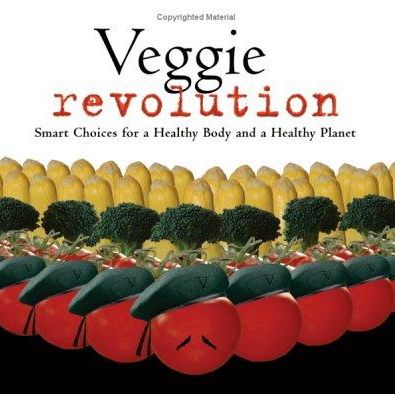
‘Veggie revolution’ may be digestable in super small doses

By Kathryn Reed

When you are part of the choir and you’re annoyed by the preaching, something is wrong with the sermon.

In this case, the sermon was “Veggie revolution: Smart Choices for a Healthy Body and a Healthy Planet” by Sally Kneidel and Sara Kate Kneidel.

The problem with this book that came out in 2005 is how it goes on and on about how horrible it is to eat meat and how much better it is to eat vegetables. No vegetarian needs to read this book – you’re already a convert. And it’s hard for me to imagine a meat eater wouldn’t start using the pages for kindling to start a barbecue to roast up some animal.

Yes, the authors talk to small farmers and show how animals can be treated humanely. But in the end, it really was a crusade to get people to stop eating animal products.

This book had potential. I think that’s what annoyed me the most when I finally finished it.

How corporations run the meat industry was the most interesting part. It was also the most alarming. Had this been the primary and only focus of the book, I would guess sales would be better, with a more diverse readership.

“More than 80 percent of the beef cattle in the United States are slaughtered and marketed by one of four big corporations.”

“Most broiler and breeder chickens in the United States are owned by eight big corporations ….”

The book goes into why big agri-business is bad for the consumer and bad for the farmer.

Had the book solely focused on the environmental aspects of meat production, it would have been better.

“According to the U.S. Environmental Protection Agency, agriculture by far is the biggest source of pollution to our streams and rivers, and a significant portion of that is runoff from hogs, poultry and cattle waste.”

“Over half the amount of water used in the United States goes toward irrigating land to grow food for livestock.”

Had the book just talked about the nutritional benefits of being a vegetarian, it would have been better.

There is lots of information in the book. Maybe it needs to be read in smaller doses than how I ingested it. Or maybe the authors should get an editor next time who can provide them with better guidance and direction.


Opinion: Obamacare, cannabis and the Supreme Court

By Steve Kubby

If you’ve been following the Supreme Court hearings regarding Obamacare, you’ve undoubtedly heard pundits and legal experts proclaiming that the Commerce Clause preempts state law, which in turn provides constitutional support for the government to require you to buy health care insurance. However, such statements are false and deliberately misrepresent the historical record.

The Commerce Clause of the U.S. Constitution proclaims: “The Congress shall have power … To regulate commerce with foreign nations, and among the several states, and with the Indian tribes.”

Steve Kubby

It would seem obvious that, if you’re growing plants for your own personal consumption, then you’re not engaged in commerce with another state, an Indian tribe, or a foreign nation. But, according to the Supreme Court, you’d be wrong.

That’s because the court ruled in Gonzales v. Raich and even growing one cannabis plant, for strictly personal use, is forbidden by federal law and the Commerce Clause.

Now that decision has become center stage in the current review of Obamacare by the Supreme Court because the federal government is relying upon the Supreme Court decision in Gonzales v. Raich, which found that consuming one’s locally grown marijuana for medical purposes affects the interstate market of marijuana, and hence that the federal government may regulate — and prohibit — such consumption. This argument stems from the landmark New Deal case Wickard v. Filburn, which supposedly held that the government may regulate personal cultivation and consumption of crops, due to the effect of that consumption on interstate commerce, however minute it may be. That may be true, but only under certain circumstances.

Lost in all the arguments presented in Gonzales v. Raich was the fact that Roscoe Filburn was a farmer who accepted New Deal federal money to limit how much wheat he grew. Filburn was caught violating his contract with the federal government by producing wheat in excess of the amount permitted. The government then sued Filburn for violating the terms of his contract, Filburn objected on constitutional grounds and the case went to the Supreme Court.

During 1941, producers who officially enrolled in the Agricultural Adjustment Act of 1938 received an average price on the farm of about $1.16 a bushel, as compared with the world market price of 40 cents a bushel. Filburn signed up for the federal program and was paid to not grow over an allotted amount of wheat. In July 1940, pursuant to the Agricultural Adjustment Act, Filburn’s 1941 allotment was established at 11.1 acres and a normal yield of 20.1 bushels of wheat per acre. Filburn was given notice of the allotment in July 1940 before the fall planting of his 1941 crop of wheat, and again in July 1941, before it was harvested. Despite these notices and a signed contract with the federal government, Filburn planted 23 acres and harvested 239 bushels from his 11.9 acres of excess area.

Filburn argued that because the excess wheat was produced for his private consumption on his own farm, it never entered commerce at all, much less interstate commerce, and therefore was not a proper subject of federal regulation under the Commerce Clause. Unfortunately, Raich failed to point out that once Filburn accepted Federal money and violated the terms of his contract, then and only then, did it become a Federal matter. Had Raich argued that Wickard v. Filburn only applied in cases where farmers had enrolled in Federal programs, signed contracts and accepted Federal money, the Supreme Court would not have had any basis to render the defective decision that they did.

Hopefully, the Supreme Court will revisit Wickard v. Filburn and recognize that only when private citizens enter into a contract with the government, and accept money from the government, can the Commerce Clause be applied.

Steve Kubby is a resident of South Lake Tahoe.


2-week book sale at Douglas County libraries

The Douglas County library is having a used book sale April 14-28 in the front lobby of the Minden and Zephyr Cove libraries during regular hours.

Paperback books, audiobooks and DVDs/VHS tapes will be on sale.

The Minden library is located at 1625 Library Lane; the Zephyr Cove library is located at 233 Warrior Way.

For more information, call (775) 782.9841.