Marketing research workshop

North Lake Tahoe Chamber of Commerce and Plumas Bank in partnership with the Small Business Development Center of Greater Sacramento/Sierra are offering Marketing Research on April 10, 9am to noon at the Tahoe City Public Utility District Board Room, 221 Fairway Drive, Tahoe City.

The workshop is geared for existing and emerging business owners. Attendees will learn the overview of the “4-P’s” of marketing, demographic and psychographic data along with industry trends.

This workshop will be followed by a series of interactive SBDC sessions that will highlight Financial Projections (April 24) and Business Plan Components (May 8), which will discuss legal structure and operation.

The workshops are free for North Lake Tahoe Chamber of Commerce members, $25/person for business association members and $50/person for the general public.

To register or for more information about the workshop, call Kym Fabel at (530) 581.8764.


Sugar Pine Foundation fundraiser

Sugar Pine Foundation is having a fund-raiser event at the Eagles Nest Lounge at the top of Kingsbury Grade on April 19 from 6-10pm.

This family event will feature a chili cook off, music, a raffle, and activities for the kids. Proceeds to benefit the Sugar Pine Foundation’s mission to save the sugar pine and other white pines from Eurasian white pine blister rust.

For more information, go online or call (650) 814.9565.


SLTPD officers enhancing patrols for those texting, using cell phones

As part of this being California’s first Distracted Driving Awareness Month, law enforcement in El Dorado County will be holding zero tolerance days for cell phone use and texting. A ticket for violating either the hands free or no texting law costs a minimum of $159, and subsequent tickets are $279.

Distracted driving is a serious traffic safety concern that puts everyone on the road at risk, joining speeding and alcohol as leading factors in fatal and serious injury crashes, according to South Lake Tahoe police Sgt. Shannon Laney.

Starting April 4 and throughout the month, South Lake Tahoe officer will join more than 225 local agencies, plus 103 CHP commands conducting zero tolerance enforcements.

Drivers who use hand-held devices are four times as likely to get into crashes serious enough to injure themselves, Laney said.


Tickets going fast for annual Elegant Evening

A gourmet dinner, raffle, silent and live auctions, music by and dancing to the Soul Experience featuring Rocky Sleight, Trey Stone, and Carlee Knight – and giving back to the community. That is what Elegant Evening is all about.

The April 21 event is a fundraiser for Soroptimist International of Tahoe Sierra.

Tickets are $50 for the 6-11pm event at Harrah’s Lake Tahoe. Tickets may be purchased online or email sitahoesierra@gmail.com.

All money raised benefits education and service opportunities for women and children on the South Shore.


Could Nevada’s ‘stand your ground’ law spark a Trayvon-like case?

By Karoun Demirjian, Las Vegas Sun

As the country tries to understand how Trayvon Martin — a hoodie-clad 17-year-old armed with nothing more than a cellphone, can of iced tea and bag of Skittles — was shot to death in Florida in February without anyone being charged, every possible culprit is being considered.

There’s the shooter, neighborhood watch captain George Zimmerman, who has offered a questionable claim of self-defense, and the conduct of Sanford law enforcement officials who decided not to prosecute.

But some of the sharpest outcry has focused on Florida’s “stand your ground” law, which justifies use of deadly force in self-defense, with no obligation to first attempt to retreat.

In Las Vegas, officials and academics are taking a close look at the Martin case, and for good reason: Nevada recently passed a law nearly identical to Florida’s, leading many to believe a similar tragedy could play out in the Silver State.

“The circumstances are ripe for a Trayvon situation to happen here,” said Sylvia Lazos, a law professor at UNLV’s Boyd School of Law. “We have a lot of crime. We have a lot of people with guns. We have a lot of people who are untrained. We have to watch it. … These combinations can be quite toxic.”

Nevada is one of 25 states, according to the Legal Community Against Violence, with a law allowing individuals to use deadly force when they feel threatened with no obligation to stand down or try to avoid violence once reasonable fear is established.

Nevada’s “stand your ground” law was approved by the 2011 Legislature and took effect in October. It allows that as long as a person who feels threatened didn’t initiate the altercation and isn’t doing anything criminal, that person can stand and use deadly force and it would be considered “justifiable homicide.”

Read the whole story


Class on dealing with bullying issues

Is your child a bully or being bullied?

There will be a training class April 16 from 5:30-8:30pm at Lake Tahoe Community College in the board room to help stop bullying.

Techniques will be provided to empower youth with methods to deal with put downs and bullying, diffuse conflicts with their peers, along with preventative methods for cyber bullying. Adolescent development will be covered.

RSVP to Dana at (916) 801.9848 or mcknight@ltcc.edu.


Placer County needs help with reviewing its charter

Placer County is seeking applications from residents interested in serving on its County Charter Review Committee.

The committee is being created to review and evaluate the County Charter, a governing document approved by voters in 1980 that provides a level of flexibility in local decision making. The charter also contains provisions that guide the organizational structure, duties and responsibilities of elected and appointed officials.

The 2012 review committee will be composed of seven members. The five members of the Board of Supervisors will each select one review committee member. The other two committee members will be at-large public representatives selected by the board as a whole.

Any recommendations for changes or additions proposed by the committee will go to the Board of Supervisors for review. Changes supported by the board will go to county voters for consideration.

For an application form, call (530) 889.4010 or go to the county website.


Vaccinations necessary before start of next school year

Parents of children entering seventh grade this fall can be ahead of the game by getting their preteen vaccinated now with the pertussis vaccine booster dose, also known as Tdap. Beginning with the 2012-13 school year, and for all future school years, California law requires incoming seventh-grade students in public and private schools to show proof of Tdap vaccination before starting school.

Pertussis, also known as whooping cough, is a contagious respiratory infection that can lead to severe coughing fits, hospitalizations, and death among unprotected individuals, particularly infants. The California law requiring the Tdap vaccine for adolescents was passed in response to the epidemic of whooping cough in California in 2010 that resulted in 9,477 cases, hundreds of hospitalizations and 10 infant deaths.

Studies have shown that immunity developed from early childhood vaccination starts to wear off around adolescence. A large number of pertussis cases in 2010 were among middle school and high school aged children. In addition to whooping cough, the Tdap vaccine also protects the body against tetanus and diphtheria.

The El Dorado County Health and Human Services Agency’s Public Health Division offers the Tdap vaccine, and other childhood and adolescent vaccines, by appointment at low cost. To schedule a vaccination appointment, call (530) 621.6100 in Placerville or (530) 573.3155 in South Lake Tahoe.


Opinion: Higher gas prices requires rethinking habits

By Rick Rodgers

There is nothing that makes your wallet squeal louder today than pulling into the gas station and dropping $50. Gasoline prices have risen more than 12 percent in the past 12 months, and some experts are predicting they’ll reach $5 per gallon in the next six months.

The average household now spends $50 per month more on gasoline than last year.

But that’s not the whole picture. Higher fuel prices affect a lot of other expenses in the family budget, from heating to food. The government estimates the average household is spending $150 per month more this year because of higher oil prices.

You can try to ease the pain at the pump by using your car less, but you should also look for other places to offset that extra $150. Car insurance is a good place to start.

According to the Insurance Information Institute, the national average auto insurance premium is $850 per year. Can you reduce that? Here six ways:

• Shop around regularly. Your insurance agent doesn’t have a lot of incentive to reduce your premiums. I recently met a consumer who told me he had been with the same agent for 15 years. After he shopped his insurance with another agent, he saved $1,600 on his premiums for all his coverage. The Internet makes it easy compare costs for the same coverage, or you can get an independent insurance agent to shop for you. Contact the Independent Agents Association at 800.2217917. (Be sure the company you go with has a good credit rating and claims-paying history.)

• Bundle your coverage. Bundling is combining different types of policies (auto, homeowners, liability, etc.) with the same company. The theory is that the company will discount the premiums if they have all of your business. The most common combination is packaging your auto insurance and homeowner’s policies together. Or, find companies that will bundle auto insurance with renter’s or tenant’s insurance. Bundled packages usually result in a 10 to 15 percent savings.

• Ask for discounts. You may qualify for discounts, but you won’t know until you ask. They’re commonly offered for good driving records, anti-theft devices, vehicle safety features (anti-lock brakes, air bags, automatic seatbelts), low annual mileage and insuring more than one car. The spunky Flo from Progressive claims discounts are also available for buying your policy online, paying in full up front, and being a loyal customer.

• Take a defensive driving class. Even if you’ve been driving for years, you can learn a lot from driver education and most insurance companies recognize the value of a refresher course, which can help you avoid accidents. The amount of discount varies by insurance company and from state to state, although most insurers offer a 10 percent discount on your premium for three years. AARP offers a driver safety program for those over age 50, and it’s available online.

• Increase your deductible. Do your auto and homeowners policies have low deductibles? If so, you may be able to reduce your premiums 15 to 30 percent by raising the deductible on your collision and comprehensive coverage. Make sure you have an emergency fund set aside to cover the cost of repairs before you make the change. But your homeowners policy may be the first place to consider raising the deductible, since statistics show the average homeowner files a claim only once every nine years. Be sure to check with your mortgage holder first; some specify maximums.

• Change cars. This is probably the most difficult savings tip to implement but may have the largest impact on your premium. Used cars are cheaper to insure than new ones (excluding antiques); sports cars are more expensive to insure than minivans. Insurance companies like cars with safety features and low repair costs. Insure.com surveyed 900 vehicles in the 2012 model year and lists the rankings from the most expensive to least expensive on their website. Six of the 10 cheapest were minivans.

Rick Rodgers is a certified financial planner.


Water content inching up, but still well below normal

By Kathryn Reed

PHILLIPS STATION – “By no means are we in great shape, but be we are nowhere near as fragile as we were last month.”

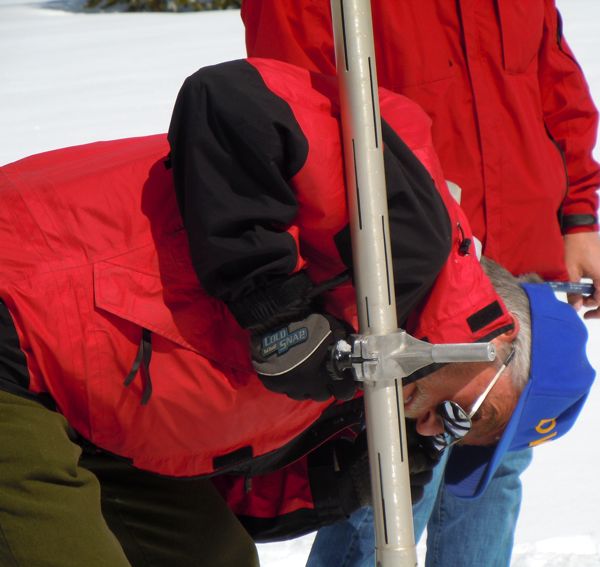
That is the assessment of the water content in the Sierra Nevada by Frank Gehrke. Gehrke, who works for the state Department of Water Resources, was at the base of Sierra-at-Tahoe along Highway 50 on Monday for the penultimate snow survey of the season.

Usually by the April survey talk begins of a diminishing snowpack. This year, the readings keep increasing. Considering the first reading this season on Jan. 3 at Phillips Station Gehrke collected dirt in his instruments, things have improved dramatically.

Frank Gehrke takes a reading April 2 near Phillips Station. Photo/Kathryn Reed

Still, this location is at 39 percent of its long-term average, with water content of 11 inches and snow depth of 31 inches. A year ago, the water content was 43.5 inches, snow depth 124.2 inches and 154 percent of normal.

For April 2, 2012, the state is 55 percent of its average. While this is not good, water gurus are staying afloat from the abundance of moisture from winter 2010-11. Lake Oroville, the State Water Project’s principal reservoir, is 107 percent of average and Lake Shasta, the federal Central Valley Project’s largest reservoir, is at 104 percent of average.

This bodes wells as the snowpack traditionally begins to diminish with the start of April because of fewer storms and warmer temperatures increasing snowmelt.

Gehrke was breaking trail on his cross country skis as the media followed alongside. Under the blue sky and sunshine the snow sparkled like diamonds, almost as though it knows it has a value that no banker will trade for a greenback.

Tahoe merchants know snow depths can be measured in dollars. On one of the best ski days of the season it was easy to find a parking spot at Sierra-at-Tahoe. Stashes of powder could be found a day after the storm, while others enjoyed the rarely groomed Clipper run. Even at 10am corduroy was scattered about.

It was an interesting Monday morning seeing how important snow is to so many facets of the California landscape and economy.

Another storm that is likely to arrive tonight in the greater Lake Tahoe area (that could last into Thursday) is good news for the overall water situation in the state. First, it means more moisture. Second, the cooler temps will slow the snowmelt. The longer water stays in its frozen form, the better for storage reasons. It means not needing to irrigate, flooding being less of a concern, and evaporation not occurring as soon.

And it’s good news for the greater Lake Tahoe economy. Businesses dependent on snow can hope to salvage a season that has been rocky in so many ways.

Location

Elevation

Snow Depth

Water Content

% of Long Term Average

Alpha

7,600 feet

  44 inches

15.9 inches

48

Phillips Station

6,800 feet

      31 inches

11 inches

                           39
Lyons Creek

6,700 feet

   52.4 inches

  19.1 inches

61

Tamarack Flat

6,500 feet

   44.9 inches

 13.6 inches

50

Source: Department of Water Resources