Tourism officials urge changes to lure more visitors to U.S.

By Richard N. Velotta, Las Vegas Sun

Agents with the U.S. Customs and Border Protection and the Transportation Security Administration will be ordered to put on their happy faces as part of a bid to make the United States a friendlier place to visit.

Sen. Harry Reid and Interior Secretary Ken Salazar were in Las Vegas for a Wednesday morning tourism roundtable meeting with industry leaders to explain some of the initiatives of Brand USA and to get suggestions on how the nation could do a better job of welcoming foreign tourists to the country.

Reid was one of the key proponents of the Travel Promotion Act that led to the formation of Brand USA, a corporation formed from a public-private partnership that will market the United States abroad.

Stephen Cloobeck, chairman of Brand USA and CEO of Las Vegas-based Diamond Resorts International, also attended the roundtable and said some of the advertising messages would be unveiled April 22 during the U.S. Travel Association’s International Pow Wow in Los Angeles.

About 40 industry and political leaders were invited to the roundtable, which was closed to the public.

Read the whole story


Workers needed on trails in Carson Valley

The Carson Valley Trails Association needs volunteers this month to work on the Fay-Luther and Genoa Trail systems.

Anyone who is interested is welcome to participate; no previous trail building experience is required. Volunteers must wear long pants, long-sleeved shirt, hiking boots, work gloves and sunglasses. Tools and hard hats are provided. Bring food and water.

Starting April 10, Fay-Luther Trail system work days will be every Sunday and Tuesday from 9am to 3:30pm. Most of the work will be new trail construction of two short reroutes on the Jeffrey Pine Trail. This work is fairly easy and will fix drainage problems. Meet at the Fay-Luther Trailhead on Foothill Road.

Work on Genoa Trail system will connect and complete the Genoa Loop. Work days will be from 9am to 3:30pm. Meet at the end of Carson Street in Genoa. The Genoa Trail system work days are as follows

April 7

April 9

April 12

April 14

April 16

April 19

April 20

April 23

April 26

April 28.

In addition, CVTA will be helping a local Boy Scout troop complete the 0.7-mile East Brockliss Loop near the Whit Hall Interpretive Center at The Nature Conservancy’s River Fork Ranch on April 21, 9am to 3:30pm. Trail work will include clearing brush and building two short boardwalks.

The Carson Valley Trails Association is a nonprofit, volunteer based organization working with partners to provide access to public lands through a recreational trail system for present and future generations to enjoy.


Opinion: Lake Tahoe’s future depends on Regional Plan update

By Joanne Marchetta

While spring can be elusive at Lake Tahoe, the calendar reminds us that warmer days are approaching. Earth Day is just around the corner. So it seems fitting that the Tahoe Regional Planning Agency is rolling out an updated vision for the future of Tahoe where the lake and our communities are restored and sustainable.

With the advent of Earth Day in 1970, the environmental movement took shape and began to form my views. In my youth, I believed that people damaged the natural landscape and should be kept out of exceptional places. I still have a passion for the environment, but over a 30-year career, my youthful views are now more nuanced. I’ve grown to see that striking a sustainable balance where people and communities live in harmony within the natural environment as a fully functioning system is a necessity.

Joanne Marchetta

At Tahoe, our system is out of balance. The lake’s clarity has been degraded by past development in what we know now were sensitive lands and our highway network transports polluted runoff into streams or directly into Lake Tahoe. Our economy is in freefall and our communities are struggling. But we have an opportunity to restore balance to the system, which is the theme of our Regional Plan update.

On April 25-26, TRPA will release an updated draft Regional Plan. Public hearings and workshops are scheduled in May to explain what the updates mean for the future of Lake Tahoe. Word of mouth about its contents is traveling fast. Despite some of the rhetoric you may hear to the contrary, the plan could ultimately become a model for communities around the world. I hope you’ll keep in mind the overarching objective is to restore Lake Tahoe and deliver other environmental gains through a host of policy changes such as incentives for environmental redevelopment and the removal of existing development from our most sensitive areas.

First, the Tahoe basin is nearly “built out” and development caps and other existing growth control measures are staying in place under the draft plan. The draft does not propose any substantial new development rights. There are only about 4,000 development rights left of the basin’s approximately 50,000 parcels. The rate of development allocations to local governments is proposed to change very little through the update. In the draft alternative proposed by TRPA, a maximum of 2,600 standard residential allocations and 200,000 square feet of new commercial floor area is proposed for distribution over a 20-year period as long as environmental improvements continue.

The carrying capacities of the Tahoe basin are well defined and there are no blank checks being written to developers. All types of land uses in the basin will remain capped. No new tourist accommodation allocations would be created since enough already exist in the region for today’s market and there are approximately 300 unused tourist units remaining from the current plan that are carrying over. What this means is that to redevelop tourist units in most cases would require that they be removed from elsewhere and the site restored. To keep environmental improvements on pace, we need to become adept at doing more with less.

Without some modest policy changes, the next 20 years could lock in the status quo of our built environment, which is an outcome we can’t afford in terms of lake restoration or community revitalization. Amendments to TRPA’s land use regulations in town centers are a key component of our focused strategy to encourage the redevelopment of older, polluting properties. Proven incentives for walkable town centers include allowing the appropriate height, density, and mix of uses.

Here is what is proposed. Four-story buildings would be allowed in most of the basin’s town centers just as they currently are today. From Ski Run to Stateline in South Lake Tahoe, six-story buildings would be allowed just as already exist around the Heavenly gondola. And on the four parcels containing the South Shore casino properties, the existing height would be grandfathered in if renovations deliver other environmental benefits and reduce land coverage. No changes to height or compactness standards are proposed outside town centers.

Most development in the Tahoe basin occurred before TRPA’s current Regional Plan was adopted. The land coverage system has had the unintended consequence of locking grandfathered coverage rights in place. If land coverage rights could be transferred anywhere within the Tahoe basin, versus in the immediate watershed area under today’s rules, crucial relocation of pavement, roads and buildings from the most sensitive lands to more appropriate, non-sensitive properties could result.

Outside Lake Tahoe’s town centers — in the places we walk, hike and bike — few changes are planned other than continued protections and restoration. But certain recreation areas such as Heavenly have highly disturbed base areas that are in need of environmental redevelopment. TRPA is proposing changes to allow skier accommodations and employee housing if plans and projects can demonstrate a net environmental benefit.

Every person who cares for our lake and communities needs to have a clear understanding of the issues and proposals in order to help shape Lake Tahoe’s future. TRPA’s Governing Board is scheduled to act on the final plan at the end of 2012. To be engaged in the Plan, go online or send comments and questions to regionalplaninfo@trpa.org.

Joanne Marchetta is executive director of the Tahoe Regional Planning Agency.



Meyers restarts process to be a more livable community

By Kathryn Reed

MEYERS – Another meeting, another plan, another promise the next document won’t sit on the shelf, but instead will actually be implemented.

That last part kept being pounded into the more than 40 people who attended the Meyers Roundtable meeting this week. But only a fraction of those people are ordinary citizens of this enclave at the base of Echo Summit. The rest have jobs with El Dorado County, Tahoe Regional Planning Agency, or other planning-design-consulting firms.

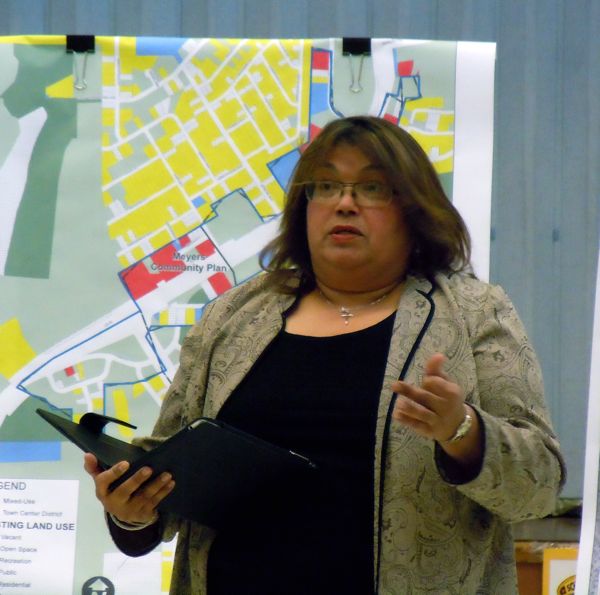
County Supervisor Norma Santiago, after the more than two-hour meeting on April 4, told Lake Tahoe News, “The teams will define the projects they want to implement so then we can shop for funding to pay for it.” (Santiago is also on the TRPA Governing Board.)

El Dorado County Supervisor Norma Santiago talks about plans for Meyers. Photo/Kathryn Reed

She said the now much-outdated community plan never came to fruition because there was no funding.

Sue Novasel, who leads the roundtable, was instrumental in getting the 18-year-old document off the ground. Back then teams worked on various components. That same way of doing things is going to be implemented this year.

The old document has things like walkable, livable communities – just phrased differently. It talks about a town eager to have connectivity through bike paths.

The original Meyers Community Plan came out in October 1993, with revisions made five years later. That document says, “The community plan for Meyers is intended to serve as the comprehensive land use and development plan through the year 1997.” The current Meyers plan may be accessed via the TRPA’s website.

The problem isn’t what is in the document – in fact, much of it will likely be used in the revision. It may just need to be tweaked to use today’s language and incorporate 21st century building requirements.

The problem is the plan has served as nothing more than a paperweight.

Community plans are one of those TRPA mandates. While in some ways they are slated to disappear if the Regional Plan update is approved at the end of the year, they are just going to be replaced with action plans that come with different criteria and mandates.

“The local community is determining their own character,” is how TRPA COO Ed Gurowitz described the new, friendlier agency and its proposed Regional Plan.

He said with Meyers starting now and intending to have its plan done as the Regional Plan comes to fruition, this particular South Shore plan could be a model for other jurisdictions around the lake.

Michael Ward, who is with the Lake Tahoe Prosperity Center and working with the Tahoe Sustainable Communities Program, spoke to the group assembled at the magnet school about the grant his group is using to help Meyers. He was evasive about the exact dollar amount that will be allocated to Meyers. Ward kept saying this is seed money that could attract other money. But for that to happen a real plan approved by TRPA that outlines priorities needs to be in place.

In the coming months a series of workshops-meetings will be scheduled so the people of Meyers can plot a course of action, with the goal being action – not just another plan.


Tahoe City Golf Course officially changes hands

On April 3, more than 200 people turned out at the Tahoe City Golf Course to honor the Bechdolt family and the legacy they have created, and to celebrate the new public ownership of the Tahoe City Golf Course.

The direct descendants of Carl Jr. and Elsie Bechdolt all received special plaques honoring the family’s contributions and legacy to the Tahoe City Community. All funding partners — Placer County, North Lake Tahoe Resort Association, Truckee Tahoe Airport District and Tahoe City Public Utility District — were recognized for their contributions to the acquisition of the golf course property.

The Tahoe City Golf Course is now under ownership of the TCPUD. A five-year lease has been signed with Duncan Golf Management to operate the golf course, bar and restaurant. The nine-hole public course will open when weather permits.


Zephyr Cove businessman indicted on federal drug charges

Justin Woodcock, who owns RastaCam in Zephyr Cove, was indicted on federal drug charges.

The 29-year-old allegedly landed a plane in Alliance, Neb., on March 9 that contained 175 pounds of marijuana.

The lyrics saying, “Jolly weed makes me feel so fine,” boom from his business’ website.

The website says Woodcock has a degree in aeronautical science and that he has a commercial pilot’s license.

If convicted, Woodstock could be in prison for 20 years, fined $1 million and have his plane confiscated.

 — Lake Tahoe News staff report


Workshops teach erosion control techniques for Tahoe

The annual workshops for erosion control best management practices in the Lake Tahoe Basin are April 20 and April 27 in Incline Village and Stateline, respectively.

The workshops train and update contractors and do-it-yourselfers in proper BMP installation procedures for the Lake Tahoe Basin, featuring outdoor presentations, exhibits and activities in addition to indoor lectures.

The Basic Contractors Workshop on April 20 is at the Tahoe Center for Environmental Sciences in Incline Village from 8am to 4:50pm and will focus on how to interpret a BMP site evaluation and install BMPs correctly in order to pass inspection.

The half-day refresher workshop, which reviews BMP installation and provides regulation updates, will be April 27 at the Tahoe Regional Planning Agency in Stateline from 8am to noon. To enroll in the Refresher Workshop, participants must have successfully completed either workshop within the past two years.

Registration fee for the basic workshop is $35. The refresher costs $25. To register, go online or call (775) 832.4144.


Why Nevada is a lottery-free state

By David McGrath Schwartz, Las Vegas Sun

Watching Nevadans form long lines across the California border last week, hoping to strike it rich gambling, would seem akin to Idahoans emigrating for potatoes or Wisconsinites taking a road trip for cheese. Gambling is, more than anything else, supposed to be Nevada’s franchise.

But California offers something Nevada doesn’t: lottery tickets.

Record lottery ticket sales of $1.5 billion last week for a jackpot of $640 million once again raises the question of why Nevada doesn’t participate in a lottery.

“Nevada is sending people out of state to gamble,” said Assemblyman Paul Aizley, D-Las Vegas, who authored a resolution in 2009 to change the state’s constitution. “That, to me, is crazy.”

Casinos see it differently. A lottery in Nevada would be, in their mind, competition.

The Nevada Constitution has prohibited lotteries since it was ratified in 1864. Over the past 30 years, efforts to change that have been squashed by the gaming industry at the Legislature. (Voters did change the constitution in 1990 to allow charitable groups and not-for-profits to hold small lotteries — think church raffles.)

Since 1975, the Legislature has considered a lottery resolution almost every session to start the ball rolling on a five-year process to amend the constitution. It has yet to pass.

A lottery in Nevada would bring in between $30 million and $50 million a year, according to one Legislative analysis done in 2005. Another study, by the Governor Kenny Guinn’s Task Force on Tax Policy, estimated in 2002 that it would net the state $40 million to $70 million a year.

Read the whole story


Nevada seeks aviation designation

By Reno Gazette-Journal

The Nevada Governor’s Office of Economic Development formed a 15-member panel Monday to seek “Center of Excellence” status from the Federal Aviation Administration for unmanned aerial systems.

Earning the designation will give the state and its higher education institutions access to financial grants from the FAA for use in setting up one of six regional research centers across the country. Such a center will help bolster Nevada’s aerospace sector and create quality, high-paying jobs, according to the state’s economic development office.

Read the whole story


Mats effective in killing invasive clams on East Coast

By Brian Nearing, Times Union

LAKE GEORGE, N.Y. — Scuba divers will plunge into the chilly waters of Lake George this month to start the second year of a campaign aimed at eradicating the invasive Asian clam before it spreads through the lake.

Last year, after divers put hundreds of plastic mats over a clam-infested, five-acre patch of lake bottom north of Million Dollar Beach, it proved to be 99 percent effective in suffocating clams by denying them oxygen.

But researchers also found a few clams from under the mats that appeared neither alive nor dead, raising questions whether the creatures may enter a kind of suspended animation in cooler water to avoid suffocation, said Sandra Nierzwicki-Bauer, director of the Rensselaer Polytechnic Institute’s Darrin Fresh Water Institute.

“This was not something that we had seen before,” she said. For now, such zombie-like clams are being labeled as “inactive” by researchers. “We are hoping that in surveying by divers this spring, we will find out what happened, if those clams eventually died or were able to recover.”

First found in Lake George in the fall of 2010 and likely brought into the lake by unwitting boaters, the dime-size clams excrete nutrients that can fuel algae blooms. The sharp-edged clams can wash up dead by the thousands along shorelines, making it risky to walk in bare feet.

Capable of self-fertilization, clams can release up to 400 young a day during reproduction in May and August.

Rapidly growing colonies can carpet a lake bottom, reaching densities of thousands per square yard. Infestations have spread out of control in Lake Tahoe.

Read the whole story