Snippets about Lake Tahoe

• The late singer John Denver was well known in the ski industry, with his celebrity ski classic a legend at Heavenly Mountain Resort. Denver has been nominated for induction into the Colorado Ski and Snowboard Museum Hall of Fame.

• Mammoth Mountain will be open daily for skiing through Memorial Day weekend.

• Truckee is probably changing its meetings to the second and fourth Tuesdays of every month. The second reading of the ordinance will take place at the April 19 town council meeting.

• South Tahoe High Band & Orchestra students will perform for free April 18 at 7pm in the Tahoe Arts & Design Academy Theatre.

• Sugar Bowl is staying open daily through April 29.


Opinion: Terrain parks not the safest place to play

By Dick Penniman

Kid’s love to fly. Boys especially, but some girls, too, want to take to the air any chance they can, whether on skis or snowboards. When I was young, I jumped from every little bump and ridge I could find. Nothing much has changed with today’s kids.

Terrain parks are the special places at mountain resorts where kids are encouraged to test their wings. Snow is piled up and shaped into a variety of configurations offering airtime to anyone who dares to fulfill the dream of flight. But there’s a catch … few (if any) resorts require prior training before participating in these parks, and there are no age or skill limits. Consequently, the big kids are jumping right next to the rank novices.

Before a competitor is allowed to participate in sanctioned aerial events, the U. S. Ski and Snowboard Association requires athletes to complete dozens of successful jumps into a training pool. This can take years of formal training under the supervision of a certified coach. The jump features that are used in training and competitions are built to rigorous engineering standards. Because they are so critical to safe landings, approach speeds are strictly controlled. Nothing of this sort happens in terrain parks at mountain resorts.

As with almost everything else on the trails at California mountain resorts, no laws or regulations exist to guide the creation of features in terrain parks. Most are “free formed” by the park employees, few (if any) of whom have any formal engineering background. They depend on trial and error to determine if features are “safe” for public use.

Before there were terrain parks, ski patrollers like me would tear down big jumps that were considered dangerous. Nowadays, they have nicknames for terrain parks such as “vegetable garden” and “bone yard” because they know it’s not a question of “if” but “when” there will be serious, life-threatening injuries.

To help keep your child a little safer:

• Ask if your ski resort has formally engineered terrain park features, and if it does, ask to see the blueprints.

• Tell the resorts to build terrain park features to engineering standards.

• Don’t let your child jump without first getting some training. Ask if the ski school at your resort offers jump lessons. If it doesn’t, find out who does provide this type of training.

• If your child really wants to jump, encourage him/her to take it seriously, and together, learn everything you can about sanctioned USSA jumping.

Dick Penniman is the chief research officer of the SnowSport Safety Foundation.


Will community colleges boot some community members?

By Spencer Michels, PBS News Hour

A hundred or so students made a ruckus recently at Santa Monica College, and — unlike many student protests — they achieved their goals. In the face of a noisy demonstration and disapproval from the state, the college administration backed down on tuition increases it had proposed, that would have boosted the cost per unit from $46 to $200 for some popular courses needed for graduation. Santa Monica, a community college, was alone in trying to implement what was called a two-tier system, which would have charged a premium for courses much in demand. That plan would have favored wealthier students, and hurt those who couldn’t afford the premium — in a system where cutbacks in funding have forced many colleges to drastically reduce course offerings. Students have been complaining more and more that they can’t get the classes they need. Santa Monica thought it had a way to address that, but the opposition was too great.

Community colleges are in the midst of a major re-make, especially in California, and the turmoil at Santa Monica was a symptom of the turmoil. The system is enormous; nationwide 13 million students are enrolled, and in California alone, 2.6 million students attend, making the state system, with 122 campuses, the largest higher educational institution in the nation. The schools serve a variety of students: those who need a boost to get up to college level; those who want to learn a vocation; those who want to just learn without regard to a degree; and those who need to beef up their English skills. Community colleges have been called the backbone of the nation’s education system, where almost anyone — regardless of income or educational level –can attend, the place where the nation can win or lose its competitive struggle with other countries, especially in technology.

Read the whole story


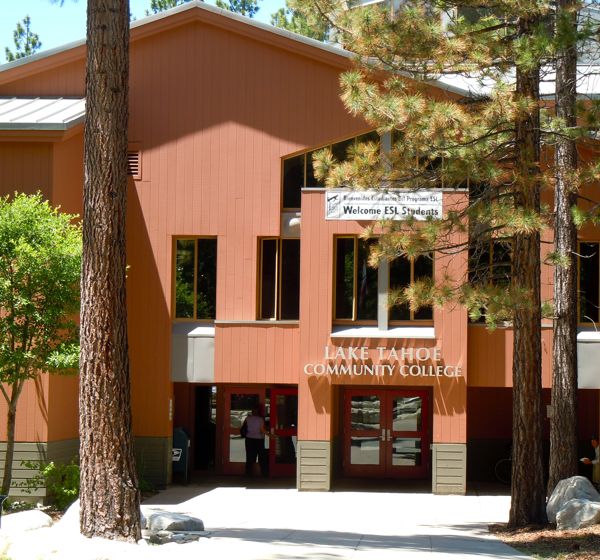
LTCC dealing with unstable financial forecast from state

By Kathryn Reed

Voters will decide if Lake Tahoe Community College must deal with “the good” or “the ugly” budget scenario.
“The model we are using now is the bad,” LTCC President Kindred Murillo told the board. It’s between “the good” which requires cutting costs by $800,000 and “the ugly” which requires cuts of $1.3 million.

“We want to be able to move either way,” she added.

If the education bill passes in November, it gives K-14 districts money that is owed them – not anything more. If it fails, it means another mid-year budget cut. LTCC took a $400,000 hit at the start of this calendar year.

If the voters say no, it will mean a workload reduction of 5.56 percent. The state pays community colleges based on the number of fulltime equivalent students. The 5.56 percent equals 105 FTES or $500,000. LTCC is now funded at 1,890 students. Just eliminating classes does not solve the problem. However, cutting some courses and putting more students into another class would help.

If that student number increases, the college gets no reimbursement from the state. In the 2009-10 school year, LTCC had 182.49 unfunded FTES. That is why administrators made a concerted effort to watch that figure and have kept it in line for two years.

The biggest problem is with the cut coming midyear; after the budget is adopted and after the school year has begun.

No matter the outcome of the November ballot measure put forth by Gov. Jerry Brown, the South Lake Tahoe college is looking at a structural deficit of $800,000. Half of that is because of increased costs of automatic salary increases via the step process and benefits.

In the last two years, LTCC has experienced a 15 percent increase in health and welfare costs. It’s expected to go up another 2 percent in fiscal year 2012-13. The college board, while well aware of the financial constraints, was presented with the grim picture in black and white during a budget workshop April 10. But the numbers presented are in a more readable format than the past 30-plus years.

Instead of a series of code numbers which most people have no idea what they mean, the line items are easier to read. For the first time restricted and unrestricted funds are separated on paper; they always had been in practice.

“We need to rethink how we serve our students and our community.” — Kindred Murillo, LTCC president

Unrestricted funds account for about 90 percent of the budget.

“That’s what funds classes for students,” Murillo explained to Lake Tahoe News.

The board was shown the new format using the current budget.

The 2012-13 budget will be the first one Murillo has prepared. Those numbers are being crunched, with the board likely to start reviewing the budget for the next school year in May.

Murillo, after Tuesday’s meeting, said she spent that morning scrubbing the budget to find anything that could bring down the deficit. She said she found several little things – like someone being budgeted twice, issues with a grant, things that can be eliminated – that adds up to close to $400,000.

While every dollar is being scrutinized, it is not possible to curtail all costs. And with revenues flat or decreasing and costs going up, the gap widens.

In the past four years, the community college system has sustained a 23 percent reduction from the state.

“We will continue to do more with less,” Murillo told the board. But she added, “We need to rethink how we serve our students and our community.”


Verizon bringing 4G network to South Lake Tahoe

By KRNV-TV

WALNUT CREEK — Verizon Wireless on Thursday announced it will expand the nation’s largest 4G Long Term Evolution (LTE) network in Reno in the coming weeks.

The expanded 4G LTE network will enable customers to use their wireless devices in more parts of Reno to access the Internet faster; listen to music or watch video on their phones; use thousands of apps; and stay in touch with family and friends, all with speeds up to 10 times faster than before.

Verizon Wireless 4G LTE service is currently available in Reno including Boomtown, and Glenbrook. With the planned network expansion, residents in areas such as Fallon, South Lake Tahoe and Caughlin Ranch will have access to the 4G network.


Help needed to put sugar pines in the ground

The Sugar Pine Foundation is looking for people to help with planting.

Caregivers for the restoration sites are also needed. This involves going to a restoration site and watering trees.

Details about the plantings are on the flyer.


Nevada out of the running for federal education dollars

By Sean Whaley, Nevada News Bureau

CARSON CITY — Nevada is out of the running for next round of federal Race to the Top-Early Learning Challenge funds to improve early childhood education.

Nevada submitted its application in November 2011.

The U.S. Departments of Education and Health and Human Services announced today that $133 million from the 2012 Race to the Top fund will be available for continued investments in state-level, comprehensive early education reform.

The agencies have invited the next five applicants from the fiscal year 2011 slate – Colorado, Illinois, New Mexico, Oregon, and Wisconsin – to apply for a share of the funds.

“The Race to the Top-Early Learning Challenge has demonstrated the dedication among states and early education and child development experts to raise the bar on early learning,” said U.S. Secretary of Education Arne Duncan. “Continuing to support states with 2012 funding will help build on the momentum from the 2011 competition, and engage more states in furthering their critical work to transition effective early learning programs into systems of excellence.”

In 2011, 35 states, Washington, D.C., and Puerto Rico applied to Race to the Top-Early Learning Challenge, creating plans that increase access to high-quality programs for children from low-income families, and provide more children from birth to age 5 with a strong foundation needed to succeed in school and beyond. In December 2011, nine states were awarded grants: California, Delaware, Maryland, Massachusetts, Minnesota, North Carolina, Ohio, Rhode Island and Washington.

Eligibility for 2012 Race to the Top-Early Learning Challenge funding was based on the strength of applications among states that participated but did not receive awards in the 2011 competition. New Mexico, Colorado, Oregon, Illinois and Wisconsin each earned approximately 75 percent or more of total points possible on a 300-point scale in the 2011 competition. The five states will each be eligible to apply for up to 50 percent of last year’s potential award amount.

Following the 2011 competition, the U.S. Department of Education conducted a thorough review of applicant and reviewer feedback, as well as reviewers’ scores and comments. The review found minor scoring inconsistencies for seven states: Hawaii, Kentucky, Massachusetts, Nevada, New Mexico, New York, and Wisconsin.

These discrepancies did not have an effect on the 2011 competition. Nonetheless, the department consulted with the original peer reviewer in each case, and as a result, scores changed slightly for five states: Hawaii was 135.2 and has been revised to 125.2; Kentucky was 208.4 and has been revised to 207.2; Massachusetts was 267 and has been revised to 257; New Mexico was 236 and has been revised to 236.2; and Wisconsin was 234 and has been revised to 224. The overall score did not change for Nevada or New York.

Nevada ranked 29th among those submitting applications.

Nevada also missed out on race to the top funding for its public education system in 2010.


Douglas County library to honor volunteers

The Douglas County Public Library in Minden will be honoring the contributions of its volunteers at a reception on April 17 in the library.

The staff has chosen National Volunteer Week to celebrate its more than 100 volunteers. From putting away books to assisting with the Summer Reading Program, they play a vital role in the library’s success. Details about the various tasks they perform will be on display in the library throughout the month of April.

The Douglas County Public Library is located at 1625 Library Lane in Minden.

For more information, call (775) 782.9841.


Dental Van making its way to South Lake Tahoe

The Dental Van is coming back to South Lake Tahoe. The van should be pulling into town (weather permitting) this weekend and be at the Al Tahoe school site at least through June 1.

The Dental Van serves:

* Children ages newborn-14 years on Medi-Cal (and their siblings up to age 17)

* Pregnant women with Medi-Cal insurance.

Services include:

Dental exams

Preventive care

Simple dental treatment.

A dentist and two dental assistants operate the clinic.

The Children’s Dental Van is a collaborative effort between First 5 El Dorado Children and Families Commission, Shingle Springs Tribal Health Program, El Dorado County Office of Education, the El Dorado County Health and Human Services Agency, Public Health Division.

For more information, call 800.388.8690.


USFS recreation sites likely to open in May

U.S. Forest Service Lake Tahoe Basin Management Unit officials are readying seasonal recreational facilities.

Campgrounds, day-use areas and forest roads generally open in mid-May. It all depends on the weather.

Taylor Creek Visitor Center and the Tallac Historic Site typically open Memorial Day weekend.

Until recreation facilities officially open no parking, trash removal, or restroom facilities are available. The Forest Service asks people to park vehicles off the roadway, to not block access gates, pack out all trash and clean up after pets.

A complete list of projected opening dates is online.