Judge rules to keep Nevada tax on casinos unchanged

By Sean Whaley, Nevada News Bureau

CARSON CITY — A Carson City District Court judge rejected an initiative petition proposing to create a new and higher rate of taxation for Nevada’s largest casinos, finding that the 200 word description of effect of the measure was misleading.

In rejecting the petition, Judge James Todd Russell said he did not believe he had the authority to rewrite the description himself.

Las Vegas businessman Monte Miller, who attended the hearing this week on his proposed gaming tax hike, said he will file a new proposal with the Secretary of State’s office reflecting Russell’s concerns and begin the signature gathering effort all over again.

The proposed petition was challenged by the Nevada Resort Association, which cited several concerns with the measure, including the use of the term “unrestricted” instead of “nonrestricted” to identify the affected gaming properties, and the use of the term “gross revenue” instead of “gross gaming revenue.”

Miller, through a group called Nevadans for a Fair 9% Gambling Revenue Tax (NF9GRT), filed the initiative petition in February. It would set a new tax rate of 9 percent on net casino gambling revenue above $250,000 per calendar month.

Under current law, net casino gambling revenue in excess of $134,000 per calendar month is taxed at a 6.75 percent rate.

Las Vegas attorney Maggie McLetchie, representing Miller’s group, argued that Russell could rewrite the description of effect for the proposed petition, thus allowing the signature gathering process to begin again without the potential for a new legal challenge.

But Carson City attorney Matt Griffin, representing the resort association, said Russell did not have the authority to rewrite the proposal, which would in effect take away the association’s due process rights.

The description is flawed and the only solution is to reject the petition and require a new one to be filed, he said.

After the hearing, McLetchie said the NRA is using the legal process to stall the petition effort.

“They are obviously trying to exploit a process that is in place to ensure that voters are informed about the effects of a law to try to drag this out for as long as possible,” she said. “And I think it is unfortunate and I think it is antithetical to the very nature of the initiative process.”

McLetchie said judges have in the past rewritten descriptions of effect on other initiative petitions.

“The interest of the NRA is in trying to delay this process for as long as possible,” she said. “Our interest is trying to get this into the hands of the voters.”

The group has until Nov. 13 to collect 72,352 valid signatures from Nevada voters to send the proposal to the Nevada Legislature in 2013. If the Legislature does not enact the proposal within 40 days, it would go to voters in 2014 and take effect in 2015 if approved. The Legislature could also opt to put a competing proposal on the ballot for voters to consider.

The Legislature would have to get a two-thirds vote to approve the tax hike on casinos instead of sending it to the voters. But Legislative Counsel Brenda Erdoes said a competing tax proposal could be placed on the 2014 ballot by a simple majority vote of the Legislature because voters would have the final say.

If both measures received more than 50 percent of the vote, the one receiving the largest number of votes would take effect.

Miller said he is pursing the gaming tax option in the face of a possible business profits tax appearing on the ballot in 2014 as well. The gaming tax, and another petition that could lead to an increase in the mining tax, would be on the ballot as alternatives to a business tax, he said.

Miller said the proposed business profits tax is a bad idea.

State AFL-CIO leader Danny Thompson said earlier this month his labor group is moving forward with a broad-based business profits tax ballot measure to raise money for education. It would assess a 2 percent tax on net profits in excess of $500,000.



What to do when a bear is ‘stuck’ in the neighborhood

By Cheryl Millham

I guess you all wondered when I would be talking about bears. OK. It’s time.

I got a call last week. It sounded like a young woman who told me a bear was “stuck” in a tree. I found out that the bear weighed about 150 to 200 pounds. Well, first of all, bears do not get stuck in trees. They are not even taken out of their birthing den until they learn to climb a tree.

So, I told her that the bear must be eating someone’s garbage, or it wouldn’t be around. She laughed and said the bear “had” been eating her garbage for about two months. Isn’t it interesting that she had been feeding the bear for two months out of her garbage can. No wonder the bear stayed by her house.

Maybe you should put yourself in the bear’s place. Think about it. A bear looks at a garbage can as a bear dish. We humans are so nice by putting a big food bowl out —  just for them. Not only that, but we do it once a week and it can be from everyone on your block.

A bear feasts on items found in an outdoor food locker. Photo/LTWC

So, one of the first things we all need to do is to secure our garbage by using either a bear proof garbage can, or keep in it your garage and only take it to the curb when you hear the refuse truck approaching. Ours arrives at 5:30am, but we hear it about 15 to 20 minutes before it reaches our house.

Also, bears have learned how to open most car doors. Bears can smell even an old French fry that has fallen between the seats. And, yes, I have had a bear open my car door, as well as my sliding glass door to my house.

Now, when we can’t keep our car in the garage, I first make sure there is no food – new or old – in the car and make sure the car is locked. So, when the bear(s) try to open the door, he/she can’t. Lots of times, we will see bear pawprints on our car door and window, but, at least, they do not get in the car.

Should you ever need any personal assistance, we are happy to help out. Just give us a call at (530) 577.2273. Or, you can also call the BEAR League, which we are members (530.525.7297). More about bears later this spring/summer.

Cheryl Millham is executive director of Lake Tahoe Wildlife Care on the outskirts of South Lake Tahoe.


Dean Martin’s 1962 Lake Tahoe concert to be released on CD

By Erik Pederson, Hollywood Reporter

A four-disc Dean Martin box set will be released June 12, Universal Music Enterprises said Thursday. “Collected Cool” will feature several dozen tracks from his years recording for Capitol and Reprise. A highlight of the set is a 51-minute 1962 concert in Lake Tahoe that is making its CD debut.

The set will span Martin’s nearly half-century career, ranging from late-’40s hits including “Powder Your Face With Sunshine (Smile! Smile! Smile!)” to the 1985 single “L.A. Is My Home.” Collected Cool also features a DVD of Dean Martin Live in London, filmed in 1983 at the Apollo Victoria Theatre. The concert aired on Showtime but has never been available on home video.

Read the whole story


TRYP extends Easter by 11 days

Tahoe Regional Young Professionals is keeping the spring season hopping with a post-Easter egg hunt and mixer at Lakeside Beach Grill, April 19 from 6–9pm.

TRYP will hide 60 or more eggs with candy and/or prizes for an array of dining and South Lake Tahoe activities. There will be one golden egg that will include an egg-tra special prize. The hunt will begin promptly at 7pm.

Lakeside Beach Grill is at 4081 Lakeshore Blvd., South Lake Tahoe.


Opinion: More gambling opportunities not the answer

By Robert Reich

Anyone who says you can get rich through gambling is a fool or a knave. Multiply the size of the prize by your chance of winning it and you’ll always get a number far lower than what you put into the pot. The only sure winners are the organizers – casino owners, state lotteries, and con artists of all kinds.

Organized gambling is a scam. And it particularly preys upon people with lower incomes – who assume they can’t make it big any other way, who often find it hardest to assess the odds, and whose families can least afford to lose the money.

Yet America is now opening the floodgates.

Robert Reich

In December, the Department of Justice announced it was reversing its position that all Internet gambling was illegal. That decision is about to create a boom in online gambling. Expect high-stakes poker to be available on every work desk and mobile phone.

Meanwhile, states are increasingly dependent on revenues from casinos, lotteries, and the “Mega Millions” game (in which 42 states pool their grand prize) to partly refill state coffers.

Given who plays, this is one of the most regressive taxes in the nation. In the most recent Mega Millions game – whose winning tickets were drawn last week and whose jackpot rose to $640 million – lottery ticket buyers shelled out some $1.5 billion, most of which went to state governments.

And then there’s the “Jumpstart Our Business Startups” or “JOBS” Act, which President Obama is expected to sign into law Thursday. It allows so-called “crowd funding” by which people whose net worth is less than $100,000 can gamble away (invest) up to 5 percent of their annual incomes in any get-rich-quick scam (start-up) that any huckster (entrepreneur) may sell them.

Forget the usual investor disclosures or other protections. In the interest of “streamlining,” Congress has streamlined the way to fraud. Although start-ups will have to market themselves through third-party portals approved by the Securities and Exchange Commission, this is like limiting Bernie Madoff to making pitches over the radio. The SEC can barely keep track of Wall Street let alone thousands of Internet portals. Small wonder SEC Chair Mary Schapiro has been one of most outspoken critics of bill.

The bill was sold to Congress as a way to promote jobs (note the acronym) on the supposition that small start-ups create huge numbers of them. Wrong. That assumption comes from research by the Kauffman Foundation, which counted as a “start-up job” every laid-off worker who morphed into an independent contractor.

I’m all in favor of more entrepreneurship, and it’s good to give investors another way to participate in emerging companies. But this bill doesn’t do nearly enough to protect the vulnerable.

America’s capital market was already a giant casino. Why now turn the rest of America into one?

Robert Reich is one of the nation’s leading experts on work and the economy, is chancellor’s professor of public policy at the Goldman School of Public Policy at UC Berkeley. He has served in three national administrations, most recently as secretary of labor under President Bill Clinton.


Ski industry veteran takes the helm of Kirkwood Mountain

By Kathryn Reed

With the sale of Kirkwood Mountain Resort to Vail Resorts being finalized Thursday, Casey Blann can officially call himself vice president and general manager of the ski area.

Blann, at 53, is a veteran of the ski industry – especially in Tahoe. Out of college it was Bill Killebrew who hired him to be a lift supervisor at Heavenly Mountain Resort in 1981. He worked there for a dozen years before going to Sierra-at-Tahoe for nine years.

For the past 10 years Blann has been back at Heavenly, with his most recent title being director of operations.

Casey Blann

“I’ve been able to live in the same house since 1989. I just turn a different direction as I leave the driveway,” Blann told Lake Tahoe News.

The ski industry is in Blann’s blood. He grew up in Bend, Ore., where his dad was general manager of Mount Bachelor. At age 2 he was skiing.

Now he has a resort to call his own.

“Casey is a real mountain man and skier at heart, and really appreciates what Kirkwood is. I think it’s a great fit for him,” Blaise Carrig, co-president of Vail Resort’s mountain division, told Lake Tahoe News.

Carrig added that beyond Blann’s expertise with mountain operations, his leadership, attentiveness to safety as well service were reasons he got the job.

(Internal and external candidates have applied for Blann’s old job at Heavenly, but a decision has not been made as to who will replace him.)

The enthusiasm as Blann talks about Kirkwood fills his voice. It also doesn’t hurt that his office allows him to watch the snow fall, even though visibility was just 100 feet. Friday was another powder day at the ’Wood.

“This resort is incredible. Every time I come out here I find something new and unique,” Blann said.

When he describes Kirkwood he calls it the Jackson Hole of California.

While his commute is now longer, he doesn’t mind.

“I’m really excited to join the team out here at Kirkwood and take it to a different level,” Blann said.

A Vail Resorts trademark of high quality guest services is one element he will be working on. But he is quick to praise the employees. Other than his arrival, no immediate staffing changes are taking place.

One of the reasons to buy the resort midseason was to be able to see how things really run and to strategize on changes for the upcoming season.

Blann said changes skiers are likely to notice at the start of the 2012-13 season are improvements to the food and beverage facilities. Specifics are still a ways off of what that might mean.

Epic Mix, a corporate-wide program that allows riders to track their vertical feet, get pins, share info with friends and other things, will be instituted at Kirkwood next season. Epic Photo will probably not be part of the initial launch.

Overall operations are being looked at, Blann said, with changes likely from the get-go. What will change still needs to be worked out.

He equated the changes about to take place at Kirkwood being similar to when he was at Sierra in 1993 and the Sprock family sold it  to Fibreboard Corp.

Having more money makes a world of difference for any business.

Blann knows he can tap into the skills and resources of Vail Resorts to put Kirkwood on a bigger map.

The current master plan for Kirkwood calls for tons of improvements. Blann and others with Vail are going over that plan to see what they like, how they would prioritize what’s in it, and are evaluating whether the U.S. Forest Service as land owner will need to be consulted about revising the plan.

“We will assess and prioritize operations as well as future capital investments,” Blann said.

What Vail officials keep saying is they don’t want to change the funkiness of the Kirkwood, just the functionality.

Kirkwood is known for its steeps and unique personality. An infusion of cash could mean making the terrain more accessible via new lifts as well as upgrading the ones in place. Kirkwood only has two high-speed quads and one of those accesses beginner terrain.

Summer operations are a growing component of what Kirkwood has to offer. An independent operator runs the zipline, there’s a mountain bike park and disc golf. Plus, at different times the lifts will run for hikers to access endless miles of trails.

Blann met with the mountain bike team Thursday, but added, “It’s premature to comment too much about summer.”

For those who don’t want to be limited to one resort, a pass for Heavenly-Northstar-Kirkwood is available. But the die-hard Kirkwood-only riders still have a pass just for the ’Wood.


Opinion: Maybe it’s time for electronic liberation

By Terry Jeffrey

Years ago, the monks at Saint Catherine’s Monastery, which sits at the foot of Mount Sinai, maintained a dormitory for visitors. It was a rustic place, where a noisy, gas-powered generator provided the only electricity.

Not long after nightfall, the monks would shut the generator down, converting the Sinai desert into the darkest place on Earth.

Yet it was a different sort of darkness that enveloped that monastery and that mountain. When the moon was down, the stars shone as brightly at the horizon as they did at the top of the sky. With no light seeping up from any city, and no clouds drifting by, it seemed as if the atmosphere itself had slipped away. No discernible barrier stood between earth and the infinite space above.

Terry Jeffrey

There was nothing to do in a place like that but sit and think.

Today in America, we never turn off the generators. We are almost permanently leashed to electronic devices. We walk down the street with tiny telephones fixed to our ears. We sit in parks texting messages on handheld devices to people whose voices we never need to hear. We carry tablets that hook us up to the Internet and that can effortlessly bring us, whenever and wherever we want, a 50-year-old movie or the very latest pop song.

Saint Ignatius Loyola made a powerful point. “Man is created to praise, reverence, and serve God our Lord, and by this means to save his soul,” he wrote in his spiritual exercises. “The other things on the face of the earth are created for man to help him in attaining the end for which he is created.”

In this view, virtually all inanimate things are merely tools that human beings can use for either good or evil. A razor is a good example. A person can use a type of razor to perform a surgery that saves a life — or use the same razor to slit a throat and destroy a life. In the former instance, the razor is used for great good; in the latter, for great evil.

But there is another principle: You would not give a razor to a toddler.

This is not because the razor is intrinsically bad. It is because the toddler could not possibly know how to handle it — and accidentally misusing a razor can cause as much harm as purposefully misusing one.

Perhaps we should start treating modern electronics with at least the sort of respect we have for sharp objects in our society. Surely, electronic devices — just like razors, scalpels and scissors — can be instruments of great good. But isn’t it also true that they can do great harm?

Before the modern electronic revolution really got going, William Butler Yeats wrote a poem called “The Leaders of the Crowd.” These were those, he wrote, who “hawk for news/Whatever their loose fantasy invent/And murmur it with bated breath, as though/The abounding gutter had been Helicon/Or calumny a song.”

And these leaders of the crowd did not yet have an Internet at their disposal, or video games, or electronic tablets.

Asked Yeats: “How can they know/Truth flourishes where the student’s lamp has shone/and there alone, that have no solitude?”

“So the crowd come they care not what may come,” wrote Yeats.

Pope Benedict XVI made a powerful observation in his Easter Vigil sermon. “The darkness that poses a real threat to mankind, after all, is the fact that he can see and investigate tangible material things, but cannot see where the world is going or whence it comes, where our own life is going, what is good and what is evil,” he said.

“If God and moral values, the difference between good and evil, remain in darkness, then all other ‘lights,’ that put such incredible technical feats within our reach, are not only progress but also dangers that put us and the world at risk,” he said.

“Today we can illuminate our cities so brightly that the stars of the sky are no longer visible,” said the pope. “Is this not an image of the problems caused by our version of enlightenment? With regard to material things, our knowledge and our technical accomplishments are legion, but what reaches beyond, the things of God and the question of good, we can no longer identify.”

Out in the Sinai, where the stars shine as brightly as anywhere on earth, a nearly complete copy of the Bible, inscribed in Greek in the 4th century, sat in the monastery library, century after century, unknown to the Western world — until it was rediscovered in the 19th century.

Here in 21st century America, we should consider taking off our electronic leashes once in a while, dusting off our old books and teaching our children how to read them.

Terry Jeffrey is the editor-in-chief of CNSNews.


TAP looking for people to fill booths at art festival

Tahoe Arts Project is sponsoring the 11th annual Arts Festival on July 6-8 at South Tahoe Middle School.

This outdoor festival will include art booths, food, children’s art activities, entertainment, and fun for the entire family. Featuring local and visiting artists, this is a juried show and there is space available for artists interested in showing and selling their work.

Cost is $250 for a 10 x 10 booth and $400 for a 10 x 20. TAP does not take a commission from your sales and artists may share a booth. Applications are available online or call (530) 542.3632 to request an application.

This event is Tahoe Arts Project’s major fundraiser for the year. Tahoe Arts project is a nonprofit organization whose mission is to provide cultural enrichment and diversity for the community through the arts and education with particular focus on our youth.


Expensive gamble to try to be Olympic host city

By Fred Dreier, Forbes

Fans of the bobsled and biathlon should not hold their breath for the United States to host the Winter Olympics.

Officials in California and Nevada formed a committee last week to bring the 2022 Winter Olympics to the Lake Tahoe-Reno area, joining Denver, and Salt Lake City as potential American Olympic host cities. But due to the United States Olympic Committee’s ongoing dispute with the International Olympic Committee over TV and sponsorship dollars, all three cities’ chances are slim.

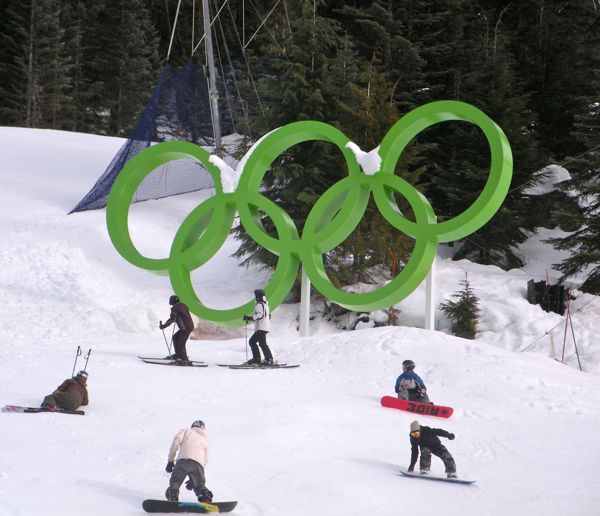
Riders check out the Olympic rings at the Women's Downhill before the Games in Whistler two years ago. Photo/LTN file

Rick Burton, a professor of sports management at Syracuse University’s Falk College of Sport and Human Dynamics, cautioned the American bid committees to spend wisely. Vancouver’s successful bid for the 2010 Winter Olympics cost a reported $34 million. Annecy, France, spent roughly $30 million in its failed attempt to win the 2018 winter games, which will be hosted by Pyeongchang, South Korea.

“You can bang your drum from a PR standpoint, but until you know that the USOC has worked out its agreement with the IOC, I’d keep my powder dry,” Burton said.

Since 2005, the USOC and IOC have sparred over the current revenue sharing agreement, which gifts 12.75 percent of U.S. broadcast revenue and between 16-20 percent of the IOC’s global sponsorship revenues to the USOC. These are serious sums of cash. NBC reportedly paid $456 million for broadcast rights for the 1996 Olympics, $3.5 billion for 2000 through 2008, $2 billion for 2010 and 2012 and 4.4 billion for 2016 through 2022. The revenue helps supply much of the USOC’s revenues, which according to its 2010 tax filing, was $250.6 million that year.

The USOC has publicly stated it will not submit any host bids to the IOC until the negotiations end. The two groups last met in January but failed to finalize a new plan. In September, Colorado state senator Michael Bennett wrote a public letter to USOC Chairman Larry Probst urging both sides to agree on a new deal.

“As you are aware, the work and preparation that it takes to produce a winning bid is extensive,” Bennett wrote. “It would be unfortunate if the current impasse undermined these efforts.”

If the IOC and USOC hammer out an agreement in the coming year, however, the American cities are still long shots for 2022, Olympics experts said. Burton, who was chief marketing officer for the USOC at the Beijing Olympics, believes the USOC would rather bid for the 2024 summer games over the 2022 winter games because the summer games generate substantially more revenue.

Read the whole story


Heavenly ski patrol party in the garage

Heavenly ski patrol is hosting its 13th annual fundraiser on the top tier of the Heavenly Village parking garage on April 14 from 4:30 to 8:30pm.

Three live bands, season’s pass raffle, and silent auction are part of the fun.

Cover charge is $10 and all proceeds go to local charities