Spring runoff sending more water into Lake Tahoe

CARNELIAN BAY – Lake Tahoe is like glass – except where the storm pipe is draining.

It’s more like a manmade waterfall just off Highway 28 in Carnelian Bay.

Across the highway a stream is filtering down from the mountainside above. It drains under the road, continuing through a pipe that is just above the water’s edge. There, it cascades into Lake Tahoe.

Storm drains are on both sides of the highway to collect the runoff from the road, deliver it to the pipe and let it flow into the lake.

On April 19, white specs of  “pollution” dot the surface. The water is shallow here, with the submerged rocks visible, albeit murky, from the road.

With a chance of thunderstorms on Friday, it could mean more gunk being carried into Lake Tahoe.

— Kathryn Reed

The roadside drain just above the lake, from left; residue floats on top; water drains directly into Lake Tahoe. Photos/Kathryn Reed


Ski legends inducted into hall of fame

By USSA

SEATTLE – In a night filled with emotion and fond memories, eight legends of skiing were inducted into the U.S. Ski and Snowboard Hall Fame as more than 600 attended a ceremony in Seattle.

Olympic and World Championship medalists Joe Pack and Eva Twardokens headlined eight skiing luminaries who joined the Hall of Fame’s Honor Roll for 2011. Also honored was ski area pioneer, the late Nick Badami, who played a pivotal role with the U.S. Ski and Snowboard Association and the Salt Lake City Olympic Winter Games.

The Hall of Fame ceremony last weekend, which rotates around the country each year, was in Seattle for the 50th anniversary ski and snowboard manufacturer K2, which received the Hall’s Legends of Skiing Award.

Also honored were ski area pioneer Phil Gravink, ski historian Mason Beekley, speed skier and author Dick Dorworth, ski show pioneer Harry Leonard and World Cup and Pro Skiing racer Tyler Palmer.

Nominations for the Hall of Fame are open to the public with the process managed by the Hall of Fame’s National Selection Committee followed by a vote of over 100 skiing experts and enthusiasts who make up its National Voting Panel.

Nominations for the Class of 2012 are now open but will close on April 30.

Nick Badami had a four-decade career in the ski industry as a business owner, executive and volunteer. After retiring from a successful business career at the age of 49 he bought Alpine Meadows and later Park City Ski Area. He served in leadership roles at the National Ski Areas Association, U.S. Skiing and both the Bid and Organizing Committees for the 2002 Salt Lake City Olympics. At the USSA he played a vital role in the transformation of the organization to become a highly respected Olympic sports organization. As chairman of Powdr Corporation he grew his resort holdings before retiring in 2003. Badami passed away in 2008.

Joe Pack was one of the stars of the Salt Lake City Winter Olympics whose performance resulted in a silver medal in the freestyle skiing aerials event. Over his career he reached the World Cup podium 12 times, including three wins. He won two World Championship bronze medals to go along with his Olympic silver medal, which he won in front of his hometown fans at Deer Valley Resort in Park City. After retiring from skiing he became a professional golfer based in Hawaii.

Reno native Eva Twardokens made her World Cup debut at the age of 17 in 1982 and was Ski Racing’s Junior Racer of the Year in 1982 and 1983. In a 12-year career she earned three podiums and 34 top tens, including the giant slalom bronze in the 1985 World Championships. She was a two time Olympian finishing sixth in the GS in Lillehammer in 1994. Today she is a fitness advocate and trainer in Santa Cruz and holds a Masters National Weightlifting title.

A 1969 junior champion, New Hampshire’s Tyler Palmer was a dominant racer on the newly formed World Cup tour in the 1970’s. In 1971, he was the first American male to crack the top three overall in slalom. During his career he won two World Cup slaloms, reached the podium four times and had nine top tens. Later he raced on Bob Beattie’s World Professional Ski Tour where he won five races. A National Masters Champion several times Palmer was a coach for junior racers at Sun Valley until his retirement in 2010.

Dick Dorworth was a ski racer, world speed record holder, coach, instructor and journalist. As a ski racer he was named a collegiate All American in 1962 and in 1963 he set a world speed record of 170 kph, in Portillo, Chile. He went on to become a certified instructor in both France and the USA, including ski school director at Aspen, and a U.S. Ski Team coach. The publisher of several books on skiing and a recipient of an Ullr Award from the International Skiing History Association, Dorworth’s articles have appeared in nearly every skiing magazine and journal.

Mason Beekley, who died in 2001, was a successful businessman and passionate skier who eventually directed that enthusiasm to the support of preserving skiing history. During his lifetime he developed an extraordinary library dedicated to skiing and one of the world’s most extensive collections of ski art leading him to form the International Skiing History Association in 1991 which today has over 2,000 members worldwide and publishes Skiing Heritage magazine.

Phil Gravink was a key player for 35 years at the national level in ski area management. After graduating from college he started out helping run his family’s farm in New York State before founding an area known as Peek’n Peak. He went on to head Gore Mountain and later New Hampshire’s Loon Mountain, developing it into a leading modern resort. He was also a key player in influencing the policies of the U.S. Forest Service and served as a National Ski Areas Association director for 18 years including a term as chairman. He received the NSAA’s Sherman Adams Award for his leadership as well as a Lifetime Achievement Award and the BEWI Award.

Harry Leonard was skiing’s impresario, visionary and cheerleader during the 1960s and 70’s. He organized the first ski consumer show in Chicago in 1958, which was a success that spread nationwide within the next few years. With his partner Jerry Simon, he brought to the shows a creative genius and enthusiasm that made them fun and entertaining. He pioneered the use of the ski deck that brought skiing right into his shows as well as great skiers who were the headliners for his events.




Early Mother’s Day event in South Lake Tahoe

Barton Health is putting on “Mom’s Morning Out” – a free event celebrating motherhood.

The event is May 5 from 10am-noon at Lake Tahoe Community College. This event is for new moms, soccer moms, mothers experiencing an empty nest, and all other types of moms.

The following will be available for every stage of motherhood:

Talks provided by local health experts

Wellness booths

Hands-on CPR Lessons with Barton University

Light brunch buffet

Hand scrub treatments

Chair massage.

Go online to RSVP, or call (530) 543-5615 or e-mail publicrelations@bartonhealth.org.


Fire danger likely to be high this summer because of dry winter

By Jeff Delong, Reno Gazette-Journal

Nevada’s worsening drought conditions and already kiln-dry vegetation should combine for extreme fire danger over the coming summer, a wildfire forecaster said.

More than 600,000 acres of Nevada terrain is expected to be scorched this fire season, Fred Svetz, manager of the Western Great Basin Predictive Services Center, reported last week during a 2012 climate conference at Reno’s Desert Research Institute.

For all intents and purposes, the danger is already here.

“We have conditions that are very much like fire season right now,” Svetz said. “We have some exceptionally dry and high fire potential conditions. While we are just barely into spring … we’re seeing fire potential we would normally see in the middle of the season.”

The forecast likely comes as no particular surprise to residents of the Reno area after two rare winter wildfires hit in November and January, together burning 5,000 acres and destroying more than 50 homes. Before the Jan. 19 Washoe Drive Fire, which burned 3,100-plus acres, the largest fire to burn in the Western Great Basin in January was only 32 acres in size, Svetz said

The winter was exceptionally dry, with an April 1 Sierra snowpack measured at only a little more than half of what it should be. Significant storms in March helped improve what was an even worse situation but were “too little, too late as far as drought is concerned,” Svetz said. Most of Northern Nevada and the Sierra are now in a state of severe drought, according to the U.S. Drought Monitor.

Read the whole story


Study: Food stamps keep people out of poverty

By Nancy Shute, NPR

Food stamps have long been are a favorite whipping boy of politicians looking to beat up on government spending. But the massive food-assistance program does help keep people out of poverty, according to new research.

Food stamp benefits led to decline of 4.4 percent in poverty from 2000 to 2009, according to a new report from the USDA’s Economic Research Service.

The impact was particularly strong for children, who are more likely to live in poverty than adults. Child poverty was reduced by 15.5 percent, on average. The researchers also looked at the depth and severity of poverty, and found that severity was reduced by 21 percent. They say looking at this gives a better measure of the role of food stamps in improving the lives of Americans, compared to just a straight look at the poverty rate.

In 2009, 21 percent of all children, or 15.5 million, lived in poverty. That’s up from 16 percent in 2001, an increase attributed to the economic downturn.And that’s including the buffering effect of food stamps.

Read the whole story


Lockwood landfill uses methane to turn trash into electricity

By Jason Hildago, Reno Gazette-Journal

It isn’t quite turning garbage into gold. But it’s close.

For the past couple of weeks, Waste Management’s Lockwood landfill has literally been having a gas, generating electricity at its new renewable energy plant by using the methane it produces from decomposing garbage.

Since going online, the plant has been sending electricity to the grid as part of a power purchase agreement with NV Energy. It has produced up to 3.2 megawatts of electricity per day — enough to power 1,800 homes. The facility also can be expanded to add a third engine once capacity at Lockwood increases. The landfill itself has 100 years worth of waste capacity, said Justin Caporusso, communications manager for Waste Management’s Northern Nevada and Sacramento operations

“We’re basically capturing the methane gas and using it to run these engines and turbines that generate power,” Caporusso said. “It’s part of our goal to not only reduce the amount of material going into our landfills but also find better uses for the material we have there now.”

The project is part of a big push by the company nationwide to leverage the materials it collects into a strong renewable portfolio. In addition to more than 130 gas-to-energy plants, such as the one at Lockwood, Waste Management also has a wide range of renewable programs under its belt, including projects that generate liquid methane gas from waste to power its trucks or even produce oil from plastic.

Read the whole story


Experts: Social media important, but it’s not a money-maker

By Kathryn Reed

OLYMPIC VILLAGE – Don’t expect to make money in social media.

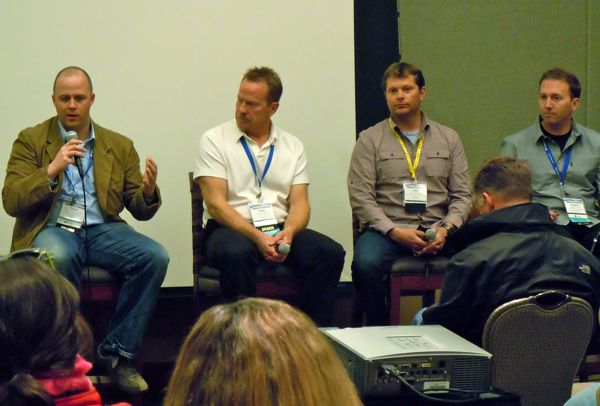
That was the message delivered by a panel of tourism marketing officials April 18 during the 37th annual Mountain Travel Symposium at Resort at Squaw Creek.

Before joining three peers, Davy Ratchford, marketing director with Northstar ski resort, spoke with Lake Tahoe News.

Davy Ratchford, Andy Chapman, Dan Sherman and Christian Knapp talk April 18 about social media. Photo/Kathryn Reed

“The best investment in marketing is hiring the right social media guy,” Ratchford said.

But validating what is going on in the world of social media is hard to quantify. Marketers say fans on Facebook and Twitter want to be a friend, not a customer, per se. That’s why sales pitches, even discounts, don’t work well.

“They want an online conversation. But when it comes time to pulling the trigger, they’ll think of you,” explained Christian Knapp, vice president of marketing at Aspen-Snowmass.

(Rounding out the panel were Andy Chapman, chief marketing officer for North Lake Tahoe Resort Association, and Dan Sherman, managing director of Ski.com.)

Ratchford said no matrix exists to show that someone online read X and therefore that translates to Y.

At the end of the session Tony Lyle with Aramark’s South Shore operations told Lake Tahoe News, “I’m not sure you can ever monetize social media. They are in that space to hang out.”

Keeping up with technology is key, as well as using it in ways that are appropriate for specific businesses. Ratchford mentioned how Alaska Airlines allows people to upload where their friends live, and then the airline lets the person know how much it would cost to fly to see their friends.

But all those speaking on the topic recognize the importance of having the social media presence. Good content – via all online modes of communication was stressed.

Allowing people to easily share that content with friends is important – words, pictures and videos.

“We are working on when your vacation is booked, you can share it with your buddies,” Ratchford said, and even invite them to join the fun.

Chapman said NLTRA is working on making items on the calendar of events page easier for people to share.

All pointed out that how many likes or fans a business has is not as important as having people of influence doing the chatting. A person of influence is someone who has engaged friends or Tweeter followers. It’s similar to one of the most basic forms of marketing — word of mouth.

“It’s about influencing the influencers,” Knapp said. But he also admitted it can hurt when influentials have bad experiences.

Engaging people increases awareness of a company’s product or destination.


Understory near Markleeville to be cleared via burning

The U.S. Forest Service is planning to burn the understory near Grover’s Hot Spring State Park in the next week.

Approximately 33 acres of understory vegetation will be treated to reduce build-up of trees and brush that can cause more intense wildland fires.

Fire crews are currently monitoring weather conditions to identify time frames that would be suitable for effective prescribed burning of brush and understory vegetation. This controlled burn will only be implemented when specific weather conditions permit.

Visitors and residents can expect to see smoke in the Markleeville area when the controlled burn occurs.


Opinion: Small businesses need help with ADA abuse

By Beth Gaines

In the Sacramento region, the original Squeeze Inn is the poster child of lawsuit abuse. A woman sued the famous burger joint for allegedly violating disability law even though she had no intention of ever doing business with them; she was merely a front for a predatory attorney looking for an easy mark.

Only wide-spread media attention and outrage spared the Squeeze Inn’s owner from going out of business. Others are not so fortunate.

Beth Gaines

The source of these shameful shakedowns is the federal Americans with Disabilities Act and its California counterpart law. Intended to end discrimination against people with disabilities and to integrate them into mainstream life, the act has improved the quality of life for countless Americans and I am inspired to see people with disabilities enjoy activities and attractions available to them as a result of these laws.

But for business owners, the ADA story is not so inspiring. Right now, lawyers drive by small businesses and look for the most trivial violations of disability law, such as having a railing height being off by a centimeter or parking lot striping not being the right shade of a particular color.

After noting these violations, the lawyers then send threatening letters to the businesses, demanding that they fix the violations and settle with them, usually for a few thousand dollars. If the owners refuse, the lawyers sue them in court for “damages” that would cost businesses even more money.

This ugly practice bears no resemblance to the noble intent of ADA law. It is a racket, and it needs to be shut down. That is why I have introduced two bills to restore some balance to ADA proceedings, protecting the rights of the disabled while helping business owners provide reasonable access to everyone.

The first reform, Assembly Bill 1878, would give California’s most vulnerable small businesses an opportunity to correct a disability violation before a lawsuit can be filed. Under this bill, once a business has received a written notice of violation, it would have 120 days to come into compliance. This common sense change would redirect the law away from lining lawyers’ pockets and back toward better access.

My second measure, Assembly Bill 1879, would require the state architect to compile a list of all federal and state disability access regulations, as well as identify any conflicts in those regulations. This would be a boon for businesses that want to adhere perfectly to the law but are overwhelmed with the conflicts and complexities of the state and federal systems.

Shortly after I introduced these measures, Sen. Dianne Feinstein, D-Calif., sent a letter to Darrell Steinberg, the state Senate president pro tem, encouraging him to advance legislation that will end these indefensible ADA lawsuits, and I am hopeful that Steinberg and our legislative colleagues will work with me to restore the intent of the Americans with Disabilities Act. These reforms are too important to be sacrificed to partisan politics.

We can do better than having lawyers continuously carpet bomb businesses with frivolous disability lawsuits. California should strike the right balance between ensuring real justice for real victims and giving businesses an opportunity to correct violations without being at the mercy of greedy lawyers.

My reforms strike that balance. It is way past time to put an end to the livelihoods of lawyers who have exploited landmark legislation and have caused so many mom-and-pop businesses unjustified grief.

Beth Gaines represents the 4th Assembly District, which includes portions of Sacramento, Placer, El Dorado and Alpine counties.


Spring paddle launches from Tahoe City

Lake Tahoe Water Trail’s annual Spring Paddle is May 19 from 9am-1pm.

Launch from Commons Beach in Tahoe City for a morning paddle, followed by lunch at Sunnyside.

Interpretive guides will navigate and educate about the Lake Tahoe environment. All ages and skill levels are welcome.

For more information and registration, go online.