757 acres return to public ownership

By Carlos Alcalá, Sacramento Bee

After a 10-year effort, the American River Conservancy has completed the purchase of 757 acres of former ranch lands that straddle Salmon Falls Road in El Dorado County.

The lands are on the north side of the South Fork of the American River where it flows into Folsom Lake.

The lands run for about 2 miles along the water front, which can be lakefront or the riverfront, depending on how high the lake is.

The new acreage will allow for more public trail opportunities, said Alan Ehrgott, Conservancy director.

Read the whole story


Warning from USPS about email scam

An email scam is just that — a scam, the U.S. Postal Service warns.

The email appears to be from the post office talking about package delivery or possible online charges, but when people click on the link it installs a virus that can steal personal information.

Report suspicious emails to 800.275.8777 or spam@uspis.gov.


Town of Mammoth on the verge of being bankrupt

By Norimitsu Onishi, New York Times

MAMMOTH LAKES — It was a seemingly perfect day at this ski resort town high in the Sierra Nevada last week, one that could have redeemed the season’s poor snowfall under brighter circumstances. Families here on spring break were enjoying the slopes or shopping at the luxury outlet mall. Some stocked up at the Vons supermarket for dinner, while others braved the half-hour waits at the town’s popular restaurants.

But despite the appearance of prosperity, the government of Mammoth Lakes is considering bankruptcy because of its inability to pay a $43 million legal judgment in a development dispute dating back to 1997. After entering a mediation process under a new California law, the town now faces a 90-day deadline to reach an agreement with its creditors, raising doubts about the future of this longtime getaway for residents of San Francisco and Los Angeles.

Town officials say they hope that mediation will allow them to avoid filing for bankruptcy. But so far, the developer that won the lawsuit, Mammoth Lakes Land Acquisition, has refused to participate in the mediation process.

Now, amid rising anxiety and recriminations, this resort town, like other more modest municipalities across the nation, is facing sharp budget cuts. They could affect not only services to full-time residents, but also ones like free bus shuttles that cater to tourists.

“We’re afraid if the services drop too low, people will choose not to come, and then it becomes a downward spiral,” Jo Bacon, the mayor, said in an interview at the Java Joint, a cafe in a 1970s shopping mall that also houses the local government.

Mammoth Lakes, a town of about 8,200 residents and a budget of $17 million, has become the second municipality after Stockton to use a new state law that requires local governments to hire a third-party mediator to negotiate with creditors before declaring Chapter 9. The union-backed law made it harder for local governments to file for bankruptcy and was intended to protect public employees in cities with large work forces, like Stockton, which entered the mediation process in February.

In Mammoth Lakes’s case, its problems are rooted in the 1997 deal with Mammoth Lakes Land Acquisition. The town gave the developer the rights to build a hotel, residential and retail project near the local airport in exchange for making airport improvements. But the town backed out of the deal after the Federal Aviation Administration, which provided Mammoth Lakes with grants to improve the airport, objected to development nearby.

The developer sued in 2006 for breach of contract and was eventually awarded a $30 million judgment. The town exhausted its legal appeals last year, and the amount has grown to $43 million.

Read the whole story


Snippets about Lake Tahoe

• South Tahoe Public Utility District is having a 6pm May 10 meeting to go over its budget. A 5 percent increase in sewer rates and 2 percent hike in water rates are being proposed.

• Tahoe City Downtown Association’s 2nd annual Farm to Table Dinner is July 10. More information is online.

• Truckee needs poll workers. Call (530) 265.1298 for info and to sign up.

• Volunteer drivers are needed for home delivered meal service in South Lake Tahoe. For information, call (530) 621.6160.

• Northstar’s Mountain Bike and Hike Park is scheduled to open June 15. Weather and conditions permitting, and will be open Friday through Sunday until July 1 when it will be open daily until Aug. 19. Following that, the park will resume Friday through Sunday operations until Oct. 7.


Make a few adjustments to eliminate winter’s extra pounds

By Mandy Kendall

The arrival of some warmer weather will most likely have us delving into our wardrobes for some lighter clothing. However, some of us may be finding that our clothes have mysteriously shrunk in our cupboards over the winter. Pants feel a little tighter around waistbands and those sleeveless tops don’t seem to make our arms look as toned as they did last year?

If we can’t blame the clothes shrinking for this strange phenomenon, then I guess the next alternative to consider is the hibernation factor that causes an insulating layer of extra flesh that appears over the winter months to protect us from the cold and any possible threat of starvation.

Mandy Kendall

So, what to do about it? Well, the warmer weather, enticing us to be outside and more active again, will go some toward shedding some of the winter layer. However, as we all know, it’s a lot to do with what we eat that will dictate how much of an extra layer we carry around with us. Traditional weight loss diets had us reducing the amount of food we ate, and therefore reducing the number of calories we took in.

Not anymore. Today’s theories surround the quality and type of food we take in. One of the latest buzz terms in the nutritional circles is “crowding out”. The idea is to add fiber rich and nutrition dense foods to your diet, which gradually crowd out the craving for any junk food. It’s all about filling your body with hunger quenching foods in such a way that you never get the chance to feel hungry. This sounded like my kind of diet, so I did a little research.

So what’s it all about? It’s all about fiber. There are numerous benefits to eating fiber. It fills us up without adding too many calories, it slows digestion keeping us feeling full longer, and also keeps our blood sugar levels even and balanced (no spikes and drops that have us grabbing for sugary snacks or drinks) and it attacks like nature’s “bottle brush” cleaning out our digestive track as it passes through. All of this along with lowering your risk of colon cancer, heart disease and digestive problems makes fiber a very important part of our diet.

Apparently we evolved eating about 100 grams of fiber a day, mainly from wild greens. It’s currently recommended women eat at least 25-30 grams and men 35-40 grams per day however, the average American currently only eats around 10-15 grams per day.

So here are some Qwik-e (quick and easy) tips on foods to increase the amount of fiber in your diet and decrease the tightness of those summer shorts.

An apple day — According to the Mayo clinic, apples contain about 4.4 grams of fiber and plenty of antioxidants in the peel. They contain a gelling agent called Pectin, used in jams and jellies, which can delay our stomachs emptying and keep us feeling full longer. Pears have 5.5 grams of fiber (if you can catch them during the 30 seconds that they are ‘just right’). However, raspberries are a whopping 8 grams per cup.

Full of beans — Topping the chart on the top 10 fiber-rich foods list are cooked split peas and cooked lentils at 15 and 16 grams a piece per cup. Maybe that’s where the saying comes from? In general, all the beans and legumes varieties are high in fiber and a great source of protein too.

Going nuts for fiber — Almonds are pretty fiber rich at 3.5 grams per ounce (about 23 almonds) so make a great hunger-quelling snack. Just be aware of over-doing nuts in general, they are high in fat (albeit good fat) and calories so you can get too much of a good thing.

Vegetables — Cooked peas provides about 8 grams of fiber per cup with broccoli yielding about 5 grams of fiber per cup. However, a medium artichoke beats them all with 10 grams of fiber. So going green is good for you in more ways than one.

Grains, cereals and pasta — Now who would have thought that whole wheat spaghetti has more than 6 grams of fiber per cup when cooked? Couple that with some fresh chopped tomatoes, some green vegetables and finish with a bowl of raspberries and you would be well on your way to your daily fiber target.

Flush it through — Just remember that plenty of water is required to flush the bulky fiber through the system.

For reference, here is the Mayo Clinic website with a list of the fiber content of the main food groups.

Here is a longer alphabetical list of foods, and their fiber content, from the USDA National Nutrient Database.

Just be aware they will possibly differ slightly but will give you a very good idea of which foods will give you the most amount of fiber.

Until next time.

Mandy Kendall operates Health Connective in South Lake Tahoe. If you have any questions, would like some advice, or would like to request some Qwik-e tips on any health and wellbeing topic, please feel free to drop me an email at healthconnective@gmail.com, visit us on Facebook, or keep an eye out on Lake Tahoe News for regular Qwik-e tips on how to make healthy changes one Quick and Easy step at a time.


Plan to slaughter horses for human consumption met with distaste

By Ted Burnham, NPR

When the ban on slaughtering horses for human consumption was lifted in the U.S. last November, it was only a matter of time before someone applied to start the practice up again.

That person is Rick De Los Santos, a New Mexico rancher and owner of Valley Meat Co. If the USDA approves his application to have a former beef slaughterhouse inspected, it would allow the first slaughter of horses in the U.S. since 2007.

The meat would be exported to Mexico, one of many countries where eating horsemeat is nothing to flick your tail at. Horse is also eaten frequently in Europe and Asia. And the Canadian grocery chain Metro lists 22 recipes for horse meat on its website.

But Americans are historically averse to eating horses. A notable exception is the Harvard Faculty Club, which served chicken-fried horse meat until 1985. Americans have typically turned to horse consumption only in tough times. When beef rations became scarce during World War II, people turned to horse as a serviceable but inferior alternative. Republicans blamed President Truman for the shortage, labeling him “Horsemeat Harry.”

Read the whole story


South Tahoe golf course opens with lower fees

By Kathryn Reed

Get out the golf clubs, not only does Bijou Golf Course open Saturday, but a round costs less than it did a year ago.

“We need to recapture the market we lost,” South Lake Tahoe City Manager Tony O’Rourke told the City Council this week. The city discovered fewer people were playing, with much of that attributed to a spike in fees and not being competitive with area courses.

Last year most fees in the Parks and Recreation Department increased by 14 percent.

Dropping the fee from $19 for a local to play a round of nine holes to $15 still has the price higher than it was two years ago.

Bijou Golf Course in South Lake Tahoe opens April 21. Photo/South Lake Tahoe

On April 17 the council voted on its annual fee structure. Most services related to recreation are now less expensive.

Camping fees are dropping for spring and fall users by $3 to $24 for no hook up and $35 with hook up.

“At the campground we were charging more than some commercial sites,” Stan Sherer, who oversees the parks department, said.

Sherer added that he’s hoping income will be better this year. Weather and construction hampered revenue last year. The golf course did not open until mid-June because it was so wet and kept snowing, and campers wanted their money back because nighttime road work on Highway 50 made for less than an ideal experience.

Airport fees are still being worked out, though talk is to have those decrease as well. That fee structure should be before the council in May.


Opinion: Selling of groundwater proves policy needs rethinking

By John Bredehoeft and Newsha Ajami

Imagine a lake half as large as Lake Tahoe, containing 17 million to 34 million acre-feet of water. That is what lies under the Cadiz and Bristol valleys in the Eastern Mojave Desert in San Bernardino County. Cadiz Inc., a privately held company, owns 34,000 acres that overlie this vast groundwater basin. The company plans to extract 2.5 million acre-feet of the water, a public good, over the next 50 years and sell it back to the public at a profit.

This project raises several concerns, some of which are directly related to the project while others point to the need for a public debate and discussion about California’s groundwater laws.

Here are some facts about the project: Cadiz is proposing to extract on average 50,000 acre-feet of groundwater from the basin each year for 50 years. The intended rate of extraction of groundwater is significantly greater than the estimated natural recharge rate (the speed that groundwater is refilled naturally by rain and snow) of 5,000-32,000 acre-feet a year, which will lead to unsustainable mining of groundwater during the life of the project. The groundwater will go into a 43-mile-long pipeline to transport it to the Colorado River Aqueduct, where it will be distributed to several water utilities in Southern California.

John Bredehoeft, formerly with the U.S. Geological Survey, formed the Hydrodynamics Group, a Sausalito consulting firm. Newsha Ajami, a hydrologist specializing in sustainable water resource management, is a senior research associate at the Pacific Institute in Oakland.

Read the whole story


Congressional impact on Nevada tourism laid out

By Kathryn Reed

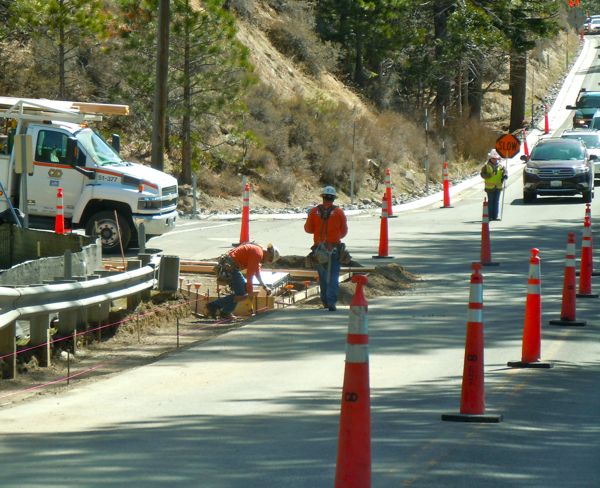
INCLINE VILLAGE – Roadwork on Nevada highways in the Lake Tahoe Basin began before the normal May 1 start date because the weather has cooperated and Congress is likely to pass a transportation bill that will keep funding in place through Sept. 30.

The current funding expires June 30, though the House on Wednesday passed a bill to extend the program for another three months.

Ryan McGinness, principal of District Strategies, gave a rundown April 19 about how what is happening in Washington directly impacts the Silver State. McGinness led one of the workshops at the Hyatt in Incline during the annual three-day Nevada Commission on Tourism Rural Roundup conference. (It ends today.)

Roadwork, like this on Higway 28 on April 19, is tied to federal funding. Photo/Kathryn Reed

While the emphasis of the gathering is to bring the six sectors of rural Nevada together to talk about tourism, McGinness pointed out how what goes on 3,000 miles from Lake Tahoe has a direct impact on tourism throughout Nevada.

“Transportation is key for tourism. It gets them to our destinations and it gets them around our destinations,” McGinness told the group.

With a limited season to work on roads, Tahoe can’t have an interruption in funding and still get the work done in a timely manner. State highways also don’t get fixed without those federal dollars.

Continued transportation dollars will be critical for the basin if the Tahoe-Reno area is awarded the 2022 Winter Olympics. (Attendees learned more about the Olympic plans on April 18.) If selected, the region will move to the top of the list for federal transportation dollars.

McGinness started the talk about the uncertainty of what will go on in the nation’s capital this political season. He said there is speculation the minimum will get done until the election, after which it remains to be seen who is in the White House and Congress, and whether the remaining electeds will try to accomplish anything for the five weeks between the election and the winter holiday break.

Tax issues related to renewable energy production need to be addressed before the end of the year. What happens to the solar industry would impact Nevada more than wind.

The Secure Rural Schools legislation affects districts throughout Nevada. Funding is up for reauthorization.

When it comes to specific tourism issues and how Washington plays a role, McGinness touched on the $823,000 bill the Government Services Administration racked up at a conference in Las Vegas.

“No one can say that was responsible spending, but we don’t want it to hurt Nevada or Las Vegas,” McGinness said. “We need to define it as a behavioral issue, not a Las Vegas issue.”

When the 2008 AIG scandal made the news it had a chilling effect on conventions in Southern Nevada. That was when the company spent about $200,000 on employees to party in Vegas after receiving a federal bailout.

Conventions are big business for Vegas. They bring in about 5 million visitors a year, add $6 billion to the area’s economy and support 58,000 jobs.

While Congress has hearings on the overspending in Vegas, it is also working on substantive ways to bring more foreign travelers to the entire country.

Bringing international travelers to the United States could get easier as Congress works on the visa waiver process. Currently, people in 36 countries don’t have to get a visa for the U.S. China, Brazil and India are the three countries being talked about being added to that list.

At an afternoon discussion where leaders of the seven tourism sectors spoke, all talked about how international travelers are growing in numbers.

Sue Barton, No. 2 at Lake Tahoe Visitors Authority and the head of the Tahoe-Reno Territory for NCOT, said it’s the number of French travelers coming into the South Shore visitors centers who have most surprised her. She believes their sense of independence leads them to the centers because they have not wanted to pre-book all of their travel.

Teri Laursen with the Las Vegas Territory said 18 of 20 group bookings come from China. However, Canada, United Kingdom and Mexico account for the top three countries in terms of travelers arriving at McCarran International Airport.

While Nevada is experiencing a surge in international travelers, the country is losing market share, according to McGinness. He said in the last decade the number of international travelers coming to the U.S. dropped by 37 percent, while during those same 10 years the number of global travelers increased by 60 million.

This is also the post-9/11 era, so how the terrorist attacks and subsequent burdensome safety measures that were put in place impacted people’s decisions to come to the U.S. is not known.

But McGinness pointed out until now the United States has never had a brand, never reached out to other countries to sell itself, while other countries do it all the time.

Ads will launch in the next few weeks. Visa application fees fund the program. Private companies like Marriott, Disney and Best Western have also committed substantial sums of money to the overall pot of cash.

Another bill floating in Congress would expedite the visa process for athletes coming to the U.S. to compete in the Olympics or World Cup.




Secretary testifies on opening day of school-shooting trial

By Peter Hecht, Sacramento Bee

Joy Fausel, secretary to Placerville elementary school principal Sam LaCara and his friend of 20 years, described the scene in vivid detail: the enraged school janitor bursting into the office at the Louisiana Schnell School, clutching a cell phone to his left ear and holding a gun in his right hand.

As the trial opened Wednesday in the first-degree murder case of John Luebbers, 45, a longtime golfing buddy of the man he is accused of killing, Fausel and school clerk Dawn Cooper recounted the searing events that culminated in a beloved principal getting gunned down in his office.

It was Feb. 2, 2011, and LaCara had sent Luebbers – the school’s lead custodian – home to cool off after he lit into the principal in a profanity-laced eruption over a pending decision to hire a night janitor, according to testimony Wednesday in El Dorado Superior Court.

Cooper, the prosecution’s opening witness, said Luebbers left the premises, only to call the school office repeatedly, demanding to speak to the principal. She put some of the calls through, and the janitor was still talking to LaCara when he stormed back in. “This is for you!” Cooper said Luebbers shouted as he opened fire in the principal’s office.

Cooper said she rushed into the office after Luebbers ran out and found the principal sprawled behind his desk, struggling to rise.

Read the whole story