Hot August Nights in Tahoe

Hot August Nights will be on the South Shore Aug. 3-5.

There will be daily show-n-shines with cash and trophy awards, poker walks with cash awards to the winners, a cool car showroom, a classic car auction, automotive exhibits, special night time cruising, vendors, a sock hop and free ’50s and ’60s style live entertainment daily on all of the outdoor stages.

Car registration is open to all 1972 and older American and European cars and trucks.

For more information, go online.


Factors beyond intelligence contribute to success

By Keld Jensen, Forbes

Albert Einstein’s was estimated at 160, Madonna’s is 140, and John F. Kennedy’s was only 119, but as it turns out, your IQ score pales in comparison with your EQ, MQ, and BQ scores when it comes to predicting your success and professional achievement.

IQ tests are used as an indicator of logical reasoning ability and technical intelligence. A high IQ is often a prerequisite for rising to the top ranks of business today. It is necessary, but it is not adequate to predict executive competence and corporate success. By itself, a high IQ does not guarantee that you will stand out and rise above everyone else.

Research carried out by the Carnegie Institute of Technology shows that 85 percent of your financial success is due to skills in “human engineering,” your personality and ability to communicate, negotiate, and lead. Shockingly, only 15 percent is due to technical knowledge. Additionally, Nobel Prize winning Israeli-American psychologist, Daniel Kahneman, found that people would rather do business with a person they like and trust rather than someone they don’t, even if the likeable person is offering a lower quality product or service at a higher price.

With this in mind, instead of exclusively focusing on your conventional intelligence quotient, you should make an investment in strengthening your EQ (Emotional Intelligence), MQ (Moral Intelligence), and BQ (Body Intelligence). These concepts may be elusive and difficult to measure, but their significance is far greater than IQ.

Read the whole story


Opinion: Distracted driving isn’t just a student problem

By Vicki Barber

A program to alert young drivers to the dangers of being distracted while driving is being quietly launched by student leaders, teachers and administrators at El Dorado County’s five public high schools and the county Office of Education.

Even a split-second distraction can have deadly or long-lasting consequences, and the advent of cell phones and other electronic devices has compounded the danger, according to Dan Stark of the California Highway Patrol, which is collaborating with the schools on the program in conjunction with California Casualty and the California Teachers’ Association.

Distracted driving now ranks at the top of causes of deaths of young persons from accidents, far ahead of driving under the influence causes, according to national statistics.

Vicki Barber

The narrow, winding roads of sprawling El Dorado County also increase the risks locally, especially when combined with inexperience and speed, Stark said.

Each year there are several serious or fatal accidents in the county, many of which are believed to be due to the driver being distracted by something. There were two fatal accidents and one serious-injury accident last spring, one of which involved DUI and the other possibly related to distractions.

One administrator got the “distracted driving” message with abrupt clarity the day before he and other officials were to meet with Stark to hear about the proposed program, early last summer.

“What was ironic was that the day before I went to meeting my daughter (Alissa) was driving down Pleasant Valley Road and ran into the car in front of her.” She just had enough time to swerve so she sideswiped the car, escaping injury but totaling her car and seriously damaging the other vehicle.

The cause was clear: “Her cell phone rang and she glanced down to see who it was. She didn’t ever pick it up. But when she looked up the car was right in front of her,” Volmer said.

Alissa is now attending USC. But Volmer said he was shocked when he went to see the car and saw the extent of damage and realized how close a thing it was to being a life-changing tragedy.

And at the meeting the next day, “I heard enough to know I need to be a better example.”

Volmer said the program being rolled out is designed for students and parents, as well as teachers and staff. After being introduced to teachers and administrators it has been referred to student leaders so there would be a peer-to-peer message.

“Parents will need to set an example if the program is to be successful,” Jeremy Meyers, deputy superintendent of the El Dorado County Office of Education, said.

Meyers said the county office is fully behind the awareness-raising effort due to the increased incidents of distractions from the proliferation of electronic devices. But he noted that there are many other causes of distraction, from eating. putting on make-up or talking with passengers.

Even if there is no injury or fatality involved, accidents can cost thousands of dollars in repairs, increased insurance rates, fines and court costs, and add negative points to one’s driver’s license – underscoring that driving is a serious responsibility and needs to be taken seriously, Meyers said.

The program has been implemented in the Lake Tahoe Unified School District for the past few years and the data regarding decreased teen driving accidents has been impressive. Other high schools involved in the program are Golden Sierra, Ponderosa, Union Mine and Oak Ridge.

Stark agreed that distracted driving is a problem that has been around for decades, but added that cell phones have made it worse in recent years.

He noted that about 75 percent of teen deaths from auto accidents are “not alcohol-related,” while many of those involved being distracted.

Stark said the El Dorado County program will utilize materials and techniques developed by a broader program known as “Impact Teen Driver,” founded by Jon Hamm, president of the California Association of Highway Patrolmen.

“CHP officers consistently report the worst part of their job is coming onto a scene where a young person has needlessly lost his or her life and subsequently having to ring a doorbell to tell parents that they will never again see their child alive,” according to the website.

“The devastating impact of these fatal crashes on the teens involved, their families, communities, and the law enforcement officers who are first responders motivated the CAHP to work with one of its long-time partners, California Casualty, and the California Teachers Association to create a powerful intervention designed to alter these grim statistics.”

Vicki Barber is superintendent of El Dorado County Office of Education.


Dispose of prescription drugs for free

South Lake Tahoe Police Department and Drug Enforcement Administration officials will accept unwanted prescription on April 28 from 10am-2pm at Safeway in South Lake Tahoe located at 1020 Johnson Blvd.

By providing a place to dispose of medications, officials hope to help prevent abuse of prescription medication. The service is free and anonymous.


MojoMan Challenge may be coming to Heavenly

Should the MojoMan Challenge, an adventure race competition that covers approximately 10½ miles and incorporates 25 to 30 challenge obstacles along the course, come to Heavenly Mountain resort in August?

That is the question the local U.S. Forest Service wants people to answer.

The event would take place on forest lands at the ski resort that are within the special use permit boundary and would be open to the public.

Temporary obstacles would be constructed of natural and man-made elements, including water and mud pits, cargo nets and log piles.

The comment period closes May 11. For more information, contact Matt Dickinson at (530) 543.2769 or go online.


Sleeping on the job can be a good thing

By David Wescott, Bloomberg

Don’t expect to find Ronit Rogoszinski in meetings, entertaining clients, or hunched over her desk around lunchtime. The 45-year-old wealth adviser and financial planner in New York describes herself as an expert “practitioner of the power nap.”

After waking up at about 5 a.m., sending her kids off to school, and putting in a morning of meeting with clients, Rogoszinski needs to crash.

“By noon, my brain starts to fry,” she says. So she heads to one of her hideouts – her car, for example – to recharge. As she puts it, “I’m not quite sure how I’d handle the day without that timeout.”

Rogoszinski is by no means a lone clandestine sleeper. Comments on Wall Street Oasis, a Web forum popular among investment bankers, reveal an obsessive interest in daytime napping, with tips on “sleep hacking” (moving to polyphasic sleep schedules), recommendations on where to doze (bathroom stalls, conference rooms), and directions for how to act when caught (as if nothing unusual had happened).

When nodding off on a toilet, “you clearly need the seat down for maximum comfort,” advises one commenter, “which necessitates pants up to prevent your bare ass on the cold porcelain. Longest I ever slept uninterrupted without tipping over was two hours, from 4-6am.”

Read the whole story


Peer review: TRPA thresholds on right track, but plenty of room for improvement

By Kathryn Reed

INCLINE VILLAGE – Rain falling on a hillside golf course. It would have made for the perfect field trip for the Tahoe Regional Planning Agency Governing Board.

Instead, the board stayed inside to talk policy.

But had they walked outside The Chateau at the Incline Village golf course, they could have asked if this course uses a fertilizer with phosphorous on its grass, seen the impacts of stormwater runoff to the near shore, witnessed issues with stream environmental zones, viewed scenic concerns, and even investigated whether they could have used public transit to get to the meeting.
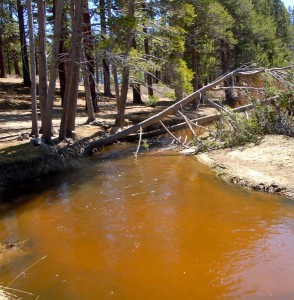
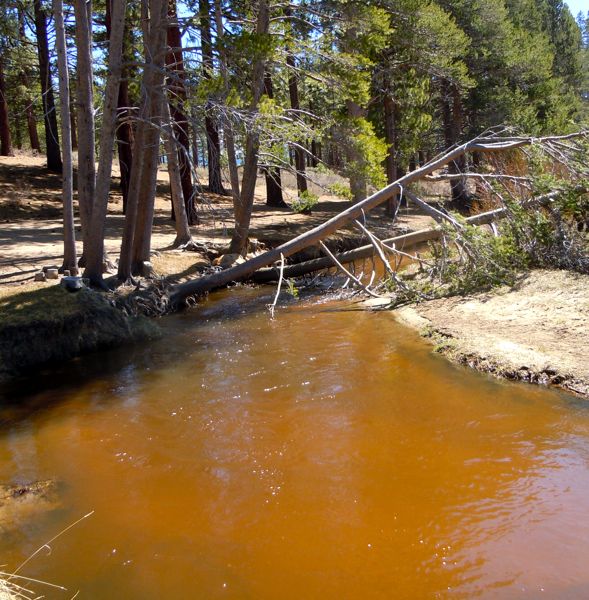
Improving Lake Tahoe clarity's includes paying attention to the tributaries. On April 22, Trout Creek in South Lake Tahoe was a brown-rust color. Photo/Kathryn Reed

After all, those were the issues they talked about all day Wednesday. Issues that amount to 2,500 pages – all of which are said to be on TRPA’s website. These are issues that everyone living or doing business in the Lake Tahoe Basin will have to follow. Many are ones that have been in effect for decades.

Under the dark skies and intermittent rain, the Governing Board endured the first of what is expected to be two full days of dialogue about the proposed update to the Regional Plan and associated documents.

By the time the April 25 meeting came to a close at 4:45pm, a couple dozen people remained – while the morning had about 75 in attendance. Much of what was discussed Wednesday was a regurgitation of what has been talked about leading up to this point.

Thursday’s session, which starts at 9:30am at TRPA’s Stateline office, will be about the environmental documents related to the Regional Plan update and Regional Transportation update. Speculators expect more public comment and a livelier session.

Only two people commented on the first segment regarding the thresholds, while no one commented on the afternoon session that delved into the Regional Plan and transportation updates. However, public comment was not expected to be taken Wednesday per Executive Director Joanne Marchetta’s opening comments, but people will have a chance to comment today on Wednesday’s items.

While Marchetta was upbeat, saying the thresholds are working and more rigor will be used going forward to analyze progress, the fact remains that since 1997 when the environmental improvement program was created more than $1.5 billion has been spent in the basin with the primary purpose being improved lake clarity.

Clarity is not declining as fast as it once did. That’s the improvement TRPA officials continually point to.

Threshold update

While the nine thresholds must be updated every four years, this is the first time the data has been peer reviewed.

Within the nine categories are 151 subcategories, so to speak. The nine are air quality, water quality, soil conservation, scientific resources, wildlife, fisheries, vegetation preservation, recreation, and noise.

Of those 151 standards, TRPA made a status determination on 92 of them. Sixty-three percent of the 92 standards were attained and 37 percent have not been attained, Shane Romsos, acting measurement department manager at TRPA, told the board.

Board members raised questions about the monitoring process and why some things cannot be measured. Money is one reason, poor standards are another.

“We are trying to move the monitoring into the 21st century; to measure things that have relevancy for policy management action,” Romsos said.

About $2 million a year is spent on monitoring TRPA threshold requirements by agencies throughout the basin. Twice that amount is needed to measure everything. Five times that amount, or $10 million a year, is what is need for “top of the line” monitoring, Romsos said.

“We have standards, but it’s unclear what we are trying to achieve,” he said.

He used wood smoke as an example. Smoke measurements are ambiguous and what they were pre-1981 are not even known. The recommendation by the peer review and from Romsos to the board is to replace wood smoke with measuring particulate matter.

TRPA outlined the concerns in the threshold measurements as:

• Long-term annual average Secchi depth and summer clarity

• Phytoplankton primary productivity and near shore attached algae

• Uncommon plant communities

• Single noise events like aircraft

• Cumulative noise events like urban outdoor recreation sites.

Jim Mahoney, who led the peer review done with six others, said, “The panel does not find any fatal flaws.” While that is the technical phrase for all is well, he went on to praise the threshold studies as one of the best he’s seen in his 30 years.

Still, there is plenty of room for improvement. Romsos said some of the suggestions are being implemented, with others to be considered.

People who don’t live or work in the basin did the review – in fact none of the seven lives in either California or Nevada.

Mahoney suggested in the next update that TRPA, “Expand the use of comprehensive land use perspectives.” He said the panel found not enough emphasis was placed on looking at how the thresholds are interrelated and how the basin is affected as a whole.

“The peer review – they really want us to link the thresholds,” Romsos said. “As we talk about policies it’s those that have multiple threshold benefits.”

Mahoney also stressed the importance of environmental and economic analysis.

The panel, Mahoney said, recommends the TRPA find out “the connection between lake clarity and near shore water quality; the important links between regional soil conservation and water clarity; the possible adoption of some of the best practices for maintaining lake ecosystems previously developed for other lake systems; the beneficial effect of riparian and wetland restoration upon the eight wildlife species chosen for monitoring in the Tahoe basin; the spatial distribution of vegetation communities throughout the basin, including management practices that support fire reduction; continued focus on air quality monitoring the basin with special attention to ozone ambient air quality standard attainment; development of percentage-of-exceedance methods to evaluate the community noise thresholds; increased use of visual illustrations in scenic value thresholds developed for community and regional design applications; and network approaches to addressing the interconnectivity of recreational venues.”

When it comes to the Regional Plan update, ways to gain threshold benefits, as presented by TRPA staff, are to:

• Transfer coverage out of sensitive lands

• Improve walkability and bike access

• Environmental redevelopment

• Phase out phosphorus fertilizers.

Muck closest to shore

What the shoreline looks like received the most dialogue by board members.

John Reuter with UC Davis, who for years has been working on lake clarity and helped create some of the thresholds, said Davis along with UNR and Desert Research Institute has received a grant to study the near shore.

“We are going to take a scientific and systematic evaluation of what the near shore indicator should be,” Reuter said. “We don’t want it just based on what the public would like. No one wants (algae). But what can be expected? What’s realistic?”

For so long lake clarity has only been defined by how far a white dinner plate-looking disc can be seen by the naked eye from aboard a boat.

With the acceleration of algae and the browning of the lake where the water hits beaches, people are becoming alarmed.

It’s a line of questioning board member Claire Fortier, who is also mayor of South Lake Tahoe, pursued.

Reuter said what’s needed is more details about stormwater.

A bit of an irony is that while TRPA embraces the total maximum daily load mandates imposed by the Lahontan Water Quality Control Board, the effects of what comes out of the stormwater pipes is not analyzed. All that has to be quantified is that less comes out each year – especially in the form of fine sediment.

But Reuter pointed out, while decreasing the sediment load reaching the lake will help the near shore, “it does not mean the entire near shore improves.”



Nevada lawmakers unite to prevent state from being black listed by feds

By Erin Kelly, Gannett

WASHINGTON — The Lake Tahoe and Reno area tourism industry shouldn’t have to suffer because of the reckless spending of some federal bureaucrats-gone-wild.

That’s the premise of legislation proposed Wednesday by Rep. Shelley Berkley, D-Las Vegas, and Sen. Dean Heller, R-Nev. The two lawmakers want to ensure that Reno and Las Vegas won’t be blacklisted by the U.S. government in the wake of the recent Las Vegas spending scandal involving federal employees.

U.S. General Services Administration officials authorized $823,000 for an October 2010 conference for 300 employees in Las Vegas that included private parties, a psychic, a talent show and a $75,000 bicycle-building exercise, according to an inspector general’s report published this month. GSA officials also spent $130,000 on eight planning trips to Las Vegas in advance of the conference, the report says.

The scandal led to the resignation of the agency’s top official, the firing of two top aides and the punishment of several others.

Congress is investigating the spending, and there has been criticism by some lawmakers, including Sen. Rand Paul, R-Ky., about federal employees meeting in Las Vegas and other cities known as gambling destinations.

Berkley fears a return to a policy by the Bush administration that effectively barred federal employees from holding meetings in casino cities such as Reno and Las Vegas even when those cities offered the cheapest rates. That policy was reversed by the Obama administration at the urging of Senate Majority Leader Harry Reid, D-Nev.

Read the whole story


Earth Day in South Lake Tahoe

South Tahoe Earth Day is returning to the Bijou Community Park in South Lake Tahoe on April 28 from 10am-4pm.

This year’s free Earth Day event includes a speakers’ stage with talks on aquatic invasive species, the history of Lake Tahoe, the story of Tahoe Tessie, and edible plants of the Sierra.

The Kid Zone area will be full of recycle-themed arts and crafts, such as milk-carton wallets and sun print papers, and the Bounce House will help kids bounce out that extra energy.

A variety of events will be happening throughout the day, highlighted by the Sugar Pine Foundation’s native tree planting at 11:30am and the “Ballad of Aquatic Invasive Species” sing-along at noon.


Particles of meteor heard exploding in Tahoe found on West Slope

By Scott Sonner, AP

RENO — Tiny meteorites found in the Sierra foothills of northern California were part of a giant fireball that exploded over the weekend with about one-third the explosive force of the atomic bomb dropped on Hiroshima in World War II, scientists said Wednesday.

The rocks each weighed about 10 grams, or the weight of two nickels, said John T. Wasson, a longtime professor and expert in meteorites at UCLA’s Institute of Geophysics and Planetary Physics.

Experts say the flaming meteor, dating to the early formation of the solar system 4 to 5 billion years ago, was probably about the size of a minivan when it entered the Earth’s atmosphere with a loud boom early Sunday. It was seen from Sacramento, Calif., to Las Vegas and parts of Northern Nevada.

An event of that size might happen once a year around the world, said Don Yeomans of NASA’s Near-Earth Object Program Office at the Jet Propulsion Laboratory in Pasadena, Calif. But most of them occur over the ocean or an uninhabited area, he said.

“Getting to see one is something special,” he said. He added, “Most meteors you see in the night’s sky are the size of tiny stones or even grains of sand, and their trail lasts all of a second or two.”

The meteor probably weighed about 154,300 pounds, said Bill Cooke, a specialist in meteors at NASA’s Marshall Space Flight Center in Huntsville, Ala. At the time of disintegration, he said, it probably released energy equivalent to a 5-kiloton explosion. The Hiroshima bomb was 15 kilotons.

“You don’t often have kiloton rocks flying over your head,” he said.

The boom, another expert said, was caused by the speed with which the space rock entered the atmosphere. Meteorites enter Earth’s upper atmosphere at somewhere between 22,000 and 44,000 mph — faster than the speed of sound, thus creating a sonic boom.

The friction between the rock and the air is so intense that “it doesn’t even burn it up, it vaporizes,” said Tim Spahr, director of the Minor Planet Center at Harvard University.

Wasson said one meteorite was found near the town of Coloma, about 35 miles northeast of Sacramento. “I’m sure more will be found, I’m hoping, including some fairly big pieces,” he said.

“The fact that two pieces already have been found means one knows where to look,” Wasson said.

Bits of the meteor could be strewn over an area as long as 10 miles, most likely stretching west from Coloma, where James W. Marshall first discovered gold in California, at Sutter’s Mill in 1848.

Robert Ward of Prescott, Ariz., who has been hunting and collecting meteorites around the world for more than 20 years, said he found the first piece about 10am Tuesday in between a baseball field and park on the edge of the town of Lotus.

Ward said he “instantly knew” it was a rare meteorite known as “CM” — carbonaceous chondrite — based in part on the “fusion crusts from atmospheric entry” on one side of the rock. He actually has two rocks that he suspects were part of the same small meteorite that split on impact.

“It was just, needless to say, a thrilling moment,” he said.

“It is one of the oldest things known to man and one of the rarest types of meteorites there is,” he said. “It contains amino acids and organic compounds that are extremely important to science.”

Yeomens confirmed this type of meteorite is one of the more primitive types of space rocks out there, dating to the origin of the solar system 4 to 5 billion years ago. And it’s “actually kind of unusual,” he said.

Yeomens said it’s got two of the most important chemicals that scientists look for: carbon and a form of water. In fact, this type of space rock is likely full of water and would have made a good candidate for the new space company announced Tuesday that plans to mine asteroids, he said.

“And this one landed in their backyard for a lot less than they planned to spend,” he said.

The minivan sized asteroid wasn’t on NASA’s lengthy list of near Earth objects that they track coming close to the planet, so it took scientists by surprise. “There are millions of objects of that size that we don’t know about,” he said. “They’re too small to image unless they’re right up on top of you.”

Ward and others tracked the meteorites’ possible location based on estimates by, among others, scientists with the Meteor Group at the Western University of Ontario in Canada that the fireball likely had exploded in the upper atmosphere above California’s Central Valley.

Wasson suspected hundreds of dealers and collectors already have joined the search. He said it was important to recover the meteorites soon because any rain will cause them to degrade, losing their sodium and potassium.

“From my viewpoint as a meteorite researcher,” he said, “I’m hopeful some big pieces are found right away.”

AP science writer Seth Borenstein contributed to this story from Washington, D.C.