Ren fair celebrates 20 years at Camp Rich

When Renaissance Productions transforms Camp Richardson into a giant stage in early June, it will mark the 20th year of the South Shore ren fair.

Queens of England, ambassadors from foreign lands and juggling jesters, winsome wenches, lords and ladies, knight of horseback, squires and simpletons will gather June 2-3 and June 9-10 for the 20th annual Valhalla Renaissance Faire.

This unique festival includes a real jousting tournament and full armored combat between knights, along with culinary delicacies, craft demonstrations, ancient music, magic, storytelling, dance and comedy. Patrons can participate in a range of activities such as archery and fencing.

Activities for children include educational areas, games, crafts, a petting zoo, puppet shows and storytelling.

The annual Valhalla Renaissance Faire recreates a renaissance village over two festival weekends and includes a merchant marketplace with nearly 100 unique merchants, and artisans.

The fair is open from 10am-6pm each day.

Cost is adults $17, $12 for seniors, military, ages 13-17, $7 for children 6-12, and under 6 no charge.

For more information, go online.


May 5 begins National Tourism Week. Where are you planning to travel this summer?


Opinion: Tahoe should form its own county

To the community,

Mountain people don’t like to be told what to do or how to do it. Self-reliance and personal freedom are part of our DNA. It’s just how we roll.

In contrast, there are a lot of people living down the hill who regard Tahoe folks as living in “La La Land.” Unfortunately, these people have ultimate control over our lives in everything from what roads we can use to what sort of justice we will face. Instead of a jury of your peers, who are far more liberal up here, you’ll be dragged down the hill to face a jury of retired military conservatives who think people like you are what is wrong with this country. Good luck with that.

Steve Kubby

In short, we need to break away from El Dorado and Placer counties and form our own Lake Tahoe County. All those tax dollars that have been going down the hill will stay here instead.

No longer would our world-class resorts be saddled with Third World roads — or roads arbitrarily closed by El Dorado County. No longer would we be forced to waste time and gas to go over the hill to do our business or seek justice. No longer would we be slaves to people who neither respect nor understand us.

Lake Tahoe is a very special place, with very special people. We deserve our own county, run by people like us. We have far more in common with Tahoe City and Squaw Valley than Placerville or Auburn.

It is time to stand up for our rights and our unique lifestyles by forming our own county and taking back control of our own lives.

Steve Kubby, South Lake Tahoe


No snow to measure at Echo Summit; reservoir storage OK

By Kathryn Reed

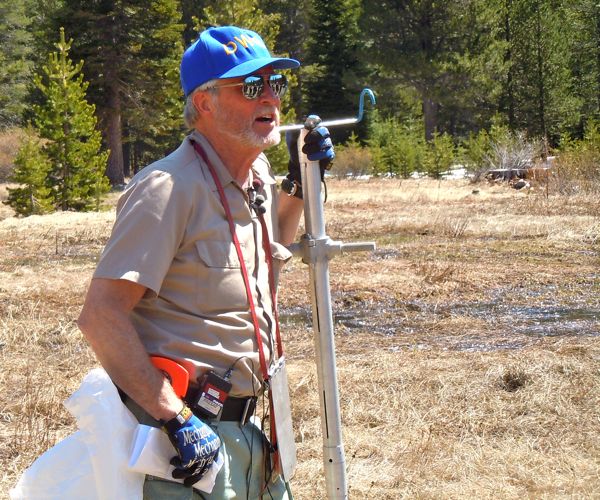
PHILLIPS STATION – Frank Gehrke with the Department of Water Resources did not need his instruments Tuesday as he walked through a barren field. Snowmelt was more in evidence on the final snow survey of the season than the actual white stuff.

“With climate change, we’ll definitely see more of these extremes,” Gehrke said comparing the abundance of snowfall a year ago to the dismal showing this season.

The May 1 reading in 2011 had 5 feet of snow with 3 feet of water content in the open area near the entrance to Sierra-at-Tahoe off Highway 50. This week the evidence of snow was the runoff at the far end of the field that was puddling and the patches on the higher peaks.

No snow for Frank Gehrke of the Department of Water Resources to measure on May 1. Photo/Kathryn Reed

Statewide, the snowpack water content is at 40 percent of average for this time of year.

According to the National Weather Service in Reno, the streams in the Lake Tahoe area have already hit their high water mark.

“Some of the smaller creeks had decent rises this year, but nothing to warrant an advisory or flood warning,” meteorologist Scott McGuire told Lake Tahoe News. He said the minimal snowpack this year meant no flooding, unlike a year ago.

While a small weather system is expected to settle over the basin this week, scattered showers and cooler temps are all that’s expected. No big weather events are on the horizon.

But McGuire did caution that while flooding is not an issue, rivers and creeks are running fast and are extremely cold.

“It doesn’t take a whole lot of water to sweep someone off their feet,” McGuire said.

It’s all that water in California reservoirs that is keeping the nerves of farmers and municipal water purveyors calm. Last year’s deluge and the late storms this season have kept the water levels at serviceable levels.

“Overall, our water supply is OK this year,” Gehrke said.

Lake Oroville is at 97 percent capacity.

Source: Department of Water Resources

Location

Elevation

Snow Depth

Water Content

% of Long Term Average

Alpha

7,600 feet

26.5  inches

12  inches

45

Phillips Station

6,800 feet

0  inches

0  inches

 0

Lyons Creek

6,700 feet

37  inches

15  inches

66


MontBleu’s owner posts quarterly net revenue loss

By Chris Sieroty, Las Vegas Review-Journal

Tropicana Entertainment Inc., the gaming company controlled by investor Carl Icahn, on Tuesday reported a first quarter loss as its three casinos in Nevada continue to struggle to recover from the recession.

The Las Vegas-based company posted a loss of $4.8 million on net revenues of $155.2 million for the quarter ended March 31. That’s compared to a loss of $1.4 million on net revenue of $156.8 million in the first quarter of 2011.

In Nevada, the company owns the Tropicana Laughlin and the River Palms properties in Laughlin, and the MontBleu casino in Lake Tahoe. The gaming company attributed its overall first quarter performance to “uncertain economic conditions.”

Read the whole story


Quarterly loss increases for parent company of Harrah’s-Harveys

By Steve Green, Las Vegas Sun

Hotel-casino operator Caesars Entertainment Corp. of Las Vegas on Tuesday said its first-quarter loss widened, even as business improved in Las Vegas.

Caesars said it lost $280.6 million, or $2.24 per share, in the quarter ended March 31 vs. a loss in the year-ago quarter of $147.5 million, or $1.18.

Net revenue of $2.27 billion was up 4.3 percent.

Caesars said the loss widened as interest costs for its $19.79 billion in debt increased.

Caesars said that in Las Vegas, where its properties include Planet Hollywood and the Rio, visitation to its hotels and casinos increased 5.9 percent during the quarter vs. 2011’s first quarter.

Las Vegas customers, however, spent 1.7 percent less per trip during the quarter, Caesars said.

For Las Vegas, this resulted in quarterly net revenue of $771.6 million, up 6.2 percent from the 2011 period.

Las Vegas EBITDA on the property level increased 9.3 percent to $211.3 million. EBITDA is a key casino industry performance measure meaning earnings before interest, taxes, depreciation and amortization.

Read the whole story


Eager off-roaders being cited by USFS officials in Tahoe basin

U.S. Forest Service law enforcement officers have observed widespread violations of road closures. In particular, officers have issued a number of warnings and citations for driving on Forest Road 1306, which leads to Camp Shelly and Camp Concord, off Highway 89 in the South Shore.

National Forest System roads in the Lake Tahoe Basin remain closed.

The LTBMU’s Motor Vehicle Use Map states the legal opening dates for each road. These dates, ranging from May 10 through June 1, represent the earliest the roads will open. If snowy or wet conditions persist, the Forest Service may extend the closure to protect the environment, as well as public safety.

Road closures help prevent soil erosion and sediment runoff and, in some cases, protect wildlife. They also help protect public safety – roads that are snow-free near the gate may be impassable at higher elevations.

For the most up-to-date information on which roads are open, contact the LTBMU’s front desk at (530) 543.2694.


Heavenly-Northstar skier visits drop 24.2%; revenue holds steady

By Jason Blevins, Denver Post

If the 2011-12 ski season was a test, Vail Resorts passed with top marks.

The largest resort operator in North America on Tuesday illustrated the power of its season pass program by reporting 2011-12 ski season lift ticket revenue that barely moved from last year despite the worst snowfall in 30-plus years. In a season that saw a 50 percent annual decline in snowfall and a 12.6 percent decline in visits, the now seven-resort ski industry leader reported a mere 0.3 percent decline in lift ticket revenue.

Lack of real snow kept skiers away from Heavenly this season. Photo/LTN

The Broomfield-based company’s Colorado resorts – Vail, Beaver Creek, Breckenridge and Keystone – saw an 8.9 percent decline in visitation. Vail’s California resorts – Heavenly and Northstar saw a whopping 24.2 percent decline. (Vail’s most recent acquisition, California’s Kirkwood ski area, was not included in the latest round of ski metrics.)

Read the whole story


Deadly force creates unintended consequences in nature

By Tom Knudson, Sacramento Bee

Like the prow of a ship, the Granite Mountains rise sharply from the creamy-white playa of the Black Rock Desert in Nevada.

Here, in rugged terrain owned by the American public, a little-known federal agency called Wildlife Services has waged an eight-year war against predators to try to help an iconic Western big-game species: mule deer.

With rifles, snares and aerial gunning, employees have killed 967 coyotes and 45 mountain lions at a cost of about $550,000. But like a mirage, the dream of protecting deer by killing predators has not materialized.

“It didn’t make a difference,” said Kelley Stewart, a large-mammal ecologist at the University of Nevada, Reno.

For decades, Wildlife Services, part of the U.S. Department of Agriculture, has specialized in trapping, poisoning and shooting predators in large numbers, largely to protect livestock and, more recently, big game.

Now such killing is coming under fire from scientists, former employees and others who say it often doesn’t work and can set off a chain reaction of unintended, often negative consequences.

In biological shorthand: Kill too many coyotes and you open a Pandora’s box of disease-carrying rodents, meadow-munching rabbits, bird-eating feral cats, and, over time, smarter, more abundant coyotes. You also can sentence the deer you are trying to help to slow death by starvation.

“There is a widespread perception that predators are the root of all evil and I’m tired of it,” said Stewart. “More often than not, if you have predation on a mule deer population, you’re going to have a healthier population.”

Agency officials say controlling predators is a must, especially in the West where livestock graze large tracts of unfenced land. “The intent is not to prevent predation,” said William Clay, deputy administrator of Wildlife Services. “All we’re trying to do is remove the problem animals.”

Killing predators is part of Wildlife Services’ DNA, a mission it pursues – along with a wide range of other animal control work – largely outside public view.

Some details, though, can be gleaned from the agency’s Web page, where it posts a sea of data showing – species by species – the millions of birds and mammals its employees kill each year. Sift through the numbers and you find that about 560,000 predators were killed across America from 2006 to 2011, an average of 256 a day.

The body count includes more than 25,000 red and gray foxes, 10,700 bobcats, 2,800 black bears, 2,300 timber wolves and 2,100 mountain lions. But the vast majority – about 512,500 – were coyotes.

“When they see a coyote, all they got is one thing in mind: killing it,” said Gary Strader, a former Wildlife Services hunter in Nevada. “They don’t know if it was a coyote that killed a sheep. It’s just a coyote, and it’s got to be killed.”

While fewer bobcats are killed today, the numbers of three other major predators shot, trapped and snared by the agency have risen. In 1970, agency employees killed 73,100 coyotes, 400 black bears, 120 mountain lions. By 2011, the tally had climbed to 83,200 coyotes (up 14 percent), 565 black bears (up 41 percent) and 400 mountain lions (up 230 percent).

Read the whole story



South Tahoe’s newest gas station opens

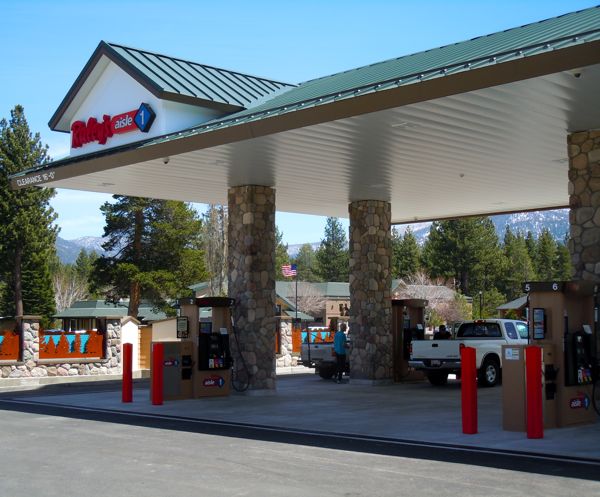
The gas station owned by Raley’s opened at 5am Tuesday at the Y in South Lake Tahoe.

People are already filling up their tanks and getting their vehicles washed.

Another place to get gas in South Tahoe opens. Photo/LTN

The inside mart is full of the typical drinks and snack food items one would expect. A few unexpected items are the souvenirs, beach items and sundries people might need or want.

— Lake Tahoe News staff report